List of European countries by area
The countries of Europe can be ordered by their geographical area. As a continent, Europe's total geographical area is about 10.18 million square kilometres.[1] Transcontinental countries are ranked according to the size of their European part only. The 14 countries marked with an asterisk (*) are transcontinental. Only sovereign states are considered.
Inland water is included in area numbers.
Table
European states by area
| Rank | State | Area | Notes | |
|---|---|---|---|---|
| (km2) | (sq mi) | |||
| 1 |  Russia* Russia* |
3,968,200 | 1,532,100 | 17,071,242 km2 (6,591,243 sq mi) when including territory in Asia (Siberia).[2] |
| 2 |  Ukraine Ukraine |
603,628 | 233,062[3] | Including Crimea and Donbas. |
| 3 |  France* France* |
551,695 | 213,011 | 672,051 km2 (259,480 sq mi) (n°2) when including overseas regions and territories. |
| 4 |  Spain* Spain* |
498,511 | 192,476 | 505,990 km2 (195,360 sq mi) when including the Canary Islands, Ceuta and Melilla.[4] |
| 5 |  Sweden Sweden |
447,425 | 172,752 | |
| 6 |  Norway* Norway* |
385,178 | 148,718 | Including Svalbard and Jan Mayen.[5] If they are excluded, continental Norway is 323,779 km2 (125,012 sq mi) in area. |
| 7 |  Germany Germany |
357,386 | 137,988[6] | |
| 8 |  Finland Finland |
338,145 | 130,559 | |
| 9 |  Poland Poland |
312,685 | 120,728 | |
| 10 |  Italy* Italy* |
301,318 | 116,340 | 301,338 km2 (116,347 sq mi) when including African islands of Lampedusa and Lampione. |
| 11 |  United Kingdom* United Kingdom* |
242,495 | 93,628 | Not including British Overseas Territories or Crown Dependencies. |
| 12 |  Romania Romania |
238,397 | 92,046 | |
| 13 |  Belarus Belarus |
207,600 | 80,200 | |
| 14 |  Kazakhstan* Kazakhstan* |
148,000 | 57,000 | Territory west of the Ural River is counted as within Europe; 2,724,902 km2 (1,052,091 sq mi) when including Asian territory. |
| 15 |  Greece* Greece* |
131,940 | 50,940 | Including island land territory. 110,496 km2 (42,663 sq mi) is mainland territory and 21,461 km2 (8,286 sq mi) is island territory. |
| 16 |  Bulgaria Bulgaria |
110,994 | 42,855 | |
| 17 |  Iceland Iceland |
102,775 | 39,682 | |
| 18 |  Hungary Hungary |
93,030 | 35,920 | |
| 19 |  Portugal* Portugal* |
88,416 | 34,138 | 91,568 km2 (35,355 sq mi) when including the Azorean Islands and the Madeiran Archipelago. |
| 20 |  Serbia Serbia |
88,361 | 34,116 | Including Kosovo and Metohija. |
| 21 |  Austria Austria |
83,858 | 32,378 | |
| 22 |  Czechia Czechia |
78,866 | 30,450 | |
| 23 |  Ireland Ireland |
70,273 | 27,133 | |
| 24 |  Lithuania Lithuania |
65,300 | 25,200 | |
| 25 |  Latvia Latvia |
64,589 | 24,938[7] | |
| 26 |  Croatia Croatia |
56,594 | 21,851 | |
| 27 |  Bosnia and Herzegovina Bosnia and Herzegovina |
51,129 | 19,741 | |
| 28 |  Slovakia Slovakia |
49,036 | 18,933 | |
| 29 |  Estonia Estonia |
45,339 | 17,505 | |
| 30 |  Denmark* Denmark* |
44,493 | 17,179 | Including the Faroe Islands. 2,210,579 km2 (853,509 sq mi) when including Greenland. Continental Denmark is 43,094 km2 (16,639 sq mi) in area. |
| 31 | .svg.png.webp) Switzerland Switzerland |
41,290 | 15,940 | |
| 32 |  Netherlands* Netherlands* |
41,198 | 15,907 | Excluding Caribbean Netherlands, Aruba, Curaçao and Sint Maarten. 42,531 km2 (16,421 sq mi) when combined into the Kingdom of the Netherlands. |
| 33 |  Moldova Moldova |
33,846 | 13,068 | |
| 34 | .svg.png.webp) Belgium Belgium |
30,510 | 11,780 | |
| 35 |  Albania Albania |
28,748 | 11,100 | |
| 36 |  North Macedonia North Macedonia |
25,713 | 9,928 | |
| 37 |  Turkey* Turkey* |
23,764 | 9,175 | 783,562 km2 (302,535 sq mi) when including Asian territory. |
| 38 |  Slovenia Slovenia |
20,273 | 7,827 | |
| 39 |  Montenegro Montenegro |
13,812 | 5,333 | |
| 40 |  Azerbaijan* Azerbaijan* |
6,960 | 2,690 | 86,600 km2 (33,400 sq mi) when including Asian territory. |
| 41 |  Georgia* Georgia* |
2,642 | 1,020 | 69,700 km2 (26,900 sq mi) when including Asian territory. |
| 42 |  Luxembourg Luxembourg |
2,586 | 998 | |
| 43 |  Andorra Andorra |
468 | 181 | |
| 44 |  Malta Malta |
316 | 122 | |
| 45 |  Liechtenstein Liechtenstein |
160 | 62 | |
| 46 |  San Marino San Marino |
61 | 24 | |
| 47 |  Monaco Monaco |
2 | 0.77 | |
| 48 |  Vatican City Vatican City |
0.49 | 0.19 | |
| 49 |  Cyprus Cyprus |
0 | 0 | A Mediterranean island south of Turkey (island of Cyprus, total area of 9,251 km2 (3,572 sq mi) divided between the Greek and Turkish Cypriot parts). Cyprus is not geographically part of Europe, but it is considered European owing to its political, cultural and historical ties with Europe. |
| 50 |  Armenia Armenia |
0 | 0 | 29,743 km2 (11,484 sq mi) when including Asian territory. Armenia is geographically part of Asia, but it is considered European owing to its political, cultural and historical ties with Europe. |
| Total | 9,725,367 | 3,754,985 | ||
Definition
Europe and Asia are contiguous with each other; thus, the exact boundary between them is not clearly defined, and often follows historical, political, and cultural definitions, rather than geographical.
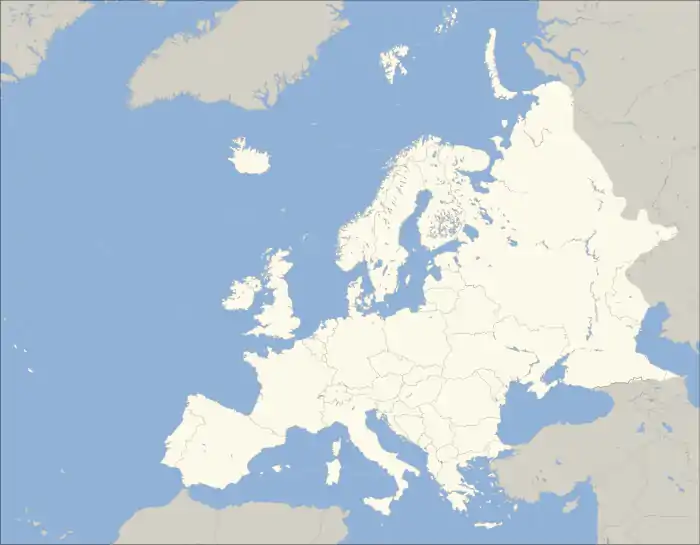
Map of Europe, showing one of the most commonly used continental boundaries[lower-alpha 1]
Legend:
Blue = Contiguous transcontinental countries
Green = Sometimes considered European but geographically outside Europe's boundaries
Range
The area of European countries varies widely, over several orders of magnitude:
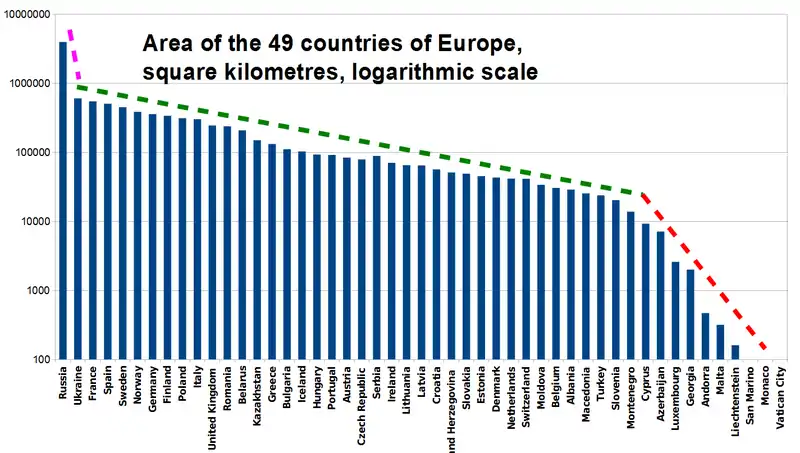
- Magenta = Russian Federation
- Green = Countries with European area bigger than 10,000 km2
- Red = Countries with European area smaller than 10,000 km2
See also
Notes
- The map shows one of the most commonly accepted delineations of the geographical boundaries of Europe, as used by National Geographic and Encyclopædia Britannica. Whether countries are considered in Europe or Asia can vary in sources, for example in the classification of the CIA World Factbook or that of the BBC. Certain countries in Europe, such as France, have territories lying geographically outside Europe, but which are nevertheless considered integral parts of that country.
References
- "Map and Details of all 7 Continents". WorldAtlas. Retrieved 4 May 2019.
- "The World Factbook - Central Asia - Russia". CIA World Factbook. Central Intelligence Agency. Retrieved 3 May 2019.
- "Ukraine". United Nations in Ukraine. Retrieved 2020-02-14.
- "Entorno físico y medio ambiente" (PDF). Instituto Nacional de Estadística. p. 10. Retrieved 4 August 2019.
- "Updated land cover figures". ssb.no. Retrieved 2015-11-21.
- "Fläche und Bevölkerung". www.statistikportal.de (in German).
- "Latvia country profile". BBC News. 29 March 2019. Retrieved 2019-10-28 – via www.bbc.com.