Tolkien and the Classical World (book)
Tolkien and the Classical World is a 2021 scholarly collection of essays on the influence from ancient Greek and Roman civilisations on J. R. R. Tolkien's Middle-earth writings, especially The Silmarillion and The Lord of the Rings. It is edited by Hamish Williams.
 | |
| Author | Hamish Williams |
|---|---|
| Cover artist | Jay Johnstone |
| Series | Cormarë, no. 45 |
| Subject | Tolkien research |
| Genre | Scholarly essays |
| Publisher | Walking Tree |
Publication date | 2021 |
| ISBN | 978-3-905703-45-0 |
Contents
The book is introduced by Hamish Williams, with an essay on Tolkien's appeal, which he states "must lie in its comprehensive hermetic consistency".[1] The body of the book consists of essays by scholars on aspects of Tolkien and the classical:
- Hamish Williams on Tolkien as a classicist
- Ross Clare on classical historiographies of decline and fall by Herodotus and Thucydides in the fictional Númenor
- Giuseppe Pezzini on how Tolkien echoes classical patterns of divine interaction
- Benjamin Eldon Stevens on katabasis in Middle-earth
- Austin M. Freeman on how Tolkien used Virgil's concept of piety
- Peter Astrup Sundt on how Tolkien used the legend of Orpheus and Eurydice
- Michael Kleu on Plato's Atlantis and Tolkien's Númenor
- Lukasz Neubauer on Plato's Ring of Gyges in his Republic and Tolkien's One Ring
- Julian Eilmann on Aristotle's theory of tragedy in his Poetics and The Children of Húrin
- Philip Burton on whether philology supports a classical origin of Middle-earth
- Richard Z. Galland on the Noldor and Edain as Romans and Germanii
- Juliette Harrisson on Gondor and Rohan as ancient Mediterranean and Germanic worlds respectively
- Alley Marie Jordan on Virgilian pastoralism in the Shire
- Oleksandra Filonenko and Vitalii Shchepanskyi on how classical antiquity influenced the role of music in The Silmarillion
- D. Graham J. Shipley's afterword setting Tolkien's response to the classics in context
Publication history
The book was published in paperback by Walking Tree Publishers in 1921. There are no illustrations.[2]
Reception
Tolkien and the Classical World has been broadly welcomed by scholars.
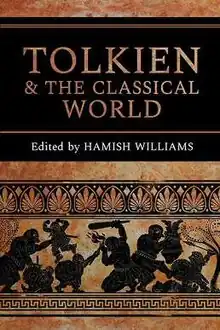
Larry J. Swain, writing in Mythlore, praises the collection as unusual in consisting entirely of good quality essays that examine a range of "classical sources and inspirations". He notes that the focus is mainly on The Lord of the Rings, with some attention to the rest of Tolkien's legendarium. He adds that the cover artwork, depicting dwarves battling trolls "in the style of Athenian black-figure pottery art where the viewer might see a battle of Greeks and Trojans" is "nothing short of fantastic", setting the stage for the scholarly essays. Reviewing each of the essays, he picks out Sundt's on the myth of Orpheus as convincing him that the myth formed the "background to much that is in Middle-earth."[3]
Victor Parker, reviewing the book for Tolkien Studies, mentions two methodological obstacles, namely that the classics are mediated by "pervasive influence" on medieval thought, and that both classical and medieval periods may attest certain objects (like networks of beacons), and it may be unclear which Tolkien was using. Parker agrees that each essay manages to show that its source is "at least" plausible, but feels that the study of classical sources has "some distance to go" before it reaches the level of Tom Shippey's analysis of Tolkien's medieval influences. He finds the strongest essays to be those that directly discuss their classical source, like Sundt's Orpheus or Kleu's Atlantis, rather than generalising from other research. He admires Pezzini's essay on divine intervention, and Neubauer's on the Ring of Gyges, though he notes that Herodotus too told the tale of a magic ring.[4]
John Houghton, in Journal of Tolkien Research, calls the book a "colossal volume". He finds essays like Clare's on historiographies open to "nebulosity", but agrees that Clare gives "three reasonably solid examples" as Númenor rises and falls like Athens, the "good" and "bad" kings paralleling attitudes to Roman emperors, and the King's men resembling persecuted Christians in the Roman empire. He finds Eilmann's expanded chapter effective in setting out how Aristotle's Poetics applies to the tragic tale of Túrin.[5]
Joel D. Ruark, writing in VII, states that the essays mainly do "comparative analysis between Tolkien and the classics", enabling the reader to see the similarities and contrasts between the two. Ruark feels that the book largely succeeds in "presenting and defending the position that the Greco-Roman classics influenced Tolkien’s thought and imagination throughout his life." He finds the balance of primary and secondary sources largely satisfying, though he would have liked more detail on Tolkien's own opinions on the links between his writings and the classics. He comments that he was "not [always] fully convinced that the comparisons being drawn were deliberate on Tolkien’s part", but found the many parallels "enlightening—and even delightful".[6]
Christian Beck, in Thersites, calls the volume "monumental" and its stated task "challenging", something that Beck notes is acknowledged by the book's editor, Williams. He finds Harrisson's essay on the classical background to Tolkien's Gondor/Rohan relationship "a compelling image" of "an alternative history". In his view, the volume is comprehensive, lacking only an article on architecture in Middle-earth. He notes Shipley's afterword which discusses Tolkien's interest in not just giving classical tales a happy ending, but that he "reinterpreted them to serve his narrative", which Shipley considers "Tolkien's greatest achievement in dealing with classical themes". Beck notes that classical references are not "the most important part ... but are nevertheless unmistakably present."[7]
Kevin Bouillot, writing in the French journal Anabases, states that despite Tolkien's millions of readers and the size of the scholarly literature about him, the role of classics and antiquity remains little studied despite dedicated issues on the topic in Tolkien Studies (2004), Journal of Inklings Studies (2011) and Journal of Tolkien Research (2014). He notes that Tolkien largely refused to make intertextual comments on his own work, obliging the contributors to identify themes and concepts that Tolkien had presumably borrowed. He finds the result reasonably coherent, despite the inevitable overlaps, setting out "the salient elements" of Middle-earth's classical roots. In his view the book is clear and well-informed on Tolkien's work, even if it is far from exhausting its subject matter.[8]
References
- Williams 2021, p. xi.
- Williams 2021.
- Swain, Larry J. (2022). Tolkien and the Classical World, edited by Hamish Williams. Mythlore. Vol. 40. Article 26.
- Parker, Victor (2022). "Tolkien and the Classical World ed. by Hamish Williams, and: Tolkien and the Classics ed. by Roberto Arduini". Tolkien Studies. 19 (2): 205–211. doi:10.1353/tks.2022.0020. ISSN 1547-3163.
- Houghton, John (2020). Tolkien and the Classical World (2021), edited by Hamish Williams". Journal of Tolkien Research. Vol. 11. Article 4.
- Ruark, Joel D. (2022). "Tolkien & the Classical World, Ed. by Hamish Williams". VII. 38 (2): e141-e143.
- Beck, Giuseppe (2022). "Review of Hamish Williams: Tolkien and the Classical World". Thersites. 15 There and Back Again: Tolkien and the Greco–Roman World (volume editors Alicia Matz and Maciej Paprocki). Article 230. doi:10.34679/thersites.vol15.230.
- Bouillot, Kevin (2022-11-02). "Hamish Williams (éd.), Tolkien & the Classical world". Anabases (in French). OpenEdition (36): 344–346. doi:10.4000/anabases.15187. ISSN 1774-4296.
Sources
- Williams, Hamish, ed. (2021). Tolkien and the Classical World. Zurich. ISBN 3-905703-45-9. OCLC 1237352408.