Timeline of the 2023 Atlantic hurricane season
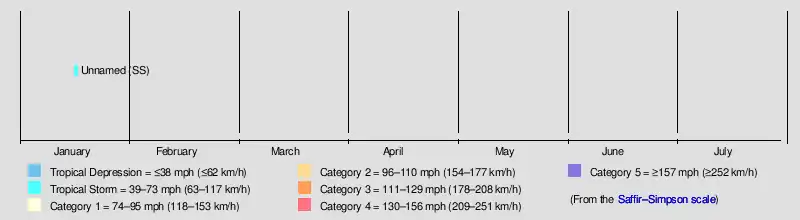
The 2023 Atlantic hurricane season is the current hurricane season, the annual period of tropical cyclogenesis in the Atlantic Ocean in the Northern Hemisphere. The season officially begins on June 1, 2023, and will end on November 30, 2023. These dates, adopted by convention, historically describe the period in each year when most subtropical or tropical cyclones form in the Atlantic.[1] However, tropical cyclone formation is possible at any time of the year, as was the case this season, when an unnamed subtropical storm formed in mid-January.[2]
| Timeline of the 2023 Atlantic hurricane season | |||||
|---|---|---|---|---|---|
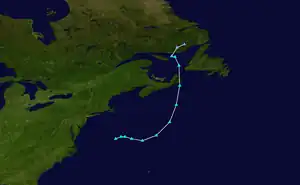 Season summary map | |||||
| Season boundaries | |||||
| First system formed | Mid-January | ||||
| Last system dissipated | Season ongoing | ||||
| Strongest system | |||||
| Name | Unnamed | ||||
| Longest lasting system | |||||
| Name | Unnamed | ||||
| Duration | Unknown days | ||||
| |||||
This timeline documents tropical cyclone formations, strengthening, weakening, landfalls, extratropical transitions, and dissipations during the season. It includes information that was not released throughout the season, meaning that data from post-storm reviews by the National Hurricane Center, such as a storm that was not initially warned upon, has been included.
By convention, meteorologists use one time zone when issuing forecasts and making observations: Coordinated Universal Time (UTC), and also use the 24-hour clock (where 00:00 = midnight UTC).[3] The National Hurricane Center uses both UTC and the time zone where the center of the tropical cyclone is currently located. The time zones utilized (east to west) are: Greenwich, Cape Verde, Atlantic, Eastern, and Central.[4] In this timeline, all information is listed by UTC first, with the respective regional time zone included in parentheses. Additionally, figures for maximum sustained winds and position estimates are rounded to the nearest 5 units (knots, miles, or kilometers), following National Hurricane Center practice. Direct wind observations are rounded to the nearest whole number. Atmospheric pressures are listed to the nearest millibar and nearest hundredth of an inch of mercury.
Timeline
References
- "Hurricanes Frequently Asked Questions". Miami, Florida: NOAA Atlantic Oceanographic and Meteorological Laboratory. June 1, 2021. Retrieved May 12, 2022.
- Barker, Aaron (May 11, 2023). "First storm of 2023 hurricane season formed in January, NHC says". Fox Weather. Retrieved May 12, 2022.
- "Understanding the Date/Time Stamps". Miami, Florida: NOAA National Hurricane Center. Retrieved July 10, 2020.
{{cite web}}: CS1 maint: url-status (link) - "Update on National Hurricane Center Products and Services for 2020" (PDF). Miami, Florida: National Hurricane Center. April 20, 2020. Retrieved May 12, 2023.
External links

- National Hurricane Center, Miami, Florida