Timeline of 20th century printmaking in America
This is a timeline of 20th Century printmaking in America.
20th century
1900s

Rachael Robinson Elmer Woolworth Building June Night, 1916
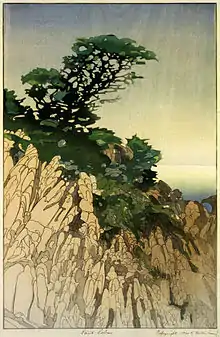
Bertha Lum, Point Lobos, 1920
- 1907 - Bertha Lum travels to Japan to learn woodblock cutting.[1]
- 1907 - Samuel Simon, an Englishman, held the earliest recorded patent for a silkscreen process; his process used a bristle brush rather than squeegee to distribute the color.[2][3]
1910s
- 1912 - Pedro Joseph de Lemos establishes the California Society of Etchers (now the California Society of Printmakers).[4]
- 1914 - A San Francisco-based commercial artist, John Pilsworth, perfected and patented a multicolor screen process, called the Selectasine method, leading to wide use of the screen print in the advertising industry.[3]
- 1915 - A small group of printmakers, including Blanche Lazzell, formed the Provincetown Printers, a "pioneering woodblock print society-- the first of its kind in America". The group developed a new form of woodblock printmaking known as the Provincetown print or white-line woodcut.[5] Other members: Ada Gilmore, Mildred McMillen, Ethel Mars, Maud Squire.[6]
- 1915 - The Print Club of Philadelphia, later to be re-named The Print Center, was founded in Philadelphia. It was one of the first venues in America "dedicated to the appreciation of prints. . .In 1942 The Print Center donated its collection of prints to the Philadelphia Museum of Art, forming the core of their fledgling print department."[7]
- 1917 - George Miller set up a lithography print shop for fine artists in New York.[8]
- 1919 - Bolton Brown set up a lithography print shop for fine artists in New York.[8]
1920s
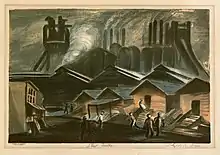
Elizabeth Olds Steel Mills, 1938
- 1922 The Art Students League of New York establishes a lithography workshop, led by Joseph Pennell.[9] In response to growing demand, the League hired a full-time professional printer seven years later.[8]
- 1923 - Louis Lozowick, a Ukraine-born master lithographer and “virtuosic precisionist”,[10] whose prints are in the collections of many museums and who often celebrated the American city in stylized cityscapes, creates his first recorded lithographs (Cleveland and Chicago).[11]
- 1927 - Elizabeth Olds becomes the first woman artist to receive a Guggenheim Fellowship,[12] and was later a silkscreen pioneer on the WPA/FAP Graphic Arts Division team (1936–40). She was also the first artist to actually create a serigraph, The Concert, while on the Silkscreen Unit.[13]
- 1927 - The Society of American Printmakers was organized and began to offer shows that included prints in different media. In the late 1930's it organized annual exhibitions.[14]
1930s
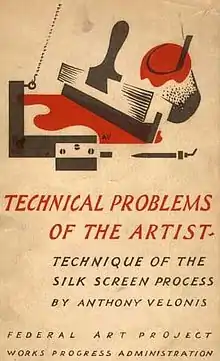
Anthony Velonis Technical Problems of the Artist 1938
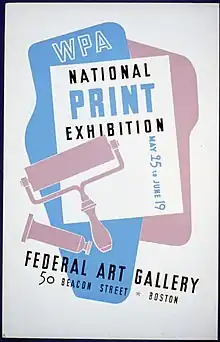
WPA national print exhibition, Federal Art Gallery
- 1933 - American printmaker Adolf Dehn set up the Adolf Dehn Print Club. For $5 annually subscribers got a brochure illustrating four of his lithos and could choose one to be mailed. His works were “visually sophisticated and mordantly witty but rarely politically challenging” and his skills were widely admired. The club had enough sales that he continued for several years.[15]
- 1934 - Associated American Artists (AAA) was established by Reeves Lewenthal, and operated until 2000. In founding AAA Lewenthal “pioneered the effective mass merchandizing of prints as popular forms of original art”.[16]
- 1935 - The Federal Art Project (FAP) was established, running until 1943.[17]
- 1935 - 1935 New York anti-lynching exhibitions include lithographs alongside drawings, paintings and sculptures.[18]
- 1936 - Audrey McMahon, a regional director for the Works Progress Administration's (WPA) Federal Art Project and an effective leader, directed the construction of a printmaking workshop in New York City to "provide impetus for experimentation and to encourage emerging artists".[19]
- 1936 - WPA Federal Art Project (FAP) New York City Graphic Arts Division workshop opens, one of its sixteen printmaking facilities around the country, with professional printmakers on staff making it possible for artists to experiment with technically demanding methods beyond the artists’ existing skills.[20]
- 1936 - Printmaker Harry Sternberg awarded a Guggenheim Fellowship for a project focusing on industrial subjects, traveling several times to Pennsylvania coal mining areas to study mining and meet miners.[21]
- 1937 - Augusta Savage, a sculptor and influential teacher associated with the Harlem Renaissance, became the first director of the Harlem Community Art Center (part of the Federal Art Project). The Center became the "heart of the Harlem Renaissance as a learning and meeting place for the first generation of modern African-American artists."[19]
- 1937 - African-American master printmaker and painter Dox Thrash joins the Fine Print Workshop of the Philadelphia Federal Art Project (of the WPA);[22] He was the first African-American to join the workshop. Thrash co-discovered with Hugh Mesibov and Michael Gallagher the innovative Carborundum printmaking process, in which an artist grinds carborundum into a copper plate before inking it; the process "produced a wide range of rich tones and smoothly modeled forms".[23][24]
- 1938 - An exhibit of about thirty carborundum prints by Dox Thrash and his WPA associates was held in New Techniques in WPA Graphic Arts at the National Museum of Natural History, Washington, D.C.; at that time it was the most extensive display of new work produced by WPA printmakers.[22]
- 1938- First one-person show of silkscreen prints, Guy Maccoy - artist, sponsored by the Contemporary Arts Gallery, New York[25]
- 1938 - Anthony Velonis, an experimental silkscreen pioneer and Federal Art Project team leader, "helped elevate screen printing to a recognized art form by petitioning the program to initiate a silkscreen project in 1938".[26] Also in this year Velonis wrote an important and influential pamphlet for artists, entitled "Technical Problems of the Artist: Technique of the Silkscreen Process".[27]
- 1938 - The FAP Graphic Arts Division team that reinvigorated screen printing processes[28] and pioneered new screen-printing technologies under the leadership of Anthony Velonis included Harry Gottlieb, Louis Lozowick, Eugene Morley, Elizabeth Olds, and Hyman J. Warsager.[29]
- 1938-1939 Louise Bourgeois, the French-American sculptor, painter, and printmaker makes her first print, St. Germain, a holiday greeting card, in offset lithography. Bourgeois made additional cards in the 1940s. She purchased a small intaglio press to work on prints at her home.[30]
- 1940 - By this year lithography had "decisively outdistanced etching as the most popular printmaking process", with artists and viewers "fascinated by the expressive power and striking visual nuances of B&W lithographic prints".[8]
- 1940 - Second one-person show of silkscreen prints, Harry Gottlieb - artist, sponsored by ACA (American Contemporary Art) Gallery[25]
- 1940 - First group show of silkscreen prints. It was organized by Elizabeth McCausland, who was an art critic, historian, and writer, at the Springfield (MA) Art Museum.[31]
- 1940 - The term 'serigraphy' is coined by Carl Zigrosser and Anthony Velonis, derived from Latin word 'seri', meaning silk, and Greek word 'graphos', meaning to draw or write,[32] in order to "distinguish art prints from the screen-processed images mass produced for commerce and industry".[33]
- 1940 - Stanley William Hayter flees Paris and moves his printing workshop, Atelier 17, to New York for the duration of World War II.[34]
- 1940 - National Serigraph Society founded.[35] The group's original name was the Silk Screen Group until 1944. The Society's goal was to advance the interests of the new technique of serigraphy.[36] The group conducted classes, ran a world-wide exhibitoin and information service, and provided a nation-wide lecture bureau and an exhibition and sales gallery in New York City.[36]
- 1940 - The Museum of Modern Art holds an exhibit American Color Prints Under $10 from November 26–December 28. The purpose was to Make American art available for purchase to a wide audience. the show consisted of 79 prints by 36 artists[37][38]
- 1944 - Jackson Pollock went to Atelier 17 where in his etchings, using automatism,[39] he achieved “some of the first dynamic and expressive compositions that were to characterize the early mode of American Abstract Expressionism”. . with “elements derived from the pre-war compositions of Picasso”.[40]
- 1946 Louise Bourgeois began making prints at Stanley William Hayter’s Atelier 17, a leading printmaking workshop and studio in New York (previously in Paris). The following year she created a print project, her illustrated book called He Disappeared Into Complete Silence, which included nine engravings, each accompanied by a parable written by Bourgeois.[30] “The imagery is primarily of skyscrapers, and Bourgeois was enamored of skyscrapers when she arrived in New York from Paris after she married an American in 1938”.[41]
- 1947 - Robert Blackburn, an African-American printmaker and highly regarded teacher, established the Printmaking Workshop in a Chelsea loft in New York City.[42] Blackburn was a renowned master printer for Charles White, Faith Ringgold, Jasper Johns, Robert Rauschenberg, and Betye Saar.[43]
1950s
- 1951-1952 Will Barnet experiments with multi-stone color lithographs in collaboration with Robert Blackburn at the latter's New York City workshop.[44]
- 1956 The Print Council of America is established.[45]
- 1956 The Pratt Graphics Center established in New York City to be a "highly experimental, internationally oriented workshop, open not only to students but to artists from all over the world who would share their experiences" in a stimulating, urban setting.[46] It closed in 1986.
- 1957 Tatyana Grosman establishes the Universal Limited Art Editions (ULAE) in Long Island.[47] The first publication was Stones by Larry Rivers and Frank O’Hara.[48]
- 1959 George Lockwood establishes the Impressions Workshop in Boston, with a focus on lithography and intaglio printing, later adding screen printing.[47]
1960s
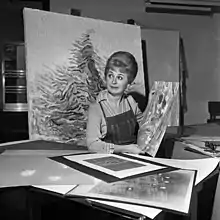
June Wayne at Tamarind Workshop, 1965
- 1960 June Wayne establishes the Tamarind Institute in Los Angeles.[47]
- 1960 Ary and Sheila Marbain establish the Maurel Studios.[49]
- 1960 Grace Hartigan's four lithograph series The Hero Leaves His Ship by is published by ULAE[50] The series is inspired Barbara Guest's poem of the same name. It is considered an example of Livres d' Artiste.[51]
- 1960 Barnett Newman begins making lithographs at the Pratt Graphics Workshop.[52]
- 1960 Jim Dine's six lithograph series Car Crash I-V and End Of The Crash is created.[53][54] The series is based on a 15 minute happening at the Reuben Gallery.[55]
- 1960 Franz Kline, an American painter associated with Abstract Expressionism, had a drawing reproduced as an etching and Willem de Kooning had an etching in 21 Etchings and Poems, a publication conceived in 1951 by members of New York’s Atelier 17.[56]
- 1961 Publication of What Is an Original Print?: Principles Recommended by the Print Council of America in response to dubious and fraudulent practices in printmaking in the 1950’s and a controversy about the definition of an original print.[57]
- 1962 Andy Warhol visits Max Arthur Cohn's graphic arts studio in Manhattan to learn additional silk screen printmaking techniques.[58] Cohn had worked in the Works Progress Administration's (WPA) easel division and was a co-founder of the National Serigraph Society.[59]
- 1962 Screen printing was given new energy as Pop Art visual imagery replicated popular commercialism, notably in Andy Warhol's Campbell's soup can images, with "bold, huge, and multicolored" prints that flaunted the photo process. The soup can prints "probably did more to revitalize the medium than any other artwork since the screen prints of (Anthony) Velonis and his group in the 1930's".[60]
- 1962 Robert Rauschenberg begins producing lithographs at Universal Limited Art Editions. One of his first prints was Merger.[61][62]
- 1962 Henry Geldzahler, curator of twentieth century art at the Metropolitan Museum of Art, took Robert Rauschenberg to Andy Warhol’s studio; Warhol showed the visiting artist how he made art from screen prints. “Shortly thereafter, in the 1962 painting Crocus, Rauschenberg used screen print for the first time, transferring an image in black ink”.[63]
- 1962 Crown Point Press established by Kathan Brown.[64]
- 1962 Los Angeles Printmaking Society founded by artists Connor Everts and Paul Darrow. LAPS is a national nonprofit for the encouragement and advancement of printmaking.[65][66]
- 1964 Wadsworth Atheneum publishes an edition of 500 of the portfolio X + X (Ten Works by Ten Painters). An early example of prints published by an art organization, it includes prints by Stuart Davis, Robert Indiana, Ellsworth Kelly, Roy Lichtenstein, Robert Motherwell, George Ortman, Larry Poons, Frank Stella, Ad Reinhardt, and Andy Warhol.[67][68][69][70]
- 1964 Irwin Hollander, artist and master printer, opened the Hollander Workshop Gallery in New York, with "a strong affinity for the Abstract Expressionists", working with Robert Motherwell, Louise Nevelson, Ellsworth Kelly, Willem de Kooning, and collaborating with Salvador Dali, Philip Guston, and Claes Oldenburg, among other notable artists.[71]
- 1965 The portfolio New York Ten is published by Tanglewood Press. An edition of 200 with prints by Richard Anuszkiewicz, Jim Dine, Helen Frankenthaler, Nicholas Krushenick, Robert Kulicke, Mon Levinson, Roy Lichtenstein, Claes Oldenburg, George Segal, and Tom Wesselmann.[72][70]
- 1965 Kenneth Tyler, master printer, opens Gemini Ltd., a fledgling print workshop, in the back room of a store-front building in Los Angeles "to infuse technology into lithography's craft and contemporary thinking into its aesthetic in order to become a viable means of modern graphic expression."[73]
- 1965 The print publishing company "Multiples, Inc." is established by Marian Goodman.[74][75]
- 1965 Roy Lichtenstein creates a screenprint Brushstroke.[76][77]
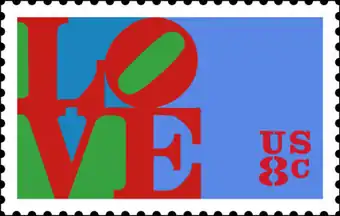
Lovestamp
- 1965 The Museum of Modern Art commissions the silk screened LOVE Christmas card from Robert Indiana, creating what is considered an iconic image from the 1960s[78][79] The image was recreated as prints, sculptures, and paintings.[80]
- 1966 Edward Ruscha's silkscreen print Standard Station based on his painting of the same name is published by Audrey Sabol in an edition of 50.[81][82]
- 1968 Warhol's screen print portfolio Campbell’s Soup Cans I is published through Factory Additions in an edition of 250.[83][84]
- 1969 The exhibition Tamarind: Homage to Lithography at the Museum of Modern Art (and later in 1971 the exhibition Technics and Creativity: Gemini G.E.L.) helped legitimize the collaborative print. The market for specialized prints of the post-war years was still developing and did not mature overnight; the acceptance of new types of prints by important museums helped stimulate public awareness and interest.[85]
1970s
- 1971 The Tamarind book of lithography: art & techniques by Garo Antreasian, Caroz Antreasian, and Clinton Adams is published by the Tamarind Lithography Workshop. It becomes the standard technical reference book.[86][87]
- 1972 The Brandywine Workshop and Archives in Philadelphia founded by Allan L. Edmunds as a collective of artists and teachers to promote "printmaking as a vital contemporary art form and to support collaboration and experimentation between visual artists and skilled professional printers".[88][89]
- 1972 Agnes Martin's portfolio of 30 screenprints entitled On a Clear Day is published in an edition of 14 by Parasol Press, Ltd..[90][91]
- 1973 Establishment of The International Institute of Experimental Printmaking by Garner Tullis in Santa Cruz, CA (re-located three years later to San Francisco), where innovative paper and paper making were a focus.[57]
- 1976 Atelier Royce (an experimental shop open to artists) initiated by Richard Royce in Santa Monica, concentrating on paper making and the creation of paper objects, some with woodcut and intaglio printings.[57]
- 1977 K. Caracio Etching Studios established by Kathy Caraccio.[92]
- 1978 World Print Council’s conference on Paper — Art & Technology (held at the San Francisco Museum of Art) included as panelists: printmakers, workshop directors, and curators of print collections.[57]
- 1978 - Derrière L'Étoile Studios, a fine art lithography printmaking workshop,[93] founded by Maurice Sánchez in New York, operating primarily on contract and collaborating with a range of artists on a multitude of types of projects, specializing in lithography and a unique approach to monoprinting.[94]
1980s
- 1980 Peter Blum Edition established in New York City, specializing in portfolio editions.[95]
- 1980 Donald Farnsworth started Magnolia Editions in California, with capabilities for lithography, intaglio, and mono printing.[96]
- 1983 Keith Haring, who had experimented with lithography in the late 1970’s, begins to make screen prints, or serigraphs. “Soon after, he was producing increasingly inventive and bold prints in both small and large editions, undoubtedly inspired by Andy Warhol, one of Haring’s most important influences”.[97]
- 1985 The large-format ink jet Iris printer is commercially available and begins being used to create fine art prints.[98][99]
- 1987 The International Fine Art Print Dealers Association (IFPDA) established as an organization for fine print artists. The annual IFPDA Print Fair in New York City presents curated collections of fine art prints and editions from old master to contemporary.[100]
1990s
- 1990 Keith Haring, just one month before his death, publishes his final edition on paper, a portfolio of 17 silkscreens called The Blue Print Drawings, revisiting a portfolio of drawings he created in 1981, "the last cohesive project of his career".[101]
- 1991 Jack Duganne begins using the term Giclée prints to refer to digital prints.[102]
- 1994-95 The Prints of Roy Lichtenstein, an exhibition at the National Gallery of Art in Washington D.C. of 85 prints and 7 sculptures “ranging from the artist’s first op image through recently completed works”. Also shown at the Los Angeles County Museum of Art, 1995.[103]
- 1996 Print Center New York (formerly International Print Center New York, IPCNY) chartered. It is a non-profit exhibition space in New York "dedicated to exploring the dynamic and accessible medium of print within broader artistic and cultural discourses". It offers exhibitions, scholarship, educational programming, and digital resources.[104]
- 1996 The Metropolitan Museum of Art exhibition W.P.A. Color Prints: Images from the Federal Art Project. From the museum News Release: " The selection of works . . .have rarely -- if ever -- been exhibited in the past. They represent some of the most advanced printmaking of the time and have had a significant impact on the history of printmaking in the United States". Lectures and Gallery talks accompanied the exhibition, March through May.[105]
References
- Hansen, T. Victoria (1995). Printmaking in America : collaborative prints and presses, 1960-1990. New York: H.N. Abrams in association with Mary and Leigh Block Gallery, Northwestern University. pp. 20–21. ISBN 9780810937437.
- Wolfe, Shira. "Agents of Change: Silk Screen". Artland Magazine. Retrieved January 19, 2023.
- Ross, John; Romano, Clare; Ross, Tim (1972). The Complete Printmaker: Techniques, Traditions, Innovations (2nd ed.). New York, N.Y.: Roundtable Press. p. 144. ISBN 0-02-927372-2.
- Hendon, Karen Crews. "Modernism in Monterey". afanews.com. Retrieved 13 January 2023.
- "White Line: Blanche Lazzell and the Provincetown Printers". Swann Auction Galleries. Retrieved January 26, 2023.
- "Women Printmakers of Provincetown: White-Line Color Print". AWA News - The Latest from American Women Artists. Retrieved January 26, 2023.
- "The Print Center - Mission & History". The Print Center. Retrieved April 17, 2023.
- Langa, Helen (2004). Radical Art: Printmaking and the Left in 1930's New York. Berkeley and Los Angeles: University of California Press. p. 14. ISBN 0-520-23155-4.
- Hansen, T. Victoria (1995). Printmaking in America : collaborative prints and presses, 1960-1990. New York: H.N. Abrams in association with Mary and Leigh Block Gallery, Northwestern University. p. 23. ISBN 9780810937437.
- Schjeldahl, Peter (January 19, 2015). "Left Turns: The Radical Art of the Nineteen-Thirties". The New Yorker. Retrieved January 28, 2023.
- Flint, Jane (1982). The Prints of Louis Lozowick: A Catalogue Raisonné. New York, N.Y.: Hudson Hills Press. p. 209. ISBN 0-933920-30-X.
- Langa, Helen (2004). Radical Art: Printmaking and the Left in 1930's New York. Berkeley, Los Angeles, London: University of California Press. p. 232. ISBN 0-52023155-4.
- Zigrosser, Carl (December 1941). Bender, John (ed.). "The Serigraph, A New Medium". The Print Collector's Quarterly. 28 (4): 459.
- Langa, Helen (2004). Radical Art: Printmaking and the Left in 1930's New York. Berkeley and Los Angeles: University of California Press. pp. Pages 13, 34. ISBN 0-520-23155-4.
- Langa, Helen (2004). Radical Art: Printmaking and the Left in 1930's New York. Berkeley and Los Angeles, California: University of California Press. p. 15. ISBN 0-520-23155-4.
- Langa, Helen (2004). Radical Art: Printmaking and the Left in 1930's New York. Berkeley, Los Angeles, London: University of California Press. p. 18. ISBN 0-52023155-4.
- "Federal Art Project (FAP) (1935)". Living New Deal. Retrieved 13 January 2023.
- Langa, Helen (2004). Radical Art: Printmaking and the Left in 1930's New York. Berkeley and Los Angeles: University of California Press. p. 152. ISBN 0-520-23155-4.
- "Etched in History: Printmakers of the Federal Art Project -- Audrey McMahon & the Federal Art Project in New York". Swan Auction Galleries. Retrieved January 24, 2023.
- Langa, Helen (2004). Radical Art: Printmaking and the Left in 1930's New York. Berkeley and Los Angeles, California: University of California Press. p. 25. ISBN 0-520-23155-4.
- Langa, Helen (2004). Radical Art: Printmaking and the Left in 1930's New York. Berkeley and Los Angeles: University of California Press. pp. 106–107. ISBN 0-520-23155-4.
- Coppel, Stephen; Kierkuc-Bielinski, Jerzy (2008). American Prints: From Hopper to Pollock. Burlington, VT: Lund Humphries (Ashgate Publishing). p. 150. ISBN 978-0-85331-992-4.
- Donnelly, Michelle (1916). "Art of Dox Thrash". The Encyclopedia of Greater Philadelphia. Retrieved February 3, 2023.
- Mansfield, Brontë. "Dox Thrash: Creator of Opheliagraph". SAIC - School of the Art Institute of Chicago. Retrieved February 3, 2023.
- Watrous, James (1984). A Century of American Printmaking - 1880-1980. Madison, WI: The University of Wisconsin Press. p. 107. ISBN 0-299-09680-7.
- "Visualizing Recovery: The Federal Art Project's Legacy in Prints". MoMA. Retrieved January 26, 2023.
- Zigrosser, Carl (December 1941). Bender, John (ed.). "The Serigraph, A New Medium". The Print Collector's Quarterly. 28 (4): 451.
- Langa, Helen (2004). Radical Art: Printmaking and the Left in 1930's New York. Berkeley and Los Angeles, California: University of California Press. p. 232. ISBN 0-520-23155-4.
- Langa, Helen (2004). Radical Art: Printmaking and the Left in 1930's New York. Berkeley and Los Angeles, California: University of California Press. p. 250. ISBN 0-520-23155-4.
- "About the Artist". MoMA: Louise Bourgeois - The Complete Prints and Books - Biography. Retrieved April 29, 2023.
- Zigrosser, Carl (January 1948). "Ten Years of Serigraphy". The New Colophon: A Book Collectors' Quarterly. 1 (1): 62.
- Ross, John; Romano, Clare; Ross, Tim (1972). The Complete Printmaker: Techniques, Traditions, Innovations (2nd ed.). New York, NY: Roundtable Press. p. 145. ISBN 0-02-927372-2.
- Eichenberg, Fritz (1976). The Art of the Print: Masterpieces, History, Techniques. New York: Harry N. Abrams, Inc. p. 482. ISBN 0-8109-0103-X.
- "Stanley William Hayter & Atelier 17, 1940-1949". Atelier Contrepoint. Retrieved 13 January 2023.
- "Serigraphs - A Brief History". The Serigraph Studio. Retrieved 13 January 2023.
- Zigrosser, Carl. Adler, Elmer; Winterich, John T.; Adams, Jr., Frederick B. (eds.). "Ten Years of Serigraphy". The New Colophon: A Book Collector's Quarterly. 1 (January 1948): 62–64.
- "American Color Prints Under $10 | MoMA". The Museum of Modern Art. Retrieved 13 January 2023.
- "Press release November 20, 1940" (PDF). Museum of Modern Art. Retrieved 11 February 2023.
- "Art Term: Automatism". Tate. Retrieved February 10, 2023.
- Castleman, Riva (1988). Prints of the 20th Century: A History (Revised ed.). New York, N.Y.: Thames and Hudson. p. 129. ISBN 0-500-20228-1.
- "Louise Bourgeois: He Disappeared into Complete Silence". Louise Bourgeois: An Unfolding Portrait. Retrieved April 28, 2023.
- "Printmaking for the Love of It". The New York Times. July 12, 1988. Retrieved January 18, 2023.
- Yale, Margot (July 17, 2020). "Visualizing Recovery: The Federal Art Project's Legacy in Prints". MoMA Magazine. Retrieved January 29, 2023.
- "Robert Blackburn". Robert Blackburn. Retrieved January 18, 2023.
- Hansen, T. Victoria (1995). Printmaking in America : collaborative prints and presses, 1960-1990. New York: H.N. Abrams in association with Mary and Leigh Block Gallery, Northwestern University. p. 46. ISBN 9780810937437.
- Eichenberg, Fritz (1976). The Art of the Print: Masterpieces, History, Techniques. New York: Harry N. Abrams, Inc. Publishers. p. 555. ISBN 0-8109-0103-X.
- Hansen, T. Victoria (1995). Printmaking in America : collaborative prints and presses, 1960-1990. New York: H.N. Abrams in association with Mary and Leigh Block Gallery, Northwestern University. p. 28. ISBN 9780810937437.
- "Larry Rivers and Frank O'Hara: Stones". FAMSF. Retrieved 22 January 2023.
- Hansen, T. Victoria (1995). Printmaking in America : collaborative prints and presses, 1960-1990. New York: H.N. Abrams in association with Mary and Leigh Block Gallery, Northwestern University. p. 44. ISBN 9780810937437.
- "The Hero Leaves His Ship I, 1960, Grace Hartigan". Universal Limited Art Editions (ULAE). Retrieved 30 January 2023.
- Tallman, Susan (1996). The contemporary print: from pre-pop to postmodern. London: Thames and Hudson. p. 19. ISBN 9780500236840.
- Tallman, Susan (1996). The contemporary print: from pre-pop to postmodern. London: Thames and Hudson. p. 21. ISBN 9780500236840.
- "Car Crash I-v And End Of The Crash by Jim Dine". Printed Editions. Retrieved 30 January 2023.
- "Jim Dine. Car Crash I. (1960)". The Museum of Modern Art. Retrieved 30 January 2023.
- Tallman, Susan (1996). The contemporary print: from pre-pop to postmodern. London: Thames and Hudson. p. 49. ISBN 9780500236840.
- Castleman, Riva (1976). Prints of the 20th Century: A History (Revised ed.). New York, N.Y.: Thames and Hudson. p. 130. ISBN 0-500-20228-1.
- Watrous, James (1984). A Century of American Printmaking: 1880-1980. Madison, WI: The University of Wisconsin Press. pp. 304–309. ISBN 0-29909680-7.
- "Sotheby's". Andy Warhol: Love, Sex & Desire. Retrieved January 23, 2023.
- "Max Arthur Cohn Biography". The Annex Galleries. Retrieved January 23, 2023.
- Ross, John; Romano, Clare; Ross, Tim (1990). The Complete Printmaker: Techniques, Traditions, Innovations (Revised ed.). New York, N.Y.: Free Press (A Division of Simon & Shuster). p. 145. ISBN 9780029273715.
- Tallman, Susan (1996). The contemporary print: from pre-pop to postmodern. London: Thames and Hudson. p. 33. ISBN 9780500236840.
- Rauschenberg, Robert (1962). "Merger". Art Institute of Chicago. Retrieved 30 January 2023.
- Williams, Reba; Williams, Dave (December 1987). "The Later History of the Screenprint". Print Quarterly. 4 (4): 398 – via JSTOR.
- "Crown Point Press records, 1962-2018". Archives of American Art. Smithsonian Institution. Retrieved 30 January 2023.
- "About LAPS - Essence". Los Angeles Printmaking Society. Retrieved January 31, 2023.
- Schwartz, Lea (October 26, 2022). "Printmaking Society Celebrates 60 Years". DT News - Downtown Los Angeles. Retrieved January 31, 2023.
- "'Ten Works by Ten Painters'". Tate. Retrieved 9 February 2023.
- "X + X (Ten Works by Ten Painters)". The Museum of Modern Art. Retrieved 9 February 2023.
- "Ten Works x Ten Painters". Princeton University Art Museum. Retrieved 9 February 2023.
- Hansen, T. Victoria (1995). Printmaking in America : collaborative prints and presses, 1960-1990. New York: H.N. Abrams in association with Mary and Leigh Block Gallery, Northwestern University. p. 47. ISBN 9780810937437.
- Hansen, Trudy V.; Mickenberg, David; Moser, Joann; Walker, Barry (1995). Printmaking in America: Collaborative Prints and Presses, 1960-1990 (Museum Paperback ed.). New York: Harry N. Abrams, Inc. in association with the Mary and Leigh Block Gallery, Northwestern University. p. 43. ISBN 0-941680-15-0.
- "New York Ten. 1964–65, published 1965 | MoMA". The Museum of Modern Art. Retrieved 9 February 2023.
- Eichenberg, Fritz (1976). The Art of the Print: Masterpieces, History, Techniques. New York: Harry N. Abrams, Inc. p. 554. ISBN 0-8109-0103-X.
- Hansen, T. Victoria (1995). Printmaking in America : collaborative prints and presses, 1960-1990. New York: H.N. Abrams in association with Mary and Leigh Block Gallery, Northwestern University. p. 47. ISBN 9780810937437.
- "Multiples, Inc.: 1965–1992". Reversible Destiny Foundation. Retrieved 30 January 2023.
- "'Brushstroke', Roy Lichtenstein, 1965". Tate. Retrieved 30 January 2023.
- Tallman, Susan (1996). The contemporary print: from pre-pop to postmodern. London: Thames and Hudson. pp. 54–55. ISBN 9780500236840.
- Tallman, Susan (1996). The contemporary print: from pre-pop to postmodern. London: Thames and Hudson. p. 58. ISBN 9780500236840.
- "Robert Indiana LOVE MoMA Christmas Card Pop Art 1965". The Missing Link. Retrieved 30 January 2023.
- "Love". Smithsonian American Art Museum. Retrieved 30 January 2023.
- "Trial Proof for Standard Station". FAMSF. Retrieved 10 February 2023.
- "Edward Ruscha. Standard Station. 1966". The Museum of Modern Art. Retrieved 10 February 2023.
- "Andy Warhol Campbell's Soup, 1968". Masterworks Fine Art Gallery. Retrieved 10 February 2023.
- "Campbell's Soup I". The Museum of Modern Art. Retrieved 10 February 2023.
- Hansen, Trudy V.; Mickenberg, David; Moser, Joann; Walker, Barry (1995). Printmaking in America: Collaborative Prints and Presses, 1960-1990 (Museum Paperback ed.). New York, N.Y.: Harry N. Abrams, Inc. in association with Mary and Leigh Block Gallery, Northwestern University. p. 81. ISBN 0-941680-15-0.
- Antreasian, Garo Z.; Antreasian, Caroz; Adams, Clinton (1971). "The Tamarind book of lithography: art & techniques". Open Library. Tamarind Lithography Workshop. Retrieved 30 January 2023.
- Tallman, Susan (1996). The contemporary print: from pre-pop to postmodern. London: Thames and Hudson. p. 17. ISBN 9780500236840.
- "Celebrating the Brandywine Workshop". Philadelphia Museum of Art. Retrieved February 2, 2023.
- "Our History". Brandywine Workshop and Archives. Retrieved February 2, 2023.
- "Agnes Martin, On a Clear Day, 1973". The Guggenheim Museums and Foundation. Retrieved 10 February 2023.
- "Agnes Martin. On a Clear Day. 1973 |". The Museum of Modern Art. Retrieved 10 February 2023.
- Hansen, T. Victoria (1995). Printmaking in America : collaborative prints and presses, 1960-1990. New York: H.N. Abrams in association with Mary and Leigh Block Gallery, Northwestern University. pp. 48–49. ISBN 9780810937437.
- "Artspace". Derriere L'Etoile Studios. Retrieved March 29, 2023.
- Stainton, Elaine M., ed. (1995). Printmaking in America: Collaborative Prints and Presses, 1960-1990. New York: Harry N. Abrams. p. 55. ISBN 0-8109-3743-3.
- Tallman, Susan (1996). The contemporary print : from pre-pop to postmodern. London: Thames and Hudson. p. 283. ISBN 9780500236840.
- Hansen, Trudy; Mickenberg, David; Moser, Joann; Walker, Barry (1995). Printmaking in America: Collaborative Prints and Presses, 1960-1990 (Museum Paperback ed.). New York: Harry N. Abrams, Inc. in association with the Mary and Leigh Block Gallery, Northwestern University. p. 55. ISBN 0-941680-15-0.
- "A Seller's Guide To Keith Haring". myartbroker.com. Retrieved April 12, 2023.
- "History of Printmaking | What is Printmaking?". Tribeca Printworks. Retrieved 13 April 2023.
- "1985 – The Advent of Large Format Digital Printing". IRIS Historical Society. Retrieved 13 April 2023.
- "IFPDA Print Fair". IFPDA Foundation. Retrieved February 5, 2023.
- "Keith Haring: The Blueprint Drawings Deconstructed". Christie's. Retrieved April 12, 2023.
- "Giclée Prints & Their History". Static Medium. Retrieved 13 April 2023.
- "The Prints of Roy Lichtenstein". National Gallery of Art. Retrieved April 17, 2023.
- "About Print Center New York". Print Center New York. Retrieved April 17, 2023.
- Holzer, Harold; Markham, Liz (January 26, 1996). "W.P.A. Color Prints: Images from the Federal Art Project - News Release". The Met: Watson Library Digital Collections. Retrieved April 20, 2023.
This article is issued from Wikipedia. The text is licensed under Creative Commons - Attribution - Sharealike. Additional terms may apply for the media files.