Thomas Howard, 4th Duke of Norfolk
Thomas Howard, 4th Duke of Norfolk, KG (10 March 1536 – 2 June 1572) was an English nobleman and politician. He was a second cousin of Queen Elizabeth I and held many high offices during the earlier part of her reign.
Thomas Howard | |
|---|---|
| Duke of Norfolk | |
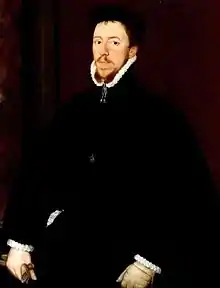 Thomas Howard painted by an unknown artist, c. 1565. | |
| Born | 10 March 1536 Kenninghall, Norfolk |
| Died | 2 June 1572 (aged 36) Tower Hill, London, England |
| Buried | Chapel of St Peter ad Vincula, Tower of London |
| Noble family | Howard |
| Spouse(s) | Mary FitzAlan Margaret Audley Elizabeth Leyburne |
| Issue | Philip Howard, 13th Earl of Arundel Thomas Howard, 1st Earl of Suffolk Lord William Howard Lady Elizabeth Howard Lady Margaret Howard |
| Parents | Henry Howard, Earl of Surrey Frances de Vere |
| Religion | Roman Catholic |
Norfolk was the son of the poet, soldier and politician Henry Howard, Earl of Surrey. He is believed to have commissioned Thomas Tallis, probably in 1567, to compose his renowned motet in forty voice-parts, Spem in alium.
He was executed for his role in the Ridolfi plot.
Early life, family, and religion

.JPG.webp)

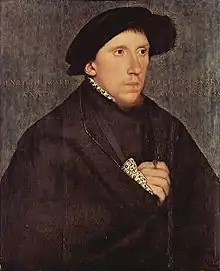
Thomas was born at Kenninghall, Norfolk on 10 March 1536, the eldest son of Henry Howard, Earl of Surrey and his wife Lady Frances de Vere. His grandparents on his father's side were Thomas Howard, 3rd Duke of Norfolk, and Elizabeth Stafford. His maternal grandparents were John de Vere, 15th Earl of Oxford, and Elizabeth Trussell. His siblings were Jane, Henry, Katherine, and Margaret. This descent reflected the religious upheaval of the times: his maternal grandfather was a supporter of the Reformation and was the first Protestant earl of Oxford, whereas his paternal grandfather was the premier Roman Catholic nobleman of England.
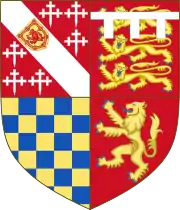
His father the Earl of Surrey, who was also a Catholic but had reformist leanings, was the heir to the dukedom of Norfolk and was destined to become the future 4th Duke; but that changed at the end of 1546 when Surrey quartered the royal arms of Edward the Confessor on his own coat of arms, incurring the fury of Henry VIII. Through his great-grandfather John Howard, 1st Duke of Norfolk (1483 creation), Surrey was a descendant of Thomas of Brotherton, 1st Earl of Norfolk, the sixth son of King Edward I, and the arms of the Howard ancestor, Thomas de Mowbray, 1st Duke of Norfolk (1397 creation), show that Surrey was entitled to bear Edward the Confessor's arms but doing so was an act of pride, and provocative in the eyes of the Crown.[1] Henry VIII, very possibly influenced by the Seymours, enemies of the Howard family at court and supporters of Protestantism, was convinced that Surrey and his father planned to usurp the crown from his son, the future Edward VI, in order to reverse the Reformation and thus return the English Church to papal jurisdiction. He ordered the arrest of the 3rd Duke and his son, both of them being tried for high treason and later sentenced to death; Surrey was executed in January 1547.[2] The 3rd Duke was saved by the death of Henry VIII the day before that appointed for the beheading, and also by the Privy Council's decision not to inaugurate the new reign with bloodshed; but he remained imprisoned in the Tower of London for the next six years, with most of his property and titles forfeit to the Crown.
After Surrey's death, his sister Mary Howard, Duchess of Richmond took over the care of his children and John Foxe, the Protestant martyrologist was employed to be their tutor. During that time, they lived in Reigate Castle, one of the residences belonging to the 3rd Duke. Despite losing his position as tutor to the Howard children six years later, Foxe remained an important recipient of Thomas's patronage for the rest of Howard's life.[3] Although Thomas and his siblings received Protestant education they were Catholic, as were the majority of his family, who remained loyal to Catholicism during the Reformation. His father fell out of favour, partly because of his Catholicism, and his grandfather was only released and pardoned in 1553 after the accession of the Catholic Queen Mary I. As soon as the 3rd Duke was released, he took over the upbringing of his grandchildren, dismissing Foxe, who went into exile in various European countries to escape anti-Protestant measures taken by Queen Mary. For a while, Thomas then studied at the home of Lord Chancellor Stephen Gardiner. A short time later, he joined his brother Henry, and continued his education in the London house of John White, a priest devoted to Catholic principles who in March 1554 was chosen to be the new Bishop of Lincoln. [4]
Career
.svg.png.webp)
In July 1554 Howard became first gentleman of the chamber to Mary's new consort, Philip II of Spain, and in November he was with them at the opening of parliament. [5] Because his father had died before his grandfather, Thomas was the heir to the Dukedom of Norfolk. In 1553 he received the courtesy title of Earl of Surrey, a subsidiary title of the dukes, when Queen Mary returned to the 3rd Duke the titles and properties that had been forfeited six years earlier. After his grandfather's death in August 1554, Thomas succeeded him, becoming the new Duke and Earl Marshal of England. Howard had been preparing to gradually take over the administration of the vast estates; he arranged his grandfather's funeral and burial at Framlingham and made suitable arrangements for the wardship of his sisters. Bassingbourne Gawdy, one of the lawyers in charge of the succession to Howard's estates, rode post haste to London with letters for Lord Chancellor Gardiner and returned as speedily as he could to Norwich. The escheator of Norfolk held a formal inquisition to survey the great Howard inheritance, of fifty-six manors, and 'many other considerable estates', which passed for the present into the hands of the Crown, as Thomas was still a minor. In due course, the young Duke would inherit the property. His younger siblings would also receive 1,000 marks each on coming of age, or marriage, according to the terms of their grandfather's will.[4] Once he came of age, the Duke was able to administer of all his estates, becoming one of the richest landowners in England.
Queen Mary died in November 1558 and was succeeded by her Protestant half-sister Queen Elizabeth I. Howard was a second cousin of Elizabeth through her maternal grandmother, Lady Elizabeth Howard, sister of the 3rd Duke, and he was trusted with public office despite his family's history and leanings towards the Catholic Church. To be a Catholic disguised as a Protestant so as not to attract the attention of the authorities was not unusual during the turbulent years of the Reformation. Many English Catholics took a stance of publicly showing themselves as Protestants, but secretly and privately professing and maintaining their Catholic faith.
Howard, as Earl Marshal, was in charge of organising Elizabeth's coronation on 15 January 1559, and the celebrations afterwards. Shortly after ascending the throne, the Queen made Norfolk a Knight of the Garter. Norfolk was favoured by Elizabeth although he was jealous of the larger measure of confidence she placed in Robert Dudley. Furthermore, Howard considered William Cecil, Elizabeth's Secretary of State, to be "Low Born". In November 1559, he was appointed Lieutenant-General of the North, a post that he accepted reluctantly because he saw it, probably correctly, as a means of distancing him from court. He was given the titular command of the army that would intervene in Scotland to support the Lords of the Congregation, a group of Protestant nobles who were opposed to the pro-French government of the regent, Mary of Guise. By his side were placed a man of military experience, James Croft, and the diplomat and politician Sir Ralph Sadler, both with vast knowledge of Scottish political affairs. Howard immediately left or the north, arriving at Berwick in early January 1560. His duty was to provide forces for the defence of the town against a possible French attack, to open up communications with the Lords of the Congregation, and cautiously aid them in their measures against the regent.[4] Norfolk was one of the negotiators of the Treaty of Berwick, signed in February 1560, through which the Congregation invited English assistance,[6] and was able to return to court after Cecil and his collaborators arrived in Edinburgh in July of the same year to sign the Treaty of Edinburgh which ended English assistance.[7]
Howard is believed to have commissioned Thomas Tallis in 1567 to compose his famous motet in forty-parts, Spem in alium.
Norfolk was the Principal of the commission held at York in October 1568 to hear evidence against Mary, Queen of Scots, presented by Regent James Stewart, 1st Earl of Moray, including the casket letters, during the investigations that were being carried out against the former Scottish sovereign in relation to her alleged involvement in the murder, a year earlier, of her second husband Henry Stuart, Lord Darnley.[8]
Legal troubles and execution
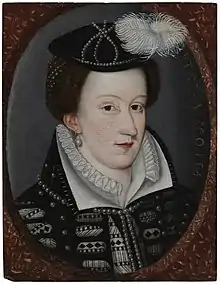
Having lost his third wife and despite having presided at the York commission, Norfolk planned marriage to Mary, Queen of Scots, who had been a prisoner in England since she fled Scotland in May 1568, after being defeated at the Battle of Langside and abdicating. For both parties, it was to be their fourth marriage; Howard had been widowed three times, whilst Mary had been widowed twice and her third husband, James Hepburn, 4th Earl of Bothwell, had escaped but ended up as a prisoner in Denmark. Both Howard and Mary were descended from the House of Plantagenet. Furthermore, the former Scottish monarch had a strong claim to the English crown, being a descendant of Henry VII, the first monarch of the reigning Tudor dynasty, through her paternal grandmother Margaret Tudor, and was considered by many Catholics to be the rightful queen of England due to Elizabeth's Protestantism. Supporters of Mary's claim to the throne thereby hoped to bring about the restoration of Catholicism. This represented a serious threat to Elizabeth. Both the Scottish statesman William Maitland of Lethington and the Bishop of Ross, John Lesley, Mary's chief adviser and agent, were in favour of the Duke's marriage to the former Scottish queen, and Mary herself consented to it, although Howard was initially reluctant to bring about political and religious change. During recesses from the Conference in York, Maitland met privately with Norfolk, suggesting to the Duke the possibility of marrying Mary, as well as a possible future marriage between Howard's daughter, Margaret and King James VI of Scotland, Mary's only son. [9] Norfolk saw in this proposal not only the means to solve the succession crisis which had plagued England ever since Elizabeth’s accession, given her reluctance to marry and produce an heir, but also an opportunity for his own social aggrandisement. Furthermore, Mary's marriage to the leading English nobleman would help the former Scottish monarch to strengthen her claim to the throne.
Politically, too, it would give him an advantage at court, as he was by now a rival of Elizabeth’s favourite, Dudley, and an enemy of Burghley. The marriage scheme with Mary was supported by most of the Catholic nobility, and some assumed that the Duke was willing to lead a revolt against Elizabeth.[10] In November 1569 the Rising of the North broke out, organised in part by Charles Neville, 6th Earl of Westmorland, Thomas' brother-in-law. Howard briefly supported the rebellion, hoping that if he succeeded, he would secure the release of Mary, who was then being held captive in Tutbury Castle. It is still debated whether the rebellion actually aimed to overthrow Elizabeth, and whether Mary even knew about it beforehand. After initial successes, Westmorland and the co-leader of the revolt, Thomas Percy, 7th Earl of Northumberland, were forced to escape to Scotland when Elizabeth sent forces north under Thomas Radclyffe, 3rd Earl of Sussex, to quell the rebellion. Norfolk tried to stop the revolt when he saw that it was going to fail, but Elizabeth ordered his arrest after receiving news that the rising had taken place.
Norfolk was a prisoner in the Tower until August 1570 when he was released for lack of evidence, and also for having confessed his intentions and begged the Queen for mercy. Thomas' intention to marry Mary, although objectionable to Elizabeth, was not a sufficient reason to charge him with treason, and also at that time there was insufficient evidence against Howard, as he was not directly involved in the revolt in the north.[7] Shortly after Howard was released, Roberto Ridolfi, an Italian merchant and banker who lived in London at the time, contacted the Duke to negotiate his participation in the eponymous plot to free Mary, put her on the English throne and thus restore Catholicism in England. Ridolfi, who was also an agent of the Holy See, relied on the Bull Regnans In Excelsis issued by Pope Pius V in February of that year, which excommunicated Elizabeth and urged Catholics to do all they could to depose her, as the reason for setting up the plot, which Spanish intelligence was also involved with. Howard had already come into contact with Philip II of Spain regarding a proposed invasion of England with troops commanded by the Fernando Alvarez de Toledo y Pimentel, 3rd Duke of Alba, based in the Netherlands. During the negotiations, Norfolk gave Ridolfi verbal assurances that he was a Catholic, despite the fact that he had been educated as a Protestant. After some hesitation, Howard placed himself at the head of the conspirators; and in return for his services he asked the Spanish King “to approve of my own marriage with the Queen of Scots.“. [11] Elizabeth's intelligence network soon learned of the existence of the plot, which quickly failed; Norfolk’s treachery was revealed to Cecil, and in September 1571 he was again arrested. Initially he denied involvement in the Ridolfi plot, but later admitted it.
The evidence to prosecute Norfolk was now much stronger than in 1569-70, as it was clear that he had been involved in a conspiracy to overthrow and assassinate Elizabeth. At his trial on 16 January 1572, which lasted twelve hours, Norfolk pleaded his innocence. However, the jury unanimously found him guilty of treason, and he was sentenced to death.
Having been condemned by a jury of his peers, it was reasonable to suppose that his execution would quickly follow. Indeed, it was rumoured that he was to be executed on the last day of January, whereupon crowds flocked to the Tower. Elizabeth, torn between the demands of justice on the one hand and Norfolk’s ‘nearness of blood [and] … his superiority of honour’ on the other, did not sign the warrant until 9 February, and on the next day she countermanded her instructions. She did the same thing a fortnight later, to the dismay of Cecil (now enobled as Lord Burghley) and the Privy Council. They insisted that Parliament be assembled to debate the urgent threat posed by Norfolk and Mary, although parliaments normally met only once every three or four years and the previous parliament had been dissolved only ten months earlier.
The new parliament, the fourth of Elizabeth’s reign, assembled on 8 May 1572. Over the course of the next three weeks, Burghley and the Council used their spokesmen in the Commons to press the case for executing Norfolk. In late May, two members went so far as to observe that by failing to execute the Duke, the queen was demonstrating that she believed the guilty verdict to be incorrect, which ‘dishonoureth the nobles that have condemned him’. Initially Elizabeth refused to relent. Indeed, as late as 21 May Leicester remarked that he could ‘see no likelihood’ that Norfolk would be executed. However, Elizabeth's opinion suddenly changed when she came up against strong parliamentary pressure calling for the executions of both Norfolk and Mary. As Stephen Alford has observed, Norfolk’s execution ‘was the political price Elizabeth had to pay to save the Scottish Queen’. Even so, the Queen was determined that the decision to execute the Duke should be seen to be hers rather than Parliament's. On Saturday 31 May the Crown's spokesmen in the Commons persuaded the lower house, with great difficulty, to postpone petitioning the Queen to execute the Duke until the following Monday (2 June), ‘in hope to hear news before that time’. That hint was well taken, as Norfolk finally went to the block less than one hour before the Commons reassembled.
At sunrise on June 2, 1572, Norfolk was led to a specially erected scaffold on Tower Hill, accompanied by his former tutor Foxe and by Alexander Nowell, Dean of St Paul’s. He addressed the crowd which had assembled to witness the execution. Despite admitting that he deserved to die, he declared himself to be partly innocent, whereupon he was interrupted by an official, who warned him that he should not try to clear himself, having been ‘tried as honourably as any nobleman hath ever been in this land’. Urged to wind up quickly, as ‘the hour is passed’, Norfolk ended his speech by denying that he was a Catholic, as was commonly believed. After bidding a tearful farewell to Foxe and Nowell, and forgiving the executioner, the Duke removed his doublet and laid his head on the block. Before a silent crowd, which had been urged not to shout out to avoid ‘frighting’ his soul, Norfolk’s head was severed with a single stroke.
Norfolk was the first nobleman to be executed during Elizabeth's reign, being the first since Henry Grey, Duke of Suffolk, father of Lady Jane Grey was executed early in Mary I's reign. Equally striking was that he was the premier nobleman of England, the Queen’s second cousin and a leading member of the Privy Council. Until recently, he had also been much admired by Elizabeth and Burghley. Indeed, in 1565 Cecil had described Norfolk as ‘wise, just, modest, careful’ and, despite his youth – he was then aged 29 – ‘a father and stay to this country’. In the immediate aftermath of his execution, Elizabeth was reportedly ‘somewhat sad’ at the Duke’s death. [12] Norfolk was buried in Chapel of St. Peter ad Vincula, in the Tower of London.
Norfolk's lands and titles were forfeit, although much of the estate was later restored to his sons. The dukedom was restored, four generations later, to his great-great-grandson Thomas Howard.
Marriages and issue
First wife

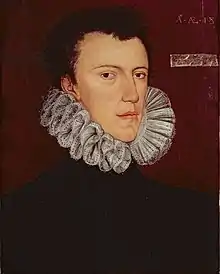
In March 1555, the nineteen-year-old Duke married his first wife, Mary FitzAlan, who was fourteen or fifteen old at the time. Mary was the daughter of Henry FitzAlan, 12th Earl of Arundel by his first wife, Lady Katherine Grey. The marriage was arranged by the 3rd Duke in 1553-1554, with the aim of uniting the two most prominent Catholic families in England.[4] Because the 4th Duke was still a minor and a ward of Queen Mary, Howard needed royal permission to marry Mary FitzAlan. Mary and her sister Jane became co-heirs to the Earldom of Arundel in 1556 after the death of their only brother. Howard's marriage to Mary brought as dowry many of the extensive properties Mary's father owned in Sussex, including Arundel Castle. Those FitzAlan properties were merged with Howard's properties in Norfolk. Mary died in August 1557, shortly after giving birth to her only son, who was to become the heir to the Arundel earldom and all of the FitzAlan family estates:
- Philip Howard, 13th Earl of Arundel (28 June 1557 – 19 October 1595), who on his maternal grandfather's death in 1580, became 13th Earl of Arundel. For remaining loyal to Catholicism, he was imprisoned in the Tower of London in April 1585, remaining there until his death from natural causes in October 1595. Shortly after his death he was declared a Catholic martyr, and he was canonised in 1970 as one of the so-called Forty Martyrs of England and Wales. His tomb and shrine are in Arundel Cathedral.
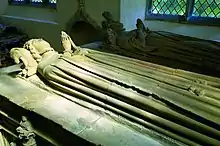
It is from this marriage that Howard's descendants, the modern dukes of Norfolk, derive their surname of 'FitzAlan-Howard' and their seat in Arundel. Although Lady Mary FitzAlan's funeral effigy is in St Michael the Archangel's Church in Framlingham, she was not buried there, but in St. Clement Danes Church, Temple Bar, London. Decades later, based on the provisions of the will of her grandson Thomas Howard, 14th Earl of Arundel, her remains were transferred to the Fitzalan Chapel in Arundel.
Second wife
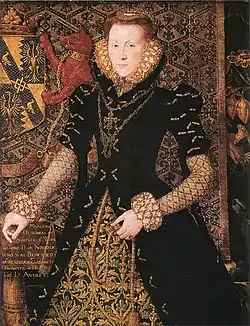
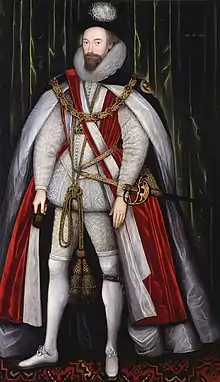
In early 1558, Norfolk was betrothed to Margaret Audley,[13] widow of Sir Henry Dudley and daughter of Thomas Audley, 1st Baron Audley of Walden and his second wife Elizabeth Grey. Thus Margaret was a first cousin of Mary FitzAlan. In order for the marriage to Margaret Audley to take place under Catholic canon law, a dispensation had to be requested from Pope Paul IV, due to the close relationship between Thomas' first wife and Audley. Howard sent lawyers to Rome to negotiate for the dispensation, but the Holy See was notorious for its delays and costs where dispensations were concerned. These delays, added to the fact that in November of the same year Queen Mary died and was succeeded by Queen Elizabeth, who began to restore Protestantism, led to the marriage being celebrated without the dispensation. It was ratified by Parliament in March 1559. [14]
Norfolk's children by his marriage to Margaret were:
- Lady Elizabeth Howard (1560-?), who died in early childhood.
- Thomas Howard, 1st Earl of Suffolk (1561-1626), who firstly married his step-sister, Mary Dacre, without issue. He married secondly Katherine Knyvet c. 1583 and had issue.
- Lady Margaret Howard (1562-1591), who married Robert Sackville, 2nd Earl of Dorset and had issue.
- Lord William Howard of Naworth Castle and Henderskelfe Castle (now the site of Castle Howard) (1563-1640), who married his step-sister Elizabeth Dacre and had issue.
Margaret died in January 1564, being buried in the first instance in St. John the Baptist's Church in Norwich, although shortly afterwards her remains were moved to the Church of St Michael the Archangel in Framlingham, Suffolk, the grave being decorated with her heraldic quarterings and her funerary effigy, which is displayed with the peerage robes. [15]
Third wife
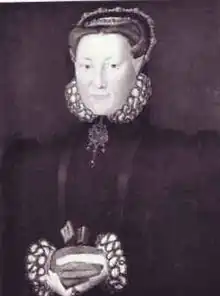
Shortly after Margaret's death, Norfolk married Elizabeth Leyburne (1536 – 4 September 1567), widow of Thomas Dacre, 4th Baron Dacre of Gillesland and daughter of Sir James Leyburn. They had no children.
Norfolk's three sons by his first two wives, Philip, Thomas and William, married, respectively, Anne, Margaret, and Elizabeth Dacre. The Dacre sisters were the daughters of Elizabeth Leyburne by her marriage to Thomas Dacre and were therefore stepsisters to Norfolk's sons.
Elizabeth died in September 1567, shortly after giving birth to a baby, whose sex is not known and who also died. She was buried at St. Mary's Church, Kenninghall.
Depictions
- Thomas Howard appears as a character in the Philippa Gregory novels The Virgin's Lover and The Other Queen, and in the novel I, Elizabeth by Rosalind Miles.
- A highly fictionalised version of the Duke, played by Christopher Eccleston, is in the 1998 film Elizabeth.
- Another version of the Duke is in the BBC mini-series The Virgin Queen, played by Kevin McKidd.
- In the Channel 4 documentary Elizabeth (2000) presented by David Starkey, the Duke is portrayed by actor John Gully.
References
- The Heraldic Charge Against the Earl of Surrey, Peter R. Moore, English Historical Review, Volume CXVI, pages 557 to 583, (2001).
- "Earl of Surrey Henry Howard", A Dictionary of British History, (John Cannon, ed.), OUP, 2009 ISBN 9780199550371
- name="EB1911">Chisholm, Hugh, ed. (1911). . Encyclopædia Britannica. Vol. 19 (11th ed.). Cambridge University Press. p. 744.
- Graves 2008.
- "Thomas Howard 4th Duke of Norfolk" https://spartacus-educational.com/Thomas_Howard.htm
- Calendar of State Papers Scotland, vol. 1 (1898), 323, 440.
- Chisholm, Hugh, ed. (1911). . Encyclopædia Britannica. Vol. 19 (11th ed.). Cambridge University Press. p. 744.
- HMC: Manuscripts of the Earl of Salisbury at Hatfield, vol.1 (1883), p. 461.
- "Thomas Howard, 4th Duke of Norfolk".
- "The execution of Thomas Howard, 4th duke of Norfolk" https://thehistoryofparliament.wordpress.com/2022/04/28/the-execution-of-thomas-howard-4th-duke-of-norfolk/
- name="EB1911">Chisholm, Hugh, ed. (1911). . Encyclopædia Britannica. Vol. 19 (11th ed.). Cambridge University Press. p. 744.
- "The execution of Thomas Howard, 4th duke of Norfolk" https://thehistoryofparliament.wordpress.com/2022/04/28/the-execution-of-thomas-howard-4th-duke-of-norfolk/
- "Margaret Howard", National Portrait Gallery
- "Journal of the House of Lords: March 1559 Pages 21-26 The Journals of All the Parliaments During the Reign of Queen Elizabeth". British History Online. Retrieved 8 October 2021.
- "Churchmouse: Framlingham, Suffolk. Church of St. Michael the Archangel". Homepage.ntlworld.com. 2 May 2000. Archived from the original on 9 March 2012. Retrieved 7 September 2012.
Further reading
- Edwards, Francis (1968). The marvellous chance: Thomas Howard, Fourth Duke of Norfolk, and the Ridolphi plot, 1570-1572. ISBN 0-246-64474-5.
- Burghley, William Cecil Baron; Haynes, Samuel; Murdin, William (1759). "Murdin, William : Collection of State Papers, 1571-1596". London. papers from Norfolk's treason trial 1568–1572.
- Williams, Neville (1965). Thomas Howard, Fourth duke of Norfolk. ASIN B0007DRE5Y.
- William Cooke Taylor, ed. (2005). Thomas Howard: Fourth Duke of Norfolk. The Benedictine Brethren of Glendalough. ISBN 1-4254-6159-X.
- . Dictionary of National Biography. London: Smith, Elder & Co. 1885–1900.