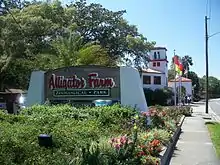
St. Augustine Alligator Farm Zoological Park
The St. Augustine Alligator Farm Zoological Park is one of Florida's oldest continuously running attractions, having opened on May 20, 1893.[3] It has 24 species of crocodilians, and also a variety of other reptiles, mammals and birds, as well as exhibits, animal performances and educational demonstrations.
| St. Augustine Alligator Farm Zoological Park | |
|---|---|
 | |
| Date opened | May 20, 1893 |
| Location | St. Augustine, Florida, United States |
| Land area | more than 7 acres (28,000 m2) |
| Memberships | AZA[1] |
| Website | www |
St. Augustine Alligator Farm Historic District | |
   | |
| Location | St. Johns County, Florida |
| Coordinates | 29°52′53″N 81°17′18″W |
| Built | 1937 |
| NRHP reference No. | 92001232[2] |
| Added to NRHP | September 10, 1992 |
History
The park began in 1893 on St. Augustine Beach as a minor attraction at the end of a railway running through neighboring Anastasia Island. The alligators were added at first to get visitors to buy souvenirs and see the museum there. Soon, the reptiles themselves became the main point of interest.
Growing in popularity, the park moved to its current location in the early 1920s. The park changed owners in the 1930s, and, after a devastating fire, they started reconstruction and expansion of the facilities. In 1993, for their 100-year anniversary, the park became the first place in the world to display every species of crocodilian.

In 2008, the zoo opened a new Komodo dragon facility that also exhibits lizards and snakes found within Southeast Asia.
National historic status
On September 10, 1992, the Alligator Farm was designated a U.S. Historic District. As such, it was referred to as the St. Augustine Alligator Farm Historic District. According to the National Register of Historic Places, it covers less than 1 acre (4,000 m2), and contains one building and one structure.[2]
Collection
As of 2012, this was the only place where one can see every species of alligator, crocodile, caiman and gharial. Over the years, the zoo has expanded to include mammals, birds, and other reptiles.[4]
The farm is home to Chance the Snapper.
Crocodilians
- American alligator
- American crocodile
- Black caiman
- Broad-snouted caiman
- Chinese alligator
- Cuban crocodile
- Cuvier's dwarf caiman
- Dwarf crocodile
- False gharial
- Freshwater crocodile
- Gharial
- Morelet's crocodile
- Mugger crocodile
- New Guinea crocodile
- Nile crocodile
- Orinoco crocodile
- Philippine crocodile
- Saltwater crocodile
- Siamese crocodile
- Smooth-fronted caiman
- Spectacled caiman
- West African crocodile
- West African slender-snouted crocodile
- Yacare caiman
Other reptiles
- Alligator snapping turtle
- Arrau turtle
- Black-headed python
- Carpet python
- Corn snake
- D'Albertis python
- Diamondback terrapin
- Dusky pygmy rattlesnake
- Eastern diamondback rattlesnake
- Eastern hognose snake
- Florida cottonmouth
- Galapagos tortoise
- Green tree python
- King cobra
- Komodo dragon
- Lace monitor
- Malayan box turtle
- Malaysian giant turtle
- Murray River turtle
- New Caledonian giant gecko
- Pope's pit viper
- Red-tailed green ratsnake
- Reticulated python
- Timor python
- Woma python
- Yellow-footed tortoise
- Yellow-spotted river turtle
Birds
- Black crowned crane
- Blue-billed curassow
- Bornean crested fireback
- Cabot's tragopan
- Cape vulture
- Curl-crested aracari
- Edwards's pheasant
- Golden conure
- Green-winged macaw
- Hooded vulture
- Hyacinth macaw
- Knobbed hornbill
- Marabou stork
- Northern pintail
- Palm cockatoo
- Pesquet's parrot
- Plush-crested jay
- Red-crested turaco
- Ruddy duck
- Scarlet macaw
- Southern cassowary
- Sunbittern
- Toco toucan
- White cockatoo
- White-cheeked pintail
- White-crested hornbill
- Yellow-headed amazon
Rookery
The back section of the park contains a large bird rookery, where free-roaming local bird species such as egrets, herons, wood storks and roseate spoonbills nest and rear their young.
Affiliations
The park is a member of the Association of Zoos and Aquariums (AZA)[1] and the Florida Attraction Association.[5]
See also
Notes
- "Currently Accredited Zoos and Aquariums". aza.org. AZA. Retrieved 19 March 2011.
- "National Register of Historical Places - Florida (FL), St. Johns County". National Register of Historic Places. National Park Service. 2007-03-15.
- Virtual Views at OldCity.com
- "FULL SPECIES LIST - St. Augustine Alligator Farm Zoological Park".
- "Florida Attractions Association". floridaattractions.org. Florida Attractions Association. Retrieved 22 February 2010.
External links