Portal:Zambia

The Zambia Portal
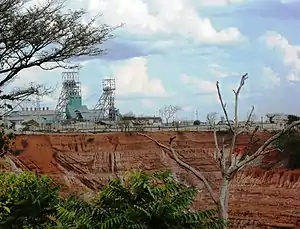
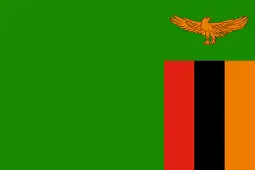
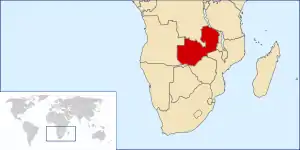
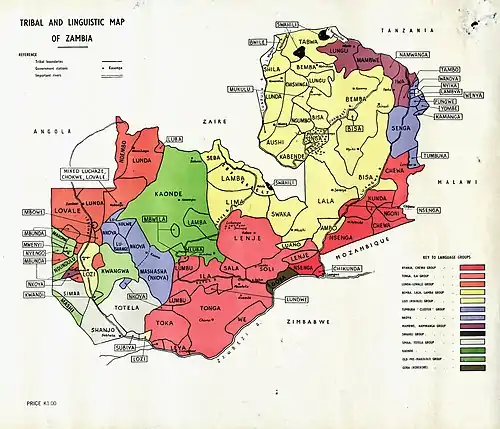
Zambia (/ˈzæmbiə, ˈzɑːm-/), officially the Republic of Zambia, is a landlocked country at the crossroads of Central, Southern and East Africa, and is typically referred to as being in South-Central Africa. Its neighbours are the Democratic Republic of the Congo to the north, Tanzania to the northeast, Malawi to the east, Mozambique to the southeast, Zimbabwe and Botswana to the south, Namibia to the southwest, and Angola to the west. The capital city is Lusaka, located in the south-central part. The population of around 20.1 million (2023) is concentrated mainly around Lusaka in the south and the Copperbelt Province to the north, the core economic hubs of the country. The region was affected by the Bantu expansion of the 13th century. Following the arrival of European explorers in the 18th century, the British colonised the region into the British protectorates of Barotseland-North-Western Rhodesia and North-Eastern Rhodesia comprising 73 tribes, towards the end of the 19th century. These were merged in 1911 to form Northern Rhodesia. For most of the colonial period, Zambia was governed by an administration appointed from London with the advice of the British South Africa Company. On 24 October 1964, Zambia became independent of the United Kingdom and prime minister Kenneth Kaunda became the inaugural president. From 1972 to 1991 Zambia was a one-party state with the United National Independence Party as the sole legal political party under the motto "One Zambia, One Nation" coined by Kaunda. Kaunda was succeeded by Frederick Chiluba of the social-democratic Movement for Multi-Party Democracy in 1991, beginning a period of government decentralisation. Zambia contains minerals, wildlife, forestry, freshwater and arable land. In 2010, the World Bank named Zambia one of the world's fastest economically reformed countries. (Full article...) Selected article -
Lesbian, gay, bisexual, and transgender (LGBT) persons in Zambia face legal challenges not faced by non-LGBT citizens. Same-sex sexual activity is illegal for both males and females in Zambia. Formerly a colony of the British Empire, Zambia inherited the laws and legal system of its colonial occupiers upon independence in 1964. Laws concerning homosexuality have largely remained unchanged since then, and homosexuality is covered by sodomy laws that also proscribe bestiality. Social attitudes toward LGBT people are mostly negative and coloured by perceptions that homosexuality is immoral and a form of insanity. LGBT persons are subjected to human rights violations by police and authorities. Subject to arbitrary arrest and detentions, they suffer violence and abuse in custody. Police are reported to threaten and extort LGBT persons. Those prosecuted for same-sex conduct are subjected to the use of forced anal examinations for evidence-gathering purposes. Such procedures are invasive and traumatic and are widely condemned by medical authorities and human rights groups; they are discredited for the purpose of providing any evidence of same-sex sexual activity. (Full article...)General images -The following are images from various Zambia-related articles on Wikipedia.
| ||||||
.svg.png.webp)
.svg.png.webp)
.png.webp)
%252C_%25_of_world_average%252C_1960-2012%253B_Zimbabwe%252C_South_Africa%252C_Botswana%252C_Zambia%252C_Mozambique.png.webp)
.svg.png.webp)
_Luba_peoples_The_Metropolitan_Museum_of_Art.png.webp)