Nude swimming classes in the United States
For almost a century in the United States, men and boys swam nude in indoor swimming pools, generally for education or athletics, not recreation. Male nude swimming had been customary in natural bodies of water since the 18th century. The tradition of skinny-dipping in secluded spots had become more visible with urbanization, and pools were a means of separating swimmers from public view.[1] For the first decades of the 20th century, male nude swimming was associated with a trope of the "old swimming hole" as representing childhood innocence and adult masculinity. In their own classes, nudity was rare for girls based upon an assumption of modesty, but might include young children. Pre-pubescent boys might be nude in mixed-gender settings, including the presence of female staff during class,[2] public competitions,[3] and open houses for families.[4]
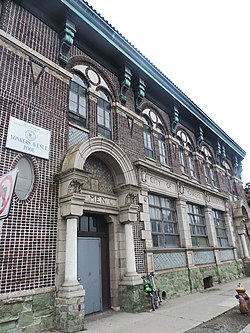

At the beginning of the 20th century, the primary reason given for nudity by officials was for public health, swimming pools being prone to contamination by water-borne diseases. During the early developmental stages of filtration and chlorination, behavioral measures were also needed to keep the water clean. Because indoor pools were generally male only, the health of swimmers could be monitored most easily by forbidding swimsuits, which often were a source of contamination, while female swimmers wore suits that were more hygienic. As the century continued, more indoor pools were built by local governments and schools, primarily in northern states, to provide year-round swimming as a sport. As with other physical education activities, swimming was gender-segregated.
Recreational swimming had been an activity for the warm months in outdoor pools or open water. In the 1960s, indoor pools also started to become recreational with mixed-sex usage, which ended nude swimming at individual pools. After the passage of Title IX in 1972, requiring gender equality in physical education, most schools found coed use of swimming pools to be the easiest means of compliance. A generation later, nude swimming in public pools as a widespread practice was forgotten, and in the 21st century sometimes denied having existed.
Origins of swimming pools

"Swimming baths" and pools were built beginning in the late 19th century in poorer neighborhoods of eastern cities to exert some control over a public swimming culture that offended Victorian sensibilities by including not only nakedness, but roughhousing and swearing. Such behavior had begun in the 18th century, but laws prohibiting public indecency had little effect. Naked swimmers from Milwaukee, Wisconsin to New York City sometimes flaunted themselves intentionally in view of more upper class passers-by.[1]: 9–10 Beginning in 1870, the first public pools in New York City were outdoor "floating baths" of wood surrounded by docks that allowed river water to flow through them. In addition to health and hygiene, they were intended to prevent drowning in the open river, which was a frequent occurrence. As the quality of urban river water declined, floating baths became a source of infection. Building indoor pools, and the addition of pools to bathhouses, was done to address this problem.[5] Since few swimmers in these neighborhoods could afford swimsuits or wanted to wear them, nudity among males was taken for granted.
Racial segregation
The first black YMCA with a pool was the Twelfth Street YMCA in Washington, DC. Swimming nude was required, but did not appeal to all.[6]: 11 Public schools and recreation facilities were often segregated in the United States, de jure until the passage of the Civil Rights Act of 1964, or de facto due to residential patterns. Prior to the 1960s, the YMCA built separate facilities in black and white neighborhoods.[7][8]: 580 In spite of the Civil Rights Act, a summer camp in Montgomery, Alabama hosted by the YMCA refused entry to two black children in 1969, resulting in a landmark desegregation decision which included the YMCA as a public accommodation.[9] Across the south, municipalities chose to close recreational facilities rather than integrate them.[10]
Public health recommendations
As early as 1918, pool operators and professionals addressed the problem of maintaining the quality of water due to the prevalence of waterborne diseases, including typhoid, dysentery and pneumonia, as well as infections of the eye and ear. Initially civil engineers recommended nudity for all swimmers, male and female, where such rules could be enforced. While this was generally accepted for men, it was true for only a some pools when used by women. Fibers from suits clogging pool filters were also given as a reason for nudity.[11] In 1926, the American Public Health Association (APHA) standards handbook recommended that indoor swimming pools used by men adopt nude bathing policies and that indoor swimming pools used by women require swimsuits "of the simplest type".[12] From 1926 until 1962, every edition of the guidelines recommended nude swimming for males.[13] Given the limits of chlorination and filtration at that time, behavioral measures were also used to maintain water quality. In addition to recommending nudity, all bathers were required to empty their bladder and shower nude before entering the pool. Those suffering from skin or respiratory disease were prohibited from using the pool.[14] The close monitoring of swimmers was based upon their being from the working class, having generally poor hygiene and often living in tenements with no bath facilities. Officially, YMCAs and municipal pools were built in working-class neighborhoods to provide such facilities.[1]
Public pools
Young Men's Christian Association
The first YMCA indoor pool in the United States was built in 1885, in Brooklyn, New York.[8]: 154 YMCAs with pools had male nude swimming until they became mixed-gender in the 1960s and 70s. In prior years pool use as either male only or scheduled for gender segregation. At the YMCA in the South End of Chicago in 1944, a summer program for boys and girls had classes for 500 students in half-hour sessions separated by gender and age. Fridays were family night for adults to see the student's accomplishments.[15]: 6 Male only use continued as in Tucson, Arizona where the pool was used to teach boys age 9 through junior high who did not already know how to swim.[16]: 25 During the transition to gender equality, attempts were made to retain male nudity by limiting access to the pool by women to certain hours, but since they had full membership, this plan was deemed discriminatory.[17]
Boy's clubs
A 1940 article in LIFE magazine describes the pool in the Olneyville Boy's Club as providing an alternative to juvenile delinquency in a declining mill neighborhood. Photos show the naked boys crowded into the "dingy little 60 ft. swimming pool" as they had for fifteen years.[18] In 1941 the Olneyville Club won two of the five final events at a national Boys Club of America swimming championship.[19]
Parks and recreation departments
In the summer of 1944, the Chicago Parks offered a summer swimming program for children, boys on Monday and Tuesday and Wednesday, girls on Thursday and Friday. In indoor pools, girls were required to bring a suit, but boys swam without.[20]: 6
In 1966 and 1967, the Manitowoc, Wisconsin Recreation Department held evening swimming utilizing school pools; families on Tuesday, women on Wednesdays, men on Thursdays with suits being optional. Children's sessions were on Saturday, with separate sessions by age and sex. Only girls were required to bring a suit.[21]: 12 [22]: 29
Public schools
The 1909 elementary school swimming championship for New York City included nearly forty schools in Manhattan, the Bronx, and Brooklyn; and was held at what was then called the Interior Public Batha, the first municipal indoor swimming pool built in New York City.
The athletic prowess of the very small boys in the eighty-pound championship was of less moment to the spectators than the enthusiasm of the youngsters, who discovered in their trial heats that their swimming trunks impeded them, and that they could swim faster nude. Thereafter the rule about trunks went into the discard, and very small boys in a state of nature swam like tadpoles through the many heats necessary for a decision.
— New York Times[3]
In the 1920s, schools began building indoor swimming pools for purposes of physical fitness and swimming instruction.[23] In 1900, there were only 67 public pools in the United States; by 1929 there were more than 5,000.
In 1935 the school superintendent in Pontiac, Michigan approved nude swim classes for boys in high school, saying it recalled "the days of the old swimming hole".[24] In 1940 a New York City school official continued to favor boys wearing bathing suits only in pools visible to both sexes. Girls were issued cotton suits that could be boiled to disinfect them between uses; the wool suits used by boys could not because they would shrink and lose their shape. It was also noted that wool suits owned by swimmers that had previously been used in salt water could not be washed effectively because salt prevents soap from lathering.[25] In addition, fibers from wool swimsuits could clog pool filters.[23] Swim classes were advocated not only for exercise, but as a recreational activity that, once learned, could become a lifelong pursuit. The swim classes were also looked upon as an opportunity to teach children proper hygiene.[25]
In a survey of Indiana high schools in 1939, all boys swim classes were nude, while girls wore suits, 87% being cotton suits issued by the school.[26] Students bringing their own suits was discouraged, the institutions not having control of decontamination.[27] A 1947 survey of schools in northern Utah found more local variation. Only three of the six schools had pools. One allowed swimmers to wear their own suits, one supplied cotton suits. At the one that required nudity, the athletic director cited the problem of lint from suits clogging the pool filter.[28]: 28–29 In 1963, as it had for 33 years, the city of Troy, New York continued its mandetory citywide program of swim classes for all students in grades 4-8 and 9-12; boys swimming nude. A letter to parents emphasized the importance of learning at least the basics of swimming for survival in an emergency.[29] The October 16, 1950 Life magazine published a photograph of boys swimming together in the indoor pool of New Trier High School in Winnetka, Illinois; the caption did not mention they were naked.[30]
Girls classes
One book on public health did agree that nudity would be the most sanitary option for girls as well as boys, and that this was practiced at some schools, but never universally as with boys.[31] In 1947 the 150 girls age 9 to 13 at the Liberty School in Highland Park, Michigan were directed to wear swimsuits by the Superintendent of Schools in response to a group of mothers protesting to the board of education. Nude swimming for girls had been optional for six weeks prior to the order. Nude swim classes continued for the 200 elementary school girls from two other schools. Boys in the schools had not worn suits in their separate classes for years, and girls requested to do the same in order to give them more time in the pool rather than changing. While following the wishes of parents who believed girls should behave modestly, all the board members disagreed, stating that there was "no moral issue involved".[32][33]
Colleges and universities
In 1920, a review of swimming pools found similar concerns for hygiene at the collegiate level. "In men's pools, where bathing suits are not ordinarily worn," inspection of swimmers was done by attendants to see that a thorough preliminary shower was taken.[34]
'Learn to swim' programs
High school,[35] college,[36] and YMCA[37] pools in the Midwestern United States were used to teach younger children to swim during weekends and summer programs, announcements noting that boys would not wear suits in indoor pools. The Sheboygan, Wisconsin Department of Public Recreation held "Learn to Swim" classes for children ages 9 to 14 at the Central High School pool. The classes were held on Saturday morning during the school year, Monday through Friday mornings in summer. Through the 1950s until 1960, the Sheboygan Press published the schedules of the separate classes for boys and girls, noting that girls would be issued suits, but boys would be nude.[38][39][40][2][41] A longer article in 1954 included details on the conduct of classes. There were an equal number of boys and girls, 404 in total, age 10 to 14 and divided into 14 half-hour classes each day. There were four teachers, three men and one woman, plus two female locker room attendants. "Boys swim unhampered by suits and bring only a towel as their contribution each afternoon. Girls bring their own bathing caps and are supplied with suits, for the morning workout". All swimmers were required to take a soap shower nude before entering the pool. The final class was designated visitor's day, with no mention of boys not being nude with families present.[4] After 1960, all students were required to bring their own suits because mixed-sex recreational sessions had been added to the schedule.[42][43]
Questioning and decline of nudity
New developments in pool chlorination, filtration, and nylon swimsuits led the APHA to abandon its recommendation of nude swimming for males in 1962.[23] However, the custom did not immediately cease.
In 1961, parents and students in Menasha, Wisconsin asked the school board to give boys permission to wear swim trunks. The board voted down a petition signed by 371 parents on the grounds that buying swim trunks would be expensive and that nude swimming built men's character; one board member asserted that "this experience is a good one for later life, for example the armed services, where the disregard for privacy is real and serious". Another board member noted that swimmers had no privacy in the gang showers required for the classes. A letter from the Department of Public Education stated that nudity for boys was practiced throughout the state to promote sanitation and to save time. A survey of other schools found suits were worn only at schools where the pool was not completely separate from other areas.[44]
In Janesville, Wisconsin nude swimming became an issue at Marshall Junior High in 1967 in part because boys at nearby Franklin Junior High wore suits because their pool had outside windows. The boys at Franklin were issued nylon suits, as were the girls at both schools. One coach noted that boys being from different backgrounds and being at different stages of maturity, some found nudity embarrassing, while others took it for granted. Parents, physicians, and clergy voiced various positions pro and con. The deciding factor was again the cost of purchasing suits for all boys.[45]
In a 1973 Duluth, Minnesota school board meeting, a discussion of "skinny-dipping" in the boys junior high school swim classes following complaints from parents who cited modesty according to the supervisor of physical education. A school board member called this false modesty in a gym class where students must shower nude. For the board, the issue was the $12,000 needed to buy suits for 2500 students in the district.[46][47]
During the 1970s, the adoption of mixed-gender swimming led to the gradual abandonment of nude male swimming in schools. Federal Title IX rules mandating gender equality in physical education led most schools to switch to co-educational classes, ending nude swimming in public schools by the 1980s. In the 21st century, the practice has been forgotten, denied having existed, or viewed as an example of questionable behaviors in the past that are no longer acceptable.[23][48] However, Jungian psychoanalyst Barry Miller views the sexualization of nudity in male only situations such as locker rooms and swimming pools as a loss.[49]
Notes
- a.^ Located at 232 West 60th Street, Manhattan, Interior Public Bath had been built in 1906.[50] In 2013 the West 60th Street bath building reopened after extensive renovations as the Gertrude Ederle Recreation Center.
References
- Wiltse, Jeffrey (2003). Contested Waters: A History of Swimming Pools in America. University of North Carolina Press. ISBN 978-0-8078-8898-8. Retrieved November 2, 2022.
- "Swimming Pool to Be Available This Summer". Sheboygan Press. 1957-06-19. p. 3. Retrieved 2022-10-11.
- "Young Swimmers in Championships". New York Times. 18 April 1909. p. 30. Retrieved 2015-11-17 – via Newspaper Archive.
- Mrs. Richard J. Jarvis (June 22, 1954). "Know Your Schools: Recreation Department Conducts Eleven-Day Swimming Instruction Course At Central H. S. Pool". The Sheboygan Press. p. 10.
- Adiv, Naomi (2015). "Paidia meets Ludus: New York City Municipal Pools and the Infrastructure of Play". Social Science History. 39 (3): 431–452. doi:10.1017/ssh.2015.64. ISSN 0145-5532. S2CID 145107499. ProQuest 1986368839. Retrieved 2020-12-27.
- Mack, James Leonard (2008). My Life, My Country, My World. Dorrance Publishing. ISBN 978-0-8059-7881-0.
The YMCA was a good place to improve my swimming, but I never cottoned to the idea of swimming naked. - poet James Leonard Mack
- Johnson, Campbell C. (1940). "Negro Youth and the Educational Program of the Y.M.C.A." The Journal of Negro Education. 9 (3): 354–362. doi:10.2307/2292606. ISSN 0022-2984. JSTOR 2292606. Retrieved 2023-03-18.
- Hopkins, Charles Howard (1951). History of the Y.M.C.A. in North America. Association Press. Retrieved November 3, 2022.
- "Landmark YMCA Desegregation Ruling Turns 40". Southern Poverty Law Center. Retrieved 2023-03-20.
- "Smith v. Young Men's Christian Association". Southern Poverty Law Center. Retrieved 2023-03-20.
- Gage, Stephen DeM. (1918). "The Sanitary Control of Swimming Pools". Journal of the Boston Society of Civil Engineers. V (6): 229–306.
- Gage, Stephen (1926). "Swimming Pools and Other Public Bathing Places". American Journal of Public Health. 16 (12): 1186–1201. doi:10.2105/AJPH.16.12.1186. PMC 1321491. PMID 18012021.
- Andreatta, David (September 22, 2017). "Andreatta: When boys swam nude in gym class". Rochester Democrat and Chronicle. Retrieved March 22, 2020.
- Horwood, M. P.; Gould, B. S.; Shwachman, H. (1933). "Indices of the Sanitary Quality of Swimming Pool Waters". Journal - American Water Works Association. 25 (1): 124–135. doi:10.1002/j.1551-8833.1933.tb18220.x. ISSN 0003-150X. Retrieved 2022-09-13.
- "Swim Campaign in Full Swing at 111th St. "Y"". Chicago South End Reporter. June 28, 1944.
- "'Y' Swim Class to Open May 27". Tucson Daily-Citizen. May 15, 1946.
- Tate, Cassandra (14 March 2001). "YMCA of Greater Seattle - Part 3: Readjustment, 1930-1980". History Link: The Free Encyclopedia of Washington State History. Retrieved October 17, 2022.
- "Kids Swarm to Olneyville Boys Club Pool". LIFE. Time, Inc. 1940-04-15. pp. 71–73.
- "Providence Boys Excel". The New York Times. 1941-04-20. p. 128. Retrieved 2023-03-18.
- "South End Swim Natatoriums Open Here to Help Beat Summer Heat". Chicago South End Reporter. June 28, 1944.
- "Indoor Swim Program Set for All Ages". Manitowoc Herald-Times. September 30, 1966.
- "Indoor Swim Program Set at Manitowoc". Manitowoc Herald-Times. October 12, 1967.
- Eng, Monica (September 10, 2017). "Baring It All: Why Boys Swam Naked In Chicago Schools". WBEZ.com. Retrieved March 22, 2020.
- "Male nude swim at school approved 1935". The Tennessean. Nashville, Tennessee. 1935-09-15. p. 2. Retrieved 2022-09-17.
- Manheimer, Wallace A. (1940). "Reducing Health Hazards in the Swimming Pool". The Journal of Health and Physical Education. 11 (1): 25–63. doi:10.1080/23267240.1940.10623710. ISSN 2326-7240. Retrieved 2022-09-13.
- Zemlock, Don (1939). Swimming in the Public Schools of Indiana (Thesis). Indiana State Teachers College. Retrieved October 24, 2022.
- Craig, H. W. (1941). "Safety and Hygiene in the School Swimming Pool". The Journal of Health and Physical Education. 12 (4): 242–279. doi:10.1080/23267240.1941.10620207. ISSN 2326-7240. Retrieved 2022-10-29.
- Taylor, Wayne G (1947). A Survey of the Requirements in Physical Education for Boys in Region One of the Utah State Athletic Association (Thesis). Utah State University.
- Mann, Channing (1963). "Swimming Classes in Elementary Schools on a City-Wide Basis". Journal of Health, Physical Education, Recreation. 34 (5): 35–36. doi:10.1080/00221473.1963.10621677. ISSN 0022-1473. Retrieved 2022-10-29.
- LIFE. Time Inc. 16 October 1950. pp. 106–. ISSN 0024-3019.
- Williams, Jesse Feiring; Brownell, Clifford Lee (1939). The Administration of Health and Physical education (2 ed.). W.B. Saunders Company.
- "Nude Swimming in Detroit School Comes Under Ban". The News-Palledium. January 16, 1947.
- "Rules Girls Must Wear Swim Suits: School Board at Detroit Acts After Mothers Protest". Iowa City Press Citizen. Highland Park, Michigan. January 15, 1947. p. 1. Retrieved 2022-04-29.
- Hinman, Jack J. (December 1920). "The Swimming Pool". American Physical Education Review. 25 (9): 383–399. doi:10.1080/23267224.1920.10651559. ISSN 2326-7224. Retrieved 2023-03-18.
- "Pools Open". Chicago Garfieldian. 1945-06-28. p. 12. Retrieved 2022-10-12.
- "Swimming Classes - Iowa State College Pool". Ames Daily Tribune. 1939-06-13. p. 3. Retrieved 2022-10-13.
- "Learn-to-Swim Campaign at "Y" Is Free to All". Emporia Gazette. 1939-05-24. p. 3. Retrieved 2022-10-13.
- "Recreation Program Set up for Children". Sheboygan Press. November 15, 1951. p. 3. Retrieved 2022-10-11.
- "Recreation Department Has Graded Program". Sheboygan Press. 1952-11-11. p. 14. Retrieved 2022-10-11.
- "Inside Recreation Calendar Is Announced by Department". Sheboygan Press. 1953-11-11. p. 6. Retrieved 2022-10-11.
- "Recreation Centers Are Open to School Children". Sheboygan Press. 1960-01-21. p. 26. Retrieved 2022-10-11.
- "Swim Schdule Set by Recreation Department". Sheboygan Press. 1961-06-09. p. 2. Retrieved 2022-10-12.
- "'Rec" Department Accepting Learn-to-Swim Applications". Sheboygan Press. 1965-05-03. p. 11. Retrieved 2022-10-12.
- "Boys Will Continue to Swim Nude at Menasha High Pool". Appleton Post Crescent (82 ed.). Menasha, Wisconsin. 1961-11-14. p. 13. Retrieved 2022-10-17.
- Burkhard, Patricia (1967-02-02). "Nudity "a Tradition' at Marshall Pool". Janesville Daily Gazette. Janesville, Wisconsin. Retrieved 2022-10-11.
- "Nude swimming causes concern". Greeley Tribune. Associated Press. November 27, 1973. p. 16.
- "'Skinny-Dipping' in School's Swimming Pool Stirs a Fuss". Ogden Standard-Examiner. Associated Press. November 27, 1973. p. 6.
- Naked in High School: Bad Dreams Do Come True, National Public Radio, Aug 1, 2006, retrieved 2007-11-27
- Miller, Barry (2016-01-02). "On the Loss of Nudity in the Men's Locker Room". Psychological Perspectives. 59 (1): 93–108. doi:10.1080/00332925.2016.1134213. ISSN 0033-2925. S2CID 147364697. Retrieved 2022-10-20.
- Renner, Andrea (2008-12-01). "A Nation That Bathes Together: New York City's Progressive Era Public Baths". Journal of the Society of Architectural Historians. 67 (4): 504–531. doi:10.1525/jsah.2008.67.4.504. ISSN 0037-9808. Retrieved 2022-09-13.
| Nakedness and clothing | |
|---|---|
| Nudity and sexuality | |
| Issues in social nudity | |
| Naturism | |
| Nude recreation |
|
| By location | |
| Social nudity advocates | |
| Depictions of nudity | |
| See also | |

