Minnesota State Academy for the Deaf
The Minnesota State Academy for the Deaf (MSAD) is a public residential school serving deaf children in Minnesota, United States. It is one of two Minnesota State Academies in Faribault and operated by the state for particular student populations.
| Minnesota State Academy for the Deaf | |
|---|---|
| Address | |
615 Olof Hanson Drive Faribault , Rice , Minnesota 55021 United States | |
| Information | |
| Former name | Minnesota School for the Deaf |
| Type | Public |
| Established | 1858 |
| School district | 160 |
| Superintendent | Terry Wilding |
| Director | Jody Olson and Ryan Johnson |
| Faculty | 18 |
| Grades | Pre-K to 12 |
| Age range | Birth to 21 |
| Number of students | 75 |
| Language | American Sign Language and English |
| Color(s) | Maroon and Gold |
| Athletics | Football, Volleyball, Basketball, Track and Field. |
| Athletics conference | Great Plains Schools for the Deaf |
| Mascot | Trojans |
| Newspaper | Companion |
| Alumni | Daniel Durant, Olof Hanson, Cadwallader Washburn, Audree Norton, A.R. Spear, Jay Cook Howard, Maurice Potter, Dr. Wesley Lauritsen, Blanche Wilkins, James Smith, and John Lee Clark. |
| Website | https://msad.msa.state.mn.us/ |
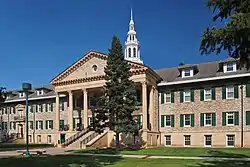
Administration Building--Girls' Dormitory, Minnesota School for the Deaf | |
 | |
| Location | 615 Olaf Hanson Drive |
|---|---|
| Nearest city | Faribault, Minnesota |
| Coordinates | 44°17′51″N 93°15′35″W |
| Built | 1912 |
| Architect | Clarence H. Johnston, Sr. |
| Architectural style | Georgian Revival |
| NRHP reference No. | 86003095 |
| Added to NRHP | November 6, 1986 |
Noyes Hall, State School for the Deaf | |
 Noyes Hall from the north | |
| Location | Off 6th Ave., NE |
|---|---|
| Nearest city | Faribault, Minnesota |
| Coordinates | 44°17′49″N 93°15′42″W |
| Built | 1902–1910 |
| Architect | Clarence H. Johnston, Sr. |
| Architectural style | Neoclassical |
| NRHP reference No. | 75001020 |
| Added to NRHP | May 12, 1975 |
History
Minnesota became a state on May 11, 1858. In that year, during the session of the first state legislature, definite action was taken looking forward the establishment of a school for the deaf children of Minnesota.
The Honorable George E. Skinner, one of Faribault's representatives in the state legislature, asked that a "deaf and dumb asylum" be located in Faribault. The legislature decided that this institution should be located in Faribault if the citizens of the town would provide 40 acres of land within two miles of town for a site.
Citizens promptly donated 40 acres a mile or so west of town for the institution. Here the matter rested for five years. No action was taken during these five years is not surprising when we recall that this was the time of the Civil War and local rebellion.
When the legislature met in January 1863, Senator Berry of Faribault introduced a bill providing for the inauguration of the proposed school for deaf and blind children.
One of the first steps was to appoint a superintendent for the school. A number of applications were received and one of the commissioners, Mr. Rodney A. Mott, went to Ohio to meet Roswell H. Kinney, one of the teachers at the Ohio School for the Deaf. Mr. Kinney was highly recommended and was named the first superintendent.
On returning to Faribault, Mr. Mott began looking for a place in which to open the school. There was no money available to put up a building on the 40 acre site. Mr. Mott did the only thing he could. He rented a building in town. The rental was $150 a year. The building was located on Front and Main and had been a store and home. This is now the corner of Central Ave and Division St.. The building was furnished and made ready for the opening of school on the second Wednesday of September, 1863.[1]
The Minnesota School for the Deaf and Dumb was established in 1863 with eight students enrolled.[2] A department for the education of the blind was added in 1866.[2] The name was changed to the Minnesota School for the Deaf in 1902.[3] In 1986, the institution's name became the Minnesota State Academy for the Deaf (MSAD).
Two buildings are listed on the National Register of Historic Places, both designed by state architect Clarence H. Johnston, Sr.: the Administration Building/Girls' Dormitory, in a Georgian Revival style, and Noyes Hall, in a Classical Revival style.[4] Frechette Hall, the boys dormitory built in 1957, was demolished in 2015 and replaced in 2018 with Wilkins Hall, named after the first African American to graduate from the school, Blanche Wilkins Williams.[5]
Student body
MSAD serves students with varying degrees of hearing loss from all regions of the state from birth to 21 years of age. Students have direct access to a challenging and rewarding education, provided in an environment rich in American Sign Language (ASL) and English. Teachers are professionally trained and licensed in Deaf and Hard of Hearing education. Families have a choice whether to have their child enrolled as a day-student and commute home daily or as a residential student and stay in one of dormitories and commute home weekly or a mix of both.[6]
Programs
MSAD offers a variety of programs and services for deaf, deafblind, and hard of hearing services. These programs include:
- Academic programs from preschool through high school
- Residential housing
- Transportation
- Speech-language therapy
- Occupational therapy
- Physical therapy
- Counseling
- Recreation
- Athletics
MSAD's academic programs are designed to meet the needs of deaf, deafblind, and hard of hearing students. The school uses a variety of teaching methods including American Sign Language (ASL), English, and Protactile. MSAD also offers a variety of extracurricular activities, such as sports, clubs, and student government.
Campus
- Location
The Minnesota State Academy for the Deaf is Deaf is located in Faribault, Minnesota. The city is about 40 miles south of Minneapolis off interstate highway 35.
- Size
The MSAD campus is nearly 100 acres in size. The campus includes a variety of buildings, including academic buildings, dormitories, a dining hall, a gym, and sports fields.
Residency
MSAD is a residential school.[7] It has two dormitories where students reside throughout the week. Students typically arrive on Sunday evenings and depart on Friday afternoons. Transportation is provided by the students' respective school districts. Parents can choose to pick up and drop off their child(ren) at the campus. Dormitories are for students who live more than 20 miles from the campus. Students who live within 20 miles of the campus are called "day students."
Athletics
MSAD offers several athletics activities in all grade levels.
Sports for boys
- Football
- National 11 man deaf football Champ in 1950 and 1977.
- Centennial Conference Champ in 1977.
- National 8 man deaf football Champ in 1992, 1997, 1998, 2003, and 2012.
- GPSD Champ in 1989, 1992, 1996, 1997, 1998, 2003, 2006, and 2012.
- Cheerleading
- Basketball
- GPSD Champ in 1999, 2005, 2006, 2007, and 2012.
- Clerc Classic Tourney - 3 wins and 3 losses
- Track and Field
Sports for girls
- Volleyball
- Centennial Conference Champ in 1984.
- Midwest/GPSD Champ in 1984, 1991, 1993, 1994, 1995, 1998, 2002, 2003 and 2004.
- Basketball
- National deaf basketball Champ in 1981, 1982, 1995, 1996 and 2005.
- District 13 Champ in 1981–1982.
- Centennial Conference Champ in 1981-1982 and 1982–1983.
- Central States School for the Deaf (CSSD) Tourney - 26 wins and 5 losses - 7 time champs in 1980, 1981, 1982, 1983, 1984, 2004 and 2005.
- Great Plains School for the Deaf (GPSD) Tourney - 43 wins and 10 losses - 17 time champs in 1992, 1993, 1994, 1995, 1996, 1997, 2003, 2004, 2005, 2006, 2007, 2008, 2009, 2010, 2011, 2012, and 2013.
- Clerc Classic Tourney - 5 wins and 1 losses - 1 time champ.
- Cheerleading
- GPSD Champ in 1996, 1999, 2010 and 2011
- GPSD Spirit Stick winners in 2008, 2010 and 2011.
- Track and Field
- GPSD Champ in 2002, 2003, 2004 and 2007.
MSAD original mascot was the Gophers. MSAD changed its mascot to Hilltoppers. In 1972, the students voted to change from Hilltoppers to Trojans because the students felt that Hilltoppers doesn't have a definite logo for its name.
MSAD belongs in the Great Plains School for the Deaf (GPSD) conference for football, volleyball, basketball, track and field, and the academic bowl competition. The Great Plains School for the Deaf conference was started in the fall of 1989 and contains Iowa School for the Deaf, Kansas School for the Deaf and Missouri School for the Deaf.
Trojans sporting events are hosted in either the Wesley Lauritsen Gymnasium or the Potter Field. Minnesota State Academy for the Deaf was host spike out 2015.
References
- "Minnesota State Academy for the Deaf". www.lrl.mn.gov. Retrieved 2023-04-14.
- Noyes, J. L. (July 1881). "The Hygiene of the Deaf and Dumb and of the Blind". American Annals of the Deaf and Dumb. Gallaudet University Press. 26 (3): 183–186. JSTOR 44460990. Retrieved 22 August 2020.
- Deaf heritage : a narrative history of deaf America. Silver Spring, Md.: National Association of the Deaf. 1981. p. 37. ISBN 0913072397.
- "Minnesota - Rice County". National Register of Historic Places. Retrieved 22 August 2020.
- Flanagan, Regina M. "MSAD Wilkins Hall". Architecture MN. Retrieved 22 August 2020.
- "Home - Minnesota State Academy for the Deaf". msad.msa.state.mn.us. Retrieved 2023-04-14.
- "Student Life Overview". Minnesota State Academy for the Deaf. Retrieved 2021-05-22.
External links
- Official website
- Minnesota State Academy for the Deaf Alumni Association Website
- July 1, 1996, through June 30, 2000 MSAD Audit Report
- July 1, 2000, through June 30, 2004 MSAD Audit Report
- July 1, 2004, through June 30, 2007 MSAD Audit Report