List of best-selling sheet music
This list contains some of the best-selling songs in terms of sheet music sales in music publishing history.
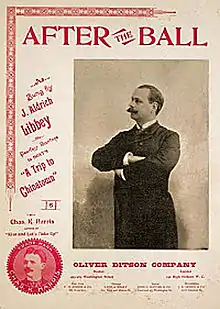
In the United States, before "Oh! Susanna" (1848) no American song had sold more than five thousand copies of sheet music.[3] Stephen Foster's "Massa's in the Cold Ground" sales of 75,000 copies by 1852, was considered "phenomenal" since music publishers did not try to promote songs.[4] The first song to became "popular" through a national advertising campaign was "My Grandfather's Clock" in 1876.[4] Mass production of piano in the late-19th century helped boost sheet music sales.[4] Toward the end of the century, during the Tin Pan Alley era, sheet music was sold by dozens and even hundreds of publishing companies.[5][6][7] Various lead sheet rose considerable amount of copies sold,[6] although revenues and royalties were of relatively small scale as each individual copies were sold in terms of a few cents.
The first title to sell one million ever (in a 12-month period[2]) of sheet music is "After the Ball" on 1892 or 1893.[8][2] However, according to other reports "Funiculì, Funiculà" achieved sales of one million copies in 1880 alone.[9] From 1900 to 1910, over one hundred songs sold more than a million copies.[6] Various "hit songs" sold as many as two or three million copies in print.[8][10] With the advent of the radio broadcasting, sheet music sales of popular songs decreased and print figures failed to make a significant recovery after the World War II.[8] By 1966, the United States House Committee on the Judiciary informed 100,000 copies of a title were "rares".[11] "(How Much Is) That Doggie in the Window?" (1953) is believed to be the last song to sell one million of sheet music.[12]
Selected million-sellers print titles
Best-selling individuals
| Century | Composer(s) | Sales (in million) |
Notes |
|---|---|---|---|
| 20th | Jay Livingston-Ray Evans | 46[26] | With eighteen songs, (Billboard reported 5 million in USA, and rest overseas) |
| 19th | William Shakespeare | 25[27] | Credited to 350 songs. |
Notes
- Based on estimated sales. Sources don't specify whether the sales are global or from a specific country.
References
- Cryer, Max (2008). Love Me Tender: The Stories Behind the World's Favourite Songs. Exisle Publishing. p. 142. Retrieved January 3, 2023.
- Baskerville, David (2006). Music Business Handbook and Career Guide. SAGE Publications. p. 9. Retrieved January 2, 2023.
- Steyn, Mark (2014). The Undocumented Mark Steyn. Simon and Schuster. p. 236. Retrieved January 4, 2023.
- Furia, Philip (2016). The American Song Book: The Tin Pan Alley Era. Oxford University Press. p. 7. Retrieved January 3, 2023.
- Facts on File (2010). Careers in Focus. Infobase Publishing. p. 185. Retrieved January 3, 2023.
- Axford, Elizabeth C. (2004). Song Sheets to Software: A Guide to Print Music, Software, and Web Sites for Musicians. Scarecrow Press. pp. 13, 29. Retrieved January 2, 2023.
- Tyler, Don (2016). Music of the First World War. ABC-CLIO. p. 4. Retrieved January 2, 2023.
- Hull, Geoffrey P. (2004). The Recording Industry. Psychology Press. p. 70. Retrieved January 2, 2023.
- Plastino, Goffredo; Sciorra, Joseph (2016). Neapolitan Postcards: The Canzone Napoletana as Transnational Subject. Scarecrow Press. p. 2. Retrieved December 29, 2022.
- Kohn (2019). Kohn on Music Licensing, 5th Edition (Plan IL). Wolters Kluwer. pp. 6–7. Retrieved December 29, 2022.
- United States House Committee on the Judiciary (1966). Copyright Law Revision: Hearings Before Subcommittee. United States Government Publishing Office. p. 278. Retrieved January 2, 2023.
- Humphries, Patrick (2012). Lonnie Donegan and the Birth of British Rock & Roll. Biteback Publishing. Retrieved December 29, 2022.
- Ewen, David (1977). All the Years of American Popular Music. Prentice Hall. p. 45. Retrieved April 8, 2023.
- Dotterer, Ronald L.; Bowers, Susan (1992). Politics, Gender, and the Arts: Women, the Arts, and Society. Susquehanna University Press. p. 199. Retrieved January 2, 2023.
- Batchelor, Bob (2002). The 1900s. Greenwood Press. p. 179. Retrieved January 2, 2023.
- Hardy, Phil; Laing, Dave (1995). The Da Capo Companion To 20th-century Popular Music. Da Capo Press. p. 616. Retrieved January 2, 2023.
- Jasen, David A. (2004). Tin Pan Alley: An Encyclopedia of the Golden Age of American Song. Taylor & Francis. p. 208. Retrieved January 2, 2023.
- Averill, Gage (2003). Four Parts, No Waiting. Oxford University Press. p. 74. Retrieved January 2, 2023.
- Smith, Kathleen E.R. (2021). God Bless America: Tin Pan Alley Goes to War. University Press of Kentucky. Retrieved January 2, 2023.
- Tyler, Don (2007). Hit Songs, 1900-1955: American Popular Music of the Pre-Rock Era. McFarland & Company. p. 91. Retrieved January 2, 2023.
- Kohn (2019). Kohn on Music Licensing, 5th Edition (Plan IL). Wolters Kluwer. p. 14. ISBN 9781543803860. Retrieved January 2, 2023.
- Dickinson, Kay (2003). Movie Music, the Film Reader. Psychology Press. p. 69. Retrieved January 2, 2023.
- Jasen, David A. (2004). Tin Pan Alley: An Encyclopedia of the Golden Age of American Song. Routledge. p. 194. Retrieved January 2, 2023.
- Young, William H.; Young, Nancy K. (2010). World War II and the Postwar Years in America. ABC-CLIO. p. 775. Retrieved January 2, 2023.
- Pinne, Peter; Johnston, Peter Wyllie (2019). The Australian Musical: From the beginning. Allen & Unwin. Retrieved January 2, 2023.
- Weber, Bruce (December 21, 1968). "Livingston & Evans Leave Coast Clear for 'Mods', B' way Bound". Billboard. p. 68. Retrieved January 3, 2023.
- McFarland, Ron (2010). The Long Life of Evangeline. McFarland & Company. p. 161. Retrieved January 2, 2023.