Church of St. Simon the Canaanite, New Athos
The Church of St. Simeon the Canaanite (Georgian: წმინდა სვიმონ კანანელის სახელობის ტაძარი) is located near the town of New Athos in Gudauta District, Abkhazia/Georgia, dating from the 9th or 10th century.[2] Not to be confused with St Simon the Canaanite Basilica in Psirtskha village.[3]
| Likhni Church Aba-Ata ლიხნის ეკლესია აბა-ათა (in Georgian) Лыхнытәи ауахәама Абаҭаа (in Abkhaz) | |
|---|---|
.jpg.webp) Church of St. Simon the Canaanite, New Athos | |
| Religion | |
| Affiliation | Georgian Orthodox |
| Province | Abkhazia[1] |
| Ecclesiastical or organizational status | ruins |
| Location | |
| Location |  New Athos, Gudauta District, Abkhazia, Georgia New Athos, Gudauta District, Abkhazia, Georgia |
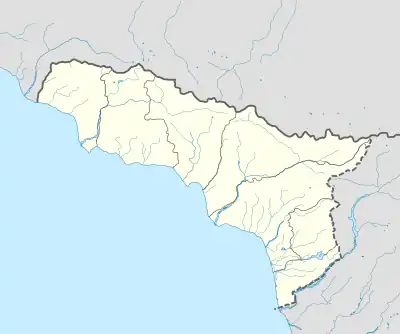  Shown within Abkhazia 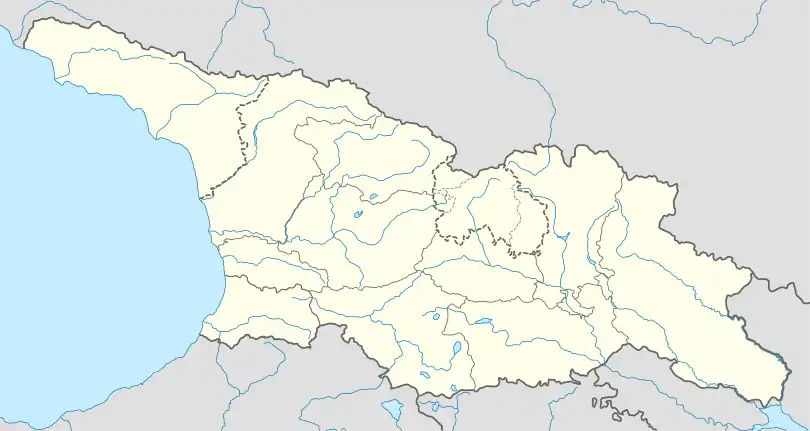 Church of St. Simon the Canaanite, New Athos (Georgia) | |
| Geographic coordinates | 43°05′26″N 40°48′59″E |
| Architecture | |
| Type | Church |
| Completed | 9th-10th century |
History
The church is dedicated to St. Simon the Canaanite, who, according to the 11th-century Georgian Chronicles, preached Christianity in Abkhazia and Egrisi and died and was buried at the town of Nicopsia, to the north of Abkhazia.[4][5][6] A nearby grotto is associated by popular legends with the site of martyrdom of St. Simon.[7]
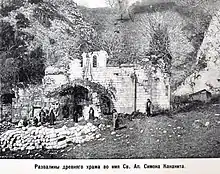
The design of the extant church dates to the 9th or 10th century[6] and is influenced by the Byzantine and Georgian art traditions,[8][6] but the church site seems to be two centuries older.[6] At the time when the Georgian historian Dimitri Bakradze visited it in the 1850s, the church was abandoned, but still standing except for the collapsed dome.[8] The church suffered greatly when the local landlord, Major Hasan Margani removed its blocks of stone for the construction of his own mansion.[7] Later, in the 1880s, the church was reconstructed, using blocks of white hewn stone, to its current state. The church is adorned with images of Christian symbols such as a fish, lion, and cross curved in relief.[6]
Current condition
Georgia has inscribed the church on its list of cultural heritage and treats it as part of cultural heritage in the Russian-occupied territories with no known current state of condition.[6]
References
- The political status of Abkhazia is disputed. Having unilaterally declared independence from Georgia in 1992, Abkhazia is formally recognised as an independent state by 5 UN member states (two other states recognised it but then withdrew their recognition), while Georgia continues to claim it as part of its own territory, designating it as Russian-occupied territory.
- St Simon the Canaanite church in Akhali Atoni settlement Historical monuments of Abkhazia — Government of the Autonomous Republic of Abkhazia.
- St Simon the Canaanite Basilica in Psirtskha village Historical monuments of Abkhazia — Government of the Autonomous Republic of Abkhazia.
- Lang, David Marshall (1976). Lives and legends of the Georgian saints. Mowbrays. p. 167.
- Hewitt, George (2013). A Reassessment of the Georgian-Abkhazian and Georgian-South Ossetian Conflicts. Brill. p. 10. ISBN 978-9004248939.
- Gelenava, Irakli, ed. (2015). Cultural Heritage in Abkhazia (PDF). Tbilisi: Meridiani. pp. 58–59.
- Vvedensky, A.N. (1871). "Религиозные верования абхазцев [Religious beliefs of the Abkhaz]". Сборник сведений о кавказских горцах [Collection of reports about the Caucasian mountainous peoples] (in Russian). Tiflis. 5: 273–274.
- Anchabadze, Zurab (1959). Из истории средневековой Абхазии [From the history of medieval Abkhazia]. Sukhumi: Abkhazia State Publishing. p. 152.