2023 North Indian Ocean cyclone season
The 2023 North Indian Ocean cyclone season is an ongoing event in the annual cycle of tropical cyclone formation.[1] The North Indian Ocean cyclone season has no official bounds, but cyclones tend to form between April and December, with the peak from May to November. These dates conventionally delimit the period of each year when most tropical cyclones form in the northern Indian Ocean.
| 2023 North Indian Ocean cyclone season | |
|---|---|
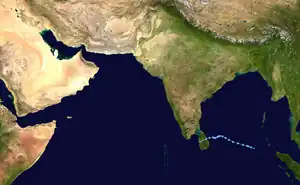 Season summary map | |
| Seasonal boundaries | |
| First system formed | 30 January 2023 |
| Last system dissipated | Season ongoing |
| Strongest storm | |
| Name | Mocha |
| • Maximum winds | 215 km/h (130 mph) (3-minute sustained) |
| • Lowest pressure | 931 hPa (mbar) |
| Seasonal statistics | |
| Depressions | 2 |
| Deep depressions | 1 |
| Cyclonic storms | 1 |
| Severe cyclonic storms | 1 |
| Very severe cyclonic storms | 1 |
| Extremely severe cyclonic storms | 1 |
| Super cyclonic storms | 0 |
| Total fatalities | 463 total |
| Total damage | $1.07 million (2023 USD) |
| Related articles | |
The scope of this article is limited to the Indian Ocean in the Northern Hemisphere, east of the Horn of Africa and west of the Malay Peninsula. There are two main seas in the North Indian Ocean — the Arabian Sea to the west of the Indian subcontinent, abbreviated ARB by the India Meteorological Department (IMD); and the Bay of Bengal to the east, abbreviated BOB by the IMD.
The official Regional Specialized Meteorological Centre in this basin is the India Meteorological Department (IMD), while the Joint Typhoon Warning Center releases unofficial advisories for interest. On average, three to four cyclonic storms form in this basin every season.[2]
Season summary
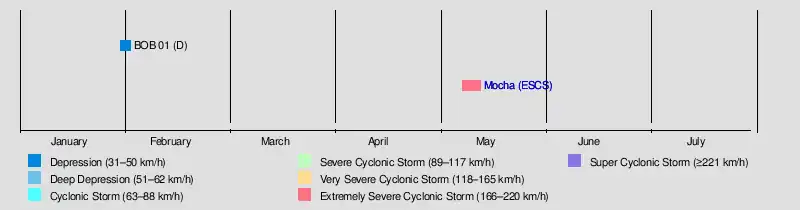
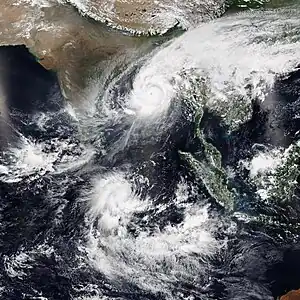
Nearing the end of January, a tropical depression classified as BOB 01 formed, becoming the first storm in the basin. The storm's formation makes it the first time since 2019 to see a storm develop in the month of January in the basin. Later, in May, another tropical depression classified as BOB 02 formed and due to the high sea surface temperatures, the chances were slowly rising. On 9 May, the chances for the depression was high due to environmental conditions. Later in the following day, BOB 02 intensified into a deep depression. On 11 May, the system was named Mocha. Mocha quickly intensified to a severe cyclonic storm at 12:00 UTC after reaching winds of 90 km/h (55 mph).[3] Satellite imagery showed the formation of a ragged eye structure.[4] On 12 May, Mocha became a very severe cyclonic storm.[5]
Systems
Depression BOB 01
| Depression (IMD) | |
  | |
| Duration | 30 January – 2 February |
|---|---|
| Peak intensity | 45 km/h (30 mph) (3-min) 1004 hPa (mbar) |
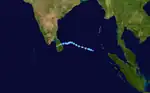
On 25 January, a cyclonic circulation formed over the equatorial Indian Ocean and the adjoining Bay of Bengal.[6] Under an influence of cyclonic circulation, a low-pressure area formed on 27 January.[7] Substantially, it concentrated into a well-marked low-pressure area on 29 January.[8] During the next day, the well-marked low organized to depression.[9] The JTWC later issued a Tropical Cyclone Formation Alert (TCFA) for the system.[10] However, increasing land interaction with Sri Lanka prompted the JTWC to downgrade the system's chance for development to medium and subsequently canceling its TCFA.[11] The disturbance finally weakened into a well-marked low pressure over Gulf of Mannar on 2 February.[12]
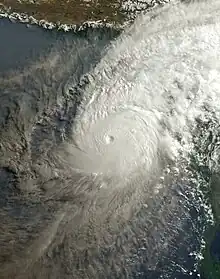
Extremely Severe Cyclonic Storm Mocha
| Extremely severe cyclonic storm (IMD) | |
| Category 5 tropical cyclone (SSHWS) | |
  | |
| Duration | 9 May – 15 May |
|---|---|
| Peak intensity | 215 km/h (130 mph) (3-min) 931 hPa (mbar) |
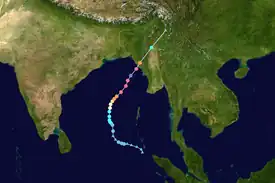
A circulation formed on 6 May over the Bay of Bengal as a result of the amplitude of the Madden–Julian oscillation (MJO), according to the IMD.[13] The JTWC also began monitoring the system on 7 May, marking its flaring convection to the west of the circulation.[14] On 9 May, the system was upgraded to a depression.[15] The JTWC later issued a TCFA on the system as it was situated in very warm sea surface temperatures.[16] The storm subsequently intensified into a deep depression at 03:00 UTC of 9 May,[17] before upgrading further to a cyclonic storm on 11 May, attaining the name Mocha.[18] The JTWC followed suit in upgrading the system to tropical cyclone status the same day.[19] Mocha quickly intensified to a severe cyclonic storm at 12:00 UTC after reaching winds of 105 km/h (65 mph).[20] Satellite imagery showed the formation of a ragged eye structure.[21] On 12 May, Mocha became a very severe cyclonic storm.[22] Mocha rapidly intensified to an extremely severe cyclonic storm at 18:00 UTC,[23] before undergoing an eyewall replacement cycle.[24] After having completing the cycle on 13 May, Mocha intensified to a Category 4-equivalent tropical cyclone on the Saffir–Simpson scale.[25] Mocha reached a peak intensity as a Category 5-equivalent tropical cyclone the next day,[26] shortly before the storm entered unfavorable conditions.[27] Mocha weakened before making landfall near Sittwe of Myanmar.[28] Mocha began to rapidly weaken after landfall from Myanmar's terrain, with wind shear also degrading the storm.[29] The system downgraded to a depression on 15 May,[30] shortly before becoming marked as a low-pressure area.[31] Mocha's remnants later moved over Yunnan and caused a blizzard.[32]
Storm names
Within this basin, a tropical cyclone is assigned a name when it is judged to have reached cyclonic storm intensity with winds of 65 kilometres per hour (40 mph). The names were selected by a new list from the Regional Specialized Meteorological Center in New Delhi by mid year of 2020.[33] There is no retirement of tropical cyclone names in this basin as the list of names is only scheduled to be used once before a new list of names is drawn up. Should a named tropical cyclone move into the basin from the Western Pacific, then it will retain its original name. The next eight available names from the List of North Indian Ocean storm names are below.[34]
|
|
Season effects
This is a table of all storms in the 2023 North Indian Ocean cyclone season. It mentions all of the season's storms and their names, duration, peak intensities according to the IMD storm scale, damage, and death totals. Damage and death totals include the damage and deaths caused when that storm was a precursor wave or extratropical low. All of the damage figures are in 2023 USD.
| Name | Dates | Peak intensity | Areas affected | Damage (USD) |
Deaths | Refs | ||
|---|---|---|---|---|---|---|---|---|
| Category | Wind speed | Pressure | ||||||
| BOB 01 | January 30–February 2 | Depression | 45 km/h (30 mph) | 1004 hPa (29.65 inHg) | Sri Lanka | None | 0 | |
| Mocha | May 9–May 15 | Extremely severe cyclonic storm | 215 km/h (130 mph) | 931 hPa (27.49 inHg) | Andaman and Nicobar Islands, Myanmar, Bangladesh, Mizoram, India | $1.07 million | 438 | [28] |
| Season aggregates | ||||||||
| 2 systems | 30 January – Season ongoing | 215 km/h (130 mph) | 931 hPa (27.49 inHg) | $1.07 million | 438 | |||
See also
- Weather of 2023
- Tropical cyclones in 2023
- North Indian Ocean cyclone season
- 2023 Atlantic hurricane season
- 2023 Pacific hurricane season
- 2023 Pacific typhoon season
- South-West Indian Ocean cyclone seasons: 2022–23, 2023–24
- Australian region cyclone seasons: 2022–23, 2023–24
- South Pacific cyclone seasons: 2022–23, 2023–24
References
- "Climatology of Tropical Cyclones over North Indian Ocean (NIO)" (PDF). severeweather.wmo.int. 8 December 2022. Archived (PDF) from the original on 6 March 2023. Retrieved 8 December 2022.
- "Annual Frequency of Cyclonic Disturbances (Maximum Wind Speed of 17 Knots or More), Cyclones (34 Knots or More) and Severe Cyclones (48 Knots or More) Over the Bay of Bengal (BOB), Arabian Sea (AS) and Land Surface of India" (PDF). India Meteorological Department. Archived (PDF) from the original on 15 December 2017. Retrieved 30 October 2015.
- Tropical Cyclone Advisory No. 5 for North Indian Ocean issued at 1500 UTC of 11.05.2023. based on 1200 UTC of 11.05.2023 (PDF) (Report). New Delhi, India: India Meteorological Department. 11 May 2023. Archived from the original (PDF) on 11 May 2023. Retrieved 11 May 2023.
- Prognostic Reasoning for Tropical Cyclone 01B (Mocha) Warning No. 4 (Report). United States Joint Typhoon Warning Center. 11 May 2023. Archived from the original on 11 May 2023. Retrieved 11 May 2023.
- High Sea For Met. Area VIII (N) (Report). New Delhi, India: India Meteorological Department. 12 May 2023. Archived from the original on 12 May 2023. Retrieved 12 May 2023.
- Tropical Weather Outlook for North Indian Ocean issued at 0600 UTC of 25.01.2023. based on 0300 UTC of 25.01.2023 (PDF) (Report). New Delhi, India: India Meteorological Department. 25 January 2023. Archived (PDF) from the original on 7 February 2023. Retrieved 12 May 2023.
- Tropical Weather Outlook for North Indian Ocean issued at 0600 UTC of 27.01.2023. based on 0300 UTC of 27.01.2023 (PDF) (Report). New Delhi, India: India Meteorological Department. 27 January 2023. Archived from the original (PDF) on 12 May 2023. Retrieved 12 May 2023.
- Tropical Weather Outlook for North Indian Ocean issued at 0600 UTC of 29.01.2023. based on 0300 UTC of 29.01.2023 (PDF) (Report). New Delhi, India: India Meteorological Department. 29 January 2023. Retrieved 12 May 2023.
- Special Tropical Weather Outlook for North Indian Ocean issued at 0730 UTC of 30.01.2023. based on 0300 UTC of 30.01.2023 (PDF) (Report). New Delhi, India: India Meteorological Department. 29 January 2023. Archived from the original (PDF) on 12 May 2023. Retrieved 12 May 2023.
- Tropical Cyclone Formation Alert (Invest 90B) (Report). United States Joint Typhoon Warning Center. 31 January 2023. Archived from the original on 31 January 2023. Retrieved 31 January 2023.
- Tropical Cyclone Formation Alert (Invest 90B) (Report). United States Joint Typhoon Warning Center. 1 February 2023. Archived from the original on 1 February 2023. Retrieved 1 February 2023.
- Speacial Tropical Weather Outlook for North Indian Ocean issued at 1930 UTC of 02.02.2023. based on 1800 UTC of 02.02.2023 (PDF) (Report). New Delhi, India: India Meteorological Department. 2 February 2023. Archived from the original (PDF) on 12 May 2023. Retrieved 12 May 2023.
- Tropical Weather Outlook for North Indian Ocean issued at 0700 UTC of 06.05.2023 based on 0300 UTC of 06.05.2023 (Report). New Delhi, India: India Meteorological Department. 6 May 2023. Archived from the original on 9 May 2023. Retrieved 9 May 2023.
- Significant Tropical Weather Advisory for the Indian Ocean, 18Z 7 May 2023 (Report). United States Joint Typhoon Warning Center. 7 May 2023. Archived from the original on 7 May 2023. Retrieved 9 May 2023.
- Tropical Weather Outlook for North Indian Ocean issued at 1600 UTC of 09.05.2023. based on 1200 UTC of 09.05.2023 (Report). New Delhi, India: India Meteorological Department. 9 May 2023. Archived from the original on 9 May 2023. Retrieved 9 May 2023.
- Tropical Cyclone Formation Alert (Invest 91B) (Report). United States Joint Typhoon Warning Center. 9 May 2023. Archived from the original on 9 May 2023. Retrieved 9 May 2023.
- Special Tropical Weather Outlook for North Indian Ocean issued at 2030 UTC of 10.05.2023. based on 1800 UTC of 10.05.2023 (PDF) (Report). New Delhi, India: India Meteorological Department. 9 May 2023. Archived (PDF) from the original on 11 May 2023. Retrieved 9 May 2023.
- Quadrant Wind Distribution in Association with Mocha over Bay of Bengal on 0000 UTC of 11-05-2023 (Report). New Delhi: India Meteorological Department. 11 May 2023. Archived from the original on 11 May 2023. Retrieved 11 May 2023.
- Prognostic Reasoning for Tropical Cyclone 01B (One) Warning No. 1 (Report). United States Joint Typhoon Warning Center. 11 May 2023. Archived from the original on 11 May 2023. Retrieved 11 May 2023.
- Tropical Cyclone Advisory No. 5 for North Indian Ocean issued at 1500 UTC of 11.05.2023. based on 1200 UTC of 11.05.2023 (PDF) (Report). New Delhi, India: India Meteorological Department. 11 May 2023. Archived from the original (PDF) on 11 May 2023. Retrieved 11 May 2023.
- Prognostic Reasoning for Tropical Cyclone 01B (Mocha) Warning No. 4 (Report). United States Joint Typhoon Warning Center. 11 May 2023. Archived from the original on 11 May 2023. Retrieved 11 May 2023.
- High Sea For Met. Area VIII (N) (Report). New Delhi, India: India Meteorological Department. 12 May 2023. Archived from the original on 12 May 2023. Retrieved 12 May 2023.
- Tropical Cyclone Advisory No. 15 for North Indian Ocean issued at 2100 UTC of 12.05.2023. based on 1800 UTC of 12.05.2023 (PDF) (Report). New Delhi, India: India Meteorological Department. 12 May 2023. Archived from the original (PDF) on 12 May 2023. Retrieved 12 May 2023.
- Prognostic Reasoning for Tropical Cyclone 01B (Mocha) Warning No. 8 (Report). United States Joint Typhoon Warning Center. 12 May 2023. Archived from the original on 12 May 2023. Retrieved 12 May 2023.
- Prognostic Reasoning for Tropical Cyclone 01B (Mocha) Warning No. 11 (Report). United States Joint Typhoon Warning Center. 13 May 2023. Archived from the original on 13 May 2023. Retrieved 13 May 2023.
- Prognostic Reasoning for Tropical Cyclone 01B (Mocha) Warning No. 13 (Report). United States Joint Typhoon Warning Center. 14 May 2023. Archived from the original on 14 May 2023. Retrieved 14 May 2023.
- Prognostic Reasoning for Tropical Cyclone 01B (Mocha) Warning No. 14 (Report). United States Joint Typhoon Warning Center. 14 May 2023. Archived from the original on 14 May 2023. Retrieved 14 May 2023.
- Alam, Julhas (14 May 2023). "Powerful Cyclone Mocha makes landfall in Myanmar, tearing off roofs and killing at least 3". AP News. Retrieved 14 May 2023.
- Tropical Cyclone Advisory No. 30 for North Indian Ocean issued at 1630 UTC of 14.05.2023. based on 1500 UTC of 14.05.2023 (PDF) (Report). New Delhi, India: India Meteorological Department. 14 May 2023. Archived from the original (PDF) on 14 May 2023. Retrieved 14 May 2023.
- Special Tropical Weather Outlook for North Indian Ocean issued at 0300 UTC of 15.03.2023. based on 0000 UTC of 15.05.2023 (PDF) (Report). New Delhi, India: India Meteorological Department. 15 May 2023. Archived from the original (PDF) on 15 May 2023. Retrieved 15 May 2023.
- Special Tropical Weather Outlook for North Indian Ocean issued at 0700 UTC pf 15.05.2023. based on 0300 UTC of 15.05.2023 (PDF) (Report). New Delhi, India: India Meteorological Department. 15 May 2023. Archived from the original (PDF) on 15 May 2023. Retrieved 15 May 2023.
- LoBiondo, Nicole (16 May 2023). "Deadly Cyclone Mocha displaces thousands in Bangladesh, Myanmar". AccuWeather. Retrieved 16 May 2023.
{{cite web}}: CS1 maint: url-status (link) - "Tropical Cyclone Naming". public.wmo.int. 30 May 2016. Archived from the original on 7 June 2022. Retrieved 8 December 2022.
- "Naming of Tropical Cyclones over the North Indian Ocean" (PDF). rsmcnewdelhi.imd.gov.in. New, Delhi: India Meteorological Department. Archived from the original (PDF) on 25 September 2021. Retrieved 25 September 2021.
External links

- RSMC New Delhi
- Indian Meteorological Department
- Joint Typhoon Warning Center (JTWC)
- National Meteorological Center of CMA (in Chinese)
Tropical cyclones of the 2023 North Indian Ocean cyclone season | ||
|---|---|---|
| ||
| ||