Deep temporal nerves
The deep temporal nerves are branches of the anterior division of the mandibular nerve that innervate the temporalis muscle.[1]
| Deep temporal nerves | |
|---|---|
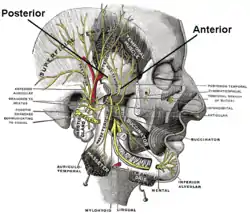 Mandibular division of the trigeminal nerve | |
| Details | |
| From | Anterior division of mandibular nerve |
| Innervates | Temporalis, temporomandibular joint |
| Identifiers | |
| Latin | nervi temporales profundi |
| TA98 | A14.2.01.071 |
| TA2 | 6254 |
| FMA | 53187 |
| Anatomical terms of neuroanatomy | |
Structure
The deep temporal nerves are usually two in number[2] - the anterior deep temporal nerve and posterior deep temporal nerve.
Origin
They are usually branches of the anterior division of the mandibular nerve (CN V3) (one may branch from the buccal nerve).[2]
Course
They pass superior to the superior border of the lateral pterygoid muscle.[2] They ascend to enter the temporal fossa and enter the deep surface of the temporalis muscle.
Distribution
The deep temporal nerves provide motor innervation to the temporalis muscle. The deep temporal nerves also have articular branches which provide a minor contribution to the innervation of the temporomandibular joint.[1]
Variation
Number
Sometimes, three deep temporal nerves are present branching from the anterior division of the mandibular nerve. In this case the extra nerve is situated between the anterior and posterior and called the middle deep temporal nerve.
Origin
The anterior deep temporal nerve is sometimes a branch of the buccal nerve.
The posterior deep temporal nerve is sometimes a branch of the masseteric nerve.
References
- Gray, Henry (2015). Gray's Anatomy : The Anatomical Basis of Clinical Practice. Standring, Susan (41 ed.). Philadelphia: Elsevier. pp. 544, 551. ISBN 978-0-7020-5230-9. OCLC 920806541.
- Sinnatamby, Chummy S. (2011). Last's Anatomy (12th ed.). p. 364. ISBN 978-0-7295-3752-0.