Tag (graffiti)
Tags are one of the primary forms of graffiti, along with throw-ups and pieces. The act of writing a tag is known as tagging.

Tags were the first form of modern graffiti, originating in New York City in the 1960s and 70s with artists such as TAKI 183 and Julio 204.[1] and are often thought of as the simplest form of graffiti art, prioritising legibility and flow[2] and are usually the form of graffiti that most artists start off with.[3] Tags are, perhaps due to their simplicity, more likely to be considered vandalism than other more elaborate graffiti styles.[4]
Form
Often done in spray paint or markers, tags are established from throw-up and pieces by being 2D, often smaller in size, and thinner lines which are the result of speed necessity due to the often illegal nature of tagging.[3] This necessity of speed has led to tags which are written in a single stroke called one-liners.[5]
While throw-ups and pieces may be formed from any word or even sentence, a tag functions similarly to a signature, as they are the graffiti artist's pseudonym (although rarely a personal name may be used) written in the unique style of the individual artist so that two artists with the same name would be distinguishable from one another, although an artist using a name of an existing artist in their locale or a "king", or "j@mes" (well-respected artists) is a faux pas. Tags are often used by artists to sign larger pieces or street art. An individual's unique style is called a handstyle.[6]
About tagging, graffiti artist Kaves said “with graffiti, most people can pass by and not even give a shit about it while other people are looking at the style, the letters—the technical stuff, y’know? The many layers of it. So, learning that over the years, you start to find your own style—your own voice".[7]
Function
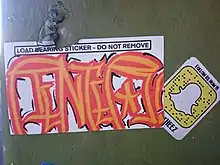
The purpose of tags is for an artist to have their tags recognised by other artists in their locale.[3] The most prevalent taggers in an area are known as "all city", a term which originated in traditional New York graffiti.[8]
While tags are often written onto objects directly, they are also sometimes written onto stickers (known as "slaps") and stuck onto things, which is faster and safer when illegally tagging.[9] Postal and "my name is..." stickers are commonly used for this purpose.
See also
- Scent marking – Behaviour used by animals to identify their territory
References
- "'Taki 183' Spawns Pen Pals". The New York Times. 1971-07-21. ISSN 0362-4331. Retrieved 2022-10-10.
- Berio, Daniel; Leymarie, F. (2015). "Computational Models for the Analysis and Synthesis of Graffiti Tag Strokes". Computational Aesthetics. doi:10.2312/EXP.20151177. S2CID 7283639.
- Snyder, Gregory (2017). "Long Live the Tag: Representing the Foundations of Graffiti". In Avramidis, Konstantinos; Tsilimpounidi, Myrto (eds.). Graffiti and Street Art: Reading, Writing and Representing the City. Routledge. ISBN 9781317125044.
- Vanderveen, Gabry; van Eijk, Gwen (2016-03-01). "Criminal but Beautiful: A Study on Graffiti and the Role of Value Judgments and Context in Perceiving Disorder". European Journal on Criminal Policy and Research. 22 (1): 107–125. doi:10.1007/s10610-015-9288-4. ISSN 1572-9869. S2CID 55771005.
- TheSkullandSword (2018-12-14). "Graffiti Basics: Tagging, Throwing Up, & Piecing". The Skull and Sword. Retrieved 2022-10-10.
- Schacter, Rafael (2013-09-03). The World Atlas of Street Art and Graffiti. Yale University Press. ISBN 9780300199420.
handstyle graffiti.
- Chapelaine, Sierra. "Kaves: Something Out of Nothing". UP MAGAZINE. Archived from the original on April 1, 2023. Retrieved 2023-04-02.
- Anderson, C. (2012). "Going 'All City': The Spatial Politics of Graffiti". Shift: Graduate Journal of Visual and Material Culture. S2CID 155573992.
- "Slaps". TRP 613. Retrieved 2022-10-10.