Sir George Hamilton, 1st Baronet, of Donalong
Sir George Hamilton, 1st Baronet of Donalong and Nenagh (c. 1608 – 1679), born in Scotland, inherited land in Ireland and fought in the Irish Army under his brother-in-law, the 1st Duke of Ormond, in the Confederate Wars and the Cromwellian conquest of Ireland, during which he defended Nenagh Castle against Henry Ireton. Hamilton was father of Antoine Hamilton, author of the Mémoires du Comte de Grammont, of Richard Hamilton, Jacobite general, and of Elizabeth, Countess de Gramont, "la belle Hamilton".
| Family tree | |||||||||||||||||||||||||||||||||||||||||||||||||||||||||||||||||||||||||||||||||||||||||||||||||||||||||||||||||||||||||||||||||||||||||||||||||||||||||||||||||||||||||||||||||||||||||||||||||||||||||||||||||||||||||||||||||||||||||||||||||||||||||||||||||||||||||||||||||||||||||||||||||||||||||||||||||||
|---|---|---|---|---|---|---|---|---|---|---|---|---|---|---|---|---|---|---|---|---|---|---|---|---|---|---|---|---|---|---|---|---|---|---|---|---|---|---|---|---|---|---|---|---|---|---|---|---|---|---|---|---|---|---|---|---|---|---|---|---|---|---|---|---|---|---|---|---|---|---|---|---|---|---|---|---|---|---|---|---|---|---|---|---|---|---|---|---|---|---|---|---|---|---|---|---|---|---|---|---|---|---|---|---|---|---|---|---|---|---|---|---|---|---|---|---|---|---|---|---|---|---|---|---|---|---|---|---|---|---|---|---|---|---|---|---|---|---|---|---|---|---|---|---|---|---|---|---|---|---|---|---|---|---|---|---|---|---|---|---|---|---|---|---|---|---|---|---|---|---|---|---|---|---|---|---|---|---|---|---|---|---|---|---|---|---|---|---|---|---|---|---|---|---|---|---|---|---|---|---|---|---|---|---|---|---|---|---|---|---|---|---|---|---|---|---|---|---|---|---|---|---|---|---|---|---|---|---|---|---|---|---|---|---|---|---|---|---|---|---|---|---|---|---|---|---|---|---|---|---|---|---|---|---|---|---|---|---|---|---|---|---|---|---|---|---|---|---|---|---|---|---|---|---|---|---|---|---|---|---|---|---|---|---|---|---|---|---|---|---|---|---|---|---|---|---|---|---|---|---|---|---|---|---|---|---|---|
| |||||||||||||||||||||||||||||||||||||||||||||||||||||||||||||||||||||||||||||||||||||||||||||||||||||||||||||||||||||||||||||||||||||||||||||||||||||||||||||||||||||||||||||||||||||||||||||||||||||||||||||||||||||||||||||||||||||||||||||||||||||||||||||||||||||||||||||||||||||||||||||||||||||||||||||||||||
George Hamilton | |
|---|---|
| Baronet of Donalong and Nenagh | |
| Tenure | 1660–1679 |
| Successor | James Hamilton |
| Born | c. 1607 |
| Died | 1679 |
| Spouse(s) | Mary Butler |
| Issue Detail | James, George, Anthony, Richard, John, Elizabeth, & others |
| Father | James, 1st Earl of Abercorn |
| Mother | Marion Boyd |
Birth and origins
George was born about 1608 in Scotland,[4] probably in Paisley, Renfrewshire, near Glasgow. He was the fourth son of James Hamilton and his wife, Marion Boyd.[5] His father had been created Earl of Abercorn by James VI and I in 1606. His paternal grandfather was the 1st Lord Paisley.
George's mother was the eldest daughter of the 6th Lord Boyd, of Kilmarnock, Ayrshire, in the south-west of Scotland. Both grandfathers fought in 1568 at Langside for Mary, Queen of Scots.[6]
George was one of nine siblings[7] who are listed in his father's article.
George's father had been a Protestant, but his mother, Marion Boyd, was a recusant, who brought him, like all his siblings, up in the Catholic faith.[8] His uncle, Sir George Hamilton of Greenlaw and Roscrea, pushed in the same direction.[9]
Anthony's father and Anthony's granduncle George share the same name and so do their wifes, who are both called Mary Butler.[10] The younger was his mother, whereas the elder was a daughter of Walter, 11th Earl of Ormond. The younger couple lived at Nenagh, the elder at Roscrea.[10] Carte (1736) already confused them.[11][12]
Early life
George was about 11 in 1618 when his father, the 1st Earl of Abercorn, died.[13] His father had been an undertaker in James VI and I's 1611 Plantation of Ulster and had as such acquired large estates in Ireland, mainly around Strabane, County Tyrone. George's eldest brother, James, succeeded to his father's title of Earl of Abercorn, but the Irish lands were shared among the younger sons according to his father's will. Strabane, the most prestigious part, went to George's elder brother Claud. George inherited Donalong, a great proportion (2000 acres).[14] His father had predeceased his paternal grandfather, the 1st Lord Paisley, who died three years later in 1621.[15] George's eldest brother James, the 2nd Earl of Abercorn, inherited at that time the title of Lord Paisley and the family's Scottish lands.
Some time after 1625 Hamilton, together with Sir Basil Brooke and Sir George Russell, acquired rights to the Knockaunderrig Silver Mine at Knockanroe in the Silvermine Mountains at the village of Silvermines, south of Nenagh.[16]
In 1627 Hamilton succeeded Sir Roger Hope to the command of a company of foot in the Irish Army.[17][lower-alpha 2]
Marriage and children
In 1635 Hamilton married Mary Butler, third daughter of Thomas Butler, Viscount Thurles.[21][22][23] Her eldest brother, James, later the 1st Duke of Ormond, thereby became his brother-in-law.
George and Mary had six sons:
- James (died 1673), became ranger of Hyde Park and lost a leg in a sea-fight[24]
- George (died 1676), killed in French service at the Col de Saverne[25]
- Anthony (c. 1645 – 1719), fought for the Jacobites and wrote the Mémoires du comte de Grammont[26]
- Thomas (died 1687), served in the Royal Navy and died in Boston, Massachusetts[27][28][29]
- Richard (died 1717),[30] fought for the Jacobites and was taken prisoner at the Boyne[31]
- John (died 1691), Colonel in the Irish army, was killed in the Battle of Aughrim[32]
—and three daughters:
- Elizabeth (1641–1708),[33] a famous beauty, married Philibert de Gramont[34]
- Lucia (died 1676), married Sir Donough O'Brien, 1st Baronet, of Leamaneh Castle, a Protestant, in 1674[35]
- Margaret, married in July 1674 Mathew Forde of Seaforde, County Down, and Coolgreany, County Wexford[36]
Midlife
In 1632 Hamilton's mother died in Edinburgh and was buried with her husband in Paisley Abbey.[37]
By 1634 Hamilton was commonly called Sir George and was supposed to be a baronet, but the title was considered invalid as he would later be created a baronet for a second time. The territorial designation and the baronetage (country) of this first baronetcy are unknown.[38]
His elder brother Claude, 2nd baron Strabane, died in his thirties in 1638 and left a widow, Jean Gordon.[39]
In 1640, Ormond, Hamilton's brother-in-law granted him the manor, castle, town, and lands of Nenagh for 31 years.[40] Ormond also became his boss in the army when he was appointed lieutenant-general (commander-in-chief) of the Irish army in September 1640.[41]
In 1641, at the beginning of the Irish Rebellion, Hamilton was, during a visit to England, suspected of supporting the rebellion as he was Catholic. He was arrested and shortly held at the Tower of London but was soon released on bail.[42] Jean Gordon, his sister-in-law, lost her home when Phelim O'Neill burned Strabane Castle in December 1641. Hamilton housed her and her children at Nenagh.[43][44]
On 2 February 1642 the Knockaunderrig Silver Mine, which Hamilton operated together with Sir Basil Brooks and Sir William Russell, was attacked by local rebels under the leadership of Hugh O'Kennedy and his English miners were killed.[45]
On 5 June 1646 the Confederate Ulster army under Owen Roe O'Neill defeated the Covenanters under Robert Monro.[46] O'Neill then marched south to Kilkenny as directed by Rinuccini, the papal nuncio.[47][48] Leinster and Munster was treated as enemy territory. On 17 September 1646, O'Neill took Roscrea, but Nenagh was not attacked at that time. O'Neill then menaced Dublin in November 1646.
It seems that Sir George had been with the King in England. In January 1647 he returned to Dublin with a message instructing Ormond to hand Dublin over to the English rather than to the Irish.[49] Ormond abandoned Dublin in July to the parliamentarians and left for England.[50]
Phelim MacTuoll O'Neill took Nenagh in 1648,[51] but it was retaken by Inchiquin in the same year by undermining the castle's wall.[52][53]
In August 1648 Hamilton was together with Ormond at Saint-Germain-en-Laye. Ormond landed in Cork 29 September 1648.[54] Hamilton seems to have been with him.
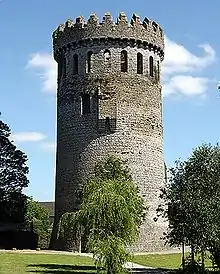
In January 1649 Sir George was appointed receiver-general of the revenues for Ireland succeeding to Lord Roscommon.[55] He was promoted to colonel of foot and upheld the Royalist cause against Cromwell. In 1649 he was appointed governor of Nenagh[56] for his brother in law, James Butler, at that time the Marquess of Ormond, leader of the royalists. At the end of 1650 he defended Nenagh Castle against the Parliamentarian army under Henry Ireton, which attacked it on the way back from the siege of Limerick to their winter quarters at Kilkenny. He surrendered the castle on 10 November 1650 after Ireton had menaced to breach its walls with artillery.[57][58]
French exile
His Irish lands were confiscated, and in spring 1651 he and his family followed Ormond into French exile. They first went to Caen[59] where Ormond's wife Elizabeth Preston lived since 1648.[60] Ormond introduced him to Charles II's exile court at the Château de Saint-Germain-en-Laye.[61] Lady Ormond with her children returned to England in August 1652,[62] and Lady Hamilton went to Paris where she lived in the convent of the Feuillantines.[63] In 1656 or 1657 Charles sent him, together with Donough MacCarty, 2nd Viscount Muskerry, to Madrid on a diplomatic mission.[64]
Restoration and death
In 1660, after the Restoration, he returned to London and stayed at the court of Charles II at Whitehall. In that same year the king created him Baronet of Donalong and Nenagh for his services to the royal cause.[65] Although several sources mention the creation of the baronetcy, it seems to have never been carried out entirely.[lower-alpha 3]
He died in 1679 at the age of 71 or 72 years.[70] He was succeeded by his grandson James Hamilton, 6th Earl of Abercorn, who never assumed the title of Baronet[70] but would later succeed to the earldom of Abercorn.
| Timeline | ||
|---|---|---|
| As his birth date is uncertain, so are all his ages. Entries in italics give historical background. | ||
| Age | Date | Event |
| 0 | 1608, about | Born in Scotland as the 4th son of James Hamilton, 1st Earl of Abercorn[5] |
| 10 | 1618, 23 Mar | Father died at Monkton, Ayrshire, Scotland.[13] |
| 13 | 1621 | Grandfather died.[15] |
| 17 | 1625, 27 Mar | Accession of King Charles I, succeeding King James I[72] |
| 19 | 1627, 16 Oct | Made commander of a company of the Irish Army.[73] |
| 24 | 1632, 26 Aug | Mother died in Edinburgh.[37] |
| 27 | 1635 | Married Mary Butler[74] |
| 32 | 1640, 1 May | Ormond grants him Nenagh for 31 years.[75] |
| 33 | 1641 | Arrested as a papist during a visit to England and held some time in the Tower of London[42] |
| 34 | 1642, 2 Feb | Lost the Knockaunderrig Silver Mine raided by the insurgents[45] |
| 35 | 1643, 15 Sep | Cessation (truce) between the Confederates and the government[76] |
| 35 | 1643, Nov | James Butler, 1st Marquess of Ormond appointed Lord Lieutenant of Ireland[77] |
| 38 | 1646, 5 Jun | Battle of Benburb[78] |
| 38 | 1646, 17 Sep | Ulster Army captured Roscrea[79] |
| 39 | 1647, 28 Jul | Ormond abandoned Dublin to the Parliamentarians.[80] |
| 40 | 1648, 29 Sep | Ormond returned to Ireland landing at Cork.[81] |
| 41 | 1649, Jan | Appointed receiver-general of revenues in Ireland.[55] |
| 41 | 1649, 30 Jan | King Charles I beheaded.[82] |
| 42 | 1650, 10 Nov | Surrendered Nenagh Castle to the Parliamentarians under Ireton[57] |
| 43 | 1651, early | Followed Ormond into French exile[59] |
| 52 | 1660, 29 May | Restoration of King Charles II[83] |
| 52 | 1660 | Created Baronet Hamilton of Donalong and Nenagh[67] |
| 65 | 1673, 6 Jun | Son James died from wounds received in a sea-fight against the Dutch.[84][85] |
| 68 | 1676, Jun | Son George killed at the Col de Saverne in French service.[25] |
| 71 | 1679 | Died and was succeeded by his grandson James Hamilton, the future 6th Earl of Abercorn[70] |
Notes and references
Notes
- This family tree is based on a drawn pedigree[1] and written genealogies of the Abercorns.[2][3] Also see the list of children in the text.
- This was likely the Roger Hope of Hopestown in Westmeath, who sat for Carlingford (Parliament of Ireland constituency) in the Parliament 1613–1615[18][19] and was knighted by Lord Deputy Oliver St John, 1st Viscount Grandison in 1622 on his last day in office.[20]
- Most sources agree that George Hamilton (d. 1681) was created a Baronet of Donalong and Nenagh in 1660. However, some say it was in the peerage of Ireland,[66][67][68] others in that of Scotland.[65] Lodge (1789b) says it is in the baronetage of Nova Scotia.[69] Hamilton's grandson succeeded him in 1679 and should have become the 2nd Baronet Hamilton of Donalong and Nenagh, but never assumed the title.[70] This might indicate that this baronetcy had never been created. Cokayne (1903) comments "This non-assumption of the dignity throws some little doubt on its creation."[71]
Citations
- Cokayne 1910, p. 4. "Tabular pedigree of the Earls of Abercorn"
- Cokayne 1910, p. 2–11
- Paul 1904, p. 37–74
- Cokayne 1903, p. 305, line 4. "... was b. [born] probably about 1607;"
- Wasser 2004, p. 838, left column, line 35. "His fourth son, Sir George Hamilton, first baronet (c. 1608–1679) soldier and landowner "
- Paul 1908, pp. 163–164. "Thomas, sixth Lord Boyd ... fought on her behalf at Langside"
- Millar 1890, p. 177, left column, line 22"Abercorn married Marion, eldest daughter of Thomas, fifth Lord Boyd, by whom he had five sons and four daughters." who are listed in his father's article.
- Paul 1908, pp. 167. "6. Marion, married James (Hamilton), 1st Earl of Abercorn ... was a very active Catholic ..."
- Wasser 2004, p. 838 left column, line 36. "... was raised, along with his siblings, by his uncle, Sir George Hamilton of Greenlaw, who converted them to Roman Catholicism."
- Manning 2001, p. 149, line 6. "... there were two George Hamiltons, one being the nephew of the other. The older couple lived at Roscrea Castle and the younger couple, the parents of Anthony Hamilton were at Nenagh."
- Manning 2001, p. 151 ;ine 36. "This confusion goes back at least to the time of Carte "
- Carte 1851, p. 265. "... after taking Roscrea on Sept. 17 [1646], and putting man, woman, and child to the sword, except sir G. Hamilton's lady, sister to the marquis of Ormond ..."
- Cokayne 1910, p. 3, line 1. "He [James Hamilton] d. v.p. [predeceased his father] at Monkton 23 Mar. and was bur. 29 Ap. 1618 in the Abbey Church, Paisley, age 43."
- Lodge 1789b, p. 110. "The great proportion and manor of Donalong on his third son George and his heirs ... [footnote]"
- Holmes 2004, p. 778, right column. "Lord Claud lived in retirement for over twenty years, dying in 1621, and was buried in Paisley Abbey"
- Gleeson 1937, p. 106. "In the times of Charles I, Sir G. Hamilton procured the concession for mine royal and had expended several 1000 pounds."
- Lodge 1789b, p. 117. "On 16 October 1627 he succeeded Sir Roger Hope (who died 7 September) in the command of his company in the army."
- Stubbs 1919, p. 311. "Borough of Carlingford / Marmaduke Whitechurch / Sir Roger Hope / Armigeri"
- House of Commons 1878, p. 626. "1613 / 6 May / Roger Hope esq., knt. / Hopetown, Westmeath / ditto. [Carlingford Borough]"
- Shaw 1906, p. 179. "1622, May 4. Roger Hope (ibid. [in Ireland] by same [viscount Grandison, lord deputy of Ireland], which day the lord viscount Grandison embarqued for England)"
- Manning 2001, p. 150, bottom. "... February 28th, 1635 regarding the marriage intended between Hamilton and Mary Butler, sister of the earl, which was to take place before the last day of April [1635]."
- Burke & Burke 1915, p. 54, right column, line 33. "4. George (Sir), 1st Bart. of Donalong ... m. [married] 1629 Mary 3rd dau. [daughter] of Thomas Viscount Thurles and sister of the 1st Duke of Ormonde. He d. [died] 1679. She d. Aug 1680 ..."
- Lodge 1789a, p. 40, line 14. "Mary, married to Sir George Hamilton, ancestor by her to the Earl of Abercorn, and died in August 1680."
- Burke & Burke 1915, p. 54, right column, line 38. "1. James, Col. ... he d.v.p. [predeceased his father] of a wound received in a naval engagement with the Dutch, 6 June 1673 and was buried in Westminster Abbey."
- Sergeant 1913, p. 217. "At the beginning of June [1676] he took part in the battle of Zebernstieg [Col de Saverne] and was engaged in covering the French retreat on Saverne when he was killed by a musket-shot."
- Burke & Burke 1915, p. 54, right column, line 59. "Anthony, the celebrated Count Hamilton, author of 'Mémoires de Grammont', Lieut.-Gen. in the French service, d. [died] 20 April 1719, aged 74."
- Burke 1869, p. 3, left column, line 25. "Thomas, in the sea service; d. in New England."
- Clark 1921, p. 74. "[Thomas Hamilton] rendered James no small service in capturing, off the west coast of Scotland, some of the ships which the Earl of Argyle had equipped to aid Monmouth in his rising."
- Sewall 1878, p. 176. "May 9 [1687]. Hamilton, Capt. of the Kingsfisher dies."
- Burke 1869, p. 3, left column, line 26. "Richard, lieut.-gen., d. in France."
- Boulger 1911, p. 155. "Richard Hamilton had been wounded and taken prisoner by the time that William's cavalry came down from Donore on the right flank of the Irish infantry commanded by him in and behind Oldbridge."
- Burke 1869, p. 3, left column, line 27. "John, Colonel in the army of James II., killed at the battle of Aughrim."
- Rigg 1890, p. 146, left column. "[Elizabeth] was born in 1641."
- Burke 1869, p. 3, left column, line 29. "Elizabeth, the beautiful and accomplished wife of Philibert, comte de Grammont; she d. [died] 1708."
- Burke 1869, p. 3, left column, line 31. "Lucia, m. [married] to Sir Donogh of Lamineagh, Bart"
- Burke 1869, p. 3, left column, line 33. "Margaret, m. [married] to Mathew Forde, Esq. of Seaforde."
- Cokayne 1910, p. 3, line 3. "His widow, a prominent Rom. Cath., who was excommunicated in the kirk of Paisley on 20 Jan. 1628, d. [died] in the Canongate, Edinburgh, 26 Aug., and was bur. 13 Sep. 1632 with her husband."
- Wasser 2004, p. 838, left column, line 41. "Some time before 5 June 1634 he was made a baronet but of which country is not known."
- Paul 1904, p. 50, line 7. "Dying 14 June 1638, he [Claude Hamilton] was buried in the church of Leckpatrick, County Tyrone."
- Manning 2001, p. 150, last line. "... on May 1st 1640 by a grant ... to George Hamilton of Knockanderig ... of the manor, castle, town and lands of Nenagh for 31 years."
- Perceval-Maxwell 2009, Paragraph 8. "... on 9 February 1640 he gave Ormond authority to appoint officers to the Irish army, and in September made him lieutenant-general."
- Sergeant 1913, p. 145, line 16. "Although arrested as a Papist in 1641, during a visit to England, sent to the Tower, and deprived of his commission in the army ..."
- Graham 1841, p. 277. "He Phelim carried the unfortunate lady to his castle at Kinnaird, where he kept her two or three days, and then sent her to Sir George Hamilton ..."
- Manning 2001, p. 154, note 40. "After the widow of Claud Hamilton surrendered Strabane Castle to him [i.e. Phelim] in December 1641 ... he sent her to her brother-in-law, 'Sir George Hamilton in Munster' ..."
- Gleeson 1937, p. 109. "... the alleged murder of 32 Protestants, men, women and children, at the mine workings ..."
- Cusack 1871, p. 317. "... encamped at Benburb. Here, on the 5th of June A.D. 1646 he [Owen Roe O’Neill] won a victory ..."
- Hayes-McCoy 1990, p. 197. "He [Owen Roe O'Neill] listened to the nuncio's plea, 'quitted the opportunity of conquest in Ulster' and marched south."
- Coffey 1914, p. 178. "Now seemed the time to follow up the victory of Benburb and subdue the whole North of Ireland; but it was not to be for letters from the Nuncio caused O'Neill to withdraw from the North and move South ..."
- Carte 1851, pp. 299–300. "About the same time [Jan 1647], some persons of quality (particularly sir G. Hamilton the younger) arrive at Dublin, having been privately dispatched with signification of his majesty's pleasure, upon the advertisement he had received of the condition of Ireland to this purpose; 'that if it were possible for the marquis to keep Dublin ... but if there we or should be a necessity ... he should rather put them into the hands of the English than of the Irish.' "
- Airy 1886, p. 56, left column, line 29. "On the 28th [July 1647] Ormonde delivered up the regalia and sailed for England, landing at Bristol on 2 Aug."
- Coffey 1914, p. 207. "... Phelim McTuoll O'Neill stormed Nenagh ..."
- Bellings 1891, p. 105. "Inchiquin ... besieged the castle of Nenagh ... that a mine was made, capable to receive a barrel of powder ..."
- Gleeson 1936, p. 257. "It [Nenagh Castle]] was taken by Phelim O'Neill in 1648 ... but was re-taken by Inchiquin ..."
- Airy 1886, p. 56, left column, line 50. "... and in August, he himself began his journey thither. On leaving Havre, he was shipwrecked ... but at the end of September he again embarked, arriving at Cork on the 29th."
- Clark 1921, p. 5, line 2. "In January 1649, after the peace between the Lord Lieutenant and the Confederates, Sir George was appointed Receiver-General of the Revenues for Ireland, in the place of the Earl of Roscommon who had died."
- Wasser 2004, p. 838, left column, line 48. "In 1649 he was made governor of Nenagh Castle ... "
- Warner 1768, p. 228. "... taking Nenagh and two other castles, on the tenth of November, he came to his winter quarters at Kilkenny."
- R. Y. 1833, p. 298, line 10. "The terrible Ireton, when Cromwell left him as his deputy in Ireland, on his way to the siege of Limerick in 1651 battered it from the high ground to the east, and the garrison, finding it untenable, surrendered it at discretion, when, as local tradition has it, Ireton caused its Governor to be hung out of the topmost window of the keep."
- Millar 1890, p. 177, left column, line 46. "... the Marquis of Ormonde, whom he [Sir George Hamilton] followed to Caen in the spring of 1651 with his wife and family."
- Carte 1851, p. 384. "The marchioness of Ormond had landed in that country on June 23d [1648], with her three sons and two daughters, and had taken up her residence at Caen"
- Williams 2014, p. 261. "... Ormond's Roman Catholic brother-in-law Sir George Hamilton, were incorporated into the exiled court at Paris through Ormond's good word."
- Perceval-Maxwell 2004, pp. 130–131. "... in August 1652 she [Lady Ormond] left for England with her family ..."
- Clark 1921, p. 8, line 27. "... his [Antoine Hamilton's] mother and his aunt, Lady Muskerry, had apartments at the Couvent des Feuillantines in Paris ..."
- Clark 1921, p. 9. "A little later [in 1657], Charles ... despatched Sir George Hamilton and his brother-in-law, Lord Muskerry, to Madrid to find out whether it would be agreeable to the King of Spain that the Irish now in Spain and those who would come over from the French should be sent immediately into Ireland."
- Burke & Burke 1915, p. 54, right column, line 33. "4. George (Sir), 1st Bart. of Donalong ... m. [married] 1629 Mary 3rd dau. [daughter] of Thomas Viscount Thurles and sister of the 1st Duke of Ormonde. He d. [died] 1679. She d. Aug 1680 ..."
- Burke 1869, p. 2, right column, bottom. "George (Sir) of Donalong, co. Tyrone, and Nenagh, co. Tipperary, created a baronet of Ireland, in 1660, for his services to the royal cause."
- Millar 1890, p. 177, left column, line 48. "On the Restoration he returned to England, was created a baronet of Ireland in 1660, and received other grants from Charles II in recompense for his services."
- Cokayne 1903, p. 305, line 7. "... the Restoration about which period (1660?) he is said to have been created a baronet [I.] ..."
- Lodge1789b, p. 111. "Sir George Hamilton, Baronet of Nova Scotia, ancestor to the present Earl of Abercorn."
- Burke & Burke 1915, p. 55, left column, bottom. "James, 6th Earl of Abercorn, who had declined assuming the title of Baronet on the decease of his grandfather, 1679, and was known as Captain Hamilton."
- Cokayne 1903, p. 305, note c. "This non-assumption of the dignity throws some little doubt on its creation."
- Fryde et al. 1986, p. 44, line 16. "Charles I. ... acc. 27 Mar. 1625 ..."
- Lodge 1789b, p. 117. "On 16 October 1627 he succeeded Sir Roger Hope (who died 7 September) in the command of his company in the army."
- Manning 2001, p. 150, bottom. "... February 28th, 1635 regarding the marriage intended between Hamilton and Mary Butler, sister of the earl, which was to take place before the last day of April [1635]."
- Manning 2001, p. 150. "... on May 1st 1640 by a grant ... to George Hamilton of Knockanderig ... of the manor, castle, town and lands of Nenagh for 31 years."
- Airy 1886, p. 54, right column. "... and the cessation was signed on the 15 Sept. [1643]."
- Fryde et al. 1986, p. 169, line 4. "1643, 13 Nov./21 Jan. 1644 /James Butler, 1st m. of Ormond, L.L. [Lord Lieutenant] (appd by K. Charles I)"
- Duffy 2002, p. 114. "When the latter [O'Neill] scored a surprise victory at Benburn, on 5 June 1646, over the Ulster Scots led by General Robert Munro, it seemed that the confederates were in sight of victory ..."
- Carte 1851, p. 265, line 27. "... after taking Roscrea on Sept. 17, and putting man, woman, and child to the sword, except sir G. Hamilton's lady, sister to the marquis of Ormond ..."
- Airy 1886, p. 56, left column, line 29. "On the 28th [July 1647] Ormonde delivered up the regalia and sailed for England, landing at Bristol on 2 Aug."
- Airy 1886, p. 56, left column, line 50. "... and in August, he himself began his journey thither. On leaving Havre, he was shipwrecked ... but at the end of September he again embarked, arriving at Cork on the 29th."
- Fryde et al. 1986, p. 44, line 17. "Charles I. ... exec. 30 Jan. 1649 ..."
- Fryde et al. 1986, p. 44, line 39. "Charles II. ... acc. 29 May 1660 ..."
- Debrett 1816, p. 93, line 7. "d. [died] of a wound in 1673 received commanding a regiment of foot, on board of the navy, with the Duke of York in one of his sea expeditions against the Dutch."
- Paul 1904, p. 57, line 3. "His regiment being embarked on board the navy, in one of the expeditions of the Duke of York against the Dutch, Colonel Hamilton had one of his legs taken off by a cannon ball of which wound he died 6 June 1673 ..."
Sources
- Airy, Osmund (1886). "Butler, James, twelfth Earl and first Duke of Ormonde (1610–1688)". In Lee, Sidney (ed.). Dictionary of National Biography. Vol. VIII. New York: MacMillan and Co. pp. 52–60. OCLC 8544105.
- Bellings, Richard (1891). Gilbert, John Thomas (ed.). History of the Irish Confederation and the War in Ireland 1646-1649. Vol. III (limited to two hundred copies ed.). Dublin: Printed for the editor by Joseph Dollard. – 1646 to 1649
- Boulger, Demetrius Charles (1911). The Battle of the Boyne. London: Martin Secker. OCLC 1041056932.
- Burke, Bernard (1869). A Genealogical and Heraldic Dictionary of the Peerage and Baronetage of the British Empire (31st ed.). London: Harrison. OCLC 1045624502. (for his children)
- Burke, Bernard; Burke, Ashworth Peter (1915). A Genealogical and Heraldic History of the Peerage and Baronetage, the Privy Council, Knightage and Companionage (77th ed.). London: Harrison. OCLC 1155471554.
- Carte, Thomas (1851) [1st pub. 1736]. The Life of James Duke of Ormond. Vol. III (New ed.). Oxford: Oxford University Press. OCLC 1086656347. – 1643 to 1660
- Clark, Ruth (1921). Anthony Hamilton: his Life and Works and his Family. London: John Lane. OCLC 459281163.
- Coffey, Diarmid (1914). O'Neill and Ormond – A Chapter of Irish History. Dublin: Maunsel & Company. OCLC 906164979.
- Cokayne, George Edward (1903). Complete Baronetage, 1611 to 1800. Vol. III (1st ed.). Exeter: William Pollard & Co. OCLC 866278985. – 1649 to 1664
- Cokayne, George Edward (1910). Gibbs, Vicary (ed.). The complete peerage of England, Scotland, Ireland, Great Britain and the United Kingdom, extant, extinct, or dormant. Vol. I (2nd ed.). London: St Catherine Press. OCLC 228661424. – Ab-Adam to Basing (for Abercorn)
- Cusack, Mary Frances (1871). A Compendium of Irish History. Boston: Patrick Donahoe. OCLC 873009963.
- Debrett, John (1816). Peerage of the United Kingdom of Great Britain and Ireland. Vol. I (10th ed.). London: F. C. and J. Rivington. OCLC 23089464. – England
- Duffy, Seán (2002). The Illustrated History of Ireland. New York: Contemporary Books. ISBN 0-8092-2437-2.
- Fryde, Edmund Boleslaw; Greenway, D. E.; Porter, S.; Roy, I., eds. (1986). Handbook of British Chronology. Royal Historical Society Guides and Handbooks, No. 2 (3rd ed.). London: Offices of the Royal Historical Society. ISBN 0-86193-106-8. – (for timeline)
- Gleeson, Dermot Florence (1936). "The Castle and Manor of Nenagh". The Journal of the Royal Society of Antiquaries of Ireland. 7. 6 (2): 247–269. JSTOR 25513829.
- Gleeson, Dermot Florence (1937). "The Silver Mines of Ormond". The Journal of the Royal Society of Antiquaries of Ireland. 67: 101–116.
- Graham, Rev. John (1841). Ireland Preserved; or the Siege of Londonderry and the Battle of Aughrim with Lyrical Poetry and Biographical Notes (2nd ed.). Dublin: Hardy and Walker. OCLC 00992682. – Short biographies in the biographical notes
- Hayes-McCoy, Gerard Anthony (1990) [1st pub. 1969]. Irish Battles: A Military History of Ireland. Belfast: The Appletree Press. ISBN 0-86281-250-X.
- Holmes, Peter (2004). "Hamilton, Claud, first Lord Paisley (1546?–1621)". In Matthew, Colin; Harrison, Brian (eds.). Oxford Dictionary of National Biography. Vol. 24. New York: Oxford University Press. pp. 776–778. ISBN 0-19-861374-1.
- House of Commons (1878). Return. Members of Parliament – Part II. Parliaments of Great Britain, 1705–1796. Parliaments of the United Kingdom, 1801–1874. Parliaments and Conventions of the Estates of Scotland, 1357–1707. Parliaments of Ireland, 1599–1800. London: His/Her Majesty's Stationery Office. OCLC 13112546.
- Lodge, John (1789a). Archdall, Mervyn (ed.). The Peerage of Ireland or, A Genealogical History of the Present Nobility of that Kingdom. Vol. IV. Dublin: James Moore. OCLC 264906028. – Viscounts (for Butler, Viscount Mountgarret)
- Lodge, John (1789b). Archdall, Mervyn (ed.). The Peerage of Ireland or, A Genealogical History of the Present Nobility of that Kingdom. Vol. V. Dublin: James Moore. OCLC 264906028. – Viscounts (for Viscount Strabane)
- Manning, Conleth (2001). "The Two Sir George Hamiltons and their Connections with the Castles of Roscrea and Nenagh" (PDF). Tipperary Historical Journal: 149–154.
- Millar, Alexander Hastie (1890). "Hamilton, James, first Earl of Abercorn (d.1617)". In Lee, Sidney (ed.). Dictionary of National Biography. Vol. XXIV. New York: MacMillan and Co. pp. 176–177. OCLC 8544105.
- Paul, Sir James Balfour (1904). The Scots Peerage, Founded on Wood's Edition of Sir Robert Douglas's Peerage of Scotland. Vol. I. Edinburgh: David Douglas. OCLC 505064285. – Abercorn to Balmerino
- Paul, Sir James Balfour (1908). The Scots Peerage, Founded on Wood's Edition of Sir Robert Douglas's Peerage of Scotland. Vol. V. Edinburgh: David Douglas. OCLC 505064285. – Innermeath to Mar (for Boyd of Kilmarnock)
- Perceval-Maxwell, Michael (2004). "Butler [née Preston] Elizabeth, duchess of Ormond and suo jure Lady Dingwall (1615–1684)". In Matthew, Henry Colin Gray.; Harrison, Brian (eds.). Oxford Dictionary of National Biography. Vol. 9. New York: Oxford University Press. pp. 130–131. ISBN 0-19-861359-8.
- Perceval-Maxwell, Michael (October 2009). McGuire, James; Quinn, James (eds.). "Butler, James". Dictionary of Irish Biography. Retrieved 23 October 2022.
- Rigg, James McMullen (1890). "Hamilton, Elizabeth, Comtesse de Gramont (1641–1708)". In Lee, Sidney (ed.). Dictionary of National Biography. Vol. XXIV. New York: MacMillan and Co. pp. 146–147. OCLC 8544105.
- Sergeant, Philip Walsingham (1913). Little Jennings and Fighting Dick Talbot: A Life of the Duke and Duchess of Tyrconnel. Vol. I. London: Hutchinson. OCLC 474495830. – 1643 to 1685
- R. Y. (16 March 1833). "Nenagh Castle, County of Tipperary". Dublin Penny Journal. Dublin: J. S. Folds. 1 (38).
- Sewall, Samuel (1878). Diary of Samuel Sewall. Vol. I. Boston, Massachusetts: The Massachusetts Historical Society. OCLC 1042962308. – 1674 to 1700
- Shaw, William A. (1906). The Knights of England. Vol. II. London: Sherratt & Hughes. – Knights bachelors & Index
- Stubbs, Major-General (1919). "County Louth Representatives in the Irish Parliament 1613–1758". Journal of County Louth Archaeological Society. 4 (4): 311–317. doi:10.2307/27729225.
- Warner, Ferdinand (1768). History of the Rebellion and Civil-War in Ireland. Vol. II. Dublin: James William. OCLC 82770539. – 1643 to 1660 and index
- Wasser, Michael (2004). "Hamilton, James, first earl of Abercorn (1575–1618)". In Matthew, Colin; Harrison, Brian (eds.). Oxford Dictionary of National Biography. Vol. 24. New York: Oxford University Press. pp. 837–838. ISBN 0-19-861374-1.
- Williams, Mark R. F. (2014). The King's Irish Men – The Irish in the Exiled Court of Charles II 1649–1660. London: The Boydell Press. ISBN 978-1-84383-925-5.
Further reading
- Mac Cuarta, Brian (2015). "Scots Catholics in Ulster". In Edwards, David (ed.). The Scots in Early Stuart Ireland. Manchester: Manchester University Press. ISBN 978-0-7190-9721-8. – Snippet view
- The lost Settlement of Dunnalong
- lost Settlement of Dunnalong