Portal:Sport of athletics/Selected article/26
The hammer throw is one of the four throwing events in regular track and field competitions, along with the discus throw, shot put and javelin.
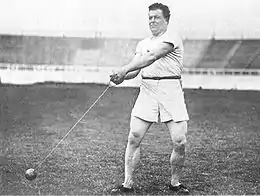 Irish American John Flanagan in the hammer throw competition at the Summer Olympics 1908 in London |
The "hammer" used in this sport is not like any of the tools also called by that name. It consists of a metal ball attached by a steel wire to a grip. The size of the ball varies between men's and women's competitions. (Full article...)
The men's hammer weighs 16 pounds (7.26 kg) and measures 3 feet 11+3⁄4 inches (121.3 cm) in length, and the women's hammer weighs 4 kg (8.82 lb) and 3 ft 11 in (119.4 cm) in length.[1] Like the other throwing events, the competition is decided by who can throw the implement the farthest.
Although commonly thought of as a strength event, technical advancements in the last 30 years have developed hammer throw competition to a point where more focus is on speed in order to gain maximum distance.
The throwing motion starts with the thrower swinging the hammer back-and-forth about two times to generate momentum. The thrower then makes three, four or (rarely) five full rotations using a complex heel-toe foot movement, spinning the hammer in a circular path and increasing its angular velocity with each rotation. Rather than spinning the hammer horizontally, it is instead spun in a plane that angles up towards the direction in which it will be launched. The thrower releases the hammer as its velocity is upward and toward the target.[2]
| More selected articles |
- "Hammer Throw". World Athletics. Archived from the original on November 19, 2021. Retrieved May 12, 2022.
- Johannsen, Dana (1 August 2021). "Tokyo 2020: Why the Olympic hammer throw may become a new national obsession". Stuff. Retrieved 1 August 2021.