Pinna bicolor
| Pinna bicolor | |
|---|---|
 | |
Scientific classification  | |
| Kingdom: | Animalia |
| Phylum: | Mollusca |
| Class: | Bivalvia |
| Order: | Pteriida |
| Family: | Pinnidae |
| Genus: | Pinna |
| Species: | P. bicolor |
| Binomial name | |
| Pinna bicolor Gmelin, 1791 | |
References
Pinna bicolor, also known as the razor clam or pen shell, is a species of large saltwater clam in the family Pinnidae. It is native to Natal, and is commonly found in shallow waters up to 50 meters deep.[1][2] It can be found embedded in firm muddy intertidal sediments, seagrass beds, and reef flats along continental and island shores.[2]
Description
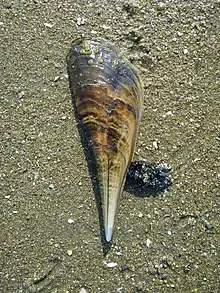
P. bicolor have thin, elongated triangular shells that narrow to a point and range in color from light yellow-brown to dark brown.[3] They are often overlooked as most of the shell is often buried with only about 2-3 cm of it sticking out of the ground. Glands near the buried end of the shell secrete byssus threads which allow the P. bicolor to attach itself to buried rocks and stones to anchor itself to the ground. When embedded in mud, the shell projects a fan shape as it is known to bury itself with the pointed end down.[4] This earns it the moniker of “razor clam” in Australia due the danger these strong shells pose to waders and their abundance at low tide.[2] With a bilaterally symmetric body, the shells of a P. bicolor have an average length of 40.0 cm with a maximum length of 50.0 cm.[1][5] Its major organs are small and located at the pointed end that is buried deep in the ground where it is difficult for most predators to reach.
Distribution
Inhabits tropical zones from 35oN-37oS and 29oE-154oW; occurs from the south and eastern African coasts, Madagascar, the Red Sea, the Persian Gulf and India as well as spanning from Japan to southern Australia and the whole East Indies. Generally absent from mid-oceanic islands such as those in the central Indian Ocean.[5] It occurs most commonly at depths of 20 meters at low population densities of 2-5 per square meter, likely because they occur in environments with low nutrient concentrations.[6] Their habitat temperatures generally range between 27-30oC and salinity ranges from 28-33 parts per thousand.[3] They sit partially embedded in firm muddy intertidal sediments, in seagrass beds, and atop reef flats along continental and island shores at depths of up to 50 meters.[2] Since this species is bottom-living, changes in environmental conditions have not impacted them much.[7]
Life History
P. bicolor are gonochoric and release their gametes into the water for external fertilization. These gametes form teleplanic veliger larva that may be carried a great distance by currents to propagate the species.[6] With an average growth rate of 1.42 centimeters per month, they can attain shell lengths of approximately 17, 25, and 30 cm in 1, 2, and 3 years respectively and can reach a reproductive size of 15 centimeters in shell length in just over a year.[3][8]
They are long-lived with low reproductive investment, a maximum age of 18 years, and have a low mortality rate.[5][6][8] Since there are no known external markers that depict age, the specimen ages of live pen shells can be determined by relating them to the total shell length.[3]
P. bicolor is a filter feeder and feeds on plankton and other small organisms.[9] At high tide, they slightly open their shells to generate a current of water and sieve out their food with enlarged gills then they tightly clamp to prevent water loss when the tide goes out.[3]
P. bicolor is an important species in marine ecosystems that have significant impact for other lifeforms as they prove to be both a habitat and food source. Pinna bicolor colonize diverse communities of plants and animals.[2] Seaweed and encrusting creatures often settle on the portions of the P. bicolor that stick out above the sand, even while they are alive. Such creatures include tiny crabs and shrimp which are known to utilize the clams as a shelter and food supply.[4]
Economic Value and Threats
P. bicolor are occasionally collected for food by coastal populations.[9] The flesh of the razor clam can be eaten although the size of the edible meat is trivial compared with the size of the shell.[2] Because of overfishing and habitat destruction, the clams have been listed as vulnerable in various regions. Although edible, the P. bicolor can be affected by red tide and other harmful algal blooms making it unsafe for human consumption.[4]
References
- "Pinna bicolor Gmelin 1791 - Encyclopedia of Life". eol.org. Retrieved 2023-04-17.
- "Pinna bicolor - Razor Clam". reeflifesurvey.com. Retrieved 2023-04-17.
- Idris, M. H.; Arshad, A.; Amin, S. M. N.; Japar, S. B.; Daud, S. K.; Mazlan, A. G.; Zakaria, M. S.; Yusoff, F. M. (6 July 2011). "Age, growth and length-weight relationships of Pinna bicolor Gmelin (Bivalvia: Pinnidae) in the seagrass beds of Sungai Pulai Estuary, Johor, Peninsular Malaysia: Age and growth of Pinna bicolor, Peninsular Malaysia". Journal of Applied Ichthyology. 28 (4): 597–600. doi:10.1111/j.1439-0426.2011.01807.x.
- "Fan clams". Wildsingapore.com. May 2020. Retrieved 14 April 2023.
{{cite web}}: CS1 maint: url-status (link) - "Pinna bicolor, Bicolor pen shell : fisheries". www.sealifebase.se. Retrieved 2023-04-17.
- de Gaulejac, Beatrice; Butler, A.; Vincente, N. (January 1993). "Ecology of the pterioid bivalves Pinna bicolor Gmelin and Pina nobilis L". Marine Life. 3 (1–2): 37–45 – via ResearchGate.
- Hullas, S. Sanchae; Stella, C.; Biruntha, Muniyandi; Priya, A.; Nagalakshmi, R. (2022-10-21). "Water quality assessment and occurrence of seagrass associated pen shell Pinna bicolor (Gmelin, 1791) and Pinna deltodes (Menke, 1843) in Pudupattinam Coastal Area, Palk Bay, South East Coast, India". Environmental Monitoring and Assessment. 195 (1): 6. doi:10.1007/s10661-022-10567-x. ISSN 1573-2959.
- Butler, A. J. (1987). "Ecology of Pinna bicolor gmelin (Mollusca : Bivalvia) in Gulf St Vincent, South Australia: density, reproductive cycle, recruitment, growth and mortality at three sites". Marine and Freshwater Research. 38 (6): 743–769. doi:10.1071/mf9870743. ISSN 1448-6059.
- "Pinna bicolor Bicolor Pen Shell, Common Razor Clam, Two-coloured Pen Shell". www.reeflex.net. Retrieved 2023-04-18.