Pavillion of the Prince of Orange (Tervuren)
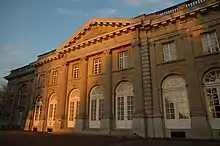
The Pavillion of Tervuren (Dutch: Paviljoen van Tervuren) was a summer palace of the Prince of Orange, constructed between 1817 and 1823. It was located in Tervuren, Belgium. After the Belgian Revolution, it was transferred to the new royal family. The former empress of Mexico, Charlotte of Belgium lived in the palace from 1867 till it burned down in 1879. Nowadays, the ‘Colonial Palace’ (Dutch: Koloniënpaleis) stands on its location, and is part of the Royal Museum for Central Africa.


.gif)

History
The prince of Orange: Pavillion of Tervuren
In the autumn of 1815, the former domains of Tervuren where granted to William, the prince of Orange and son of the King of the United Netherlands. [1][2] As Tervuren castle was demolished in 1782, he was allowed to construct a new summer palace at the expense of the Dutch treasury.[1][2] The Dutch crown prince received this grant as a gift from the nation in gratitude for his heroic conduct and achievements at the Battle of Waterloo.[1][2]
The new palace is located in the northwestern edge of the Park of Tervuren, the so-called Warande.[1][2] The park is further expanded to ensure sufficient privacy for the royal family.[1][2] Construction started in 1817 and it took five years to complete.[1][2]
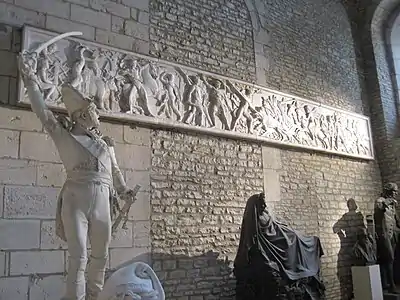
The new pavilion is lavishly furnished and decorated, including reliefs by the famous French sculptor François Rude, who was then living in exile in Brussels.[1][2] The building is surrounded by terraces and gardens.[1][2] To the east extends an Italianate garden decorated with neoclassical statues, including a Claudius Civilis, by the sculptor Jean-Louis Van Geel.[1][2]
Leopold II
After the Belgian Revolution, the Pavilion, together with the entire park of Tervuren, is confiscated and transfers to the Belgian state.[1][2] However, most of the furniture was returned to the Dutch royal family.
The Pavilion and the surrounding park is put under disposal of the new king, Leopold I, who transfers it to his eldest son and heir to the throne, Leopold II. Leopold II was very fond of Tervuren and considered at a certain point to live there permanently. Therefore, the Warande was further expanded through targeted purchases.[1][2]
Charlotte of Belgium
After her return to Belgium in the summer of 1867, Charlotte of Belgium, former Empress consort of Mexico and sister of Leopold II, moved into the pavilion for a few months.[1][2] However, the building appears to be insufficiently furnished and not well adapted to the cold season.[1][2] On 8 October 1867, Charlotte moves in with her brother and sister-in-law in the Palace of Laeken. She does not return to the adapted pavilion until May 1869. Thirty-seven persons are at her service, including five lackeys who serve her at the table. On the night of 2 March 1879, a fire breaks out in the pavilion.[1] Empress Charlotte is awakened in time by her ladies-in-waiting and escapes the flames. She then moves to Bouchout Castle, where she will stay until her death.[1]
Afterwards
The Pavillion burned down and was not rebuild. The park of Tervuren remained empty until 1897. At the instigation of Leopold II, the World Exhibition of 1897 took place simultaneously in Brussels and in Tervuren.[1][2] Here, a full-fledged department would bring the wealth and future prospects of the Congo Free State to the public's attention.[1][2] To make the colonial exhibition attractive and accessible, Tervuren was connected to the capital by a broad, 12-kilometre tree-lined avenue, flanked by a tram line that was also constructed for the occasion.[1][2] At the terminus of this avenue - the current Tervurenlaan - on the site of the burnt-down Pavilion of the prince of Orange, the Colonial Palace arose, a stylish neoclassical Louis XVI pavilion that was realized by Ernest Acker (1852-1912).[1][2] The pavilion was intended as an exhibition space and was framed by the so-called French gardens with impressive sight lines, ponds, staircases and statues designed by Keilig's successor, the French landscape architect Elie Lainé.[1][2] Lainé had made a name for himself in the 1870s as the designer of the "French" garden at Waddesdon Manor (Buckingshamshire, England) commissioned by Baron Ferdinand de Rothschild.[1][2] He was an exponent of the growing interest in the classical French garden à la Le Nôtre, which would grow into a real revival, mainly under the impulse of his compatriots Henri and Achille Duchêne.[1][2]
Royal Museum for Central Africa
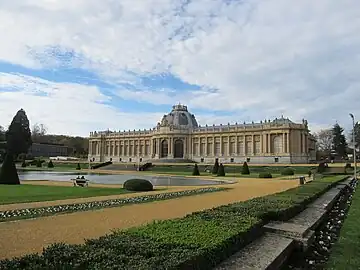
Due to its great success, the exhibition in the Colonial Palace has been given a permanent character as a museum since 1898.[1][2] However, the available space soon proved insufficient, so that Leopold II decided by decree of 3 December 1902 to build a new museum in which the overseas territories of Japan and China would also be discussed.[1][2] The entire project would be borne by the Independent Congo State.[1][2] The French architect Charles Girault (1851-1932), whose "Petit Palais" was particularly popular with Leopold II at the Paris World Exhibition of 1900, was commissioned to develop a prestigious concept that encompasses the entire Lokkaartsveld along the Leuvensesteenweg, including of the Colonial Palace site.[1][2] In addition to a museum, the ambitious project also provided an international conference center and a world school.[1][2] Following the death of Leopold II and the subsequent austerity policy, only the Congo Museum (1904-1909), the current Royal Museum for Central Africa, would be realized.[1][2]
References
- Wijnants, Maurits (1997). Van hertogen en Kongolezen. Tervuren en de Koloniale tentoonstelling 1897 (in Dutch). Tervuren: Koninklijk museum voor Midden-Afrika. p. 184. ISBN 90-75894090.
- "The Warande in Tervuren". www.onroerenderfgoed.be (in Dutch). Retrieved 6 May 2023.
Literature
- Davidts, Juul Egied (1981). Het Hertogenkasteel en de Warande van Tervuren (in Dutch). Tervuren: Gemeentebestuur Tervuren.
- Wijnants, Maurits (1997). Van hertogen en Kongolezen. Tervuren en de Koloniale tentoonstelling 1897 (in Dutch). Tervuren: Koninklijk museum voor Midden-Afrika. p. 184. ISBN 90-75894090.
