Money Shot: The Pornhub Story
Money Shot: The Pornhub Story is a 2023 Netflix documentary about Pornhub and its parent company MindGeek. It presents interview footage from sex workers, ex-Pornhub employees, journalists, and anti-sex-trafficking figures. The documentary focuses on a 2020 scandal over non-consensual pornography on Pornhub, including that of children, and how the aftermath affected pornographic performers.
| Money Shot: The Pornhub Story | |
|---|---|
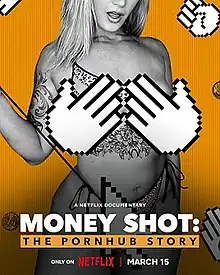 Promotional poster | |
| Directed by | Suzanne Hillinger |
| Produced by |
|
| Cinematography | Iris Ng |
| Edited by | Alexis Johnson |
| Music by | Kyle Scott Wilson |
Production company | Jigsaw Productions |
| Distributed by | Netflix |
Release date | March 15, 2023 |
Running time | 94 minutes |
| Country | United States |
| Language | English |
Netflix approached Jigsaw Productions about the film: director Suzanne Hillinger was keen for sex workers' opinions to be highlighted, feeling them to have been underrepresented in media coverage. Hillinger said that many figures in the pornographic industry were initially reluctant to participate. Cherie DeVille was skeptical but participated to present the narrative that anti-sex-trafficking groups had right-wing agendas. Ex-MindGeek employee Noelle Perdue worked as an archivist and fact-checker as well as being interviewed.
According to Rotten Tomatoes, most reviews of the documentary were positive. However, reviewers were divided on many topics, including the message, provenance, and pacing. Some critics called it neutral, but others saw it as pro-sex work. The focus on anti-sex-trafficking organizations' political aims was generally seen as a strength, but some reviews criticized a lack of depth to the interviews or unresolved contradictions between different views that are presented. Conclusions drawn by other reviewers include that Pornhub's content moderation was lacking and that there are issues with the concentration of money and power in the industry.
Synopsis

The documentary, which presents interview footage without narration, opens with some subjects recounting their first memories of watching pornography. It interviews sex workers and individuals associated with Pornhub, including former employees, journalists, and legal figures.
The Canadian corporation Pornhub began as a free tube site to watch pirated content, comparable to LimeWire for music or The Pirate Bay for movies. It was founded by three students of Concordia University and sold to Fabian Thylmann of MindGeek, a data company, in 2010. After Thylmann was convicted of tax evasion, Pornhub and MindGeek came under the control of Feras Antoon and David Tassillo and investor Bernd Bergmair. Pornhub gained traction through search engine optimization (SEO) and profited from advertisements and promotions. Pornographic performers were initially unhappy as they could not monetize content on Pornhub; this changed in 2018 with the Modelhub feature. Noelle Perdue is interviewed for the documentary: she worked for Pornhub for three years as a pornographic script writer, producer, and recruiter.
In 2020, Nicholas Kristof wrote the article "The Children of Pornhub" for The New York Times, on the topic of child victims of non-consensual pornography uploaded to Pornhub.[lower-alpha 1] Contemporaneously, the Christian non-profit Exodus Cry led a campaign, '#Traffickinghub', that opposed sex trafficking content on Pornhub. These events led Mastercard and Visa to disallow payment processing with the company and caused Pornhub to ban uploads by unverified users. Kristof's article had suggested three changes to Pornhub: require user verification, prevent user download, and increase content moderation. Siri Dahl—a pornographic performer—said these were "insanely reasonable" and measures that sex workers favored, but that these workers became the victims of the credit card company boycotts. Meanwhile, most of Pornhub's income came from banner ads.
Executives at Pornhub spoke at a hearing of the Parliament of Canada on non-consensual content on the website. Though MindGeek co-operates with the National Center for Missing & Exploited Children (NCMEC) to remove non-consensual content, an anonymous ex-employee describes that content moderators were expected to view at least 700 videos per day and could not thoroughly investigate content that had been reported. Lawyer Michael Bowe represents 30 clients in a civil lawsuit against Pornhub. The women state that the company is complicit in non-consensual pornography that featured them, including revenge porn, videos of rape, and videos of child sexual abuse. Bowe compares the company to The Sopranos, a program about a fictional criminal gang. Dani Pinter speaks against child sexual exploitation on Pornhub on behalf of the National Center on Sexual Exploitation (NCOSE). The sex workers interviewed comment that Exodus Cry is far-right, was founded by an Evangelical preacher, and wishes to end all sex work, while NCOSE—formerly Morality in Media—has similar roots.
The documentary shows parts of the filming, editing and organization involved in the work of Gwen Adora and Dahl, when performing alone and in a group scene. Both subjects raise issues that sex workers face. In October 2021, OnlyFans said that it would prohibit pornographic material. Adora says this left pornographic actors like her in financially insecure positions. Dahl comments that website censorship is an issue for sex workers: their accounts on Instagram can be shadow banned even if no sexual material is posted, and sites like OnlyFans ban words associated with consensual sexual activity, such as "pegging". Michael Stabile notes that MindGeek CEO Feras Antoon's mansion was burned down shortly after his location was mentioned in the Parliament of Canada, although the culprit and motive are not known. Perdue criticizes that Pornhub executives were unaware of the U.S. bill FOSTA-SESTA (2018), which affected legal sex workers. Allie Knox describes that changes to Craigslist increased danger to sex workers while making child traffickers harder to identify.
Interviewees
.JPG.webp)

- Gwen Adora, pornographic actress
- Asa Akira, pornographic actress and spokesperson for Pornhub
- Michael Bowe, legal representative for victims of non-consensual pornography on Pornhub
- Whitney Burgoyne, ex-Pornhub employee
- Siri Dahl, pornographic actress
- Cherie DeVille, pornographic actress
- Natassia Dreams, pornographic actress and spokesperson for Pornhub
- Wolf Hudson, pornographic actor
- Allie Knox, pornographic actress
- Nicholas Kristof, journalist for The New York Times
- Bree Mills, pornographic director
- Martin Patriquin, journalist for The Logic
- Noelle Perdue, ex-MindGeek employee
- Dani Pinter, spokesperson for the National Center on Sexual Exploitation
- Yiota Souras, spokesperson for the National Center for Missing & Exploited Children
- Michael Stabile, spokesperson for the Free Speech Coalition
Production
The documentary was released on streaming platform Netflix on March 15, 2023 in around 65 countries.[1][2] It was directed by Suzanne Hillinger and edited by her wife Alexis Johnson. Netflix approached Jigsaw Productions about making a documentary on Pornhub and corporate responsibility. The first scenes shot were with Bowe on the day he filed a legal complaint.[3]
Hillinger described the central focus as "what sexuality and consent means when billion-dollar internet platforms thrive on user-generated content". Hillinger aimed for it to facilitate "important conversations about sex and consent".[1] Hillinger said that issues with non-consensual content applied to the entirety of the internet, not just Pornhub.[4] According to Hillinger, NCOSE had "some questionable motives" but Pinter was knowledgeable, persuasive and did not refuse to answer difficult questions. Hillinger chose not to focus on the financial supporters of Exodus Cry or NCOSE, believing it would have distracted from larger themes of privacy, consent and free speech.[3]
Hillinger said that many ex-MindGeek employees had signed non-disclosure agreements (NDAs) with the company and were "really, really scared" to participate in the documentary. Adora put Hillinger into contact with Perdue, who was "rightly suspicious" at first.[3] In addition to being interviewed, Perdue served as an archivist and fact-checker for the documentary. She has written about sex work for newspapers including Slate, The Washington Post and Wired.[5] As a self-described "internet porn historian", Perdue hoped the documentary would cause viewers to feel a "sense of responsibility" and "engage further ... out of curiosity instead of shame or stigma".[5][4]
Hillinger wanted to center sex workers, feeling them to have been underrepresented in Kristof's op-ed and media reporting.[4] She did not give interviewees the right to approve the edited footage of them that was used. Hillinger said she opened conversations by acknowledging that subjects would be suspicious of her and stating that the documentary would not have a narrator. She suggested that Adora trusted her after reviewing her filmography and because of their shared queer identity.[3] Dahl gave positive feedback to the final product, saying that it succeeded in presenting the viewpoint of sex workers "in a way they never have been before" and sparked conversations about sex work and porn among the public.[2]
DeVille wrote in Rolling Stone that campaigns presenting as anti-sex-trafficking were right-wing, Christian, and anti-porn, and that Hillinger said the film would present this narrative. Though skeptical to be interviewed, DeVille agreed to participate, choosing to cover her skin and use soft colors to mitigate being portrayed as unintelligent or untruthful. Filming took place at a rented cottage outside Los Angeles over four hours. She said that she neither hated nor loved the film and did not regret her role in it.[6]
Adora's Instagram account was suspended on the day that Money Shot premiered and Hillinger's was suspended one week later.[7]
Reception
Netflix stated that in its first week, Money Shot was the fourth-most watched film on the platform, being streamed for 13 million hours. It reached the top ten in each country it was available in.[2] On review aggregator Rotten Tomatoes, which categorized 28 reviews as either positive or negative, the documentary holds an approval rating of 82%.[8] Out of five stars, it was rated 2.5 stars by News24 and two stars by The Indian Express and The Guardian.[9][10][11] While Barry Hertz suggested in The Globe and Mail that its pace was too slow,[12] Noel Murray of Los Angeles Times thought the documentary should have had a longer running time and GQ's Lucy Ford found it to have a broad scope.[13][14] Reviewers largely found the tone unsalacious.[10][15][9] However, Murray thought it contained sexually explicit details that were not relevant to the narrative.[13]
Views on the documentary's provenance were varied. It had a neutral position according to News24's Gabi Zietsman, but gave most screen time to adult industry workers.[9] In Variety, Owen Gleiberman praised the "no-fuss journalistic evenhandedness", in which the documentary gives "detached and sobering" analysis of anti-sex-trafficking campaigns' claims.[16] While Hertz said it had "no particular point of view as to the state of contemporary sex culture",[12] Peter Bradshaw of The Guardian believed the documentary took the side of sex workers as "creative entrepreneurs and heroes of consenting sensuality".[11] Polygon's Katie Rife wrote that the documentary has a "bold stance" that child sexual abuse material is not as widespread on Pornhub as anti-sex-trafficking campaigners claim.[17]
Rife said it covered a longstanding clash of feminist views on pornography, centering the underrepresented views of sex workers.[17] A criticism, given by The Daily Beast's Nick Schager, was that the depiction of pornography was misleadingly softcore.[15] In a review for Jezebel, Rich Juzwiak wrote that it "excels at teasing out the nuances" of the topic: industry workers are given a chance to explain the effects of anti-sex-trafficking measures on their lives, but Pornhub is also scrutinized for "grossly inadequate" content moderation.[18] Moreover, Murray approved the documentary as a thoughtful perspective on a complicated topic with continued relevance.[13]
In The Indian Express, Rohan Naahar criticized the "loose narrative" and lack of contributions from current Pornhub employees or anti-Pornhub campaigners.[10] For instance, as Bradshaw noted, Exodus Cry's Laila Mickelwait is not interviewed.[11] Similarly, Schager and Zietsman felt there was a lack of depth or investigative journalism,[15][9] and Hertz believed it suffered from an unresolved tension between the opposing views presented.[12] On the other hand, Juzwiak opined that the documentary succeeds in showing that "anti-sex operatives" are capitalizing on a legitimate backlash to sexual exploitation with a "narratively compelling" reveal of NCOSE's political agenda, albeit one that "somewhat confuses the message".[18] Schager believed that Pinter underplayed NCOSE's religious values and motives and Juzwiak said that Pinter's interviews fail to "disguise the actual agenda" of the organization.[15][18]
Naahar suggested that audience retention would be low as the documentary has "absolutely nothing new to contribute to an argument that has already been resolved". Naahar found it obvious that Pornhub had engaged in unethical behaviors, sex workers became "collateral damage" and the company's "damage control" was not virtuous.[10] Bradshaw wrote that a more interesting, unexplored question is whether Pornhub—and non-pornographic websites—are publishers or platforms, and what responsibility they have for content that they host.[11]
The title is a pun on the phrase money shot, referring to a cum shot in pornography, and the way that Pornhub raises revenue.[15] Ford lauded the decision to open with "the deeply unsexy reality" of Pornhub's use of data and advertising and the logistics of producing and editing sexual material. Ford suggested that the documentary's message is that pornography is a "capitalist monopoly" dictated by economic factors.[14] Rife saw it to have a persuasive opposition to the concentration of unaccountable power in the hands of "tech bros and venture capitalists".[17]
Notes
- Kristof, Nicholas (December 4, 2020). "The Children of Pornhub". The New York Times.
References
- Spangler, Todd (February 15, 2023). "Netflix Sets Pornhub Documentary 'Money Shot' Premiere Date". Variety. Archived from the original on March 7, 2023. Retrieved April 8, 2023.
- Turner, Gustavo (March 21, 2023). "Pornhub Doc 'Money Shot' is 4th Most Watched Netflix Movie Worldwide". XBIZ. Archived from the original on March 27, 2023. Retrieved April 9, 2023.
- Bright, Susie (March 16, 2023). "The Truth About Pornhub". Book and Film Globe. Archived from the original on March 27, 2023. Retrieved April 8, 2023.
- Horton, Adrian (March 15, 2023). "'The story is really complicated': inside the controversial world of Pornhub". The Guardian. Archived from the original on April 7, 2023. Retrieved April 8, 2023.
- Tisdale, Jennifer (March 15, 2023). "Noelle Perdue, a Porn Historian, Lends Her Expertise to 'Money Shot: The Pornhub Story'". Distractify. Archived from the original on March 22, 2023. Retrieved April 8, 2023.
- DeVille, Cherie (March 11, 2023). "Why I Chose to Appear in Netflix's Controversial Pornhub Documentary". Rolling Stone. Archived from the original on March 30, 2023. Retrieved April 8, 2023.
- Turner, Gustavo (March 23, 2023). "Instagram Deplatforms Director of Netflix's Pornhub Documentary 'Money Shot'". XBIZ. Archived from the original on April 5, 2023. Retrieved April 9, 2023.
- "Money Shot: The Pornhub Story". Rotten Tomatoes. Archived from the original on March 22, 2023. Retrieved April 8, 2023.
- Zietsman, Gabi (March 20, 2023). "Its title may be the most salacious thing about Netflix's bare minimum doccie Money Shot". News24. Archived from the original on March 29, 2023. Retrieved April 8, 2023.
- Naahar, Rohan (March 18, 2023). "Money Shot The Pornhub Story movie review: New Netflix documentary takes timid approach to potentially scandalous story". The Indian Express. Archived from the original on March 20, 2023. Retrieved April 8, 2023.
- Bradshaw, Peter (March 11, 2023). "Money Shot: The Pornhub Story review – doc can't find a point of view". The Guardian. Archived from the original on April 7, 2023. Retrieved April 8, 2023.
- Hertz, Barry (March 17, 2023). "Five things to stream this weekend: Netflix's Money Shot: The Pornhub Story offers skin-deep look at internet's dirtiest little secret". The Globe and Mail. Archived from the original on April 7, 2023. Retrieved April 8, 2023.
- Murray, Noel (March 20, 2023). "Review: Keira Knightley pursues the 'Boston Strangler' in Hulu journalistic thriller". Los Angeles Times. Archived from the original on April 4, 2023. Retrieved April 8, 2023.
- Ford, Lucy (March 15, 2023). "The deeply unsexy truth at the centre of Netflix's Money Shot". GQ. Archived from the original on March 25, 2023. Retrieved April 8, 2023.
- Schager, Nick (March 11, 2023). "How Pornhub Became Public Enemy Number One for Christian Crusaders". The Daily Beast. Archived from the original on March 30, 2023. Retrieved April 8, 2023.
- Gleiberman, Owen (March 11, 2023). "'Money Shot: The Pornhub Story' Review: A Netflix Documentary Explores the World's Reigning Porn Site and the Clampdown On It". Variety. Archived from the original on March 29, 2023. Retrieved April 8, 2023.
- Rife, Katie (March 15, 2023). "Netflix's Pornhub documentary is out to radicalize and weaponize porn fans". Polygon. Archived from the original on March 23, 2023. Retrieved April 8, 2023.
- Juzwiak, Rich (March 14, 2023). "Pornhub, Exploitation, and the Casualties of an Anti-Sex Crusade". Jezebel. Archived from the original on April 5, 2023. Retrieved April 8, 2023.
Further reading
- Bradley, Sian (March 15, 2023). "How Pornhub became the front line of the war on sex work". Dazed.
- Corbett, Erin (March 15, 2023). "The History of Pornhub: A Timeline of How It Started and Where It Stands Now". Netflix.