How to Blow Up a Pipeline (film)
How to Blow Up a Pipeline is a 2022 American environmentalist action-thriller film directed by Daniel Goldhaber, who co-wrote the screenplay with Ariela Barer and Jordan Sjol.[4] It relies on ideas advanced in Andreas Malm's 2021 book of the same name, published by Verso Books.[4][5] It stars Barer, Kristine Froseth, Lukas Gage, Forrest Goodluck, Sasha Lane, Jayme Lawson, Marcus Scribner, Jake Weary and Irene Bedard.[4]
| How to Blow Up a Pipeline | |
|---|---|
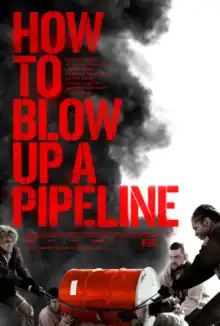 Theatrical release poster | |
| Directed by | Daniel Goldhaber |
| Written by |
|
| Based on | How to Blow Up a Pipeline by Andreas Malm |
| Produced by |
|
| Starring | |
| Cinematography | Tehillah De Castro |
| Edited by | Daniel Garber |
| Music by | Gavin Brivik |
Production companies |
|
| Distributed by | Neon |
Release dates |
|
Running time | 104 minutes[1] |
| Country | United States |
| Language | English |
| Box office | $856,530[2][3] |
Malm's book is a work of nonfiction that uses a history of social justice movements to argue that property destruction should be considered a valid tactic in the pursuit of environmental justice.[6] The film, set primarily in West Texas, revolves around a fictional group of eight young people who decide to blow up an oil pipeline in two key locations.[4] It was released in the United States on April 7, 2023.[7]
Plot
Theo and Xochitl, lifelong friends from Long Beach, California, a heavily polluted city with multiple oil refineries, witness the effects of climate change when Xochitl's mother dies during a heat wave. Disillusioned by the slow progress of their campus divestment campaign, Xochitl expresses interest in more radical environmental action to Theo, who is diagnosed with leukemia. They recruit Theo's girlfriend Alisha for support and gather a group of five strangers with their own motivations: Dwayne, who becomes radicalized against an oil company due to abuse of eminent domain laws threatening his family's homestead; Shawn, a documentary crew member who meets Xochitl during college protests advocating for divestment; Michael, a Native American from a North Dakota reservation with a history of challenging oil rig workers; and Rowan and Logan, a reckless couple. Together, they form a plan to blow up an oil pipeline in West Texas.
Cast
- Ariela Barer as Xochitl
- Kristine Froseth as Rowan
- Lukas Gage as Logan
- Forrest Goodluck as Michael
- Sasha Lane as Theo
- Jayme Lawson as Alisha
- Marcus Scribner as Shawn
- Jake Weary as Dwayne
- Irene Bedard as Joanna
Production
According to director and producer Goldhaber, the production of the film spanned 19 months, from conception to completion and premiere. Goldhaber worked alongside a team of seven credited producers.[8]
Goldhaber collaborated with Jordan Sjol and actor Ariela Barer to co-write the screenplay, completing it within four months after two months of research.[8] Casting meetings commenced even before the script was finalized. Despite initial challenges in securing financial backing, Goldhaber and Barer successfully obtained support from a financier acquainted with Goldhaber during the Cannes Film Festival.[9]
Filming spanned 22 days, primarily in New Mexico, with a key sequence filmed in North Dakota on the reservation where actor Forest Goodluck's family lived.[9] Additional scenes were shot in California. The filmmakers opted for 16 mm film to capture the desired quality in daylight exterior scenes, and to give the footage a more cinematic feel. The shooting ratio averaged around 21 or 22 to one.[8]
Extensive conversations with individuals involved in direct action were held to ensure accuracy and authenticity. The team also collaborated with a government contractor specializing in counterterrorism for realistic depictions of bomb-making scenes, while certain steps were omitted for dramatic purposes. The film's explosion sequence combined practical effects with CGI augmentation. A structure made of industrial cardboard and wood was detonated to create the desired explosive and fire effects. Post-production involved six months of editing.[9]
Release
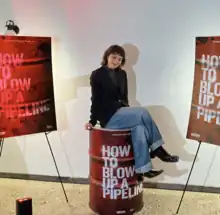
The film premiered in the Platform Prize program at the 2022 Toronto International Film Festival on September 10, 2022.[10][11] A few days after its premiere, Neon acquired the North American distribution rights, intending to release it theatrically.[12][13] It was released in the United States on April 7, 2023,[7] and set to be released in the United Kingdom and Ireland on April 21.[14] Gavin Brivik wrote its score.[15]
Reception
On the review aggregator website Rotten Tomatoes, the film has an approval rating of 94%, based on 140 critic reviews with an average rating of 7.8/10. Its critical consensus reads, "An explosive adaptation of Andreas Malm's treatise, How to Blow Up a Pipeline delivers a high-stakes eco-thriller ignited by riveting and complex antiheroes."[16] Metacritic, which uses a weighted average, assigned a score of 77 out of 100, based on 28 reviews indicating "generally favourable reviews".[17]
In a review for The New York Times, Peter C. Baker called the film a "cultural landmark" for its uniquely sympathetic portrayal of ecoterrorism.[18] In another review for the newspaper, Ben Kenigsberg wrote that the film “has a degree of suspense and efficiency that are becoming all too rare in the mainstream.” However, he criticized it for packaging itself as having a deeper message while avoiding grappling with the characters' ideologies. He also questioned the placement of flashbacks, which he noted seem to serve primarily as plot twists, and suggested that the film's clean plotting and sympathetic motives undermine its confrontational goals.[19]
In his review for RogerEbert.com, Matt Zoller Seitz gave the film 3.5 out of 4 stars, praising it as "one of the most original American thrillers in years." Seitz commends the film for its thought-provoking nature and its exploration of the moral and psychological challenges faced by individuals involved in underground activist movements. He notes that the film's presentation of its central characters, a group of young American self-described "terrorists," is likely to make it controversial. Seitz highlights the film's ability to connect various systemic problems and lauds its meticulous approach in shedding light on these issues. He also commends the performances of the cast, particularly Jayme Lawson and Forrest Goodluck.[20] Film critic Brian Tallerico praised How to Blow Up a Pipeline as a unique and intense film that breaks away from the polished mainstream. He highlighted the personal passion of director Daniel Goldhaber, who brings a gritty texture and a sense of urgency to the film. Tallerico noted that the film effectively transforms the concept of climate change into a thrilling heist narrative, and that he believed it would resonate with younger viewers and contribute to the ongoing climate change conversation.[21]
According to the Washington City Paper, the film is not an instruction manual but "a way to illuminate genuine moral objections".[22] A pair of reviews in The Guardian by Wendy Ide and Peter Bradshaw each gave the film four out of five stars; Ide wrote that the film functions as both a "nervy thriller" and "a lightning rod for the mounting anger of climate-conscious audiences",[15] while Bradshaw found it "fiercely watchable".[14]
Themes
Peter C. Baker of The New York Times highlighted the film's examination of uncertainty and the question of how future generations will judge present actions. He noted the sympathetic treatment of the protagonists and the deliberate creation of a historical feel, and underscores the film's emphasis on the moral stakes of decision-making and the unpredictable nature of the future.[18] How to Blow Up a Pipeline supports the book's argument that the climate threat justifies sabotage as self-defense against powerful energy interests. Through the protagonists' perspective, the film raises questions about the validity of extreme actions in addressing the urgent climate crisis.[9]
References
- "How to Blow Up a Pipeline". British Board of Film Classification. Retrieved March 1, 2023.
- "How to Blow Up a Pipeline". The Numbers. Retrieved May 5, 2023.
- "How to Blow Up a Pipeline". Box Office Mojo. Retrieved May 5, 2023.
- Kuplowsky, Peter. "How to Blow Up a Pipeline". Archived from the original on August 14, 2022. Retrieved August 25, 2022.
- Malm, Andreas (January 5, 2021). How to Blow Up a Pipeline: Learning to Live in a World on Fire. ISBN 9781839760259. Archived from the original on October 29, 2020. Retrieved August 25, 2022.
- Kunkel, Benjamin (May 26, 2021). "The Climate Case for Property Destruction". The New Republic. Archived from the original on September 13, 2021. Retrieved August 25, 2022.
- Lattanzaio, Ryan (March 2, 2023). "'How to Blow Up a Pipeline' Trailer: Neon's Environmental Thriller Is Off the Rails". Indiewire. Retrieved March 2, 2023.
- Rizov, Vadim (September 12, 2022). "19 Months from Conception to Completion: Daniel Goldhaber on How to Blow Up a Pipeline | Filmmaker Magazine". Filmmaker Magazine | Publication with a focus on independent film, offering articles, links, and resources. Retrieved April 12, 2023.
- Rapold, Nicolas (April 14, 2023). "How to Build an Environmental Thriller in Five Not-So-Easy Steps". The New York Times. ISSN 0362-4331. Retrieved May 20, 2023.
- Vlessing, Etan (August 3, 2022). "Toronto Film Festival: Emily Bronte Movie 'Emily' to Open Platform Competition". The Hollywood Reporter. Archived from the original on August 26, 2022. Retrieved August 25, 2022.
- Kay, Jeremy (August 3, 2022). "Frances O'Connor's 'Emily' to open TIFF Platform alongside films from Maïmouna Doucouré, Rima Das". Archived from the original on August 5, 2022. Retrieved August 25, 2022.
- Ravindran, Manori (September 13, 2022). "Neon Buys TIFF Environmental Thriller How to Blow Up a Pipeline". Variety. Penske Media Corporation. Archived from the original on September 13, 2022. Retrieved September 13, 2022.
- Ritman, Alex (September 13, 2022). "TIFF: Neon Acquires Eco-Terrorist Thriller 'How to Blow Up a Pipeline'". The Hollywood Reporter. Retrieved February 3, 2023.
- Bradshaw, Peter (April 20, 2023). "How to Blow Up a Pipeline review – explosively Tarantino-esque eco thriller". The Guardian. ISSN 0261-3077. Retrieved April 23, 2023.
- Ide, Wendy (April 23, 2023). "How to Blow Up a Pipeline review – a gripping, of-the-moment eco-thriller". The Guardian. ISSN 0029-7712. Retrieved April 23, 2023.
- "How to Blow Up a Pipeline". Rotten Tomatoes. Archived from the original on March 4, 2023. Retrieved April 9, 2023.
- "How to Blow Up a Pipeline". Metacritic. Archived from the original on March 4, 2023. Retrieved April 9, 2023.
- Baker, Peter C. (April 5, 2023). "Will We Call Them Terrorists?". The New York Times. ISSN 0362-4331. Retrieved April 5, 2023.
- Kenigsberg, Ben (April 6, 2023). "'How to Blow Up a Pipeline' Review: A Different Kind of Oil Boom". The New York Times. ISSN 0362-4331. Retrieved May 19, 2023.
- Seitz, Matt Zoller. "How to Blow Up a Pipeline movie review (2023) | Roger Ebert". RogerEbert.com. Retrieved May 20, 2023.
- Tallerico, Brian. "TIFF 2022: How to Blow Up a Pipeline, Sisu, Blueback | Festivals & Awards | Roger Ebert". RogerEbert.com. Retrieved May 20, 2023.
- Zilberman, Alan (April 5, 2023). "See a Climate Crisis Thriller in How to Blow Up a Pipeline - WCP". Washington City Paper. Retrieved April 5, 2023.