History of Spanish slavery in the Philippines
Slavery was widespread in the Philippine islands before the archipelago was conquered by the Spanish Empire. It was also common during Spanish rule.[1] Policies banning slavery that the Spanish crown established for its empire in the Americas were not extended to its territories in the Spanish East Indies, which included the Philippines. The Viceroyalty of New Spain (Mexico) ruled the Philippines administratively, and the terminus of the Manila galleon in Acapulco saw the importation of Filipino slaves to Mexico, who were labeled chinos.
Spanish Crown policies regarding the favorable treatment of indigenous populations of the Americas were passed very early, while the prohibition of slavery of Asians was not enforced in the Americas until the 18th century, when African and Asian slavery was beginning to be outlawed altogether.[2]
Enslavement of compatriots by native Filipinos
Pre-hispanic Filipino society was composed of barangays with small populations and low production levels. In order to exploit the rich natural resources of the country, the ruling datus increased available manpower by not limiting legal penalties to fines but also including labor service penalties. Creditors did the same for debtors not having properties to offer as collateral. Manpower scarcity also brought wars to widen a barangay's territories and to acquire captives who could be indentured. These were termed alipin in Tagalog or oripun in Visayan and were traded legally from one owner to another. The people under a datu, except for his personal supporters called timawa who accompanied him in wars, also paid him tributes. This remained generally true during Spanish colonization and in the early part of Spanish colonial Philippines as the Spanish East Indies.
Slavery in Spanish-ruled Philippines
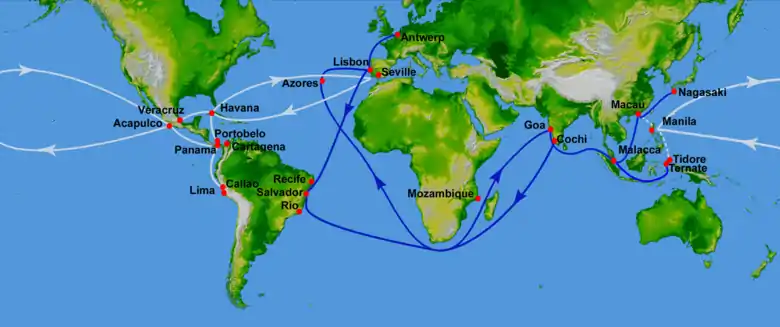
When Spaniards conquered the archipelago, many Spaniards seized natives in various parts of the country. Filipino slaves were taken to New Spain and were called “chinos esclavos”.[3]
Filipinos could be kept as slaves in the Spanish territories, while natives of the new world were forbidden to be made slaves of. Only after, during the 17th century were new laws written against slavery of all peoples. Later on, the division of Luzon into encomiendas created a form of compulsory work for the encomenderos, who were given the responsibility of evangelizing the natives working for them. Many held workers for household chores. However, it is arguable whether these workers were slaves in the common sense of the word. A Portuguese visitor noted that there was no Spanish soldier who did not have a Indio chino or native worker. Even the religious houses held at least one. The king, however, after hearing about this, appointed a minister, called the Protector of the Indios, to investigate and restore the liberty of possible slaves. It seemed unfair to encomenderos to generally abolish slavery though as it would cause economic disruption.
There were also many foreign African slaves employed in Manila and in the provinces. Some of them were also resold in Mexico with the Asian slaves during the time of the Manila Galleon Trade to cover transportation costs.[4]
Spaniards considered it legitimate to enslave non-Christian captives from wars and trade them legally in the past. This is because they did not consider this as an uncivilized and unchristian act because they believed that men were not created equal and the inferior men may be ruled by the superior ones. Many Filipino slaves were taken on ships to New Spain and sold as slaves in Acapulco.[5]
There were two major types of slaves: the esclavos negros who were Africans purchased from Portugal, and the esclavos chinos, or Filipino slaves.[6] and were usually sold in public auctions. People from both the middle and the upper classes bought them, as well as the clergy.
End of slavery in the Philippines
Although the Spanish enforced laws to end slavery in the East Indies during the 18th century, they did not include laws that may end the native Philippine slavery between the Filipinos. Although it was not completely abolished, it underwent considerable changes during the Spanish occupation. The mangangayaw raids, which were the raiding of barangays for obtaining slaves and territories, disappeared. Tyrannical enslavement also disappeared since the datus were forced to free their slaves and the exchange of slaves in the weddings was not allowed after most Filipinos were converted to Christians. By the middle of the 18th century, Philippine slavery disappeared in areas under the Spanish control. In areas that were not under the Spanish control like mountains in Mindanao and Cordillera, however, it was still present.
Spanish slavery, on the other hand, declined in the Philippines with the decline of slavery in Spain and Latin America. It was abolished in Spain and Mexico in the 1820’s, when Spanish liberals took power and reimposed the Spanish Constitution of 1812 on Ferdinand VII and during the independence of the Mexican Empire, in Puerto Rico in 1873, and in Cuba in 1886. It was completely abolished after industrialization in all places took place during the nineteenth century.
See also
References
- Seijas 2014, p. 39
- Seijas 2014, p.
- Seijas 2014, p.
- Seijas 2014, p.
- Seijas 2014, p.
- Seijas 2014, p.
Bibliography
- Renato Constantino, The Philippines: A Past Revisited (Quezon City 1975)
- William Henry Scott, Slavery in the Spanish Philippines (1991)
- "Maharlika and the ancient class system", Pilipino Express Website, Dec 9, 2014, Web
Further reading
- Arcilla, José S. "Slavery, Flogging and Other Moral Cases in 17th century Philippines,," Philippine Studies 20, no. 3 (1972) 399–416.
- Cushner, Nicholas P. Landed Estates in the Colonial Philippines. Vol 20. New Haven: Yale University Press Southeast Asia Studies 1976.
- Garvan, John M. The Negritos of the Philippines. Wiener Beitrage zur Kulturgeschichte und Linguistik. Horn: F. Berger 1964.
- Hidalgo Nuchera, Patricio. "Esclavitud o liberación? El fracaso de las actitudes esclavistas de los conquistadores de Filipinas." Revista Complutense de Historia de América 20 (1994) 61.
- Luengo, Josemaria Salutan. A History of the Manila-Acapulco Slave Trade, 1565-1815. Tubigon, Bohol: Mater Dei Publications 1996.
- Phelan, John Leddy. The Hispanization of the Philippines: Spanish Aims and Filipino Responses, 1565-1700. Madison: University of Wisconsin Press 1959.
- Salman, Michael (2003). The Embarrassment of Slavery: Controversies Over Bondage and Nationalism in the American Colonial Philippines. University of California Press. pp. 10–11. ISBN 9780520240711.
- Salman, Michael. "Resisting Slavery in the Philippines: Ambivalent Domestication and the Reversibility of Comparisons," Slavery & Abolition 25 no. 2 (2004) 30.
- Schurz, William. The Manila Galleon. New York: E.P. Dutton 1939, 1959.
- Schwalbenberg, Henry M. "The Economics of Pre-Hispanic Visayan Slave Raiding," Philippine Studies 42, no. 3 (1994) 376-84.
- Scott, William Henry. Slavery in the Spanish Philippines. Manila: De La Salle University Press 1991.
- Seijas, Tatiana. Asian Slaves in Colonial Mexico: From Chinos to Indians. New York: Cambridge University Press 2014.
- Villiers, John. "Manila and Maluku: Trade and Warfare in the Eastern Archipelago, 1580-1640". Philippine Studies 34 no. 2 (1986).