Gölpınar, Şanlıurfa
Gölpınar is a village in Turkey's Şanlıurfa Province, located about 15 km (9.3 mi) north of Urfa in the Karaköprü district.[2]: 17 It is located just south of the road to Kabahaydar, 2 km (1.2 mi) east of the road's intersection with the main Urfa-Siverek highway.[2]: 17 It lies on a plain that stretches east toward Kabahaydar, between the Akziyaret Tepe hill to the north and the forested hills called Atatürk Ormanı (part of Germuş Dağ) to the south.[2]: 17 There is a spring in the east of the village.[2]: 17
Gölpınar | |
|---|---|
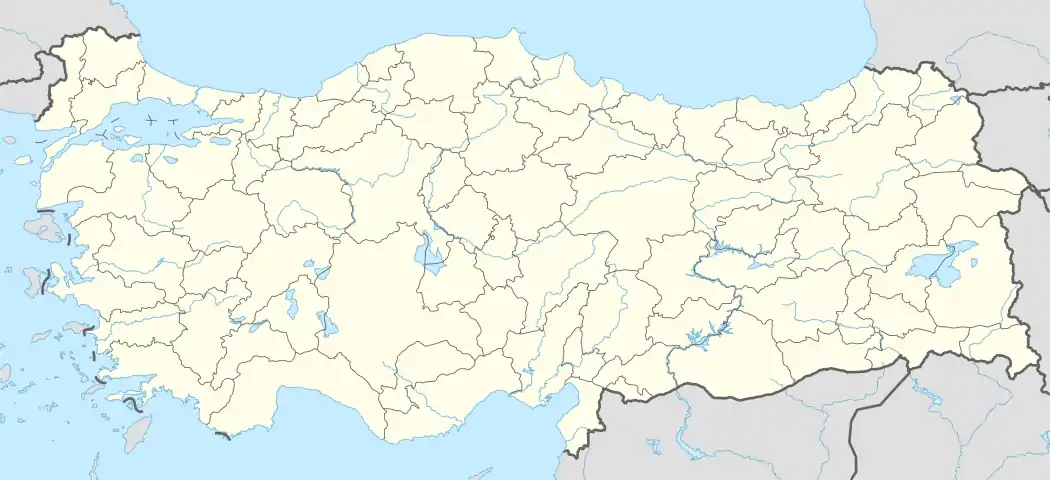  Gölpınar Location in Turkey | |
| Coordinates: 37.28569°N 38.8265°E[1] | |
| Country |  Turkey Turkey |
| Province | Şanlıurfa |
Archaeology
The village sits on top of a small archaeological mound about 250 m in diameter and 10 m in height.[2]: 17 In some places, erosion from the spring has revealed basalt architectural fragments.[2]: 17 Old relief fragments are also visible in the walls of some houses.[2]: 17 Two ancient stone artifacts were found at Gölpınar: one is a broken stele, 116 cm tall and 42 cm wide, is now kept at the Şanlıurfa Museum; the other is an orthostat measuring 116x75x20 cm.[2]: 17–8 F. Kulakoğlu dated the stele to approximately the 8th century BCE and the orthostat to about the late 10th century BCE.[2]: 17–8 The stele depicts a male figure riding on a bull; the upper part of the male figure is missing.[2]: 18 He is wearing a short skirt with a wide belt and traditional Hittite shoes with upturned tips.[2]: 18 Attached to his belt is a sword.[2]: 18 The orthostat depicts a male figure riding a deer, also in a Hittite-like style with the head and lower body in profile but the torso shown head-on.[2]: 18 In this case, his head is missing except for his beard.[2]: 18 He is wearing a short-sleeved robe with a wide belt; attached to the belt is a short sword with a crescent-shaped hilt.[2]: 18 He is holding a bow in his left hand and two arrows in his right.[2]: 18 This imagery is associated with a god who was protector of the countryside.[2]: 18
References
- "Geonames Search". Do a radial search using these coordinates here.
- Çelik, Bahattin (2008). Arkeoloji'de Urfa (PDF). Istanbul: Fsf Printing House. ISBN 978-975-585-992-7. Retrieved 8 November 2022.