Coleophora leucochrysella
The chestnut casebearer moth (Coleophora leucochrysella) was a species of moth in the family Coleophoridae. It was endemic to the United States, where it was found in Indiana, Pennsylvania, and Virginia.[2] It was a highly specialized species, its larvae fed specifically on the leaves of the American Chestnut. It is thought the species became extinct when many of these trees died due to an infection of the fungus Cryphonectria parasitica, which was accidentally introduced from Asia around 1900.[3]
| Chestnut Casebearer Moth | |
|---|---|
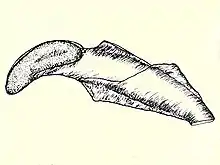 | |
| Larval case | |
Scientific classification  | |
| Kingdom: | Animalia |
| Phylum: | Arthropoda |
| Class: | Insecta |
| Order: | Lepidoptera |
| Family: | Coleophoridae |
| Genus: | Coleophora |
| Species: | †C. leucochrysella |
| Binomial name | |
| †Coleophora leucochrysella Clemens, 1863 | |

References
- World Conservation Monitoring Centre (1996). "Coleophora leucochrysella". IUCN Red List of Threatened Species. 1996: e.T5111A11115175. doi:10.2305/IUCN.UK.1996.RLTS.T5111A11115175.en. Retrieved 17 November 2021.
- "Species Profile for Chestnut casebearer moth".
- Extinct species Archived 2011-09-27 at the Wayback Machine
Sources
- World Conservation Monitoring Centre (1996). "Coleophora leucochrysella". IUCN Red List of Threatened Species. 1996: e.T5111A11115175. doi:10.2305/IUCN.UK.1996.RLTS.T5111A11115175.en.
This article is issued from Wikipedia. The text is licensed under Creative Commons - Attribution - Sharealike. Additional terms may apply for the media files.