Boston Health Care for the Homeless Program
Boston Health Care for the Homeless Program, also known as Boston Healthcare for the Homeless, Healthcare for the Homeless, and BHCHP, is a health care network throughout Greater Boston that provides health care to thousands of homeless and formerly homeless individuals and families.
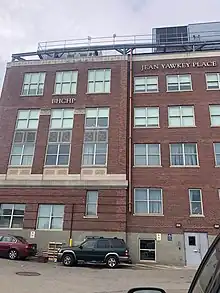 | |
| Abbreviation | BHCHP |
|---|---|
| Formation | 1985[1] |
| Founder | Kip Tiernan, Barbara McInnis, Jim O'Connell[2][3] |
| Founded at | Pine Street Inn |
| 04-3160480 | |
CEO | Dr. Stephanie Sullivan[4] |
Chief Medical Officer | Dr. Jessie M. Gaeta[5][6] |
President | Dr. Jim O’Connell[7] |
| Award(s) | American Academy of Physician Assistants’ Caring for Communities Award[8] |
| Website | https://www.bhchp.org/ |
Origin
Funding
In 1984, the city of Boston received funding for a homeless healthcare pilot program, one of nineteen that was funded across the country by The Robert Wood Johnson Foundation and the Pew Charitable Trust.[9]
In 1987, Congress passed the Stewart B. McKinney Homeless Assistance Act, making BHCHP a federally qualified health center funded by the Health Resources and Services Administration’s Bureau of Primary Health Care.[10]
Founding providers
In 1985, a small group of 7 professionals led by Dr. James O’Connell worked together to initiate dedicated and coordinated clinical services for homeless people. They built health care centers in homeless shelters and hospitals utilizing a rotating team that worked in multiple settings.[11]
O'Connell is the founding physician and president of Boston Health Care for the Homeless. He initially agreed to the role of founding physician as a temporary favor to the City of Boston but stayed with and grew BHCHP substantially over the last forty years.[12][13][14]
O'Connell was trained by Barbara McInnis, a nurse at the Pine Street Inn clinic, whose ideology was foundational to BHCHP. McInnis taught O'Connell the value of spending time soaking patients' feet before interjecting medical expertise. Foot-soaking is still offered to homeless people at the BHCHP clinic at St. Francis House, the largest day shelter in Massachusetts.[15][16][17][18]
Electronic medical records systems
In 1996, BHCHP became the first homeless organization in the United States to implement a computerized electronic medical record (EMR) system, which was designed and built by the Laboratory of Computer Science at Massachusetts General Hospital.[19][20]
In 2019, the organization announced a partnership with Netsmart to implement a new electronic medical record specifically designed for tracking and coordinating addiction treatment.[21][22][23]
Haiti earthquake response
The 2010 Haiti earthquake caused 300,000 people to become injured and 1.5 million people to become homeless. BHCHP's Director of Development at the time, Cheryl Kane, RN, reached out to a hospital she was connected with in Haiti and asked how the organization could help. The hospital expressed they needed doctors and nurses. 41 providers from BHCHP volunteered to go to Haiti, each for a week, to treat people impacted by the earthquake. Medical volunteers spent 17 to 18 hours a day caring for patients. Providers from BHCHP were comfortable working in the makeshift environments set up to care for patients because they were already accustomed to treating patients in nontraditional settings. Barry Bock, the chief operating officer at the time, stated he was amazed at the way the Haitian people cared for each other in crisis, despite many of them meeting for the first time.[24][25]
Medical respite programs
BHCHP has demonstrated the effectiveness of the medical respite model for homeless people.[26] Respite centers allow people who are homeless to recuperate and heal in a safe, clean place after major hospital treatments, rather than discharging them to the streets. Respite centers within the organization have helped stabilize clients in a less traumatic environment than hospitals,[27] reduce readmissions and over-utilization of emergency rooms,[28] and improve overall health outcomes for homeless and formerly homeless individuals.[29]
Lemuel Shattuck Respite
In 1985, Boston Health Care for the Homeless Program, led by Dr. Jim O'Connell opened the first medical respite for homeless individuals in the United States at the Lemuel Shattuck Shelter, beginning with five beds and expanding to 25 beds.[30][31]
Barbara McInnis House
In 1993, Boston Healthcare for the Homeless program opened the Barbara McInnis House respite center, named in honor of Barbara McInnis, a veteran nurse and tuberculosis specialist who pioneered providing treatment for people living in shelters.[32][33] The facility helps over 2,200 patients a year stay off the street and out of congregate settings while they recover from acute illnesses and medical procedures. McInnis House also serves undocumented, terminally ill, homeless people with dignified end-of-life care.[34] In 2008, McInnis House expanded, moving from a former nursing home in Jamaica Plain to the Jean Yawkey Place clinic in the South End.[32][35]
Stacy Kirkpatrick House
In 2016, BHCHP opened the Stacy Kirkpatrick House, a 20-bed medical respite in the former location of Barbara McInnis House.[36] It was named for Stacy Kirkpatrick, a beloved BHCHP nurse of 16 years who passed away from cancer.[37] The building is also home to Francis Grady Apartments, 30 studio units for formerly homeless men and women, along with onsite case management and behavioral health services.[38]
Outbreak of bacterial meningitis
In 2016, an outbreak of fatal bacterial meningitis occurred amongst the City of Boston's homeless population, especially in shelters. Centers for Disease Control and Prevention (CDC) investigated the outbreak and found close contact over a series of hours to be a risk factor. Close contact is difficult to avoid in congregate settings, such as shelters. Healthcare for the Homeless responded to the crisis by vaccinating 2,400 people in two weeks and providing antibiotics to infected and high-risk patients. Healthcare for the Homeless in collaboration with the Boston Public Health Commission and the CDC implemented contact tracing and provided preventative antibiotics to people who had close contact with diagnosed patients for extended periods of time.[39][40][41][42]
Street outreach
Rationale
In 1985, Dr. Jim O'Connell recognized that the majority of deaths of homeless people were occurring among "rough sleepers", people who sleep outside rather than in shelters. At the time, there was a tuberculosis outbreak that could only be treated by a structured medical regimen, unrealistic to be adhered to by rough sleepers. These factors drove O’Connell and fellow medical workers at the Pine Street Inn and the former Boston City Hospital to practice street medicine, traveling to where clients resided outside to treat them.[43][2]
Early efforts and funding
In 1986, the Massachusetts government funded the first outreach van for homeless people in the state, dubbed "The Overnight Rescue Van" which street doctors would ride around Boston at night, checking up on people during the three coldest winter months. The doctors quickly determined that their approach was intrusive based on feedback from patients so they began using food, survival supplies, humor, and patience to build rapport with the community.[43] RN Barbara McInnis proposed that the workers on the van should keep track of deaths among rough sleepers to determine what seasons averaged the highest deaths. In that year, the staff documented 56 deaths among rough sleepers and found that they died an equal amount in all four seasons. McInnis and O'Connell reported this data to the Massachusetts State House, which led to the legislature's public health committee financing the van year-round.[2]
Accounts
O'Connell's career treating rough sleepers has been documented in his book, Stories From the Shadows: Reflections of a Street Doctor, and Tracy Kidder's book, Rough Sleepers.[44][2][15][45]
Suffolk Downs Racetrack clinic
In 1992, Healthcare for the Homeless opened a medical clinic at the Suffolk Downs Thoroughbred racetrack to treat hundreds of uninsured backstretch workers who would otherwise be without medical care. The majority of patients at this clinic were traveling migrant workers who came from Spanish-speaking countries such as Guatemala, Mexico, and El Salvador. Providers at the clinic noted that due to a lack of health care, patients were known previously to medicate themselves with drugs meant for the horses. The presence of BHCHP helped workers on the track recover from addiction, especially from alcoholism.[46][47][48]
Supportive Place for Observation and Treatment (SPOT)
In 2016, Healthcare for the Homeless opened SPOT, a medical observation and stabilization space for intoxicated patients. Within just two months of SPOT's opening, nurses logged 447 visits from 129 patients. Monitoring and communication established between providers and patients help providers better understand current street drugs and their impacts on people who use them. SPOT focuses on giving patients oxygen, rather than giving every person naloxone and potentially making them sick or damaging rapport. SPOT workers only give naloxone to patients if it's completely necessary to their survival. Patients have expressed appreciation for the space to move through their highs without fearing being hit by cars in the high-traffic neighborhood of Mass and Cass and for not having to hide their drug use in bathrooms and alleyways, which creates a high risk of fatal overdose.[49] Due to SPOT, the average number of over-sedated individuals observed in public significantly decreased by 28% in two years.[50][51][52]
Transgender Clinic
In 2008, Healthcare for the Homeless began creating services designed to meet the needs of transgender people experiencing homelessness. During the COVID-19 pandemic, due to a sharp decrease in people coming in for services, a team of workers began doing street outreach. This allowed them to discover a group of transgender people staying outside and prompted BHCHP workers to apply for a grant to distribute gender affirming clothing and chest binders to the group. Such connections have led previously untreated transgender people to be able to access primary care. The Transgender Clinic has helped older transgender people transition and begin living authentically because it's the first time many have had access to transgender medical care. One in five transgender individuals have experienced homelessness at some point in their lives.[53][54][55][56][57]
Women's clinics
Women who are homeless are at high risk for physical and sexual assault, addiction, and physical and mental illnesses. As a population, they have experienced more trauma than men who are homeless. They access fewer services due to being designated caregivers and societal expectations that they not prioritize themselves. BHCHP created women-only spaces to help women feel free away from men and have their needs met. BHCHP has women-only clinics at Woods Mullen Shelter Clinic, Pine Street Inn Women’s Clinic, Rosie’s Place, Women’s Lunch Place, and St. Anthony Shrine. They offer HER (Health, Empowerment, Resources) Saturdays at their headquarters, a women-only weekly health clinic that offers medical walk-in visits, case management, behavioral health assistance, movies, skincare, massages, crafts, and a place to relax and chat. Associate Medical Director, Melinda Thomas, says BHCHP is looking to expand these services, training staff around the specific needs of the population and creating more nighttime spaces for women to utilize.[58][59][60][61][62][63]
See also
References
- "Dr. Stephanie Sullivan Appointed CEO of BHCHP".
- Kidder, Tracy (2023). Rough sleepers. New York. ISBN 978-1-9848-0143-2. OCLC 1312653408.
- "Carrying on Kip Tiernan's Legacy". YouTube.
- "Stephanie Sullivan Named CEO of Boston Health Care for the Homeless Program".
- "Massachusetts Medical Society: Six Women Physicians Driving Change and Improving Population Health".
- "Nine Greater Boston Leaders Awarded 2021 Pinnacle Awards for Outstanding Achievement in Business and Management" (Press release).
- "Author Tracy Kidder, Dr. Jim O'Connell discuss new book, homelessness and healthcare in Boston".
- "Caring for Communities Award".
- Zlotnick, Cheryl; Zerger, Suzanne; Wolfe, Phyllis B. (2013). "Health Care for the Homeless: What We Have Learned in the Past 30 Years and What's Next". American Journal of Public Health. 103 (S2): S199–S205. doi:10.2105/AJPH.2013.301586. ISSN 0090-0036. PMC 3969140. PMID 24148056.
- "Linking Housing and Health Care Works for Chronically Homeless Persons | HUD USER". United States Department of Housing and Urban Development. Retrieved 2023-04-20.
- "Telling the Story Part One: About Boston Health Care for the Homeless Project". St. Paul Catholic Collaborative. Retrieved 2023-04-21.
- "This Boston doctor has cared for the homeless for 40 years. Here's what he's learned". WGBH. 2023-03-02. Retrieved 2023-04-18.
- "Jim O'Connell". Irish America. 2022-10-05. Retrieved 2023-04-18.
- "'Just give love': One man's tireless care for homeless people". Christian Science Monitor. ISSN 0882-7729. Retrieved 2023-04-20.
- Kidder, Tracy (2023-01-05). "'You Have to Learn to Listen': How a Doctor Cares for Boston's Homeless". The New York Times. ISSN 0362-4331. Retrieved 2023-04-18.
- Gotbaum, Rachel. "Boston Foot-Care Clinic Treats Feet of the Homeless". NPR.
- "A time for charity: St. Francis House in Boston provides refuge, clothes and a path to stability". WGBH. 2021-12-20. Retrieved 2023-04-20.
- "Street Doctor". Harvard Magazine.
- Blewett, D. R.; Barnett, G. O.; Chueh, H. C. (1999). "Experience with an electronic health record for a homeless population". Proceedings. AMIA Symposium: 481–485. ISSN 1531-605X. PMC 2232624. PMID 10566405.
- Angoff, Gerald H.; o'Connell, James J.; Gaeta, Jessie M.; De Las Nueces, Denise; Lawrence, Michael; Nembang, Sanju; Baggett, Travis P. (2019). "Electronic medical record implementation for a healthcare system caring for homeless people". Jamia Open. 2 (1): 89–98. doi:10.1093/jamiaopen/ooy046. PMC 6951900. PMID 31984348. Retrieved 2023-04-18.
- "Boston Health Care for the Homeless Program Partners with Netsmart to Address the Opioid Crisis". Argentum. Retrieved 2023-04-18.
- "Boston Health Care for the Homeless Program Partners with Netsmart to Address the Opioid Crisis". Business Wire. 2019-11-05. Retrieved 2023-04-18.
- "Boston organization to use new EHR to reduce opioid-related deaths". Health Data Management. Retrieved 2023-04-18.
- "UN marks anniversary of devastating 2010 Haiti earthquake". United Nations News. 2022-01-12. Retrieved 2023-04-19.
- Metzger, Andy. "Maintaining a connection to Haiti". Wicked Local. Retrieved 2023-04-19.
- Shetler, Dan; Shepard, Donald S. (2018). "Medical Respite for People Experiencing Homelessness: Financial Impacts with Alternative Levels of Medicaid Coverage". Journal of Health Care for the Poor and Underserved. 29 (2): 801–813. doi:10.1353/hpu.2018.0059. ISSN 1548-6869. PMID 29805141. S2CID 44069562.
- Wood, Lisa. "Hospital discharges to 'no fixed address' – here's a much better way". The Conversation. Retrieved 2023-04-18.
- "How respite care for homeless reduces readmissions | athenahealth". Athena Health. Retrieved 2023-04-18.
- Robinson, Tyler D.; Oliveira, Thiago M.; Timmes, Theresa R.; Mills, Jacqueline M.; Starr, Nichole; Fleming, Matthew; Janeway, Megan; Haddad, Diane; Sidhwa, Feroze; Macht, Ryan D.; Kauffman, Douglas F.; Dechert, Tracey A. (2017-04-05). "Socially Responsible Surgery: Building Recognition and Coalition". Frontiers in Surgery. 4: 11. doi:10.3389/fsurg.2017.00011. ISSN 2296-875X. PMC 5380666. PMID 28424776.
- McMurray-Avila, Marsha (1999). "Medical Respite Services for Homeless People: Practical Models" (PDF). National Health Care for the Homeless Council.
- Stamatis, Renee (2019-03-27). "White Mass talk to focus on homeless". Diocese of Bridgeport. Retrieved 2023-04-18.
- Zagastizábal, Andy (2008-04-04). "McInnis House will move out". Jamaica Plain Gazette. Retrieved 2023-04-18.
- "The Birth of Consumer Advisory Boards at Health Care for the Homeless Programs: A Case Study from Boston" (PDF). National Healthcare for the Homeless Council. 2018.
- "McInnis House Provides End-Of-Life Care For The Undocumented And Homeless". WBUR. Retrieved 2023-04-18.
- "Boston Health Care for the Homeless Program to dedicate new health care facility". Business Journals. Retrieved 2023-04-18.
- Marino, Maryann. "Community Welcomes 30 Men and Women, No Longer Homeless". Jamaica Plain News. Retrieved 2023-04-18.
- Marquard, Bryan. "Stacy Kirkpatrick, 52; caregiver to the neediest". The Boston Globe. Retrieved 2023-04-18.
- "Jamaica Plain Apartments House 30 Formerly Homeless Men and Women". Jamaica Plain, MA Patch. 2016-05-02. Retrieved 2023-04-18.
- "CDC in Boston to investigate illness striking homeless". The Boston Globe. Retrieved 2023-04-20.
- "CDC investigates infection affecting Boston's homeless population". The Daily Free Press. Retrieved 2023-04-20.
- Adams, Katie (2023-03-13). "How Providers Across the US Are Caring For the Country's 580,000+ Homeless People". MedCity News. Retrieved 2023-04-20.
- Freyer, Felice J. "Death of homeless man from bacterial infection sparks vaccination drive". The Boston Globe. Retrieved 2023-04-20.
- Dillon, Katie. "What Is a Street Doctor?". HealthCity. Retrieved 2023-04-18.
- O'Connell, James J. (2015). Stories from the shadows : reflections of a street doctor (Second ed.). [Boston, MA]. ISBN 978-0-692-41234-3. OCLC 921146086.
- "Doctor takes his practice to the streets to help heal the homeless". TODAY. Retrieved 2023-04-19.
- "Putting medical relief on track". The Boston Globe. Retrieved 2023-04-18.
- "Aiding former backstretch workers, The Eighth Pole perseveres in New England | Topics: New England, Suffolk Downs, The Eighth Pole, Rockingham Park". Thoroughbred Racing Commentary. Retrieved 2023-04-18.
- Zezima, Katie (2008-11-11). "In Boston, House Calls for the Homeless". The New York Times. ISSN 0362-4331. Retrieved 2023-04-18.
- "In A Safe Space, Medical Professionals Monitor What's Really Happening During A Drug High". www.wbur.org. Retrieved 2023-04-19.
- León, Casey; Cardoso, Lena J.P.; Johnston, Salem; Mackin, Sarah; Bock, Barry; Gaeta, Jessie M. (2018). "Changes in public order after the opening of an overdose monitoring facility for people who inject drugs". International Journal of Drug Policy. 53: 90–95. doi:10.1016/j.drugpo.2017.12.009. PMID 29294417.
- "Providing A Safe Space And Medical Monitoring To Prevent Overdose Deaths". 2016-08-31. doi:10.1377/forefront.20160831.056280.
{{cite journal}}: Cite journal requires|journal=(help) - Leung, Brandon (2020). "Describing connections to substance use disorder treatment from a medical monitoring program servicing the homeless".
{{cite journal}}: Cite journal requires|journal=(help) - Seervai, Shanoor (2021-11-05). "Meeting the Health Care Needs of Transgender People Without Housing". Commonwealth Fund. doi:10.26099/4mkn-kc85. Retrieved 2023-04-19.
- "Trans Scripts: Get Involved". American Repertory Theater. Retrieved 2023-04-19.
- Thornhill, Lee; Klein, Pamela (2010). "Creating Environments of Care With Transgender Communities". Journal of the Association of Nurses in AIDS Care. 21 (3): 230–239. doi:10.1016/j.jana.2009.11.007. PMID 20207173. S2CID 23637400.
- Zunner, Brian P.; Grace, Pamela J. (2012). "The Ethical Nursing Care of Transgender Patients". AJN, American Journal of Nursing. 112 (12): 61–64. doi:10.1097/01.NAJ.0000423514.58585.a3. ISSN 0002-936X. PMID 23190676.
- "Housing & Homelessness". National Center for Transgender Equality. Retrieved 2023-04-19.
- adviser; Guerrero, Mayra Parrilla (2020-08-25). "Caring for women experiencing homelessness during COVID-19". The Scope. Retrieved 2023-04-21.
- "Mariane St. Juste '21". '68 Center for Career Exploration. Retrieved 2023-04-21.
- Raef, Haya S.; Bartenstein, Diana W.; Golbari, Nicole M.; Burns, Zoe; Tan, Jennifer K. (2022). "Healthy skin from within: A novel intervention for women experiencing homelessness". Journal of the American Academy of Dermatology. 87 (1): 223–225. doi:10.1016/j.jaad.2021.07.055. ISSN 0190-9622. PMID 34364933. S2CID 236958578.
- "About Face | Tufts University School of Medicine". medicine.tufts.edu. Retrieved 2023-04-21.
- "Boston Scenes 8-15-19: HER Saturday Clinic". The Bay State Banner. Retrieved 2023-04-21.
- Milaney, Katrina; Williams, Nicole; Lockerbie, Stacy Lee; Dutton, Daniel J.; Hyshka, Elaine (2020-03-26). "Recognizing and responding to women experiencing homelessness with gendered and trauma-informed care". BMC Public Health. 20 (1): 397. doi:10.1186/s12889-020-8353-1. ISSN 1471-2458. PMC 7099814. PMID 32216770.