Blahodatne, Olhynka settlement hromada, Volnovakha Raion, Donetsk Oblast
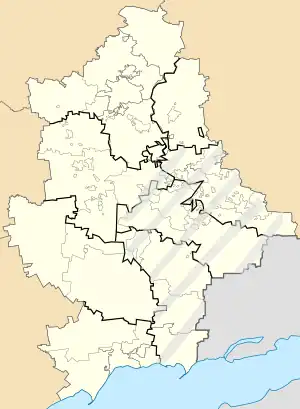
Blahodatne (Ukrainian: Благодатне) is an urban-type settlement in Volnovakha Raion of Donetsk Oblast in Ukraine. It belongs to Olhynka settlement hromada, one of the hromadas of Ukraine. Population: 1,023 (2022 est.)[2]It has been controlled by Russia since february.
Blahodatne
Благодатне | |
|---|---|
Urban-type settlement | |
  Blahodatne 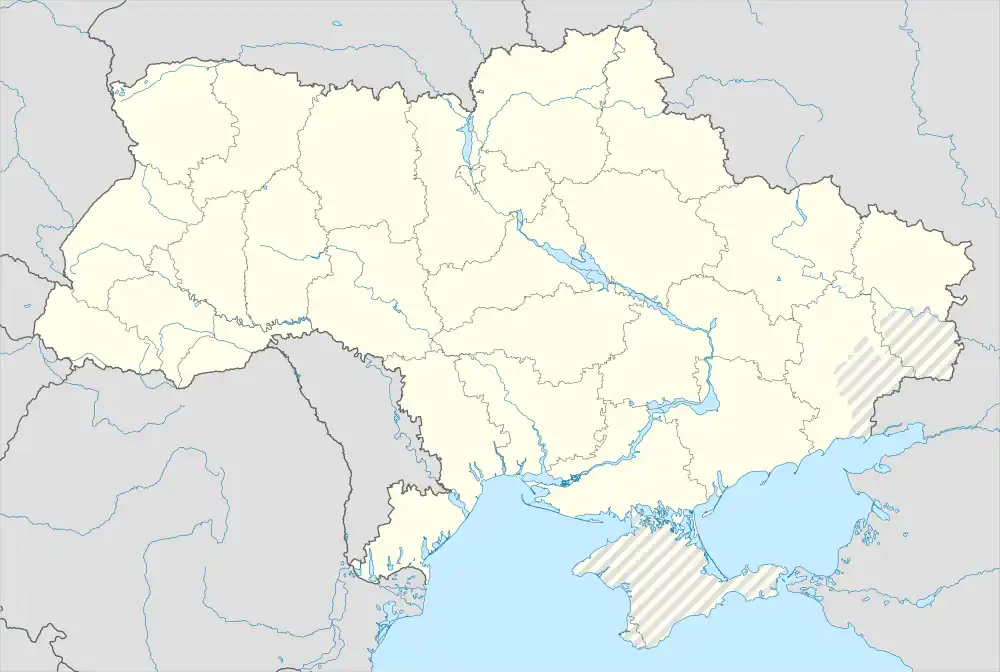 Blahodatne | |
| Coordinates: 47°41′59″N 37°25′08″E | |
| Country |  Ukraine Ukraine |
| Oblast | Donetsk Oblast |
| Raion | Volnovakha Raion |
| Hromada | Olhynka settlement hromada |
| Elevation | 201 m (659 ft) |
| Population (2022)[2] | |
| • Total | 1,023 |
| Time zone | UTC+2 (EET) |
| • Summer (DST) | UTC+3 (EEST) |
History
Blagodatne was founded in 1840. During the Ukrainian War of Independence, fierce battles took place near the settlement between Bolshevik forces and the Volunteer Army led by Pyotr Wrangel.
In 1853, local residents built the first wooden temple in dedication to the Annunciation of the Virgin Mary. The church served the community until it was closed by the Soviet regime in 1961, and converted into a dance club and library. The community fought to keep the church open, and it was finally restored to a working condition in the 1990s, after the dawn of Ukrainian independence. The church is an atypical representative of classical architecture, with a single-seat cruciform central-domed building and a restored belfry. The church can be reached by car or intercity transport and is located in the center of the village.[3]
In 1920, a KNS was created. During the Soviet times, the settlement had the central manor of the "Road to Communism" collective farm, which was known for its meat and dairy livestock breeding, as well as its production of cereals, such as winter wheat. In 1938, Blagodatne was granted the status of an urban-type settlement.
On November 7, 2014, during the war in Donbas, Ukrainian border guards repelled an attack by a group of armed men near Blahodatne. The incident took place around midnight, when the movement of 12 armed men was detected using a thermal imager. After several warning shots were fired, fire was opened to defeat the enemy, who then retreated.[4]
In November 2022, Ukrainian military forces retook the village of Blahodatne from the Russian-backed forces during the Russian invasion of Ukraine. The Ukrainian Armed Forces claimed to have repelled an attack on Blahodatne and 13 other settlements in the eastern part of the Donetsk region. Meanwhile, in January 2023, the Russian-aligned Wagner Group private military group claimed to have taken control of the village. The exact line of contact in the Donetsk region was unclear due to the heat of the fighting, especially in the town of Bakhmut where some of the heaviest fighting was taking place. In response, Ukraine won promises of Western battle tanks and was seeking fighter jets and long-range missiles to push back against Russian and pro-Moscow forces. The situation along the front line in the Donetsk region was described as challenging, with 17 people wounded and 4 civilians killed in Russian attacks on the region prior to its alleged liberation.[5]
On January 29, 2023 PMC Wagner troops claimed to have conquered the town.[6]
Geography
Climate
| Blahodatne | ||||||||||||||||||||||||||||||||||||||||||||||||||||||||||||
|---|---|---|---|---|---|---|---|---|---|---|---|---|---|---|---|---|---|---|---|---|---|---|---|---|---|---|---|---|---|---|---|---|---|---|---|---|---|---|---|---|---|---|---|---|---|---|---|---|---|---|---|---|---|---|---|---|---|---|---|---|
| Climate chart (explanation) | ||||||||||||||||||||||||||||||||||||||||||||||||||||||||||||
| ||||||||||||||||||||||||||||||||||||||||||||||||||||||||||||
| ||||||||||||||||||||||||||||||||||||||||||||||||||||||||||||
Demographics
Native language as of the Ukrainian Census of 2001:[8]
| Language | Percentage of Population (2001 Census) |
|---|---|
| Ukrainian | 88.33% |
| Russian language | 11.21% |
| Belarusian and Moldovan | 0.15% |
References
- "Blahodatne (Volnovakha Raion, Donetsk Oblast)". weather.in.ua. Retrieved 12 June 2022.
- Чисельність наявного населення України на 1 січня 2022 [Number of Present Population of Ukraine, as of January 1, 2022] (PDF) (in Ukrainian and English). Kyiv: State Statistics Service of Ukraine.
- "Благовіщенська церква в Благодатному". zabytki.in.ua. Retrieved 2023-01-30.
- "Українські прикордонники відбили напад озброєної групи біля Благодатного, - РНБО". РБК-Украина (in Ukrainian). Retrieved 2023-01-30.
- "Ukraine says it repels attack around Blahodatne, Wagner claims control". Reuters. 2023-01-29. Retrieved 2023-01-30.
- Terajima, Asami (2023-01-31). "Ukraine war latest: Russia claims control over Blahodatne, intensifies attacks near Vuhledar". The Kyiv Independent. Retrieved 2023-02-03.
- Ukraine. Donetsk Oblast. Blahodatne Archived 2019-07-21 at the Wayback Machine (in English)
- Розподіл населення за рідною мовою на ukrcensus.gov.ua Archived 31 July 2014 at the Wayback Machine