Accession of the United Kingdom to CPTPP
The accession of the United Kingdom to the Comprehensive and Progressive Agreement for Trans-Pacific Partnership (CPTPP) has been on the current agenda for the enlargement of the CPTPP since 2 June 2021, when the CPTPP Commission decided to move forward with the application of the United Kingdom as an aspirant economy.[1] The United Kingdom officially applied for Comprehensive and Progressive Agreement for Trans-Pacific Partnership membership on 21 February 2021.[2] Accession negotiations were agreed and concluded on the 31 March 2023.[3][4][5] Each of the existing member nations will need to ratify the UK's addition to the partnership before it takes effect.[6]

| This article is part of a series on |
| Politics of the United Kingdom |
|---|
_(2022).svg.png.webp) |
United Kingdom portal
|
.svg.png.webp)

.svg.png.webp)






The United Kingdom is set to become the 12th member of CPTPP, as the 11 members have agreed to its accession allowing it to join for the 7th CPTPP Commission on 15 July 2023.[3][4][7] The UK will become the first non-original member and European country to join CPTPP.[8] It is one of six current CPTPP applicant countries, together with China, Costa Rica, Ecuador, Taiwan and Uruguay.
History
Following its withdrawal from the European Union on 31 January 2020, the United Kingdom began negotiations on several free trade agreements to remove or reduce tariff and non-tariff barriers to trade, both to establish new agreements and to replace previous EU trade agreements. Withdrawal ended 47 years of membership during which all its trading agreements were negotiated by the European Commission on behalf of the bloc. The UK did not actually withdraw from the European Single Market and the European Union Customs Union (and its trade agreements) until 31 December 2020.
In January 2018, the government of the United Kingdom stated it was exploring membership of the CPTPP to stimulate exports after Brexit and has held informal discussions with several of the members.[9] World Trade Organization rules do not permit multilateral trade agreements unless they are regional, which would not allow the European country to join, however British sovereignty over the Pitcairn Islands, located in the Pacific Ocean has allowed the UK to qualify to join CPTPP.[10][11]
In October 2018, Japanese Prime Minister Shinzo Abe said he would welcome the United Kingdom joining the partnership post-Brexit.[12] In a joint Telegraph article with Simon Birmingham, David Parker, and Chan Chun Sing, the trade ministers of Australia, New Zealand, and Singapore, UK Secretary of State for Trade, Liz Truss, expressed the United Kingdom's intent to join the CPTPP.[13] The UK Department for Trade's chief negotiator Crawford Falconer helped lead the New Zealand negotiations for the predecessor Trans-Pacific Partnership before leaving the Ministry of Foreign Affairs and Trade in 2012.[14]
In June 2020, the government of the United Kingdom issued a policy paper[15] reaffirming the UK's position on accession to the CPTPP. There were three reasons given:
- Securing increased trade and investment opportunities that will help the UK economy overcome the unprecedented challenge posed by coronavirus. Joining CPTPP would open up new opportunities for UK exporters in strategically important sectors and helping to support an industrial revival in the UK
- Helping the United Kingdom diversify trading links and supply chains, and in doing so increasing economic security at a time of heightened uncertainty and disruption in the world.
- Assisting the UK's future place in the world and advancing the UK's longer-term interests. CPTPP membership is an important part of our strategy to place the UK at the centre of a modern, progressive network of free trade agreements with dynamic economies. Doing so would turn the UK into a global hub for businesses and investors wanting to trade with the rest of the world.
Furthermore, the British government stated that in 2019, each region and constituent country of the United Kingdom exported at least £1 billion ($1.25 billion) worth of goods to CPTPP member countries.[16] The UK government also highlighted that British companies held close to £98 billion worth of investments in CPTPP countries in 2018[17] and that in 2019, the UK did more than £110 billion ($137 billion) worth of trade with countries in the CPTPP free trade area.[18] In December 2020 the UK's Secretary of State for Trade Liz Truss further expressed her desire for the UK to formally apply in early 2021.[19] In a speech, held on January 20, 2021, Truss announced the UK planned to submit an application for participation "shortly".[20] In October 2020 the United Kingdom and Japan already signed the UK–Japan Comprehensive Economic Partnership Agreement which was a roll over of the agreement between the EU and Japan.
The British government has not produced an impact assessment that explains or quantifies the benefits it expects for the UK economy from accession to CPTPP.[21] As such, it is a matter of dispute in UK as to whether accession is worth pursuing for economic reasons.[22] Farmer, environmental and consumer groups have all raised concerns that the UK government will need to agree to lowering standards on pesticides, pig welfare and food labelling.[23] These concerns have also been raised by the Scottish government.[24]
On 1 February 2021, the United Kingdom formally applied to join CPTPP.[2] The UK is the first non-founding country to apply to join the CPTPP. If successful, Britain would become the second largest CPTPP economy, after Japan.[25] Japan had expressed support for the UK's potential entry into CPTPP in 2018,[26] and as 4th CPTPP Commission (2021) chair, Japan's minister in charge of negotiations on the trade pact, Yasutoshi Nishimura, expressed hope on Twitter that Britain will "demonstrate its strong determination to fully comply with high-standard obligations" of the free trade accord, and mentioned that "I believe that the UK’s accession request will have a great potential to expand the high-standard rules beyond the Asia-Pacific."[27]
Negotiations
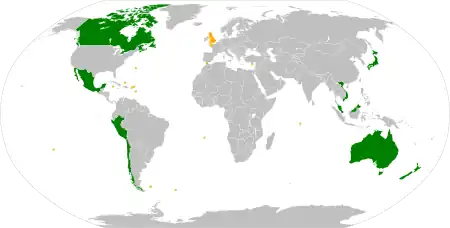
United Kingdom (orange)
British Crown Dependencies and Overseas Territories (light Orange)
In June 2021, the CPTPP states agreed to open accession talks. A working group was established to discuss tariffs and rules governing investment and trade. The United Kingdom was forecast to accede to the CPTPP at 2022 at the earliest.[28]
Prior to its withdrawal, the United Kingdom had agreed 36 free trade agreements with countries and trade blocs, the majority of which entered force on 1 January 2021.[29][30] Thirty-three of these free trade agreements were continuity agreements. These used a mutatis mutandis concept in order to quickly replicate the existing EU agreements, only having to call out those minor areas of differentiation.[31][32] This meant that the UK had continuity free trade agreements with 6 CPTPP members, these were: Chile, Canada, Mexico, Peru, Singapore, and Vietnam.
The UK and Japan had also signed a Enhanced agreement in October 2020 which was mostly based on European Union–Japan Economic Partnership Agreement, but was branded as "marking an historic moment" as the "UK’s first major trade deal as an independent trading nation".[33][34] In addition, two further new agreements were negotiated with Australia, on 17 December 2021, and New Zealand, on 28 February 2022.[35][36] This meant that the UK had free trade agreements signed with all members of CPTPP, except for Brunei and Malaysia, by the end of February 2022.
On 18 February 2022, confirmation came from the Japanese government, as Chair of the United Kingdom's Accession Working Group on behalf of the CPTPP members, that the UK had moved into the second (and final) ‘market access’ phase of negotiations with the CPTPP.[37]
As of April 2023, the United Kingdom is set to join the CPTPP as the 11 members have agreed to its accession.[3][4][38] Each of the existing member nations will need to ratify the UK's addition to the partnership before it takes effect.[6]
On 17 April 2023 on the occasion of G7 Foreign Ministers' Meeting in Karuizawa, Foreign Secretary, James Cleverly attended a bilateral meeting with Japan's Minister for Foreign Affairs, Yoshimasa Hayashi. The two ministers affirmed to continue advancing the UK's accession process to the CPTPP, and they engaged in a candid discussion from a strategic perspective.[39]
Membership
Each of the existing member nations must ratify the UK's accession to the CPTPP before it takes effect.[6]
Application timeline
| Event | Date | Reference |
|---|---|---|
| Application submitted | 21 February 2021 | [2] |
| Accession process opened | 2 June 2021 | [40] |
| Negotiations concluded | 31 March 2023 | [4][41] |
| Existing member ratifications |
0 / 11 |
[6] |
| Domestic ratification | ||
| Accession documents deposited | ||
| Full membership |
Ratification process
| Signatory | Date | Institution |  |
 |
AB | Deposited | Ref. |
|---|---|---|---|---|---|---|---|
.svg.png.webp) Australia Australia |
House of Representatives | ||||||
| Senate | |||||||
| Royal assent | |||||||
 Brunei Brunei |
Government | ||||||
.svg.png.webp) Canada Canada |
House of Commons | ||||||
| Senate | |||||||
| Royal assent | |||||||
 Chile Chile |
Chamber of Deputies | ||||||
| Senate | |||||||
 Japan Japan |
House of Representatives | ||||||
| House of Councillors | |||||||
 Malaysia Malaysia |
Cabinet of Malaysia | ||||||
 Mexico Mexico |
Senate | ||||||
| Presidential Assent | |||||||
 New Zealand New Zealand |
House of Representatives | ||||||
| Royal assent | |||||||
 Peru Peru |
Congress | ||||||
 Singapore Singapore |
No parliamentary approval required | ||||||
 Vietnam Vietnam |
National Assembly |
| Signatory | Signature | Institution | |
|
AB | Deposited | Ref. |
|---|---|---|---|---|---|---|---|
| United Kingdom |
Government |
Response
Economists and media outlets criticised the assertion by Prime Minister Rishi Sunak that CPTPP "demonstrates the real economic benefits of our post-Brexit freedoms", by citing the International Agreements Committee report wherein it states that the percentage increase in the United Kingdom's GDP provided by CPTPP membership is only 0.08%.[42][43][44] Economist Sam Lowe stated that while this figure is credible, the methodology had been actively changed "with the intention of making the GDP figure sound more impressive."[45] Lowe also pointed out that this figure is low due to the UK already having bilateral free trade agreements with all member states, with the exceptions of Brunei and Malaysia.[46][47]
In contrast, the costs of leaving the EU is credibly estimated to have reduced the UK's GDP by 5.5%, provoking criticism from prominent media outlets as to the extent of the benefits of CPTPP, particularly as an alternative to the EEA.[48][49]
Specific criticism of the UK government occurred after it agreed to eliminate all import tariffs on palm oil from Malaysia, a product blamed for widespread deforestation, prompting outrage from green campaigners.[50][51] The British government's decision violates the United Kingdom's COP27 pledge to end deforestation by 2030, which it had committed to less than a year prior in Glasgow.[52][53]
Further concerns were raised by trade unions over clauses in the deal that will allow large companies to sue the UK government behind closed doors if they believe their profits have suffered from changes to laws or regulations. The TUC's general secretary, Paul Nowak, noted that these clauses could allow large companies to sue on grounds such as an increase in the minimum wage or bringing energy companies back into public ownership.[54]
However, Britain's decision to join the CPTPP gives it a strengthened presence and influence in the Asia-Pacific region which is rapidly growing in significance both economically and politically.[55]
Trade secretary, Kemi Badenoch argues the deal is the most significant commercial agreement signed by the UK since Brexit, with a potential to grow in importance as the rise of Pacific Rim countries continues, with applications from China and Taiwan highlighting further market opportunities that Britain could gain access to through CPTPP.[42][56]
Member state relations
See also
References
- "Decision by the Commission of the Comprehensive and Progressive Agreement for Trans-Pacific Partnership regarding the United Kingdom's Formal Request to Commence the Accession Process" (PDF). 2 June 2021. Retrieved 18 June 2021.
- "Formal Request to Commence UK Accession Negotiations to CPTPP". GOV.UK. 1 February 2021.
- "CPTPP trade bloc to give UK green light to join". The Nikkei Asia. 29 March 2023. Retrieved 29 March 2023.
- "Britain secures agreement to join Indo-Pacific trade bloc". Politico. 29 March 2023. Retrieved 29 March 2023.
- "Joint Ministerial Statement on the UK's accession process to the CPTPP" (PDF). 31 March 2023. Retrieved 31 March 2023.
- The Canadian Press (30 March 2023). "Britain set to join trans-Pacific trade pact". CBC News. Retrieved 30 March 2023.
- "Joint Ministerial Statement on the UK's accession process to the CPTPP" (PDF). 31 March 2023. Retrieved 31 March 2023.
- Progress on UK free trade agreement negotiations (PDF) (Report). UK Parliament. 15 May 2023. Retrieved 15 May 2023.
- Gregory, Julia (3 January 2018). "Britain exploring membership of the TPP to boost trade after Brexit". The Guardian. ISSN 0261-3077. Retrieved 3 January 2018.
- Lowe, Sam (5 January 2018). "TPP: The UK is having a Pacific pipe dream". Prospect. Retrieved 3 November 2018.
For one, unless we are planning on assigning far greater significance to the Pitcairn Islands (which form the last British overseas territory in the region) the UK is not a Pacific power, so the name of the trade deal would need to change.
- "US needs to join the Pacific trade deal". Washington Examiner.
- McCurry, Justin (8 October 2018). "UK welcome to join Pacific trade pact after Brexit, says Japanese PM". The Guardian. Retrieved 8 October 2018.
- Truss, Liz (28 April 2020). "Enemies of free trade must not be allowed to use coronavirus to bring back protectionism". The Telegraph. ISSN 0307-1235. Retrieved 30 April 2020.
- Watkins, Tracy (3 April 2012). "Diplomats take the gloves off". Stuff. Archived from the original on 15 September 2020. Retrieved 15 September 2020.
- "[Withdrawn] UK approach to joining the CPTPP trade agreement". GOV.UK.
- "Foreign direct investment involving UK companies (directional): outward - Office for National Statistics". www.ons.gov.uk.
- "UK total trade: all countries, non-seasonally adjusted - Office for National Statistics". www.ons.gov.uk.
- ""HM Revenue & Customs: UK Imports and Exports by Region, year to March 2020"". Archived from the original on 29 January 2017.
- @trussliz (15 December 2020). "🇬🇧 🇲🇽 Our trade deal with Mexico means we have now secured agreements with 58 countries. It's our 7th deal with a…" (Tweet) – via Twitter.
- "The UK-Japan Free Trade Summit. Keynote for The UK-Japan Free Trade Summit, A Shared Economic & Financial Vision for Mutual Benefit". Department for International Trades. Retrieved 24 January 2021.
- "StackPath". www.instituteforgovernment.org.uk.
- "Comprehensive and Progressive Transpacific Partnership Submission to the Department for International Trade" (PDF).
- Union, National Farmers (17 June 2020). "Food standards petition". NFU Online.
- "Trade Policy Response to UK Government Consultations on Future Free Trade Agreements" (PDF).
- "UK applying to join Asia-Pacific free trade pact CPTPP". BBC News. 30 January 2021. Retrieved 30 January 2021.
- "Brexit: Japan 'would welcome' UK to TPP says Abe". BBC News. 8 October 2018. Retrieved 1 February 2021.
- "Britain to apply to join CPTPP Asia-Pacific free trade bloc". Japan Times. 31 January 2021. Retrieved 1 February 2021.
- "UK begins process to join Asia-Pacific trade bloc". BBC News. 2 June 2021. Retrieved 2 June 2021.
- "Regional Agreements Database (United Kingdom)". World Trade Organization.
- "UK trade agreements in effect". UK government. 3 November 2022. Retrieved 13 April 2023.
- Eiser, David; McEwen, Nicola; Roy, Graeme (7 April 2021). "The Trade Policies of Brexit Britain: the Influence of and Impacts on the Devolved Nations" (PDF). Brill Publishers.
- Emmerson, Carl; Johnson, Paul; Mitchell, Ian; Phillips, David (May 2016). "Brexit and the UK's Public Finances" (PDF). Institute for Fiscal Studies.
- "UK and Japan sign free trade agreement". UK government. 23 October 2020. Retrieved 9 May 2023.
- "UK and Japan agree historic free trade agreement". Gov.UK. 11 September 2020. Archived from the original on 10 May 2021.
- "UK and Australia sign world-class trade deal". Gov.UK. 17 December 2021.
- "UK-New Zealand Free Trade Agreement". Gov.UK. 20 October 2021.
- "Trade Secretary secures major trade bloc milestone ahead of Asia visit". GOV.UK.
- "Joint Ministerial Statement on the UK's accession process to the CPTPP" (PDF). 31 March 2023. Retrieved 31 March 2023.
- "Japan-UK Foreign Ministers' Meeting". MOFA, Japan. 17 April 2023. Retrieved 17 April 2023.
- "Decision by the Commission of the Comprehensive and Progressive Agreement for Trans-Pacific Partnership regarding the United Kingdom's Formal Request to Commence the Accession Process" (PDF). 2 June 2021. Retrieved 18 June 2021.
- "Joint Ministerial Statement on the UK's accession process to the CPTPP" (PDF). 31 March 2023. Retrieved 31 March 2023.
- "UK strikes agreement to join Asia-Pacific trade bloc". Financial Times. 31 March 2023. Retrieved 6 April 2023.
- "UK membership of the trans-Pacific trade agreement". UK Parliament. 26 January 2022. Retrieved 6 April 2023.
- UK accession to the Comprehensive and Progressive Agreement for Trans-Pacific Partnership (CPTPP): Scrutiny of the Government's Negotiating Objectives (Report). UK Parliament. 17 November 2021. Retrieved 6 April 2023.
- "Predicted 0.08% boost from UK-Asia trade deal could be overestimate". The Independent. 10 April 2023. Retrieved 11 April 2023.
- What Does CPTPP Actually Do? (Report). Most Favoured Nation. 30 March 2023. Retrieved 15 May 2023.
- Progress on UK free trade agreement negotiations (PDF) (Report). UK Parliament. 15 May 2023. Retrieved 15 May 2023.
- "Britain's bumpy ride to the Asia-Pacific". Financial Times. 13 March 2023. Retrieved 6 April 2023.
- "THE COST OF BREXIT TO JUNE 2022". Centre for European Reform. 21 December 2022. Retrieved 6 April 2023.
- "UK poised to remove import tariffs on Malaysian palm oil". Financial Times. 14 March 2023. Retrieved 6 April 2023.
- "Government hails Trans-Pacific trade deal, but green groups raise alarm over deforestation risks". BusinessGreen. 31 March 2023. Retrieved 6 April 2023.
- "Pacific trade deal 'will make mockery of UK's climate ambitions'". The Guardian. 3 April 2023. Retrieved 6 April 2023.
- "COP27: More than 25 countries band together to keep deforestation pledges made in Glasgow". Euronews. 7 November 2022. Retrieved 11 April 2023.
- "UK joins Asia-Pacific CPTPP trade bloc that includes Japan and Australia". The Guardian. 31 March 2023. Retrieved 11 April 2023.
- "Britain joining trade pact CPTPP has marginal immediate benefits, but opportunities are plentiful". The Straits Times. 31 March 2023. Retrieved 11 April 2023.
- "How Britain left Brexit behind with a new Pacific trade deal". The Telegraph. 10 April 2023. Retrieved 11 April 2023.