2020s controversies around critical race theory
Since 2020, efforts have been made by conservatives and others to challenge critical race theory (CRT) being taught in schools in the United States.
_-_Anti_critical_race_theory_protester.jpg.webp)
Following the 2020 protests of the murders of Ahmaud Arbery, George Floyd, and Breonna Taylor, school districts began to introduce additional curriculum and create diversity, equity, and inclusion (DEI)-positions to address "disparities stemming from race, economics, disabilities and other factors."[1] These measures were met with criticism from conservatives, particularly those in the Republican Party. Critics have described these criticisms to be part of a cycle of backlash against what they view as progress towards racial equality and equity.[2]
Outspoken critics of critical race theory include former U.S. president Donald Trump, conservative activist Christopher Rufo, various Republican officials, and conservative commentators on Fox News and right-wing talk radio shows.[3][4][5][6] Movements have arisen from the controversy; in particular, the No Left Turn in Education movement, which has been described as one of the largest groups targeting school boards regarding critical race theory. In response to CRT being taught, dozens of states have introduced bills which limit what schools can teach regarding race, American history, politics, and gender.[7]
Background
Critical race theory is a cross-disciplinary intellectual and social movement of civil-rights scholars and activists who seek to examine the intersection of race, society, and law in the United States and to challenge mainstream American liberal approaches to racial justice. Conservative activism and efforts to censor curricula has resulted in the introduction of legislation banning the teaching of critical race theory in schools in many states across the United States.[7][8][9]
History
In an interview on Fox News in September 2020, Conservative activist Christopher Rufo strongly denounced critical race theory.[10][lower-alpha 1][11] Rufo was invited to a series of meetings with President Donald Trump which resulted in President Trump's denouncing CRT in a September 17 speech. At the same time President Trump announced the formation of the 1776 Commission with former Mississippi Governor Phil Bryant as a member, to produce a report in response to The 1619 Project. On September 22, Trump signed Executive Order 13950 calling on a number of federal agencies to defund programs that referred to CRT and concepts such as white privilege.[12] CRT was accused of being "racist", "un-American", and "divisive".[3][4][12][lower-alpha 2][lower-alpha 3][lower-alpha 4]
Right wing media outlets weaponized CRT in advance of the 2021 off-year and 2022 midterm elections,[2] as did Republican candidates, such as Glenn Youngkin and Jason Miyares.[13] Fox News promoted No Left Turn in Education, which was described by a June 15, 2021, NBC News report as "one of the largest groups targeting school boards" regarding critical race theory".[14] The Media Matters article described No Left Turn in Education as one of the "leading groups fearmongering about the teaching of critical race theory in schools". The article said that the group and Elana Yaron Fishbein its founder, frequently "used toxic and bigoted rhetoric on social media and in right-wing media to downplay CRT".[13] In his 2022 book, How to Raise an Antiracist, American radical activist Ibram X. Kendi, author of How to Be an Antiracist described how Fishbein created No Left Turn in Education in the summer of 2020. Fishbein had pulled her children out of Gladwyne Elementary School and sent the superintendent of Lower Merion School District (LMSD) an email on June 18, 2020, challenging the LMSD's decision to introduce additional lessons in "cultural proficiency" in the wake of the murder of George Floyd, and that as an unspecified number of non-white students were launching a campaign calling for "antiracist education", Fishbein "rejected the premise of antiracism, CRT, comprehensive sex education (CSE), and climate change".[15][16] Her movement was relatively small initially, but was really launched when she began to be invited as a guest on the prime time Tucker Carlson show in September 2020.[17] Fishbein describes the movement as a grassroots parental organization that uses veteran GOP activists' playbook to enact change on school boards.
On December 7, 2020, the conservative nonprofit American Legislative Exchange Council (ALEC), that works with state legislators to draft and share model acts, facilitated a workshop entitled "Against Critical Theory's Onslaught Reclaiming Education and the American Dream" with Chris Rufo as a featured guest and 31 state legislators in attendance.[18][19][lower-alpha 5] ALEC provides a forum for collaboration on model bills—helping state legislators draft legislation that other states can also modify and introduce as bills.[20]
During the fall of 2020 and in 2021, Trump's messaging during the 2020 U.S. presidential election campaign and its aftermath included strong messaging against critical race theory. On January 19, 2021, the 1776 Project report Trump had commissioned was submitted in the form of a 41-page "national plan" for a "patriotic education" in rebuttal to the 1619 Project, the journalists who produced it, and to CRT.[21][22] The 1776 Commission also criticized what they alleged as being CRT's theoretical underpinnings—Italian Marxist Antonio Gramsci, Herbert Marcuse, and the Frankfurt School, identity politics, and Howard Zinn. In contrast, the Trump White House described the 1776 Commission report as the "definitive chronicle of the American founding, a powerful description of the effect the principles of the Declaration of Independence have had on this Nation's history, and a dispositive rebuttal of reckless "re-education" attempts that seek to reframe American history around the idea that the United States is not an exceptional country but an evil one."[21][22] The Commission was dissolved on January 21 in an Executive Order signed by President Biden in his first day in office.[22]
Conservative commentators on Fox News and right-wing talk radio shows were strongly critical of CRT.[23][24] Media Matters reported that in June 2021, Fox News network mentioned "critical race theory" a record high of 901 times; in May they made 537 mentions; by July it was up to a total of over 1,900 times in the previous 3.5 months.[25] CRT became a "flash point" for Republicans in the United States as part of the culture wars, according to a Washington Post article.[26] Throughout 2021, several conservative think tanks and pressure groups, such as the Heritage Foundation, the Idaho Freedom Foundation, the American Legislative Exchange Council and organizations funded by the Koch brothers adopted opposition to critical race theory as a major theme.[27][14][28] Republicans focused on banning CRT from being used in schools across the United States, outside of college electives.[26] By mid-summer 2021 conservative groups were bringing the battle over CRT to school boards.[14] In Texas, Southlake, Tarrant County Carroll High School a group of POC students vied to address alleged racism after reported incidents dating back to at least 2018, and helped form the Southlake Anti-Racism Coalition (SARC). Dissenting parents formed the Southlake Families PAC and fought against them, endorsing a mayoral candidate and candidates for the school board and the city council. The PAC endorsed candidates won with about 70% of the vote.[29] When they voted down the "call for cultural awareness into the curriculum", the PAC wrote on Twitter, "Critical Race Theory ain't coming here. This is what happens when good people stand up and say, not in my town, not on my watch." On their website the PAC wrote, "CRT is a theoretical framework which views society as dominated by white supremacy and categorizes people as 'privileged' or 'oppressed' based on their skin color....It also teaches kids to hate America. Ask yourself who in their right mind would want this taught in public schools?"[29]
In February 2021, William A. Jacobson, a blogger and law school professor at Cornell University launched the website CriticalRace.org,[30] which became the go-to site where many CRT opponents get their information about CRT, according to a Forbes article. Jacobson established conservative non-profit, Legal Insurrection Foundation, and its website "Legal Insurrection" in 2008. He added the CRT database to warn students away from CRT tenets and anti-racism initiatives by listing universities and colleges where administrators in senior positions "promote equity and/or make public statements about racism." It includes colleges and universities that offer courses and/or training on CRT, "anti-racism", or create race-related programs and centers, and includes schools that hire faculty whose research or methodologies include CRT and anti-racism.[31] His database also provides content about K-12 schools in the United States that might be CRT-friendly.[31] Critics of Jacobson assert that "CRT encourages the questioning of unchallenged assumptions about America's "foundations as a nation", and calls for a deeper understanding of the "massive socio-economic differences" within the context of race", and that "CriticalRace.org portrays such questioning of America's foundations as "anti-American".[31]
The Economist and Reuters have conducted polls on how much the general public understands CRT, a "once-obscure academic concept", and they found that most people are unfamiliar with CRT and misunderstand it.[32][33] Those who support CRT promote the idea that it is an "intellectual tool set developed by legal scholars for examining systemic racism". CRT originated in legal studies and was intended for legal scholars and academics.[34] The Economist, based on YouGov data from 2021, said that 50% of Americans thought they had a "good idea of what critical race theory was and most people thought it was bad for America.[32] However, The Economist asserted that "the attitudes and beliefs of 70% of Americans actually "chime" with CRT—that racism is a significant social problem in the United States". The claim that CRT makes is that racism is "woven into the U.S. legal system and ingrained in its primary institutions", according to Reuters.[35] Further, according to a survey conducted by The Economist, "a majority" of adult Americans believes that racism exists in the US Congress, in American legal structures, financial institutions, and in organizations and agencies, including the police force.[32]
A Reuters 2021 national opinion survey found that 57% of American adults said that they were not familiar with CRT. Of those who did claim they were familiar with CRT claims, Reuters found that follow-up responses to specific questions about CRTs tenets, were informed by "misconceptions about critical race theory that have been largely circulating among conservative media outlets".[35] When asked true-false questions about CRT history and teachings, only 5% of those who said they were familiar with CRT, could provide the correct answers.[35]
State-level legislation
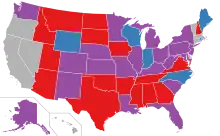
From January 2021 through February 2022, 35 states had introduced 137 bills which limit what "schools can teach with regard to race, American history, politics, sexual orientation and gender identity".[7] PEN America, an American nonprofit association of writers "dedicated to free speech" that is affiliated with the International Freedom of Expression Exchange has been monitoring this legislation.[8][7] Jeffrey Sachs, who is tracking the legislation, said that the "recent flurry" of bills means that the classroom has become a "minefield" for educators who want to teach "slavery, Jim Crow laws or the Holocaust".[8] An April 2022 article in Education Week said that 42 states had either introduced legislation or "taken other steps" to restrict "teaching critical race theory" and, "more broadly, limit how teachers can discuss racism and sexism in class."[9]
The first state to ban CRT was Idaho when a bill was introduced in mid-April 2021,[36] and signed by Governor Brad Little on May 4.[37] By May 2021, multiple state legislatures introduced bills restricting the teaching of critical race theory (CRT) in public schools.[38] Bills were passed in 14 states, all of which had both Republican-majority legislatures and Republican governors.[5][39] Several of these bills specifically mention "critical race theory" or single out the New York Times 1619 Project.[26]
The Texas state legislature, which is predominantly Republican, banned teachers from using the New York Times's 1619 Project as part of coursework.[32][lower-alpha 6] The 1619 Project revisits the role of African Americans in American history by reframing the consequences of slavery in the United States. Texas House Bill 3979 which was authored by Senator Bryan Hughes (R-Mineola) and others, became law in December 2021 limiting the way in which Texas schools can teach about race and racism, as well as other issues.[40] Under Bill 3979, this bill declares that teachers should avoid teaching the following concepts "(1) one race or sex is inherently superior to the other; (2) an individual is inherently racist, sexist or oppressive because of their own race or sex; (3) an individual should be treated unfairly because their race or sex; (4) members of certain groups should not disrespect individuals on the basis of race, sex, or religion; (5) an individual's morality is based on their race or sex; (6) an individual bears responsibility for actions committed in the past by people of the same race or sex; (7) an individual should be ashamed or guilty because of their race or sex; (8) meritocracy is racist or sexist."[41] As well, teachers no longer have any obligation to undertake any training on how to deal with racism in the classroom.[41] The list is based on the divisive concepts listed in Trump's September 28, 2020, Executive Order,[42]
On June 10, 2021, the Florida Board of Education banned CRT out of concerns that the concept of racism embedded in CRT is one that continues to uphold white supremacy in American society and its legal systems.[32] The board's vote, which was encouraged by governor Ron DeSantis, was unanimous.[43]
In April 2022, when Republican Governor Brian Kemp signed bills banning CRT, he said that the state was protecting parents' fundamental rights to direct their children's education by preventing classrooms in Georgia from becoming "pawns to those who indoctrinate our kids with their partisan political agendas."[33]
A number of state laws to ban CRT from being taught in state public schools, did not include the words "critical race theory," with the exception of the laws passed in Idaho, according to a July 2, 2021, Brookings Institute article.[44]
Outside the United States
In countries outside of the United States, the teaching of critical race theory and white privilege is also controversial. In Australia, the conservative Coalition government supported a Senate motion by Pauline Hanson to ban the teaching of critical race theory in the Australian National Curriculum.[45] The Senate motion occurred during a review of the Australian National Curriculum. The motion did not recognize that the curriculum document did not have a reference to Critical Race Theory. Such a pre-emptive move has been linked to transnational culture wars between the UK, US and Australia.[46]
In the United Kingdom, educators were warned that teachers teaching white privilege would be breaking the law.[47]
Critics of CRT
The most outspoken critics of CRT include Donald Trump, Chris Rufo, and Republican officials.[3][4][5][39]
Chris Rufo, a senior fellow at the Manhattan Institute,[48] has been one of the most active critics of CRT, according to a June 2021 New Yorker article.[49] It was through Rufo's appearance on Fox News that President Trump learned about CRT. Rufo participated in drafting the language of the executive order.[12] He spoke at the December 7, 2020 American Legislative Exchange Council workshop on creating the model bill adapted by a number of state legislators.[18] On March 15, 2021, Rufo tweeted that the "goal is to have the public read something crazy in the newspaper and immediately think "critical race theory." We have decodified the term and will recodify it to annex the entire range of cultural constructions that are unpopular with Americans."[50] Rufo said that CRT is anti-American and it poses a "an existential threat to the United States". He warned that it had "pervaded every aspect of the federal government" by 2021.[49]
American cultural critic, James A. Lindsay, who was known mainly for his role in the grievance studies affair,[51] published a book in February 2020 in which he criticised critical race theory.[52] In his book, he published numerous extracts taken directly from the original authors and their texts on critical race theory as objective proof of CRT's flaws.[53]
When the Republican Senator from Arkansas, Tom Cotton, introduced an amendment to the 2021 budget reconciliation package that would prohibit the use of federal funds in CRT promotion in Pre-K programs and K-12 schools in August 2021, it passed 50 to 49.[54] Cotton's Stop CRT Act was introduced in July 2021. Rufo praised Cotton's actions, saying that the "fight against CRT ha[d] gone national" and Senator Cotton was "leading the way."[54]
Jim Pillen won the Republican primary race for governor in the 2022 Nebraska gubernatorial election with an election campaign based on his opposition to critical race theory as well as his stance against abortion rights.[55]
Anti-CRT school boards firings, suspensions and resignations
One of the first suspensions related to critical race theory took place on September 1, 2021, in Colleyville in Tarrant County.[56] James Whitfield, who was the high school's first Black principal at Colleyville Heritage High School, was suspended for allegedly promoting CRT—Whitfield repeatedly denied the allegation.[56][57] Parents and dozens of teachers pleaded with school district's board of trustees to reinstate Whitfield, a popular principal.[56] Students held walkouts to support the principal.[56][57] In the summer of 2020, Whitfield wrote an open letter sharing his concerns over the murders of Ahmoud Arbery and George Floyd, and the killing of Breonna Taylor.[58] In response, a former school board candidate, Stetson Clark, spoke up at July school board meeting to accuse Whitfield of promoting CRT. A few people attending the meeting called out, "Fire him."[56][58]
According to the Dallas, Texas-based WFAA television, by February 2022, some Christian pastors were fighting back against what they call the "far-right playbook to take down Texas public schools" saying it is "sheer destructive chaos" that has resulted in an "obscure term called Critical Race Theory...consum[ing] parents who believe it is being taught in Texas classrooms."[59] It has also resulted in the resignations of several school district superintendents, including in the Independent school district (ISD)s of Dallas and Fort Worth.[59]
On June 16, 2022, ProPublica and Frontline published an article on how a group of vocal and organized anti-CRT white parents in the Cherokee County School District (CCSD) in Georgia, had targeted Cecelia Lewis, a Black educator, who had been offered a job in early 2021 as CCSD's first diversity, equity and inclusion (DEI)-focused administrative position. Some of the parents researched and targeted the educator and were successful in making her next job impossible, which led to her resignation.[1]
Religious organizations
American Christianity
Discourse around CRT has been divisive for many churches.[60][61][62] In 2018, the Statement on Social Justice and the Gospel, also known as the Dallas Statement, denied that 'critical race theory' could be 'consistent with biblical teaching'.[63]
The Southern Baptist Convention in a 2019 resolution stated that "[c]ritical race theory and intersectionality [...] can aid in evaluating a variety of human experiences".[64][65][66] In 2020 six SBC presidents declared critical race theory to be 'incompatible' with SBC's statement of faith.[65][67][68][66][69][62][70] Consequently, several pastors have left the SBC.[71][72][73]
In November 2020, Cru (Christian organization) staff members wrote a letter to Cru's president[74] associating CRT with "unbiblical ideas that have led us to disunity".[73]
In an American Association of Christian Counselors talk entitled "The Five Greatest Global Epidemics", Josh McDowell cited critical race theory as the first epidemic. He also stated that "many African Americans don’t have those privileges like I was brought up with" which indicated that USA lacked "equal opportunity". He later apologised to minority families for his comments.[73]
See also
Notes
- Critical race theory (CRT) refers to an "emerging transdisciplinary, race-equity methodology that originated in legal studies and is grounded in social justice. Critical Race Theory's tools for conducting research and practice are intended to elucidate contemporary racial phenomena, expand the vocabulary with which to discuss complex racial concepts, and challenge racial hierarchies." CRT "integrates transdisciplinary methodologies that draw on theory, experiential knowledge, and critical consciousness to illuminate and combat root causes of structural racism. It emerged after years of struggle by law students and faculty contesting what they perceived as institutionalized racism in the hiring and curricular decisions of elite law schools. Convinced that their understandings of racial power dynamics diverged in important ways from those of other legal models, they convened a meeting in 1989 at which they enumerated key racial equity principles." CRT refers to the "emergent set of methodologies that draws on these principles in pursuing racial equity via the law. Persons whose scholarship relies on Critical Race Theory (called critical race theorists) are often described as "a collection of activists and scholars interested in studying and transforming the relationship among race, racism, and power."
- Rufo participated in drafting the language of the executive order.
- The September 22, 2020 Executive Order 13950 of Sep 22, 2020 defined "divisive concepts" as "concepts that (1) one race or sex is inherently superior to another race or sex; (2) the United States is fundamentally racist or sexist; (3) an individual, by virtue of his or her race or sex, is inherently racist, sexist, or oppressive, whether consciously or unconsciously; (4) an individual should be discriminated against or receive adverse treatment solely or partly because of his or her race or sex; (5) members of one race or sex cannot and should not attempt to treat others without respect to race or sex; (6) an individual's moral character is necessarily determined by his or her race or sex; (7) an individual, by virtue of his or her race or sex, bears responsibility for actions committed in the past by other members of the same race or sex; (8) any individual should feel discomfort, guilt, anguish, or any other form of psychological distress on account of his or her race or sex; or (9) meritocracy or traits such as a hard work ethic are racist or sexist, or were created by a particular race to oppress another race. The term "divisive concepts" also includes any other form of race or sex stereotyping or any other form of race or sex scapegoating."
- This EO was revoked by President Joe Biden in EO 13985 on January 20, 2021.
- Organizers included Bridget Weisenberg from the Heritage Foundation. Featured guests included Chris Rufo, Jonathan Butcher and Angela Sailor from the Heritage Foundation, Ian Rowe from the American Enterprise Institute, and Robert Woodson from the Woodson Center. Along with corporate representatives, there were also 31 legislators from 20 states in attendance.
- The 1619 Project is both a book The 1619 Project: A New Origin Story and a long-form article, The 1619 Project, developed by Nikole Hannah-Jones and others.
Citations
- Carr 2022.
- Wilson 2021.
- Dawsey & Stein 2020.
- Lang 2020.
- Waxman 2021.
- Education Week 2021.
- Gross 2022.
- Sachs 2022.
- Najarro 2022.
- Meckler & Dawsey 2021.
- Ford & Airhihenbuwa 2010.
- Trump 2020.
- Hananoki 2021.
- Kingkade, Zadrozny & Collins 2021.
- Kendi 2022a, p. 169.
- Kendi 2022b.
- Carlson & Fishbein 2021.
- American Legislative Exchange Council 2020.
- Wiener & Kotch 2021.
- Greenblatt 2011.
- Scott 2021.
- Pittman 2021.
- Meyer, Severns & McGraw 2021.
- Harris 2021.
- Power 2021.
- Iati 2021.
- Greenfield 2021.
- Banks 2021.
- Asmelash 2021.
- Bunay 2021.
- Gasman 2021.
- The Economist 2021.
- Bernstein 2022.
- Encyclopaedia Britannica 2021.
- Kahn 2021.
- Richert & Jones 2021.
- Adams 2021.
- O'Kane 2021.
- Education Week 2021.
- Awtrey 2021.
- The Texas Legislature 2021.
- Federal Register 2020.
- Postal 2021.
- Ray & Gibbons 2021.
- Knowles 2021.
- Napier-Raman 2021.
- Wood 2020.
- Manhattan Institute n.d.
- Wallace-Wells 2021.
- Rufo 2021.
- Beauchamp 2018.
- Lindsay 2022.
- Manus 2022.
- Gregory 2021.
- Bauer 2022.
- Shepherd 2021b.
- Reid 2021.
- Lopez 2021.
- Whitely 2022.
- Shellnutt, Kate. "Bethlehem Baptist Leaders Clash Over 'Coddling' and 'Cancel Culture'". ChristianityToday.com. Retrieved May 12, 2023.
- Br; Showalter, on; Reporter, Senior Investigative (November 28, 2020). "John Piper warns Christians against critical race theory that makes god of self". The Christian Post. Retrieved May 12, 2023.
- Moody, Chris (June 16, 2021). "How Critical Race Theory Overran the Southern Baptist Convention". New York (magazine). Retrieved May 12, 2023.
- "The Statement on Social Justice & the Gospel | For The Sake of Christ & His Church". Dallas Statement. Retrieved May 17, 2023.
we deny that the postmodern ideologies derived from intersectionality, radical feminism, and critical race theory are consistent with biblical teaching.
- "On Critical Race Theory And Intersectionality - SBC.net". Southern Baptist Convention. Retrieved May 12, 2023.
WHEREAS, Critical race theory and intersectionality alone are insufficient to diagnose and redress the root causes of the social ills that they identify, which result from sin, yet these analytical tools can aid in evaluating a variety of human experiences; [...]RESOLVED, That critical race theory and intersectionality should only be employed as analytical tools subordinate to Scripture—not as transcendent ideological frameworks;
- "Why grievance studies hoaxer and atheist James Lindsay wants to save Southern Baptists". Religion News Service. May 18, 2021. Retrieved July 3, 2022.
When asked why he looked to Lindsay to understand critical race theory, rather than Christian scholars, Albert Mohler claimed few people had "given sustained attention to critical theory from a conservative viewpoint."
- Silk, Mark (December 29, 2020). "The SBC's critical race theory debacle". Religion News Service. Retrieved May 12, 2023.
June 2019. At its annual convention in Birmingham, Alabama, the SBC passes a resolution that slightly affirms CRT and intersectionality, the (quoting the Oxford English dictionary here) "interconnected nature of social categorizations such as race, class, and gender, regarded as creating overlapping and interdependent systems of discrimination or disadvantage."
- "Seminary presidents reaffirm BFM, declare CRT incompatible | Baptist Press". baptistpress.com. November 30, 2020. Retrieved May 12, 2023.
- Smietana, Bob (March 22, 2022). "Anti-woke preachers Voddie Baucham and Tom Ascol to be nominated as SBC leaders". Religion News Service. Retrieved May 12, 2023.
- "Two Prominent Pastors Break With SBC After Critical Race Theory Statement". Christianity Today. December 18, 2020. Retrieved May 12, 2023.
In op-eds announcing their decisions to leave, Charlie Dates of Chicago's Progressive Baptist Church and Ralph D. West of Houston's The Church Without Walls both criticized SBC seminary presidents' declaration that critical race theory was "incompatible" with the denomination's statement of faith.
{{cite web}}: CS1 maint: url-status (link) - Shimron, Yonat (December 1, 2020). "Southern Baptist seminary presidents nix critical race theory". Religion News Service. Retrieved May 17, 2023.
[T]he [SBC] presidents' statement takes aim at the race-based theory that has become a bugaboo to many conservatives within the Christian right.
"We stand together on historic Southern Baptist condemnations of racism in any form and we also declare that affirmation of Critical Race Theory, Intersectionality, and any version of Critical Theory is incompatible with the Baptist Faith & Message," the statement reads. - "Several Black pastors break with the Southern Baptist Convention over a statement on race". Washington Post. ISSN 0190-8286. Retrieved May 12, 2023.
- Stone, Roxanne (December 18, 2020). "'We out': Charlie Dates on why his church is leaving the SBC over rejection of critical race theory". Religion News Service. Retrieved May 17, 2023.
- Yee, Curtis (June 3, 2021). "Cru Divided Over Emphasis on Race". Christianity Today. Retrieved May 17, 2023.
[the document's] authors, a grassroots group of Cru staff members, raise concerns that a "victim-oppressor worldview" has become embedded throughout the organization, dividing staff and detracting from the true gospel.
"In pursuing [diversity], we have inadvertently adopted a system of unbiblical ideas that have led us to disunity," the document reads. "These concepts have created distrust, discouragement, and a host of other problems."
[...]The anti-CRT document says that "at least 1,000 staff" share the group's concerns[..]
[T]he Southern Baptist Convention's six seminary presidents released a statement calling the theory "incompatible" with the denomination's message, prompting at least four Black pastors to break with the denomination. - Smietana, Bob (September 19, 2021). "Christian author Josh McDowell steps away from ministry after comments about Black, minority families". Religion News Service. Retrieved May 17, 2023.
The talk, entitled "The Five Greatest Global Epidemics," identified a series of threats McDowell claims face the Christian church. The first, he said, was critical race theory, an academic field of study on the nature of systemic racism. [...] CRT [...] has become controversial among Christian conservatives[...].
McDowell told Christian counselors that CRT "negates all the biblical teaching" about racism — because it focuses on systems rather than the sins of the human heart and said today's definition of "social justice" is not biblical.
[...] Cru, formerly known as Campus Crusade for Christ, has faced criticism by some long-term staff because of its recent focus on issues of race and diversity. A group of staff has accused Cru of "embracing a secular system of ideas that divides humans into victims and oppressors."
[...]"I do not believe Blacks, African Americans, and many other minorities have equal opportunity. Why? Most of them grew up in families where there is not a big emphasis on education, security — you can do anything you want. You can change the world. If you work hard, you will make it. So many African Americans don't have those privileges like I was brought up with."
After being contacted by Religion News Service, McDowell issued a statement on social media apologizing for his remarks, saying they do not reflect his own beliefs. He said his comment about minority families "does not reflect reality."
"Racism has kept equality from being achieved in our nation," he said.
References
A
- Adams, Biba (May 4, 2021). "Bill banning critical race theory in public schools becomes law". Yahoo News. Archived from the original on May 6, 2021. Retrieved May 7, 2021.
- American Legislative Exchange Council (December 7, 2020). Against Critical Theory's Onslaught Reclaiming Education and the American Dream. ALEC Workshops. Bridget Weisenberg (Director) and Chris Rufo, Jonathan Butcher, Angela Sailor, Ian Rowe, Robert Woodson (Guests). Event occurs at 1:00:03. Retrieved May 9, 2022.
- Asmelash, Leah (May 5, 2021). "A school district tried to address racism, a group of parents fought back". CNN. Archived from the original on October 24, 2021. Retrieved October 24, 2021.
- Awtrey, Jeff (July 16, 2021). "Texas Senate passes Hughes bill banning teaching of critical race theory in public schools". KLTV. Archived from the original on October 23, 2021. Retrieved May 9, 2022.</ref>
B
- Banks, Jasmine (August 13, 2021). "The Radical Capitalist Behind the Critical Race Theory Furor". The Nation. ISSN 0027-8378. Retrieved May 25, 2022.
- Bauer, Will (May 10, 2022). "Race results: Trump's endorsement fails in Nebraska GOP governor primary: NPR". NPR. Retrieved May 10, 2022.
- Beauchamp, Zack (October 15, 2018). "The controversy around hoax studies in critical theory, explained". Vox. Retrieved February 17, 2021.
- Bernstein, Sharon (April 28, 2022). "Georgia becomes latest U.S. state to ban 'divisive' concepts in teaching about race". Reuters. Retrieved May 9, 2022.
- Bunay, Angela (February 24, 2021). "Students Weigh in on Critical Race Theory Database Launched by Law School Professor". The Cornell Daily Sun. Retrieved May 11, 2022.
C
- Tucker Carlson (host), Elana Fishbein (guest) (October 7, 2021). Pennsylvania parent speaks out after DOJ targets parents at school board meetings. Event occurs at 2:56. Retrieved June 17, 2022.
- Carr, Nicole (June 16, 2022). "White Parents Rallied to Chase a Black Educator Out of Town. Then, They Followed Her to the Next One". ProPublica and Frontline. Retrieved June 17, 2022.
D
- Dawsey, Josh; Stein, Jeff (September 5, 2020). "White House directs federal agencies to cancel race-related training sessions it calls 'un-American propaganda'". The Washington Post. ISSN 0190-8286. Archived from the original on September 11, 2020.
E
- "Americans who have heard of critical race theory don't like it". The Economist. June 17, 2021. ISSN 0013-0613. Retrieved May 9, 2022.
- "Map: Where Critical Race Theory Is Under Attack". Education Week. June 11, 2021. ISSN 0277-4232. Retrieved January 22, 2022.
- "Critical race theory". Encyclopaedia Britannica. September 21, 2021. Archived from the original on November 22, 2021.
F
- "Combating Race and Sex Stereotyping". Federal Register. September 28, 2020. Retrieved May 9, 2022.
- Ford, Chandra L.; Airhihenbuwa, Collins O. (April 2010). "Critical Race Theory, Race Equity, and Public Health: Toward Antiracism Praxis". American Journal of Public Health. 100 (Suppl. 1): S30–S35. doi:10.2105/AJPH.2009.171058. ISSN 0090-0036. PMC 2837428. PMID 20147679.
G
- Gasman, Marybeth (June 17, 2021). "What The Critics And Supporters Of Critical Race Theory Have In Common". Forbes. Retrieved May 11, 2022.
- Gregory, Chandi (August 11, 2021). "Cotton amendment to defund Critical Race Theory passed by Senate". 5News Online. Retrieved May 17, 2022.
- Greenblatt, Alan (December 2011). "ALEC Enjoys A New Wave of Influence and Criticism". Governing. Archived from the original on December 24, 2013. Retrieved December 23, 2013.
- Greenfield, Nathan M. (June 12, 2021). "Why are states lining up to ban critical race theory?". University World News. Archived from the original on June 13, 2021.
- Gross, Terry (February 3, 2022). "From slavery to socialism, new legislation restricts what teachers can discuss". NPR. Retrieved May 17, 2022.
H
- Hananoki, Eric (June 22, 2021). "No Left Turn in Education, a leading anti-critical race theory group, frequently pushes toxic rhetoric in media". Media Matters for America. Retrieved June 17, 2022.
- Harris, Adam (May 7, 2021). "The GOP's 'Critical Race Theory' Obsession". The Atlantic. Archived from the original on May 26, 2021.
I
- Iati, Marisa (May 29, 2021). "What is critical race theory, and why do Republicans want to ban it in schools?". The Washington Post. Retrieved December 1, 2021.
K
- Kahn, Chris (July 15, 2021). "Many Americans embrace falsehoods about critical race theory". Reuters. Retrieved May 9, 2022.
- Kendi, Ibram X. (June 14, 2022a). How to Raise an Antiracist. Random House Publishing Group. ISBN 978-0-593-24253-7.
- Kendi, Ibram X. (June 15, 2022b). "Republicans help maintain racism by undermining critical race theory in public education". USA TODAY. Retrieved June 17, 2022.
- Kingkade, Tyler; Zadrozny, Brandy; Collins, Ben (June 15, 2021). "Critical race theory battle invades school boards — with help from conservative groups". NBC News. Archived from the original on June 16, 2021.
- Knowles, Rachel (June 23, 2021). "Coalition supports Pauline Hanson motion to ban critical race theory teachings". National Indigenous Times. Archived from the original on November 5, 2022. Retrieved November 5, 2022.
L
- Lang, Cady (September 29, 2020). "President Trump Has Attacked Critical Race Theory. Here's What to Know About the Intellectual Movement". Time. Archived from the original on January 16, 2021.
- Lindsay, James (February 15, 2022). Race Marxism: The Truth About Critical Race Theory and Practice. New Discourses. p. 357. ASIN B09QFYX2CD.
- Lopez, Brian (November 10, 2021). "North Texas principal resigns to end fight over whether he was teaching "critical race theory"". The Texas Tribune. Retrieved November 11, 2021.
M
- "Christopher F. Rufo". Manhattan Institute. n.d. Retrieved May 9, 2021.
- Manus, Matt (March 2022). "Race Marxism Is a Very Strange, Very Bad Book". Jacobin. Retrieved April 29, 2022.
- Meckler, Laura; Dawsey, Josh (June 21, 2021). "Republicans, spurred by an unlikely figure, see political promise in critical race theory". The Washington Post. ISSN 0190-8286. Archived from the original on June 21, 2021.
- Meyer, Theodoric; Severns, Maggie; McGraw, Meridith (June 23, 2021). "'The Tea Party to the 10th power': Trumpworld bets big on critical race theory". POLITICO. Retrieved June 23, 2021.
N
- Najarro, Ileana (April 21, 2022). "How Laws on Race, Sexuality Could Clash With Culturally Responsive Teaching". Education Week. ISSN 0277-4232. Retrieved May 17, 2022.
- Napier-Raman, Kishor (June 22, 2021). "Government backs Hanson's critical race theory culture war. The question is: why?". Politics. Crikey. Archived from the original on November 5, 2022. Retrieved November 5, 2022.
O
- O'Kane, Caitlin (May 21, 2021). "Nearly a dozen states want to ban critical race theory in schools". CBS News. Archived from the original on June 13, 2021. Retrieved June 12, 2021.
P
- Pittman, Ashton (January 21, 2021). "Biden Disbands Trump's 'Patriotic Education' Committee That Included Ex-Gov. Bryant". Mississippi Free Press. Retrieved May 9, 2022.
- Postal, Leslie (June 10, 2021). "Florida board votes to ban "critical race theory" from state classrooms". orlandosentinel.com. Archived from the original on June 12, 2021. Retrieved June 12, 2021.
- Power, Lis (June 15, 2021). "Fox News' obsession with critical race theory, by the numbers". Media Matters for America. Retrieved May 9, 2022.
R
- Ray, Rashawn; Gibbons, Alexandra (November 2021). "Why are states banning critical race theory?". Brookings. Retrieved May 9, 2022.
- Joy Reid (host), James Whitfield (guest) (September 17, 2021). First Black Principal At TX School Suspended After Being Accused Of Promoting CRT. MSNBC. The ReidOut. Retrieved May 12, 2022.
- Richert, Kevin; Jones, Blake (April 19, 2021). "Legislative roundup, 4.19.21: New bill targets sectarianism, critical race theory". Idaho Education News. Archived from the original on April 19, 2021. Retrieved April 20, 2021.
- Rufo, Christopher F. Rufo (March 15, 2021). "@ConceptualJames The goal is to have the public read something crazy in the newspaper and immediately think "critical race theory." We have decodified the term and will recodify it to annex the entire range of cultural constructions that are unpopular with Americans" (Tweet). Twitter. Retrieved May 9, 2022 – via @realchrisrufo.
S
- Sachs, Jeffrey (January 24, 2022). "Steep Rise in Gag Orders, Many Sloppily Drafted". PEN America. Retrieved May 17, 2022.
- Scott, Eugene (January 19, 2021). "Analysis | The 1776 Project report attacks a concept at the foundation of the Trump presidency: 'Identity politics'". Washington Post. ISSN 0190-8286. Retrieved May 9, 2022.
- Shepherd, Katie (September 1, 2021a). "Texas parents accused a Black principal of promoting critical race theory. The district has now suspended him". Washington Post. Retrieved May 12, 2022.
- Shepherd, Katie (September 21, 2021b). "Families beg for Black principal to be reinstated after critical race theory dispute: 'Nothing short of a witch hunt'". Washington Post. ISSN 0190-8286. Retrieved October 22, 2021.
T
- "House Bill 3979" (PDF). The Texas Legislature. June 15, 2021. Retrieved July 26, 2021.
- Trump, Donald J. (September 22, 2020). "Executive Order on Combating Race and Sex Stereotyping". The White House. Archived from the original on February 25, 2021.
W
- Wallace-Wells, Benjamin (June 18, 2021). "How a Conservative Activist Invented the Conflict Over Critical Race Theory". The New Yorker. Retrieved June 19, 2021.
- Waxman, Olivia (June 24, 2021). "'Critical Race Theory Is Simply the Latest Bogeyman.' Inside the Fight Over What Kids Learn About America's History". Time.
- Whitely, Jason (February 2, 2022). "The far-right playbook to take down Texas public schools is 'sheer destructive chaos,' pastors claim". wfaa.com. Dallas. Retrieved May 12, 2022.
- Wiener, Don; Kotch, Alex (July 27, 2021). "ALEC Inspires Lawmakers to File Anti-Critical Race Theory Bills". The Center for Media and Democracy. Retrieved May 9, 2022.
- * Wilson, Reid (June 22, 2021). "GOP sees critical race theory battle as potent midterm weapon | The Hill". Retrieved June 17, 2022.
- Wood, Vincent (October 21, 2020). "Teachers presenting white privilege as fact are breaking the law, minister warns". News. The Independent. Archived from the original on November 5, 2022. Retrieved November 5, 2022.