1922 regnal list of Ethiopia
The 1922 regnal list of Ethiopia is an official regnal list that was provided by Ethiopian prince regent Tafari Makonnen (later known as Emperor Haile Selassie), with reference to multiple Ethiopian traditions and legends. The regnal list is partially inspired by older lists of kings of Axum and chronicles that detail the reigns of Ethiopian emperors. The 1922 regnal list however includes many additional names that allude to ancient Nubia, which was known as Aethiopia in ancient times.
This list of monarchs of Ethiopia was published in Charles Fernand Rey's book In the Country of the Blue Nile in 1927, and is the longest Ethiopian regnal list published in the Western world, claiming that over 300 monarchs reigned from 4530 BC to 1779 AD. It is the only known regnal list that attempts to provide a timeline of Ethiopian monarchs from the 46th century BC up to modern times without any gaps.[1] However, earlier portions of the regnal list are pseudohistorical, and this has been noted by archaeologists and historians such as E. A. Wallis Budge and Manfred Kropp. The regnal list brings together a wide range of names from older regnal lists but also additionally includes figures from Biblical, Coptic, Ancient Egyptian, Nubian, Ancient Greek and Arab sources. These figures are later additions of the 20th century and do not appear on earlier Ethiopian regnal lists.
There are also different versions of the regnal list that are known to exist, and it is not clear when the first version was written. Ethiopian foreign minister Heruy Wolde Selassie is a contender for the author of the original regnal list.[2] His book Wazema contains a version of the list that begins in 2545 BC instead of 4530 BC.[3] Aleka Taye Gabra Mariam also wrote a variation of this regnal list which has some slight differences in names and reign dates.[4] These variations will be mentioned and discussed in this article. The 1922 regnal list will be referred to as "Tafari's list" in this article in order to differentiate it from other versions. However, Tafari himself did not claim authorship and instead stated that he had made a copy of an already existing list.[5]
It is important to note that this regnal list contains a great deal of conflation between the history of modern-day Ethiopia and Aethiopia, a term used in ancient times and in some Biblical translations to refer to a generalised region south of Egypt, most commonly in reference to the Kingdom of Kush in modern-day Sudan. As a result, many parts of this article will deal with the history of ancient Sudan and how this became interwoven into the history of the Kingdom of Axum, Abyssinia (which includes modern-day Eritrea) and the modern-day state of Ethiopia. The territory of modern-day Ethiopia and Eritrea was known as "Abyssinia" to Europeans until the mid-20th century, and as such this term will be used occasionally in this article to differentiate from 'ancient' Aethiopia (i.e. Nubia).
Background
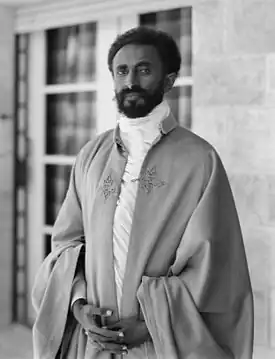
Charles Fernand Rey's 1927 book In the Country of the Blue Nile included a 13-page appendix with a list of Ethiopian kings written by the Prince Regent Tafari Makonnen, who later became the emperor of Ethiopia in 1930.[6] Tafari's list stretches back to 4530 BC and ends in 1779 A.D., with dates following the Ethiopian Calendar.[7] Tafari's cover letter was written in the town of Addis Ababa on the 11th day of Sane, 1914 (Ethiopian Calendar), which was 19 June 1922 on the Gregorian Calendar according to Rey.[8] Rey himself was awarded Commander of the Order of the Star of Ethiopia by Tafari.[9]
The goal of Tafari's list was to showcase the immense longevity of the Ethiopian monarchy. The list does this by providing precise dates over 6,300 years and drawing upon various historical traditions from both within Ethiopia and outside of Ethiopia (see "Historicity" section below).
The regnal list includes 312 monarchs divided into eight dynasties:
- Tribe of Aram (4530–3244 BC) (21 monarchs)
- Tribe of Kam (2713–1985 BC) (24 monarchs)
- Agdazyan dynasty (1985–982 BC) (52 monarchs)
- Dynasty of Menelik I (982 BC–493 A.D.) (132 monarchs)
- Dynasty of Kaleb (493–920) (27 monarchs)
- Zagwe dynasty (920–1253) (11 monarchs)
- Solomonic dynasty (1253–1555) (26 monarchs) and its Gondarian branch (1555–1779) (18 monarchs)
In addition to the above, there is an "Israelitish" dynasty with 8 unnumbered kings from the time of Zagwe rule which did not ascend to the throne of Ethiopia.
The first three dynasties are mostly legendary and take various elements from the Bible, as well as Ancient Egyptian, Nubian, Greek, Coptic and Arab sources. Many of the monarchs of the Menelik and Kaleb dynasties appear on Ethiopian regnal lists written before 1922, but these lists often contradict one another and many of the kings themselves have not been archeologically verified, though some of the later kings on Tafari's list are confirmed by Aksumite coinage. Many of the historically verified rulers of the Agdazyan and Menelik dynasties did not rule over Ethiopia but rather over Egypt and/or Nubia. It is only from the dynasty of Kaleb onwards that the monarchs are certainly Ethiopian or Aksumite in origin. The Zagwe and Solomonic dynasties are both historically verified, though only the Solomonic line has a secure dating of 1270 to 1975, which at times contradicts the reign dates found Tafari's list.
Because of the length of the Menelik dynasty, Tafari's regnal list breaks up the line of monarchs into three sub-sections, concerning the time periods 982 BC–9 AD (the monarchs who reigned before the birth of Jesus Christ), 9–306 AD (Pre-Christian monarchs who reigned after the birth of Christ) and 306–493 AD (Monarchs of this line who were Christian themselves). Tafari's list names the kings from Kaleb to Dil Na'od as a separate dynasty, however other Ethiopian regnal lists do not make the same distinction and the Solomonic dynasty additionally claimed descent from Menelik I through Dil Na'od.
Each monarch has their respective reign dates and number of years listed. Two columns of reign dates were used in the list. One column uses dates according to the Ethiopian calendar from 4530 BC to 1779 A.D., while the other column lists the "Year of the World", placing the creation of the world in 5500 BC Other Ethiopian texts and documents have also placed a similar date for the creation of the world, such as a manuscript in which the year 7260 A.M. was equivalent to the Gregorian date 1768, placing the creation of the world at 5492 BC[10] Another manuscript in dated to the year 7276 A.M. and is equivalent to 1784 A.D., which would place the beginning of the world in 5492 BC as well.[11] Considering that the Ethiopian calendar is roughly 7 or 8 years behind the Gregorian calendar, this would match very closely with the date given on Tafari's list of 5500 BC (Ethiopian calendar). E. A. Wallis Budge noted that the Abyssinians/Ethiopians believed that the world was created "at the autumnal equinox 5500 years before the birth of Christ" and had previously used this as their main dating system.[12] The dating of 5500 BC as the creation of the world on this list is influenced by calculations from the Alexandrian and Byzantine eras which placed the world's creation in 5493 BC and 5509 BC respectively.[13]
The use of Biblical figures in royal lineage has also been found in other fictitious histories, such as the Swedish Historia de omnibus Gothorum Sueonumque regibus, written in the 16th century.
Response to the regnal list
Egyptologist E. A. Wallis Budge was dismissive of the claims of great antiquity made by the Abyssinians, whom he described as having a "passionate desire to be considered a very ancient nation", which had been aided by the "vivid imagination of their scribes" who borrowed traditions from the Semites (such as Yamanites, Himyarites and Hebrews) and modified them to "suit [their] aspirations".[14] He noted the lack of pre-Christian regnal lists and believed that there was no 'kingdom' of Abyssinia/Ethiopia until the time of king Zoskales.[14] Budge additionally stated that all extant manuscripts date to the 17th–19th centuries and believed that any regnal lists found in them originated from Arab and Coptic writers.[15] Budge felt that Tafari's regnal list "proves" that "almost all kings of Abyssinia were of Asiatic origin" and descended from "Southern or Northern Semites" before the reign of Yekuno Amlak.[16] However, native Ethiopian rule before Yekuno Amlak is evidenced by the kingdoms of D'mt and Aksum, as well as by the rule of the Zagwe dynasty.
The Geographical Journal reviewed In the Country of the Blue Nile in 1928, and noted the regnal list, which contained "many more names [...] than in previously published lists" and was "evidently a careful compilation" which helps to "clear up the tangled skein of Ethiopian history".[17] However, the reviewer did also notice that it "[contained] discrepancies" which Rey "makes no attempt to clear up".[17] The reviewer points to how king Dil Na'od is said to have reigned for 10 years from 910 to 920 A.D., yet travel writer James Bruce stated that the deposition of this dynasty occurred in 960 A.D., 40 years later.[17] The reviewer does admit, however, that Egyptologist Henry Salt's dating of this event to 925 A.D. may have had "more reason" to it compared to Bruce's dating, considering that Salt's dating is seemingly backed up by Tafari's regnal list.[17]
Contemporary historian Manfred Kropp described the regnal list as an artfully woven document developed as a rational and scientific attempt by an educated Ethiopian from the early 20th century to reconcile historical knowledge of Ethiopia.[18] Kropp noted that regnal list has often been viewed by historians as little more than an example of a vague notion of historical tradition in north-east Africa.[18] However he did also note that the working methods and sources used by the author of the regnal list remain unclear.[18] Kropp further stated that despite some rulers' names having astonishing similarities to those of Egyptian and Meroitic rulers, there has been little attempt to critically examine the regnal list in relation to other Ethiopian sources.[19]
Kropp further noted that Tafari's regnal list was the first Ethiopian king that attempted to provide the names of kings from the 970th year of the world's creation onwards without any chronological gaps.[20] In particular, it was the first Ethiopian regnal list to consistently fill in all dates from the time of Solomon to the Zagwe dynasty.[20] Kropp felt that the regnal list was a result of incorporating non-native traditions of Ethiopia into the native Ethiopian history.[20]
Historicity and Sources
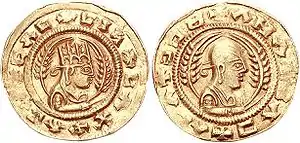
The regnal list includes a mixture of legendary and historically verifiable rulers. Many kings from the reigns of Makeda and Menelik I onwards appear to be verified through their appearances on other existing regnal lists. However, these regnal lists are not always supported by archaeological evidence. Aksumite kings from approximately the third century onwards minted coins, a practice that may have begun either with the reign of Endubis or a short time before and continued until the 7th century. These coins help to prove the historicity of some kings on Tafari's list, but there are also many kings named on these coins who do not appear on Tafari's list. Likewise, there are numerous kings on Tafari's list who allegedly reigned during the Aksumite period that are otherwise unattested in the archaeological record beyond the regnal lists that were written centuries after the fall of the kingdom of Aksum (c. 960). While there are undoubtedly traces of historical fact on Tafari's regnal list, it is only from the Zagwe dynasty onwards that the names and order of the kings match the opinion of historians and archeologists who study Ethiopia. Although even the Zagwe dynasty has differing traditions on the order of the kings (see Regnal lists of Ethiopia).
Heruy Wolde Selassie and Wazema
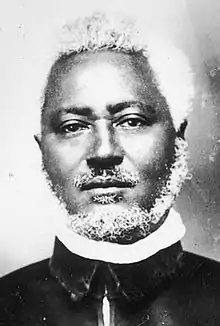
German historian Manfred Kropp believed the author of the regnal list was Ethiopian foreign minister Heruy Wolde Selassie (1878–1938).[21] Selassie was later foreign minister to Haile Selassie and was a philosopher and historian, as well as being able to master several European languages.[21] He had previously served as secretary to emperor Menelik II.[21] Kropp noted that Selassie's historical sources include the Bible, Christian Arab writers Jirjis al-Makin Ibn al-'Amid and Ibn al-Rāhib, and Christian traveller and writer Sextus Julius Africanus.[22] Kropp argued that Selassie was one of a number of Ethiopian writers who sought to synchronize Ethiopian history with the wider Christian-Oriental histories.[22] This was aided by the translation of Arabic texts in the 17th century.[22] Kropp also felt that the developing field of Egyptology influenced Selassie's writings, particularly from Eduard Meyer, Gaston Maspero and Alexandre Moret, whose works were published in French in Addis Ababa in the early 20th century.[22] Manfred Kropp additionally noted the existence of multiple versions of the regnal list, which suggest that Selassie grew increasingly critical of the sources he used for the first version of the list in 1922.[22] Kropp believed that Selassie was also assisted by French missionaries and the works they held in their libraries.[18]
Selassie wrote a book called Wazema which contained a variation of the regnal list.[23] Kropp stated that there were three different versions of the regnal list published in the works of Heruy Wolde Selassie.[23] Selassie's regnal list omits the first dynasty of Tafari's list – the so-called "Tribe of Ori or Aram" – and also the first three rulers of the second dynasty, instead beginning in 2545 BC with king Sebtah.[23] Selassie himself stated that he used European literature amongst his sources, including James Bruce's Travels to Discover the Source of the Nile.[23]
Manfred Kropp noted one important source for the information in Wazema. Selassie himself told the reader that if they wish to find out about more about Joktan, the supposed founder of the Ag'azyan dynasty, they could consult page 237 of a book by "Moraya".[24] At first Kropp thought this was referring to Alexandre Moret,[24] but it was later made clear that Selassie's regnal list had been inspired by a book called Histoire de l'Éthiopie by Louis J. Morié, published in 1904.[25]
Louis J. Morié's Histoire de l'Éthiopie
Louis J. Morié was a French historian who wrote a history of Ethiopia in the early 20th century. The two-volume work, titled Histoire de l'Éthiopie (Nubie et Abyssinie), was published in 1904 and was the first part of a series on the history of Africa, with the first volume focusing on ancient Nubia (also called "Ancient Ethiopia" by Morié) and the second volume focusing on Abyssinia ("Modern Ethiopia").[26][27] Historian Manfred Kropp identified the first volume as a key source in the creation of the Ethiopian regnal list that was copied by Tafari Makannon in 1922 and published in Charles F. Rey's book In the Country of the Blue Nile in 1927.[25] Kropp provided examples from Morie's text, specifically page 237 which provides information on Piori I (no. 46 on the regnal list) and pages 304–305 which provide information on the High Priests of Amun that appear on the Ethiopian regnal list, including the additional "Pinedjem" whose existence was an error of early Egyptology.[25] Kropp described the discovery of the regnal list's source as exciting but mixed with some "bitterness" as Morié's book is more imaginative than scientific in its approach to Ethiopian history.[25] Kropp blamed Selassie's European friends and contemporaries for the influence of Morié's book on Selassie's writing of Ethiopian history.[25] Peter Truhart's Regents of Nations includes a list of Ethiopian kings resembling the 1922 list with additional information resembling that found in Morié's book, suggesting that Truhart was aware of this text being the source of a large part of the regnal list.[28] E. A. Wallis Budge mentions Morié's book in his own similarly titled two-volume work A History of Ethiopia: Nubia and Abyssinia,[29] but surprisingly makes no mention of the clear similarity between Morié's narrative and the 1922 Ethiopian regnal list.
Morié's book displays his desire to hold on to religion and Biblical narratives in a world that was increasingly looking towards science. He showed concern with the possibility of abandoning religion, which would result in the "civilized" peoples of the world to descend down the moral scale.[30] Morié felt that it was possible for science and religion to be in agreement.[31] He described Atheism as one of the greatest scourges of nations and a cause of moral and political decadence.[32] Because of his anxieties of the decline of religion, Morié sought to base his historical narrative around the Biblical timeline. He described the Book of Genesis as the best source to consult on the most remote parts of human history.[33]
Morié believed that the "Ethiopian state of Meroe" was the oldest empire of the post-Flood world, having been founded by Cush of the Bible, and went on to birth the kingdoms of Egypt, Uruk, Babylon, Assyria and Abyssinia.[34] Morié followed the Biblical tradition by crediting Nimrod, a son of Cush, with founding Uruk and Babylon, and crediting Mizraim, a son of Ham, with founding Egypt.[31] He additionally identified Mizraim with the Egyptian god Osiris, Ham with Amun and Cush with Khonsu.[35]
Louis J. Morié defined the history of "Ethiopia" as divided into two parts; Ancient Nubia and Christian Abyssinia,[36] and defined "Ethiopians" as the Nubian and Abyssinian peoples.[37] E.A. Wallis Budge similarity defined "Ethiopia" as including both Nubia and Abyssinia in his own two-volume work A History of Ethiopia, published in 1928. Morié acknowledged the potential confusion this could cause and thus occasionally used "Abyssinia" to specify which of these two regions he was writing about, with a priority of using "Ethiopia" for ancient Nubia.[38]
Sources of information for Tafari's regnal list
The following collapsible tables include lists of sources from Louis J. Morié's Histoire de l'Éthiopie for the names and information on the 1922 Ethiopian regnal list:
Volume 1
| Monarch | Reference | Ref. |
|---|---|---|
| Ori or Aram (no. 1) | The so-called "Soleyman" dynasty from Coptic and Arabic folklore that ruled over Egypt in the Antediluvian era. The order is the same as recorded on the 1922 Ethiopian regnal list. The majority of the names also match, though some were altered for the Ethiopian regnal list ("Zeyn al-Zaman" to "Zeenabzamin", "Riyan" to "Elaryan", "Dalukah" to "Eylouka", "Sahalok" to "Saloug", "Scharid" to "Kharid" and "Malinos" to "Milanos"). The name used for the first ruler on the 1922 regnal list, "Ori", lstems from Morié's claim that this dynasty was called the "Aurites", and that Aram had inspired the name of his country, "Aurie" or "Aeria".[39] | [40] |
| Gariak I (no. 2) | ||
| Gannkam (no. 3) | ||
| Borsa (no. 4) | ||
| Gariak II (no. 5) | ||
| Djan I (no. 6) | ||
| Djan II (no. 7) | ||
| Zeenabzamin (no. 9) | ||
| Sahlan (no. 10) | ||
| Elaryan (no. 11) | ||
| Nimroud (no. 12) | ||
| Eylouka (no. 13) | ||
| Saloug (no. 14) | ||
| Kharid (no. 15) | ||
| Hogeb (no. 16) | ||
| Makaws (no. 17) | ||
| Affar (no. 19) | ||
| Milanos (no. 20) | ||
| Soliman Tehagui (no. 21) | ||
| Kam (no. 22) | Morié refers to Ham as "Kham" and dates his reign to 5880–5802 BC (78 years), the same length of time that Kam has on the 1922 Ethiopian regnal list, though with much later dates used. | [41] |
| Habassi (no. 24) | Morié names a king called "Habesch" who was the father of the Abyssinians.[42] He later claimed that Habesch was a son of Cush who ruled in Axum while the other sons of Cush ruled different regions.[43] | [42][43] |
| Nehasset Nais (no. 29) | Morié mentioned a story of a Nubian courtesan named "Nahaset Nais" ("Nahaset the black") who drowned all her lovers in the Red Sea until she suffered the same fate at the hands of the Egyptian king "Hor-ka-am" (Horus), who is placed directly after Nehasset Nais on the 1922 Ethiopian regnal list. | [43] |
| Horkam (no. 30) | An alternate name for the Egyptian god Horus used by Morié. He is identified by Morié with Raamah, a son of Cush. Morié also claims that Horkam/Raamah ruled over a coastal region of Ethiopia. | [43] |
| Saba I (no. 31) | Morié named Seba, son of Cush, as "Sheba I". | [43] |
| Manturay (no. 38) | Morié named "Mentou-Rai" as a Meroitic king and identified him with the Iranian god Mithra or Mithras. Morié equated Mithras with the Egyptian god Mentu (or "Mentou-Ra"). Morié described "Mentou-Rai" and "Ra-khou" as the "Ethiopian Menes and son" and the first legislators of Aethiopia, as well as regulating solar worship. | [44] |
| Rakhu (no. 39) | Morié named "Ra-khou" as a Meroitic king who succeeded "Mentou-Rai" and identified him with Phlegyas. | [44] |
| Sabe I (no. 40) | Morié named king "Sebi I" as the successor to Manturay and Rakhu. | [44] |
| Sousel Atozanis (no. 42) | Morié used the name "Attozanes" as one of a number of alternate names for the Kushite king Aktisanes. | [45][46] |
| Ramenpahte (no. 44) | Morié claimed that this was the name of an Ethiopian nobleman who was supposed to marry "Béroua" (or Meroe), a daughter of "Ba-en-Khons"/Cambyses, but she was taken by the king to be his own wife. | [47] |
| Piori I (no. 46) | Morié named "Poeri I" as a ruler of Ethiopia at some point between 3817 and 1800 BC, who reigned during a time when Rama (a Hindu god that Morié claimed was originally Maharaja of Magadha and Ayodhya) was able to conquer the whole of India, Ceylon and Arabia before arriving in Egypt and fought against the Pharaoh, who was killed in the fighting. The Pharaoh's successor then became a tributary to Rama and the king of Ethiopia, "Poeri", followed his example without engaging in battle with Rama. The empire of Rama did not survive its founder. | [48] |
| Akbunas Saba II (no. 47) | Morié named Sheba, son of Raamah, as "Sheba II" and specifically notes that he ruled a part of Ethiopia. Morié also claimed that Sheba II built the city of "Sheba" in Ethiopia, named after himself, and also built "Hasabo" (the "City of the South") which later became Meroe. This narrative is partially based on Josephus's text Antiquities of the Jews, in which he described Sheba as a walled city in Aethiopia that was renamed Meroe by Cambyses II.[49] The name "Akbunas" is derived from "Ankhnas", a supposedly "little-known" ruler of Aethiopia named by Morié who believed the name to be translated into Greek as Oceanus.[50] King "Akhnas" reigned for 29 years (1914–1885 BC) and was directly succeeded by "Nekhti I" (named Nakehte Kalnis on the 1922 Ethiopian regnal list).[50] "Akhnas" was considered by Morié to be the first of the Hyksos or the "Pasteurs" dynasty who reigned after Aethiopia's conquest by Rama. |
[51] |
| Nakehte Kalnis (no. 48) | Morié names a king of Ethiopia called "Nyktée, of the Nekhti".[52] This is a reference to Nycteus, a king of Thebes in Greece, although the name "Thebes" was also used to refer to a place in Upper Egypt. Morié mentions a king named "Nekhti I" who directly succeeded "Ankhnas" and reigned for 55 years (1885–1830 BC), mirroring the succession of Akbunas Saba II by Nakehte Kalnis on the 1922 Ethiopian regnal list.[50] The reign length of 55 years was used for king Aknas/Akbunas Saba II on the 1922 regnal list instead. Morié identified "Nekhti I" as the husband of Amalthea, though does not give an explanation why.[50] |
[52][50] |
| Kasiyope (no. 49) | Cassiopeia or "Kassiopée" is named as a monarch of Ethiopia and is, for unclear reasons, identified with the priest Khonsuemheb from the ancient Egyptian ghost story "Khonsuemheb and the Ghost".[52] Morié uses the name "Kassiopée I" to refer to an otherwise unnamed queen of Ethiopia who plotted with Set the assassination of Osiris according to one version of the Osiris myth as recounted by Plutarch.[53] Morié uses this name a second time to refer to the wife of "Sebi III", whom he identifies with Cepheus.[54] The second "Kassiopée" is also known as "Kassiépée" or "Anna-Melekît", allegedly a daughter of "Cynthia".[54] Morié identified the "Kassiopée II" with the Syrian and Mesopotamian goddess Anammelech.[55] "Kassiopée II" is the famous Cassiopeia of Greek mythology while "Kassiopée I" is a queen regnant who appears on the 1922 Ethiopian regnal list. |
[52] |
| Sabe II (no. 50) | Morié named king "Sebi II (Képhée)", who reigned for 15 years (1830–1815 BC), as the successor of "Nekhti I" and husband of "Kassiopée the Elder". This is mirrored on the 1922 Ethiopian regnal list which names "Sabe II" as the direct successor of "Kasiyope", who succeeded "Nakehte Kalnis". The 15-year reign length of "Sebi II" is replicated on the 1922 regnal list for "Sabe II". Morié stated that some people believed this king was deified as the Semitic god Adrammelech. Aleka Taye called this king "Sabe II Ayibe" on his regnal list, inspired by the name "Adrammelech" being associated with Sabe II.[56] |
[50] |
| Etiyopus I (no. 51) | Morié called this king "Atew I (Ethiops)" and named him as a son of the Roman god Vulcan, following the narrative written by Pliny the Elder.[57] Morié claimed this king ruled Aethiopia for 60 years (1760–1700 BC), similar to the 56-year figure used on the 1922 Ethiopian regnal list. Morié also claimed that a king called "Nekhti II" reigned for 55 years between "Sebi II" and "Atew I", but this king was omitted from the 1922 regnal list. | [58] |
| Lakndun Nowarari (no. 52) | Morié claimed that a king of Aethiopia called "Nower-Ari" was the father of Ahmose-Nefertari, wife of the Egyptian pharaoh Ahmose I. Morié additionally claimed that "Nower-Ari"'s wife was called "Ahhotep", similar to Ahmose's mother Ahhotep I, though Morié clarified that she should not be confused with Ahmose's mother. However, Ahmose-Nefertari's father was in fact the Egyptian pharaoh Seqenenre Tao. Morié dated this king's reign to 1700–1670 BC, which lasted 30 years. The 1922 Ethiopian regnal list likewise gives this king a 30-year reign. |
[58] |
| Tutimheb (no. 53) | Morié claimed that "Nower-Ari"'s successor was called "Thout-em-heb" and was defeated by Moses, who was the head of the army of pharaoh Amenemhat I. Morié dated this king's reign to 1670–1650 BC (20 years). This 20-year reign length was also used in the 1922 Ethiopian regnal list, although the dates were one century earlier than Morié's dates. | [59] |
| Her Hator I (no. 54) | Morié claimed that pharaoh Amenhotep I replaced "Thout-em-heb" with one of his astrologers named "At-Hor" (identified with Jethro, father of Zipporah and father-in-law of Moses), son of "Ra-oëri" (or "Raguel").[60] King "At-Hor" reigned for 25 years (1650–1625 BC) according to Morié and was succeeded by his son "Kheb-ab" (Hobab),[61] who is omitted from the 1922 Ethiopian regnal list. "At-Hor" was the first of the "Jethrides" dynasty in Morié's narrative. This dynasty also included "Kheb-ab", "Atew II" and "Nekthi III". In an earlier part of his book, Morié names Hephaestus as father of "Aethiops" (Etiyopus II is the 55th king of the 1922 Ethiopian regnal list).[62] This piece of information was combined with the later section on king "At-Hor" to provide the placement of king "Her Hator I" on the 1922 regnal list. Aleka Taye called this king "Yotor" on his version of the regnal list, based on the name "At-Hor".[56] |
[60][62] |
| Etiyopus II (no. 55) | Morié named a king called "Atew II (Ethiops)" who reigned for 2 years (1572–1570 BC) "Atew II"'s daughter married "Danaos", nomarch of Tanis, possibly the same person as the mythical figure Danaus. Morié additionally claimed this king was succeeded by "Nekhti III" (r. 1570–1515 BC), although he is omitted from the 1922 Ethiopian regnal list.[63] | [64][62] |
| Senuka I (no. 56) | Morié gave the name "Snouka I Menken" to the Kushite king Aktisanes and stated that he dethroned the last king of the Thirteenth dynasty and founded the Fourteenth dynasty.[45] "Snouka I Menken" ruled Egypt for 13 years (from 2398 BC to 2385 BC) before being deposed and expelled by the second king of the Fourteenth dynasty, called "Hakori III" or "Akhoréos".[45] This statement was inspired by a narrative told by Diodorus.[65] Later in his book, Morié mentiones another king called "Snouka II Menken" who ruled Aethiopia for 16 years (1515–1499 BC) and had "Aktisanès" and "Attozanès" as alternate names, like with the first king named "Snouka".[46] According to Morié's narrative, "Snouka II Menken" was also the High Priest of Amun and had support from the Egyptian people, who were revolting against Akhenaten and the Atenist religion at the time.[46] "Snouka II Menken" was able to defeat Akhenaten in 1512 BC and became ruler of Egypt until his death, afterwards allowing Egyptians to choose a native Egyptian as the next king.[46] Modern Egyptology however dates Akhenaten's reign to much later, c. 1351–1334 BC, unlike Morié's dating. The 1922 Ethiopian regnal list more closely follows the narrative of the second king named "Snouka", as his chronological placement comes after "Atew"/Etiyopus II and the 16-year reign length is similar to the 17-year reign length that appears on the 1922 list. Aleka Taye's version of the regnal list calls the 56th king "Senuka Menkon".[56] |
[45][46] |
| Bonu I (no. 57) | For unclear reasons, Morié identified the Egyptian god Bennu (or "the Phoenix, Bennou") as a king of Ethiopia (i.e. Nubia).[66] This is because of his belief that the name of the ancient Egyptian city Hebenu meant "home of the phoenix".[67] Morié names "Bennou I" as the successor to "Snouka II Menken", reigning for 8 years (1449–1491 BC).[68] Both the line of succession and the reign length match with what is written on the later 1922 Ethiopian regnal list. | [66][68] |
| Mumazes (no. 58) | Morié stated that "Bennou I" was succeeded by his daughter "Moumésès (Moso)", who reigned for 4 years and was said to ride a chariot dragged by bulls. Her name supposedly meant "Child of water, of the Nile". The line of succession and reign-length are both replicated on the 1922 Ethiopian regnal list. This name was inspired an alternate name used by Morié for Moses, "Moumësès (Moïse)".[69] Morié claimed that, according to ancient Greek scholar Alexander Polyhistor, "Moso" had apprently been a female legislator to the Jews.[70] Morié believed that there had been some confusion with accounts claiming that "Moso" was a legislator of the Jews, and other accounts claiming that Moses was a legislator for the Aethiopians.[70] He believed that it was more likely that "Moso" referred to woman ruling over Aethiopia.[70] |
[70] |
| Aruas (no. 59) | Morié stated that queen "Moumésès (Moso)" was succeeded by her son "Arouas", who reigned for 7 months. His name supposedly means "Precious Existence" and was sometimes been confused with Aaron, elder brother of Moses. The 1922 Ethiopian regnal list replicated the name, order of succession and reign length, but changed the gender of "Arouas"/Aruas to female. Aleka Taye's version of the regnal list does not specify the gender of this ruler.[56] | [70] |
| Amen Asro I (no. 60) | Morié claimed that "Arouas" was directly succeeded by "Amenasro I", who reigned for 17 years (1487–1470). He supposedly briefly ruled Egypt as well for 2 years (1477–1475) before being driven out of Egypt by "Nowertai", a brother of pharaoh Ay.[71] | [72] |
| Piori II (no. 62) | Morié mentioned a painting of pharaoh Seti I seated in a chapel while his son prince Ramesses brings with him the Aethiopian prince "Amen-em-hat", son of king "Poeri". These figures are the Viceroys of Kush named Paser I and Amenemopet, who were father and son and served as Viceroys during the reigns of the pharaohs from Ay to Seti I. Morié believed that "Amen-em-hat I" attempted a revolt against Ramesses II.[73] | [74] |
| Amen Emhat I (no. 63) | ||
| Protawos (no. 67) | Morié mentions Proteus as a king of Egypt from Greek mythology. | [75] |
| Konsi Hendawi (no. 69) | Morié claimed that "Amen-em-hat I" was succeeded by king called "Khonsi (Gangès)" in 1370 BC and reigned for 5 years, a reign length that was replicated on the 1922 Ethiopian regnal list.[76] According to Morié, this king was born in India and arrived in Aethiopia with a Hindu colony.[76] Morié earlier claimed that in c. 1370 BC, a Hindu colony settled in Aethiopia, and this was the reason why some ancient Greek writers mentioned Aethiopians of Indian origin.[77] Morié described "Khonsi" as a "hero remarkable for his beauty and size".[76] He also stated that "Khonsi" was the son of an incestuous union, "committed unwittingly", between king "Ganges", previously called "Khliaros", and his mother, the goddess Ganga.[76] Additionally, "Khonsi" was apparently the brother of "Limnate" and "Princess Limniaké", the latter being the mother of "Atys the Indian" who was killed the wedding of Perseus, the legendary founder of Mycenae.[76] Morié claimed that "Khonsi" had come to Aethiopia and ruled there after going into exile following the death of his father by suicide.[76] Despite having a "glorious reign" in which he founded "60 cities" and "drained swamps", he was nonetheless put to death by his subjects.[76] The name "Khonsi" is similar to the name of the Egyptian god Khonsu and "Gangès" is a clear reference to the Ganges river. |
[76] |
| Bonu II (no. 70) | According to Morié, "Khonsi" was succeeded by "Bennou II", who reigned for 2 years, from 1365 to 1363 BC, a reign length that was replicated in the 1922 Ethiopian regnal list, though with reign dates set 110 years earlier. Morié clarified that this king should not be confused with the Egyptian god Bennu, despite the similarity in the name. "Bennou II" was the first of "the Bennides" dynasty, which also included "Sebi III", "Se-Khons" and "Snouka III Menken".
"Bennou II" was married to several women, including:
Additionally, he fathered children whose mothers are not known:
In total, he had 13 children. These marriages show that "Bennou II" is to be equated with several male mythological figures:
Such identifications result in much confusion around "Bennou II". In particular, it is odd that Morié should claim this king was both Aleus and married to a daughter of Aleus, even though there is no tradition telling of an incestous marriage between them. Morié claimed that "Bennou II"/"Phoenix" had settled in Aethiopia due to his sister Europa being kidnapped by the Cretans and Agenor forbidding his sons to return until she was found. "Bennou II"/"Phoenix" was unpopular because he was considered a usurper and abdicated in favour of his son Cepheus after two years of rule. He later returned to Sidon to became its second "Egyptian king" after the death of Agenor according to Morié. Additionally, Morié stated that "Sebi (Képhéos)" succeeded him at Meroe as king of Aethiopia, while another son "Bennou (Phinée)" was a nomarch of a province and was heir to the throne until Persius sowed disunity between them. |
[78] |
| Sebi III (Kefe) (no. 71) | "Sebi III" was the son of the previous king "Bennou II" and reigned for 15 years (1363–1348 BC), a reign length that is replicated on the 1922 Ethiopian regnal list, which pushes the dates back by over 100 years. Morié claimed that Cepheus/"Sebi III" was deified as the ancient Sicilican god Adranus.
"Sebi III" was married to two women:
The traditional narrative of Cassiopeia in partially recounted by Morié in association with the wife of "Sebi III", though with some slight differences. He claims that a kind of beauty contest took place in Greece in which Cassiopeia (or possibly Andromeda) found no success due to her "tanned complexion" and this led to an open war. Cassiopeia insulted the queen of Crete and this led to the Greeks invading Aethiopia. In the ninth year of "Képhée"'s reign, a Greek fleet led by "Kétos" or "Karkharias" (who is normally a sea creature instead of a fleet commander in Greek mythology) attacked the coast of Aethiopia and seized the port of Jaffa, where Cepheus was residing, and forced the king to give his daughter Andromeda in marriage to him. The oracle of Amun advised to king to grant this request. Cepheus/"Képhée" agreed to this on the condition that the Greeks do not stop trade with Aethiopia. Andromeda was unhappy with this arrangement but was nonetheless taken to the ship of "Kétos". She was rescued by Perseus, who killed "Kétos" and returned her to her father. Perseus married Andromeda after killing "Bennou (Phinée)", a brother of "Sebi III", who the king had once promised his daughter's hand in marriage. One of the children of Perseus and Andromeda was "Képhène", named after "Képhée", who was the father of the Aethiopian king "Erythras III". "Sebi III" was a powerful king who possessed Syene (modern-day Aswan in Egypt), and had the Nasamones of Libya and the Aethiopians of Gedrosia as his tributes.[79] "Sebi III" had 20 sons and 2 daughters.[79] The sons include "Anhour-em-hat" (Andromada) and "Pehrer" or "Pehres", while the rest are little known.[79] One of the daughters was named "Hathor-em-hat" (Andromeda).[79] |
[80] |
| Djagons (no. 72) | According to Morié, the next king of Aethiopia after "Sebi III" was called "Se-Khons (Gigon)" ("Son of Khons") and he reigned for 21 years (1348–1327 BC). Aleka Taye's version of the 1922 Ethiopian regnal list calls the 72nd king "Jagonis Sekones".[56] However, Tafari's version does not include the name "Sekones" or "Se-Khons" for Sebi III's successor. The 21-year reign length from Morié's account is slightly shorted to 20 years on Tafari's list. Morié claimed that it was during the reign of this king that Bacchus ravaged Aethiopia and "probably" killed the king. During the reign of "Se-Khons", an Egyptian prince named "Meneptah" (son of Sesostris) fled to Aethiopia and never left the country afterwards. | [81] |
| Senuka II (no. 73) | According to Morié, king "Snouka III-Menken" ruled Aethiopia for 13 years (1327–1314 BC). He was secretly summoned by Egyptian nobles to declar war on pharaoh Amenmesse, who ruled Egypt with great cruelty. "Snouka III-Menken" defeated Amenmesse and ruled over Egypt for 3 years (1327–1324 BC), during which time he ruled both Egypt and Ethiopia with kindness, equity and righteousness. He had the noses of thieves cut off before the thieves themselves were sent to Rhinocorura, located on the Egypt-Syria border (This story is inspired by that of Actisanes, who, according to Diodorus Siculus, founded Rhinocorura and conquered Egypt in the reign of pharaoh "Amasis"). "Snouka III-Menken" was eventually driven out of Egypt in 1324 BC by "Meneptah II", who was devoted to his minister named "Bai" (this likely refers to Siptah and Chancellor Bay). "Snouka III-Menken" held a son of "Meneptah I", named "Seti", as prisoner in Aethiopia and sent him to Egypt to cause embarressment to the pharaoh, but an unexpected compromise was reached and "Meneptah II" acknowledged "Seti" as his eventual successor Seti II. Morié's interpretation of events is completely at odds with modern-day Egyptology, which places Seti II before Siptah and acknowledges Siptah as a son of either Seti II, Amenmesse or Merneptah. | [82] |
| Helena (no. 76) | The name "Hemera" is an alternate name Morié used for Eos, wife of Tithonus. Hemera is more commonly known as a personification of day in Greek mythology but is sometimes identified with Eos. | [83] |
| Her Hator II (no. 78) | Morié names a king called "Her Hator", who he identified with the ancient Greek mythical figure Erythras for unclear reasons.[84] Morié believed that this king was a contemporary of Esau.[84] Even though Morié called this particular king "Her Hator I", the 1922 Ethiopian regnal list reserves this regnal number and name for the king Morié called "At-Hor". Aleka Taye called Her Hator II "Herhator Ertas" on his regnal list, based on Morié's original narrative.[56] According to Morié, "Her Hator II (Erythras)" was a later king who succeeded "Snouka III-Menken" and ruled Aethiopia for 29 years (1314–1285 BC), similar to the 30-year figure used on the 1922 Ethiopian regnal list.[85] "Her Hator II" (meaning "The Supreme Hathor") was a grandson of "Sebi III"/Cepheus through his daughter Andromeda and Perseus.[85] Little is known of this king's reign and he drowned in Erythraean Sea, which gets its name from king "Her Hator II (Erythras)".[85] This name also influenced the naming of Eritrea.[85] He also named the continent of Africa "Kephenia" in honour of his grandfather.[85] "Her Hator II" had no children.[85] "Her Hathor II" was the first of the "Perseides", a dynasty that also included "Her Hathor III" and "Nekhti IV". |
[84][85] |
| Her Hator (Za Sagado) III (no. 79) | According to Louis J. Morié, "Her Hator II" was succeeded by his nephew "Her Hator III (Erythras)", who was the son of Persus, son of Andromeda and Perseus, and king of the Persians. "Her Hator III" reigned for only one year (1285–1284 BC), a reign length which is replicated on the 1922 Ethiopian regnal list. Morié stated that little is known about this king and me may have drowned in the Erythraean Sea rather than his predecessor. | [86] |
| Akate (Za Sagado) IV (no. 80) | "Her Hator III"'s successor was "Nekhti IV", who reigned for 4 years (1284–1280 BC). According to Morié, this king arrived in Aethiopia as head of a Greek or Egyptian colony.[87]
Morié identified this king with several mythical figures:
Morié is unsure who the parents of "Nekhti IV" are, naming Neptune, "Kelene", Belus, Hyrieus, Bacchus, Apollo and Sandocus as potential candidates. Morié did however name Lycus and Orion as "Nekhti IV"'s brothers. This suggests that Hyrieus is the most likely father of "Nekhti IV", as he had a son named Lycus. In turn, this would suggest that "Nekhti IV" is meant to be identified with Nycteus, who was the brother of Lycus of Thebes and sometimes named as a son of Hyrieus. "Nekti IV" has several wives:
According to Morié, "Nekti IV" had many children including:
According to Morié, "Nekhti IV"'s daughter Antiope fled to the court of king Apis of Argos, who was charmed by her beauty and married her. Apis refused to return Antiope to "Nekhti IV", who then declared war on him. "Nekhti IV" later died of wound he received during a battle. Before his death, "Nekthi IV" asked his brother Lycus to avenge him, and Lycus later killed Apis, which brought an end to the war. |
[88] |
| Titon Satiyo (no. 81) | According to Morié's narrative, "Nekhti IV" was succeeded by "Tetouni" or "Tithon", who reigned for 10 years, from 1280 to 1270 BC. "Tithon" was a foreign prince and was the son of Laomedon of Troy and "Strymo" or "Strymno" (daughter of Scamander), and was a brother of Priam. According to Morié, "Tithon" was a "well built and great warrior" who left Mysia and became a Satrap of Susiana. "Tithon" later seized the country by arms and founded or "embellished" the city of Susa (This narrative was inspired by Herodotus's statement that Susa was "the city of Memnon".[89]). "Tithon" attempted a conquest of Aethiopia but was taken prisoner by "Nekhti IV". However, he was later freed after a daughter of the king named "Ait" or "Ida" wished to marry him due to his handsome appearance. "Ait"/"Ida" was the daughter of "Nekhti IV" and "Hapi-aa-kenen" (Iphigenia) according to Morié.
"Tithon" and "Ait" had four sons:
"Tithon" also had another son with a concubine:
After "Nekhti IV"'s death, "Tithon" ascended the throne of Aethiopia and later took advantage of the troubles the emerged at the end of the Nineteenth dynasty of Egypt with the usurption of "Arisou" (possibly Amenmesse?) and conquered a part of Upper Egypt. "Tithon" gave his son Memnon the title of "Royal son of Abydos", similar to the way that "Prince of Kush" was given to sons of Egyptian pharaohs in the past. "Tithon" reigned during the time of the Trojan war, as recorded in Greek mythology, and sent 10,000 men and 200 war chariots under the command of his son Memnon, who killed many Greeks, including Antilochus. However, Memnon himself was killed after the Aethiopians were ambushed by the Thessalians. Memnon's body was burned and his bones were carried back to his father. According to Morié, Memnon had several children:
However, despite stating all of the above, Morié claims there were several "Memnons" and insisted that the "Memnon" who fought in the Trojan war was actually "Mhamnoun", the son of "Touklat-Adar I" (king of Assyria) and "Eos". According to Morié, "Tithonus" reached an advanced age and was overwhelmed by infirmiries. Because of this, he took his own life. "Tithonus" would be succeeded to the throne of Aethiopia by his three sons, "Hermathion II" (son of a concubine), "Memnon" and "Kousch-Avril". |
[90] |
| Hermantu I (no. 82) | According to Morié's narrative, an illegitimate son of "Tithonus" usurped the throne after his death. "Her-Mentou"/"Hermathion" or "Se-Khons"/"Gigon II" was deceitful and cruel and was later killed by Hercules. | [91] |
| Amenemhat II (no. 83) | Louis J. Morié claimed that Memnon from Greek mythology was an Ethiopian king named "Amenemhat".[92] In Morié's narrative, this king succeeded his half-brother "Her-Mentou"/Emathion and reigned for 5 years, from 1270 to 1265 BC. This reign length and succession placement was replaced on the 1922 Ethiopian regnal list, though with dates set over a quarter of a century later. "Amenemhat II-Meiamoun" was born and died in Meroe and never went to Troy according to Morié (apparently this "Memnon" is different from the more famous Memnon). However, "Amenemhat II" did fight in a war abroad and was greatly missed by his people. He was initially buried in Meroe but his body was later transferred to Abydos in Egypt. The sites in Abydos called "Memnonia" by Strabo were supposedly named after "Amenemhat II-Meiamoun". The king also was the inventor of the Meroitic script according to Morié, though the earliest surviving examples of it date to the 2nd century BC. | [93] |
| Konsab (no. 84) | In Morié's narrative, "Tithonus"'s son "Khons-Ab I" (or "Kousch-Avil-Dendan") ruled Aethiopia for 5 years, from 1265 to 1260 BC. This reign length was replicated on the 1922 Ethiopian regnal list. Morié claimed that a civil war erupted in Aethiopia after the death of Memnon due to two rival claimants fighting over the throne. According to Morié the name "Koush-Avil-Dendan" was supposedly recorded by the Assyrians (possibly referring to an Assyrian king) and meant "son of Dendan", referring to "Doudani" (or Tithonus). During the reign of "Khons-Ab I" (or possibly "Khons-Ab II"), Aethiopia experienced a rise in power following a victorious war against Iran. Morié believed that "Thraetaouna" (or Fereydun) invaded lands owned by "Khons-Ab I" and was defeated. Morié theorised that this was not recorded in Persian records because they did not wish to acknowledge their defeats. "Khons-Ab I" himself was defeated by "Khons-Ab II" in 1260 BC and subsequently fled and disappeared, or possibly died in battle. His followers fled to Troy and Cyzicus. | [94] |
| Sannib (no. 85) | "Khons-Ab I" was directly followed by "Khons-Ab II" in Morié's narrative. This second "Khons-Ab" was not recorded in the 1922 Ethiopian regnal list but was recorded in other versions written by Heruy Wolde Selassie and Aleka Taye, suggesting that the name "Sannib" was an error on Tafari's version.
Morié claimed this king was a contemporary of Ramesses III (who actually reigned later, around 1186 to 1155 BC). According to Morié's narrative, Ramesses III was able to expand the Egyptian empire as far as south as the Tigray Region in modern-day Ethiopia, though there is no archeological proof that this happened. The decline of Egyptian power after the reign of Ramesses III meant that Meroe and the Kingdom of Kush would no longer recognize the suzerainty of Egypt. | |
| Sanuka III (no. 86) | In Morié's narrative, king "Snouka IV-Menken" or "Snouka IV (Aktisanes)" reigned for approximately 15 years, from c. 1255 to c. 1240 BC. The 1922 Ethiopian regnal list lowered this reign length to 5 years. Apparently nothing is known of this king except that he was a contemporary of Jephthah. | [95] |
| Amen Astate (no. 88) | This king reigned for approximately 10 years, from c. 1240 to c. 1230 BC, according to Morié. The 1922 Ethiopian regnal list extended this reign length to 30 years. The king was known as "Amen-As-Tat" or "Monostatos". When Ramesses VII was prince of Kush, a young princess he was engaged to named "Pat-Amen" was kidnapped with her servant by "Amen-As-Tat". The High Priest of Isis, named "Ousir-as-ro", along with three priestesses was able to bring back the princess to be married to Ramesses VII. Louis J. Morié claimed that the next 100 years in Aethiopia after the reign of "Amen-As-Tat" remain shrouded in darkness. Morié noted that Egyptologists of his time theorised that the High Priests of Amun in Upper Egypt founded the kingdom of Napata after being expelled from Egypt at the end of the New Kingdom of Egypt. He believed that this indeed took place, and Napata replaced the kingdom of Meroe, encompassing all of present-day Nubia and Abyssinia up to Aswan (although in reality the Napatan kings are not proven to have ruled over Abyssinia). Morié believed that after the death of the last king of the "Perseides" dynasty, "Her-Hor" entered Aethiopia with an army and was elected king. He was supposedly already the religious leader of the country before this. |
[96] |
| Herhor (no. 89) | According to Louis J. Morié, "Her-Hor" was the first of the "Ammonienne" or "Ammonian" dynasty that ruled at Napata. Regarding the High Priests of Amun, Morié's narrative follows mainstream Egyptology of his time. He states that the weakening power of the Twentieth dynasty of Egypt allowed the High Priests at Thebes to increase their own power in Upper Egypt and eventually claim Pharaonic titles. Morié noted that "Her-Hor" (Herihor) claimed the title "Prince of Kush", possibly referring to the title Viceroy of Kush. "Her-Hor" established his reign in 1100 BC and was recognised in Egypt, Aethiopia and Syria. According to Morié, a civil war erupted in Egypt between Smendes of the Twenty-first dynasty in Lower Egypt and Herihor which lasted 10 years until Herihor was driven out of Egypt. Herihor then fled to Aethiopia and took the tile of King of Napata. He had support from the descendants of the Egyptian High Priests who fled to Aethiopia during the reign of Akhenaten and together they developed a flourishing kingdom in Lower Nubia. "Her-Hor" would be an ancestor of the future Twenty-fifth Dynasty of Egypt. This king and his descendants were initially allies of the Assyrian kings. Morié believed that "Her-Hor" introduced the practice of embalming to Aethiopia, where previously the dead were cremated. "Her-Hor" first reigned over Egypt from 1110 to 1100 BC, and over Aethiopia from 1100 to 1094 BC. This results in a reign length of 16 years in total over both countries. This reign length was replicated on the 1922 Ethiopian regnal list. While Morié's dates are not too far removed from modern-day Egyptological dating, the 1922 regnal list pushes back the reign dates by over 40 years in an attempt to fill the gap in dates between "Amen-Astat" and "Her-Hor". |
[97] |
| Wiyankihi I (no. 90) | "Piankhi I" (Piankh) was a son and successor of "Her-Hor" in Louis J. Morié's narrative, and apparently did not rule over Upper Egypt. His reign lasted for 9 years from 1094 to 1085 BC. This reign length was replicated on the 1922 Ethiopian regnal list. Some modern-day Egyptologists however now consider Piankh to actually be Herihor's predecessor. Additionally, Piankh certainly ruled over Upper Egypt and was Viceroy of Kush. | [98] |
| Pinotsem I (no. 91) | "Piankhi I" was succeeded by his son "Pinotsem I" (Pinedjem I), who reigned for 16 years, from 1085 to 1069 BC. The 1922 Ethiopian regnal list slightly extended this reign length to 17 years. In Morié's narrative, "Pinotsem I" was able to recover parts of Upper Egypt and was crowned at Thebes. His wife was "Tiouhathor-Honttaoui" (Duathathor-Henuttawy), who was a daughter of "Khonsoumos" and "Tontamoun" (Tentamun). "Pinotsem I" had two children, his successor "Pinotsem II" and a daughter named "Ouait-at-en-Mout" (Mutnedjmet). | |
| Pinotsem II (no. 92) | "Pinotsem II" married princess "Makera" of the Ramesside line to legitimize his rule, and had 2 sons with her named "Masaherta" (Masaharta) and "Ra-men-khoper" (Menkheperre). "Makera" died in childbirth with their third child, a daughter named "Moutemhat" (Maatkare Mutemhat). "Pinotsem II" reigned for 41 years, from 1069 to 1028 BC. This reign length was replicated on the 1922 Ethiopian regnal list. Modern-day Egyptology now considers there to be only two High Priests of Amun named "Pinedjem". The information Louis J. Morié relates about "Pinotsem I" and "Pinotsem II" both refer to Pinedjem I. | |
| Massaherta (no. 93) | After the death of "Pinotsem II", his younger son "Masaherta" (Masaharta) seized the throne and reigned for 16 years, from 1028 to 1012 BC. This reign length was replicated on the 1922 Ethiopian regnal list. | |
| Ramenkoperm (no. 94) | "Masaherta" was followed to the throne by his brother "Ra-men-khoper" (Menkheperre), who reigned for 14 years, from 1012 to 998 BC. This reign length was replicated on the 1922 Ethiopian regnal list. "Ra-men-khoper" married his niece "Isi-em-Kheb" (Isetemkheb), a daughter of "Masaherta". They had 3 children:
| |
| Pinotsem III (no. 95) | "Pinotsem III" (Pinedjem II), son of "Ra-men-khoper", reigned 6 years, from 998 to 992 BC. The 1922 Ethiopian regnal list slightly extended this reign length to 7 years. "Pinotsem III" was married to "Neskhonsu" (Neskhons), a daughter of lady "Tonthontthouti" (Takhentdjehuti). "Pinotsem III" and "Neskhonsu" had 4 children:
"Pinotsem III" was a contemporary of king Solomon according to Louis J. Morié. | |
| Sabi IV (no. 96) | According to Louis J. Morié, there was a dispute over the succession to the throne after the death of "Pinotsem III". The Egyptian pharaoh "Psiounkha III" (Psusennes II) acted as arbitor and appointed "Sebi IV (Képhée)" as the king of Aethiopia. "Sebi IV" resided in "Ioppé" (Jaffa) and his parentage is apparently unknown, though he possibly is identifiable with Psusennes III. However, Morié does state that this king was a relative of Solomon. This later statement explains why this king was placed close to the reign of Makeda on the 1922 Ethiopian regnal list. Morié claimed this king reigned for 9 years, from 992 to 983 BC. The 1922 regnal list extended his reign length to 10 years. | [99] |
| Menelik I (no. 99) | Morié's narrative names "Sebi IV"'s successor as "Ro-ke-Amen", a king who does not appear on the 1922 Ethiopian regnal list and supposedly reigned for 25 years, from 983 to 958 BC.[99] Morié identified "Ro-ke-amen" with Luqman, a wise man who is named in the Quran.[99] This identification is made because Luqman was said to be Nubian, although Morié himself noted he could have been Abyssinian.[100] "Ro-ke-Amen" married "Neit-akert", a daughter of Egyptian pharaoh Psusennes II (possibly identifiable with Maatkare B, although she actually married Osorkon I).[101]
Morié identifies "Ro-ke-Amen" as Menelik I,[100] who is already mentioned in native Ethiopian/Abyssinian regnal lists and thus there was no need to include the name "Ro-ke-Amen" on the 1922 regnal list. | |
| Sera I (Tomai) (no. 101) | The next king after "Ro-ke-Amen" in Louis J. Morié's narrative was his son "Atserk-Amen I", who was the Biblical Zerah the Cushite, and reigned for 15 years, from 958 to 943 BC.[100] Morié was sceptical of a theory in mainstream Egyptology that identified Zerah the Cushite with Osorkon I or Osorkon II because Zerah is explicitly described in the Bible as being a king of Aethiopia and Morié believed it was unlikely at this time that the king of Aethiopia was the son of the king of Egypt, unless he had married a daughter of the Egyptian king and was able to seize the throne after the Egyptian king's death.[102] Morié believed that there may have been some confusion over the status of Zerah's relationship to the pharaoh of Egypt, being a son-in-law rather than son of the king.[102] Morié theorised that Zerah was a distinct individual to Osorkon II and was in fact his brother-in-law who raided Egypt on his path to Judah before being defeated by Asa.[103] Morié claimed that archeologists Émile Brugsch and François Lenormant theorized the original name of Zerah to be "Atserk-Amen".[103] The author of the 1922 Ethiopian regnal list did not use the name "Atserk-Amen" for the name of this king, but instead used the name "Sera" twice, first for the 101st king "Sera I (Tomai)" and secondly for the 104th king "Awseyo Sera II". Both Tomai and Awseyo appear on traditional Ethiopian regnal lists, but never with "Sera" added to their name.[104][105][106] Louis J. Morié used "Zerah" as an alternate name for the first two kings named "Atserk-Amen" in his line of succession, who both align roughly with the positions of Tomai and Awesyo on the 1922 Ethiopian regnal list. |
[107] |
| Amen Hotep Zagdur (no. 102) | According to Louis J. Morié, "Atserk-Amen I" was succeeded by his youngest son "Amenhotep", who was a son of "Isinowert" (daughter of Shoshenq I) and reigned for 59 years, from 943 to 884 BC. He was able to retain his father's conquests in Libya but lost control of Thebes in Egypt. The 1922 Ethiopian regnal list identifies "Amenhotep" with "Zagdur", who is named on pre-1922 Ethiopian regnal lists, though never with the addition of "Amenhotep" to his name.[104][105][106] | [108] |
| Aksumay Ramissu (no. 103) | King "Amenhotep" was succeeded by his son "Ramessou (Ramses)", who reigned for 27 years from 884 to 857 BC. Apparently little is known of this king according to Morié, except that he built a temple to Ptah in Aethiopia's capital. The 1922 Ethiopian regnal list identifies this king with "Aksumay", who appears on some pre-1922 regnal lists but never with "Ramissu" added to his name.[106][105] The 1922 list also gives this king a shorter 20-year reign length. | [109] |
| Awseyo Sera II (no. 104) | In Louis J. Morié's narrative, "Ramessou" was succeeded by "Atserk-Amen II", also known as "Zerakh II", who reigned for 39 years, from 857 to 818 BC. Morié claimed that this king desired to invade the kingdom of Judah during the reign of Jehoram as revenge for the failure of the earlier invasion by "Zerakh I". King "Atserk-Amen II"/"Zerakh II" was apparently responsible for carrying off the whole family of Jehoram except his youngest son Ahaziah, as recorded in the Bible. The 1922 Ethiopian regnal list identified this king in Morié's narrative with "Awesyo", an Ethiopian king named on pre-1922 regnal lists who was never previously known as "Sera".[104] The author of the 1922 regnal list merged Morié's history with the native Ethiopian regnal lists and kept the order of succession close to Morié's list. The name "Atserk-Amen" was not used for this king on the 1922 regnal list, but "Zerakh" was retained in the form of "Sera". Morié's reign length of 39 years for this king was shortened slightly to 38 years on the 1922 regnal list. According to Morié, king "Shakaba I" ascended the throne of Aethiopia 40 years after the reign of "Atserk-Amen II"/"Zerakh II". "Shabaka I" (or "Shabakon I") would reign for 12 years, from 780 to 768 BC, and directly before "Piankhi". The author of the 1922 Ethiopian regnal list omitted "Shabaka I" completely and instead named "Tawasya" as the king who reigned between Sera II and Piyankihi II. The reign length was also extended from 12 years to 21 years. This king, previously known as "Tahawasya" or "Ta'asya", appears on some pre-1922 Ethiopian regnal lists,[105][106] sometimes as the successor to Awesyo.[106] |
[110] |
| Abralyus Wiyankihi II (no. 106) | The next king in Louis J. Morié's narrative is "Piankhi II" (i.e. Piye, founder of the Twenty-fifth Dynasty of Egypt), who, according to Morié, reigned for 30 years in Aethiopia (761–731 BC) and 10 years in Egypt (741–731 BC). In Morié's narrative, the princes in Egypt implored Piankhi to help them prevent the expansion of territory under the Twenty-fourth dynasty Pharaoh Tefnakht, who ruled at Sais. Piankhi was able to defeat Tefnakht and established an empire stretching from "the Equator to the Mediterranean". Morié describes this as the sixth conquest of Egypt by Aethiopia and states that it took place in 741 BC, claiming that Piankhi annexed the Theban region, but left the Delta and Middle Egypt as vassals, with Osorkon IV ruling at Sais (although Morié calls him "Osorkon V"). The 1922 Ethiopian regnal list alters "Piankhi"'s names slightly to "Piyankihi" and identifies him with "Abralyus", a king who appears on some pre-20th century Ethiopian regnal lists.[106] The 1922 regnal list extended "Piankhi"'s reign to 32 years and pushed his reign dates back by 27 years compared to Louis J. Morié's dating. |
[111] |
| Kashta Hanyon (no. 108) | According to Louis J. Morié, "Piankhi II" was succeeded by "Kashta", who reigned for 6 years, from 731 to 725 BC. Modern-day Egyptology considers Kashta to have been Piye/Piankhi's predecessor rather than successor. The 1922 Ethiopian regnal list called this king "Kashta Hanyon", combining the name "Kashta" with "Hanyon", a king who appears on some earlier Ethiopian regnal lists under the name "Endor" or "Handadyo".[105][106] The reign length has also been extended from 6 years to 13 years on the 1922 regnal list. While Kashta was certainly related to Piye/Piankhi, Morié instead claimed that "Kashta" was of foreign origin and came to the throne by marriage to a daughter of "Piankhi II". "Kashta" was supposedly descended from a Theban family. During his reign, "Kashta" waged war against "Takelot IV", son of "Osorkon V", who ruled in the Delta region of Egypt and desired independence. "Kashta" was also able to defeat "Ahmose the Blind", known as Anysis to the Greeks (although Herodotus, who originally wrote of this event, claimed that Anysis was actually defeated by "Sabacos" rather than Kashta). However, Bakenranef, son of Tefnakht, was able to re-unify Egypt while Kashta was occupied with revolts in Napata and was able to bring the whole of Egypt back under his country, founding the Twenty-fourth dynasty of Egypt, as per Manethoian tradition. "Kashta" had two children, a son named Shabaka and a daughter named "Ameneritis". |
[112] |
| Sabaka (no. 109) | In Louis J. Morié's narrative, "Kashta" was succeeded by his son "Shabaka II", who reigned for 10 years in Aethiopia from 725–715 and reigned over Egypt for 12 years from 725–713 BC. The 1922 Ethiopian regnal list uses the 12-year reign length for king "Sabaka". As a result of Morié's numbering, the regnal list mistakenly referred to this king as "Sabaka II" even though no prior king of this name appears on the 1922 list.[113] According to Morié, Shabaka was able to conquer Libya, Cyrenaica and eventually Egypt. Egyptians were unhappy with Bakenranef due to his attempts at reforming Egyptian religion and welcomed Shabaka. | [114] |
| Nicauta Kandake I (no. 110) | The inclusion of a "Kandake" queen between "Sabaka" and "Tsawi Terhak" may have been inspired by Louis J. Morié's description of Amenirdis I as a "Kantakeh" queen who ruled as regent during the reigns of three Aethiopian kings. It also may have been inspired by Morié's claim that Taharqa brought his mother "Isit" to Egypt and gave her the title of "Great Regent".[115] Taharqa's mother was actually Abar. | [116] |
| Tsawi Terhak Warada Nagash (no. 111) | In Louis J. Morié's narrative, "Tahraka" ruled Aethiopia for 49 years, from 715 to 666 BC and Egypt from 692 to 666 BC. The reign length of this king was replicated in the 1922 Ethiopian regnal list. Morié claimed that Taharqa conquered Egypt in 692 BC while Shebitku was ruling it (although in reality both ruled Nubia and Egypt and their reigns did not take place next to each other). Shebitku was later taken to Aethiopia and executed. Egypt was temporarily conquered by the Assyrian empire during "Tahraka"'s reign, but he was able to regain control of Egypt. According to Morié, "Tahraka" at his peak ruled over an empire including Libya and North Africa up to the Strait of Gibraltar. Palestine and Assyria were also tributaries to "Tahraka". The 1922 Ethiopian regnal list calls this king "Terhak" and combines his name with those of two other kings who appear on certain pre-1922 Ethiopian regnal lists named "Tsawi" and "Warada Nagash".[104][106][105] The two names are not known to appear on the same regnal lists. | [117] |
| Erda Amen Awseya (no. 112) | In Louis J. Morié's narrative, "Tahraka" was succeeded by his son-in-law "Ourd-Amen I", who ruled ruled Aethiopia for 6 years, from 666 to 660 BC and Egypt for 1 year, from 666 to 665 BC. Morié claimed that when Taharqa married "Amentakehat" (Takahatenamun), she was a widow and had a son named Ourd-Amen, who claimed Thebes after Taharqa's death while the Assyrians took Memphis without difficulty. "Ourd-Amen I" was able to take back the whole of Egypt was recognised as Pharaoh in 666 BC, but was driven out by Ashurbanipal in 665 BC. The 1922 Ethiopian regnal list retained the 6-year reign length and identified "Ourd-Amen I" with a king named "Awesyo" or "Ausanya", who appears on some pre-1922 Ethiopian regnal lists as the successor to king "Warada Nagash".[105][106] | [118] |
| Nuatmeawn (no. 114) | "Ourd-Amen I" was succeeded by "Nouat-Meiamoun" in Morié's narrative history, and is claimed to have reigned for 3 years over Aethiopia and Egypt, from 660 to 657 BC. "Nouat-Meiamoun" was a son of "Ourd-Amen I" and was elected by the Oracle of Amun in Napata to be king. "Nouat-Meiamoun" invaded Thebes during the early days of his reign and was eventually able to take Memphis and the Delta region, but eventually lost control of most of Egypt after 3 years under unclear circumstances. "Noaut-Meiamoun" is likely meant to be Tantamani.[119] The 1922 Ethiopian kign list included a king named "Nuatmeawn" at no. 114 and extended his reign length slightly to 4 years. Peter Truhart believed that the name "Nuatmeawn" is an altered version of "Maute" or "Mawat", the name of a king who appears on some pre-1922 Ethiopian regnal lists.[120] "Maute" is usually named as the successor to the short-reigning king "Gasyo" on these lists.[104] This line of succession was replicated on the 1922 regnal list, which inserts "Gasiyo" between "Erda Amen"/"Ourd-Amen" and "Nautmeawn"/"Nouat-Meiamoun". | [121] |
| Tomadyon Piyankihi III (no. 115) | According to Louis J. Morié, "Nouat-Meiamoun" was succeeded by "Piankhi III", who was the widower of Amenirdis I. He ruled both Aethiopia and Thebes for 5 years, from 657 to 652 BC. Morié claimed that after "Piankhi III"'s death, his cartouches were hammered out and erased, as if they belonged to a usurper. The 1922 Ethiopian regnal list extends the reign of this king to 12 years, and names him "Tomadyon Piyankihi". King "Tomadyon" or "Toma Seyon" appears on some pre-1922 Ethiopian regnal lists.[105][106] | [122] |
| Amen Asero II (no. 116) | In Louis J. Morié's narrative, "Piankhi III" was succeeded by "Amenasro II", who ruled over Aethiopia for 2 years, from 652 to 650 BC and over Egypt for 1 year, 652 to 651 BC. He was the son or brother of "Nouat-Meiamoun". Aethiopian power in Egypt came to end during his short reign due to the Ethiopians being expelled from Egypt by Psamtik I and the Assyrians (this actually happened in the reign of Tantamani). The Hermotybian division of the Egyptian military (made of approximately 240,000 Meshwesh warriors) apparently tried to rebel against Psamtik I but later emigrated en masse to Aethiopia. Psamtik begged them to return to Egypt, but they refused. This supposedly was the reason why they were later called the "Asmakh" (meaning "People on the left of the king") and were called by the Greeks the "Automoles" (Voluntary Emigrants) or "Sembrites". The "Asmakhs" gave themselves to the service of the king in Napata, "Amenasro II", who gave permission to conquer more territory on his behalf. Morié believed that this territory included what later became the Kingdom of Axum. The "Asmakhs" remained in Aethiopia and founded a capital city called "Esar" between the Blue Nile and White Nile, where their descendants lived for 300 years, and the territory was where the Shilluk Kingdom was later located. Despite the loss of a large part of his army, Psamtik would attempt to conquer Aethiopia and massacred many people there before relocating the southern boundary of Egypt to the second cataract of the Nile, and area called "Dodekaschoinos" by the Greeks. "Amenasro II"'s daughter and heir "Ait" was taken prisoner and given as a slave to Psamtik's daughter "Amen-merit". "Amenasro"'s wife queen "Hatasou" was killed. As revenge, "Amenasro II" waged war against Egypt but was captured by an Egyptian general named "Ramessou" and taken prisoner. However, "Ramessou" had fallen in love with "Ait" and attempted to flee Egypt with both her and her father "Amenasro". Psamtik's daughter "Amen-merit", who "Ramessou" was betrothed to, was jealous and foiled this plan. Only "Amenasro" was able to escape Egypt, but a group of Egyptians had been sent to find him and he later died while defending his life and freedom. "Ramessou" and "Ait" were sentenced to death. "Amenasro II" had two daughters with his wife, including "Ait". According to Morié, his name can be found on a pink granite lion statue discovered at Jebel Barkal. This refers to a granite lion statue bearing the name of Amanislo, a Kushite king who reigned in the 3rd century BC. One of "Amenasro II"'s daughters had a son named "Aspourta" who did not immediately succeed "Amenasro". The 1922 Ethiopian regnal list extended this king's reign to 16 years. |
[123] |
| Piyankihi IV (Awtet) (no. 117) | According to Louis J. Morié, "Amenasro II" was succeeded by "Piankhi IV", who reigned for 34 years, from 650 to 616 BC. "Piankhi IV" was married to "Kenensat", daughter of an Egyptian prince who was descended from the Twenty-second dynasty and princess "Moutiritis", who was a daughter of "Piankhi III" and Amenirdis I. The 1922 Ethiopian regnal list retained the 34-year reign length for this king, but added "Awtet", a name that appears on some Ethiopian regnal lists. | [124] |
| Zaware Nebret Aspurta (no. 118) | "Piankhi IV" was succeeded by "Aspourta", who reigned for 41 years from 616 to 575 BC. According to Morié, "Aspourta" was designated king of Aethiopia and High Priest of Amun by the Orcale of Amun. "Aspourta" was born in Napata and lived there until his death in 575 BC. His wife "Matsenen" (or "Rhodope") was a priestess of Mut and daughter of lady or princess "Nensaou". "Aspourta" and "Matsenen" had a daughter named "Kheb-ha". It is likely that "Aspourta" is the historical Kushite king Aspelta. The 1922 Ethiopian regnal list retained the 41-year reign length for king "Aspurta" and added "Zaware Nebrat" to his name. "Zaware Nebrat" is a name that appears on some pre-1922 Ethiopian regnal lists, usually as the successor of "Awtet", the name given to "Piankhi IV"/"Piyankihi IV" on the 1922 regnal list.[105][106] | [125] |
| Saifay Harsiataw (no. 119) | In Louis J. Morié's narrative, "Aspourta" was succeeded by "Hor-se-atew I", who reigned for 34 years, from 575 to 541 BC. He was born at Napata and waged war against various tribes. Morié believed he was the last of the Napatan kings and was overthrown after a revolt by the "Meroities". The 1922 Ethiopian regnal list retained the 34-year reign length for this king and added "Saifay" to his name. The name "Saifay" appears on some pre-1922 Ethiopian regnal lists, usually as the successor to "Zaware Nebrat", who is identified with "Aspurta".[105][106] | [126] |
| Ramhay Nastossanan (no. 120) | The first of the "Meroitic" branch according to Morié. King "Nastosenen" reigned for 16 years, from 541 to 525 BC. He was descended from Cepheus, Perseus and Memnon. Morié claimed that following the Achaemenid conquest of Egypt, a daughter of Psamtik III named "Ashen" fled to Aethiopia and became a wife of "Nastosenen" and ancestress of future Aethiopian kings. Louis J. Morié claimed that during this period the Kingdom of Napata was divided into two regions, the "To-kens" in the north and the "Alo" in the south. The "To-kens" region included Kerma, Dongola, Napata, Jebel Barkal, Astaboras and Meroe. The "Alo" region was sometimes considered to begin with Meroe, and included Alodia, Sennar, Soba and modern-day Khartoum. On the southern border of the "Alo" region lived the "Asmakh" people, descendants of the soldiers of Psamtik I. Between the Darfour region, Abyssinia and the Red Sea lived a number of "savage tribes". Morié argued that the loss of Egypt meant that Aethiopia had become isolated, but this did not negatively affect the people, who were perceived to be "marvelous" and "almost divine" beings by outsiders. During the reign of king "Nastosenen", Cambyses II sent spies to Aethiopia who pretended to be ambassadors bringing gifts. "Nastosenen" was however immediately suspicious and did not believe that Cambyses wanted a peaceful relationship with Aethiopia. He gave the 'ambassadors' a bow to send back to Cambyses and stated that if the Persians were able to draw bows with the same skill as the Aethiopians then he can attack. Cambyses was angry at the response from "Nastosenen" and marched to Aethiopia, but the army was poorly equipped and suffered from famine, with half of the army dying. Because of this, Cambyses turned back to Egypt. According to Morié, the Greeks described "Nastosenen" as athletic and tall. "Nastosenen" is meant to be the historical Kushite king Nastasen, who actually reigned in the 4th century BC. The 1922 Ethiopian regnal list reduced this king's reign to 14 years and added the name "Ramhay". The name "Ramhay" appears on some pre-1922 regnal lists as the immediate successor of "Safay", "Zaware Nebrat" and "Awtet", who are all identified with the previous three kings of Morié's narrative.[105][106] |
[127] |
| Handu Wuha Abra (no. 121) | According to Louis J. Morié, king "Nastosenen" was succeeded by his brother "Houd-as-ew", who reigned for 27 years, from 525 to 498 BC. During his reign, the Satrap of Egypt, Aryandes went to war with Aethiopia. The wife of "Houd-as-ew" was called "Ashen" (otherwise known as "Persina" or "Persinaké") and fell pregnant after 10 years of marriage. According to Morié, queen "Ashen" looked at a painting of Andromeda being saved by Perseus during the moment of conception and gave birth nine months later to a girl with blond hair. She feared that her husband would not approve of this and thus she pretended the baby died in childbirth and gave her to "Sisimithrès" or "Se-Mentoura", a member of the divine council, along with a ring, a necklace of precious stone and silk. After 7 years, he gave the girl to "Khariklès" (Charicles), a priest of Apollo at Delphi, who had recently lost a daughter. This priest named the girl "Khariklea" (Chariclea), otherwise known as "Pythias", "Thisbe" or "Leucippe". She was introduced to the sciences, was received as a priestess of Diana and was engaged to "Alkamine", a nephew of "Charicles". At the time of the marriage, a man named "Theagenes", who was a priest of Apollo and head of the sacred embassy of the Ainianians, arrived in Delphi with an Egyptian priest named "Kalasiris" (or "Kha-lashiri"). "Khariklea" fell in love with "Theagenes" at the sacred procession. They both fled with their confidant "Kalasiris" on a Phoenician vessel but were shipwrecked on Zakynthos and were kidnapped by a pirate named "Trakhinos", who was later thrown overboard at the coast of Egypt following a revolt against him because of his desire to keep "Khariklea" for himself. The companions of "Trakhinos" killed each other in a fight over his wealth and "Khariklea" and "Theagenes" were then prisoners of the Egyptian High Priest of Memphis "Thyamis" or "Toumi", who later gave them freedom. However, "Khariklea" and "Theagenes" were soon after taken prisoner by "Mitranes", chief guard of the satrap of Egypt Aryandes, who was at war with Aethiopia at the time. On the way to being taken to "Mitranes", the lovers were then surprised by a group of 800 Ethiopians and 200 Troglodytes who took them to the Aethiopian king. King "Houd-as-ew" fought against Aryandes and the Persians for control of Philae and the Elephantine and marched onto the battlefield with elephants. He was aided by the Meroeites, the Troglodytae and the Blemmyes and won the battle. "Khariklea" and "Theagenes" were offered as sacrifies to the gods after the victory, but when it was proven that "Khariklea" was of royal origin the practice of human sacrifice was abolished. "Sisimithrès"/"Se-Mentoura" was able to identify her as a princess. "Khariklea", aged 17, then married "Theagenes". On the occasion of the wedding, ambassadors from vassals and neighbouring countries attended. These included the Seres, Arabs from Yemen, Troglodytae, Blemmyes, Syenites and Axumites. According to Louis J. Morié, the Greek language was spoken at the court of Meroe during this king's reign. "Houd-as-ew" was succeeded by his nephew "Beroua-em-heb". The chronological placement of "Houd-as-ew" inspired the placement of king "Handu" after Saifay Harsiatew and Ramhay Nastossanan on teh 1922 Ethiopian regnal list. A king named "Handu" appears on at least one Ethiopian manuscript as a direct successor to "Awetet", "Zawari Nebret", "Safay" and "Ramhay", who are all combined with the previous four kings of Morié's narrative.[106] The 1922 regnal list however reduces this king's reign to 11 years. |
[128] |
| Elalion Taake (no. 129) | According to Louis J. Morié, king "Houd-as-ew" was succeeded by his nephew "Beroua-em-heb", who ruled for an unknown number of years. He was then succeeded by "Theagenes" in c. 450 BC, the priest that princess "Khariklea" had married. "Theagenes" ruled under the name of "Taaaken" for an unknown number of years with "Khariklea" as his queen consort. They had a son named "Syros" (possibly after the Greek island of the same name), who was otherwise known as "As-hour" or "As-har" and ruled as king after the death of his father. The name "Taaaken" may be taken from the real-life Kushite king Talakhamani. The 1922 Ethiopian regnal list combines "Taaaken" with a king named "Ilalyos" or "Elalyon", who appears on some pre-1922 Ethiopian regnal lists.[106] | [129] |
| Atserk Amen III (no. 130) | According to Louis J. Morié, queen "Kantakeh" (no. 135 on the 1922 regnal list) was succeeded by king "Atserk-Amen III or I", during whose reign the north-east part of Aethiopia fell under the rule of the Egyptian pharaoh Ptolemy II. The 1922 Ethiopian regnal list also called this king "Atserk Amen III", though this creates some confusion with numbering as the author of this list chose to call the first two kings of this name in Morié's narrative by the name of "Sera" instead. | [130] |
| Atserk Amen IV (no. 131) | In Morié's narrative, king "Atserk-Amen IV or II" reigned after "Erk-Amen I" ("Arkamen" on the 1922 regnal list) and succeeded in c. 230 BC, ruling for around 15 years (this was reduced to 10 years on the 1922 list). According to Morié, Ptolemy IV attempted to reclaim territory in Aethiopia that had been lost before his reign. However, he was unable to overcome resistance by "Atserk-Amen IV" and his expansion was limited to Qasr Ibrim. "Atserk-Amen IV" worked on the temples of Dakka and Debod. In reality, the Temple of Dakka was built in collaboration between Ptolemy IV and Arqamani, while the Temple of Debod was built by Adikhalamani, though later expanded by the Ptolemaic pharaohs of Egypt. | [131] |
| Nikawla Kandake II (no. 135) | Louis J. Morié dated the reign of queen "Kantakeh II" to c. 340–c. 320 BC and claimed she offered her hand in marriage to Alexander the Great soon after he conquered Egypt. The Aethiopians supposedly recognized him as their sovereign though he never visited Aethiopia and died in 323 BC before he had the chance. "Kantakeh II" is placed before "Atserk-Amen III" in Morié's narrative, though the 1922 Ethiopian regnal list moved her placement further down the regnal order due to the dating used on this list and the desire of the author of the 1922 list to ensure this queen's reign aligns roughly with the reign of Alexander. | [132] |
| Akawsis Kandake III (no. 137) | According to Louis J. Morié, this queen is the earliest known ruler of the "Blemmyes" dynasty that was established after the reign of "Hor-se-atew II" and the name of the founder of this line is lost. Queen "Kantakeh III" ruled from c. 30 BC to c. 20 BC and was the Kandake queen who fought against Gaius Petronius during his campaign into Nubia. According to Morié, Petronius was able to capture Napata in 24 BC and in response "Kantakeh III" abandoned the former capital and rebuilt Meroe. She attempted to make peace proposals with Petronius but he refused. However, Petronius decided to move back to Egypt after his troops made it as far as Qasr Ibrim because he was unfamiliar with the region beyond this point. Queen "Kantakeh III" then attempted to recapture Qasr Ibrim. In response, Petronius chose to enter negotiations with the queen. In c. 20 BC, an Aethiopian embassy was sent to Augustus. He granted peace on the condition that Lower Nubia was ceded to the Roman Empire. The queen was also exempt from the tribute that was imposed on her by Petronius previously. She later founded a new capital named "New Napata", but her favourite residence was the Gash-Barka Region in modern-day Eritrea. This queen's reign dates in Morié's narrative align comfortably with the historical reign of Amanirenas, who was most likely the Kandake queen who fought against the Romans. The 1922 Ethiopian regnal list however moves the reign of "Kandake III" nearly three centuries earlier and thus she can no longer be considered to the Kandake who fought against the Romans. |
[133] |
| Arkamen (no. 138) | Morié dated the reign of "Erk-Amen I" to c. 250 BC and placed him after "Atserk-Amen III", though the 1922 Ethiopian regnal list pushed "Erk-Amen"/"Arkamen" further down the line of succession. According to Morié, the priesthood in Aethiopia was so powerful from c. 1110 to 240 BC that they could order the death of the king. However, when a messenger was sent to "Erk-Amen I" to inform him of his death, he marched with his army (which included Greek mercenaries) to Arada where the temple of Gold was located at an almost inaccessible height and slaughtered the priests. This event took place in c. 240 BC and put an end to sacerdotal power. "Erk-Amen I" instituted a new cult and the monarchy once again became hereditary instead of elective. "Erk-Amen I" was also interested in Greek philosophy and literature. This story is based on the account written by Diodorus Siculus of a Kushite king named Ergamenes who resented the power of the priests and wished to have absolute power like his neighbour Ptolemy II and was instructed in Greek philosophy. It is possible that Ergamenes was the Kushite king Arakamani. In Morié's narrative "Erk-Amen I" reigned for around 20 years, though this was reduced to 10 years on the 1922 regnal list. | [134] |
| Awtet Aruwara (no. 139) | In Morié's narrative, king "Arou-Amen" reigned after "Atserk-Amen IV" and succeeded to the throne in c. 215 BC, ruling for around 9 years. By comparison, the 1922 Ethiopian regnal list moved "Arou-Amen"/"Aruwara" further down the regnal order and extends his reign to 10 years. Morié claimed that the reign of "Arou-Amen" was peaceful. A king named "Awtet" does appear on pre-1922 Ethiopian regnal lists as the successor of "Ba'os" or "Basyo".[106] The 1922 Ethiopian regnal list combines "Awtet" with Morié's "Arou-Amen" and places the king after "Bassyo", though not as the direct successor. |
[135] |
| Nikosis Kandake IV (no. 144) | In Louis J. Morié's narrative, this queen directly succeeded "Kantakeh III" and was the mother of the next king "Erk-Amen II". The 1922 Ethiopian regnal list moved "Kantakeh IV" further down the regnal order and maintains her position as "Erk-Amen II"/"Arkamen"'s predecessor. | [136] |
| Ramhay Arkamen II (no. 145) | Queen "Kantakeh IV" was succeeded by her son "Erk-Amen II" in c. 20 A.D., who was a contemporary of Tiberius. The 10-year reign of "Erk-Amen II" was retained for the 1922 regnal list. | |
| Feliya Hernekhit (no. 146) | According to Louis J. Morié, king "Hor-nekht-atew" ruled Aethiopia from c. 192 to c. 229 A.D., over 100 years after the last known king "Erk-Amen III" (who is not included on the 1922 Ethiopian regnal list). "Hor-nekht-atew" took advantage of the unrest that followed the death of Commodus to conquer Upper Egypt. He was apparently recognized by Pescennius Niger after his rule was proclaimed at Thebes. He helped Pescennius Niger to usurp the Roman throne, but both were defeated by Septimius Severus in 195. "Hor-nekht-atew" was married to "Tsetisi", a daughter of an Aethiopian official, who gave birth to several sons. Their eldest son was named "Pasan". "Hor-nekht-atew" had a second wife named "Moutoeri", with whom he had a son named "Ouikera". "Hor-nekht-atew" disinherited his eldest son "Pasan" in favour of passing the thron to "Ouikera", leading to infighting that affected the last years of his reign. The 1922 Ethiopian regnal list renamed "Hor-nekht-atew" as "Hernekhit" and identified him with "Falaya" or "Filya", a king who appears on pre-20th century Ethiopian regnal lists.[104] The 1922 regnal list also reduced the reign length from 37 years to 15 years. |
[137] |
| Hende Awkerara (no. 147) | King "Hor-nekht-atew" was succeeded by his son "Ouikera", who ruled from c. 229 to 250 A.D., instead of his elder son "Pasan". The first 15 to 20 years of "Ouikera"'s reign were filled with infighting against his elder brother "Pasan". "Ouikera" had two sons, of whom the eldest, named "Psheraan", succeeded him as king. | |
| Agabu Baseheran (no. 148) | King "Psheraan" succeeded his father "Hor-nekht-atew" in c. 250 A.D. according to Morié's narrative and ruled until c. 268 A.D., staying in power for 18 years. "Psheraan" took power over Philae and the Elephantine and had himself declared king at Thebes in 268, attempting to take advantage of the state that the Roman Empire at this time. In c. 273 this king or his successor supported the Roman usurper Firmus in his bid to claim the title of emperor. However, Aurelian was able to defeat the Aethiopians and their allies the Axumites, who had previously supported Zenobia. After Aurelian's death in 275, the Aethiopians again invaded Egypt, having been called by the inhabitants of Ptolemais, which was seized alongside Coptos. The Aethiopians ruled the Theban area for 4 years, from 276 to 280, until they were driven out by Probus. The 1922 Ethiopian regnal list identified this king with "Bahas", a king whose name appears on some pre-1922 Ethiopian regnal lists.[104] The 1922 list also reduced his reign length from 18 years to 10 years. | |
| Sulay Kawawmenun (no. 149) | In Morié's narrative, king "Psheraan" was succeeded, possibly not immediately, by "Khouwoumenou" in c. 300 A.D., who recognized the suzerainty of Emperor Galerius. There is apparently little known about "Khouwoumenou" except that he had several children. The 1922 Ethiopian regnal list identified this king with "Kawida" or "Kawuda", who appears on pre-1922 Ethiopian regnal lists.[104] | |
| Messelne Kerarmer (no. 150) | According to Morié, king "Tererermen" ruled Aethiopia from c. 373 to c. 381 A.D., approximately 70 years after the reign of the last known king "Khouwoumenou". Louis J. Morié also referred to a number of cities in Sudan, including one named "Mesalamieh" or "Messalanieh".[138] | |
| Nagey Bsente (no. 151) | According to Morié, a king named "Psentes" reigned at some point between 450 and 530 A.D. and ruled at Thebes. | |
| Etbenukawer (no. 152) | According to Morié, a king named "Berou-Kanower" reigned at some point between 450 and 530 A.D. and ruled at Thebes. | |
| Safeliya Abramen (no. 153) | According to Morié, "Ab-ra-men" was a king of the Blemmyes who reigned for at least 2 years and had a wife named "Nekarou". | |
| Akaptah Tsenfa Arad (no. 167) | In Louis J. Morié's narrative, king "Hakaptah" began his rule in c. 40 AD. It was during his reign that Matthew the Apostle came to Aethiopia and converted the king's daughter, Ephigenia, to Christianity. In the original story of Matthew the Apostle, the king was named "Egippus".[139] King "Hakaptah"/"Egippus" was succeeded by his brother "Hor-em-tekhou", known as "Hirtacus" in the original story. In Morié's narrative, "Hor-em-tekhou" desired to marry Ephigenia but Matthew told her to persevere and avoid marriage. "Hor-em-tekhou" was angered by this and had Matthew killed at the foot of the altar. This retelling of the events largely stays true to the original narrative.[140] According to Morié, "Hor-em-tekhou" abandoned Christianity after this and turned back to the cult of Isis. During his reign, "Hor-em-tekhou" helped Roman envoys in their search to find the source of the Nile but they were ultimately unable to do this. The 1922 Ethiopian regnal list reduces the reigns of these kings to 8 and 2 years respectively compared the original 10-year reign length given by Morié. The list identifies "Hakaptah" with a king named "Tsenfa Arad" who appears on some pre-1922 Ethiopian regnal lists.[141] The 1922 regnal list also includes a statement that king Akaptah Tsenfa Arad was baptised by Matthew the Apostle, which is clearly inspired by Morié's book. "Hor-em-tekhou" is not identified with any pre-existing Ethiopian or Axumite kings and his reign dates on the 1922 list are too early to align with the reign of Nero. |
[142] |
| Horemtaku (no. 168) | ||
| Garsemot Kandake VI (no. 169) | According to Morié, queen "Kantakeh V" ruled Aethiopia for approximately 20 years, from c. 60 to c. 80, succeeding king "Hor-em-tekhou". In contrast to the claims made by the 1922 Ethiopian regnal list, Morié did not believe this queen was the Kandake mentioned in the story of the Ethiopian eunuch who was baptised by Philip the Evangelist, and instead believed this referred to a different queen who ruled Abyssinia rather than Nubia, which was still non-Christian by the 6th century. Morié stated that "Kantakeh V" was succeeded by her son "Erk-Amen III", who does not appear on the 1922 Ethiopian regnal list. There is a gap of over 100 years in Morié's narrative between "Erk-Amen III" and the next named king "Hor-nekht-atew", who is numbered 146th on the 1922 regnal list. | [143] |
Volume 2
| Monarch | Reference | Ref. |
|---|---|---|
| Habassi (no. 23) | Louis J. Morié claimed that "Habesch I" was a son of the Biblical Cush and it was from his name that the word "Abyssinia" originates from. He was then followed by "Habesch II", son of Canaan, who brought a Canaanite colony to Aethiopia from Palestine. | [144] |
| Angabo I (Zaka Laarwe) (no. 74) | Morié dated the reign of "Za Beesi Angabo I" to 1376 BC, 200 years before the reign of "Za-Gedur I". While native Ethiopian tradition gives Angabo a reign of 200 years, Morié instead believed this figure refers to the gap between the beginning of Angabo's reign and the accession of "Za-Gedur I". | [145] |
| Zagdur I (no. 77) | Morié dated the reign of "Za-Gedur I" to 1176 BC and believed this king resided at "Nuch". The king reigned 100 years before the reign of "Za-Sebadho". While native Ethiopian tradition gives "Za-Gedur" a reign of 100 years, Morié instead believed this figure refers to the gap between the beginning of "Za-Gedur"'s reign and the accession of "Za-Sebadho". | |
| Akate (Za Sagado) (no. 80) | Morié dated the reign of "Za-Sebadho" to 1076–1026 BC and believed this king resided at "Sado". The fifty-year reign length given here matches the reign length given to this king in native Ethiopian sources. According to Morié, this king had only one daughter with his wife "Geres". The daughter's name was "Ismenie-Kallipyge" and the throne passed to his son-in-law "Za-Qaouasya". | |
| Tawasya Dews (no. 97) | Morié dated the reign of "Za-Qaouasya" to 1026–1005 BC and believed this king was the first to make Axum his capital. Morié believed this king reigned for 20 years and not for only 1 year as native Ethiopian sources claim. The king died at the age of 75. He had a son named "Nour-al-Rouz", who was born in 1021 BC but was burned alive after his nurse accidentally dropped him into a fire. "Za-Qaouasya" was also father of "Makeda", the queen who would succeed him to the throne. "Za-Qaouasya"'s minister, "Mouezin", usurped the throne while he was on an expedition. "Za-Qaouasya"'s wife "Ismenie-Kallipyge" was also called "Scharistany", a name which inspired the Persian word "Shahristan". | |
| Makeda (no. 98) | According to Louis J. Morié, this queen was born in 1020 BC and reigned for 50 years, from 1005 to 955 BC. She was the daughter of king "Za-Qaouasya" and queen "Ismenie". Morié stated she ascended the throne at the age of 15, one year before Solomon began his reign. Morié believed that the name "Queen of Sheba" came from the title "Queen of the South" or "Neghect-Hasabo", which was given to her by Abyssinian historians. He also believed that "Saba" was a corruption of "Hasabo". Additionally, Morié stated that the name given to her, "Candance", was simply an alteration of the Nubian "Kandake" title, which was never used in Abyssinia. He believed that these conflations led to Makeda being confused with "Bilqis", daughter of Arabian king "El-Hodad" or "Had-Had", who reigned from 1050 to 1030 BC. Louis J. Morié then relates the traditional story of Makeda's meeting with Solomon, as told in the Kebra Nagast. One of Solomon's generals, named "Boulboul", visited the land ruled by Makeda and gave him a description of her beauty, which made Solomon wish to send an embassy to her and ask her to come to Jerusalem. She initially refused to go and instead sent 1,000 slaves, along with jewels, musk and amber. Solomon refused these gifts and warned the ambassador that he would take his army to humiliate the lords that had advised the queen. In response, Makeda decided to meet Solomon in the 25th year of her reign, bringing with her gold, perfume, spices and precious stones. Several months later, Makeda returned to her kingdom with the high priest Azariah and 12,000 Jews (1,000 from each tribe). She gave birth to Menelik I on her way home. Makeda sent Menelik to Jerusalem as an adult to be educated there. He spent several years there before his father had him consecrated and anointed king of Abyssinia in the temple of Jerusalem under the name of David or Daoud. Makeda is credited with the law prescribing circumcision for boys and banning women from reigning over Abyssinia. She was buried in Axum. Morié claimed that her name influenced the name of the "Makedos" tribe in southern Nubia. The kings of Kaffa also claimed descent from Solomon and Makeda. |
[146] |
| Angabo dynasty (nos. 74–98) | On the 1922 Ethiopian regnal list, 426 years elapse between the accession of king Angabo I and the death of queen Makeda. Louis J. Morié's claimed that the "Angaban dynasty" reigned for 421 years. | [147] |
| Menelik I (no. 99) | According to Louis J. Morié Menelik I reigned from 955 to 930 or 925 BC (25 or 30 years), and ascended the throne at the age of 26. During his reign, the people of Aethiopia converted to Judaism and the government was modelled on that of Judea. Azariah wrote a code of law that became the institutions of the kingdom of Ethiopia. It was also during his reign that several factions of Israelite tribes emigrated to Abyssinia during the revolts against Rehoboam. They settled in Damot under the name of Gafat and it is from them that the Falasha descend from. Menelik was buried in a Jewish temple in Axum, which has since been converted to a Catholic church. While Judaism became the official religion under Menelik, the ancient priests who followed the old religion had many followers and undermined Judaism. | [148] |
| Hanyon (no. 100) / Sera I (Tomai) (no. 101) | According to Louis J. Morié, Menelik was succeeded by his son, known as either "Tomai" or "Za Handadyo", who reigned for only one year. This is based on information found on native Ethiopian regnal lists, some of which state Menelik's successor was king "Hendedya" or "Handadyu",[104] who reigned for either 1 or 8 years, while others claim it was king "Tomai" or "Tomas", who reigned for 15 years according to one list.[106] Because no known Ethiopian king before 1922 includes both names, Morié decided to identify them as the same person and chose to believe the short 1-year reign length. The 1922 Ethiopian regnal list by comparison names both kings separately but gives Hanyon/Handadyo a 1-year reign while Tomai is given a 26-year reign length, which is otherwise unattested on other Ethiopian regnal lists. | [149] |
| Amenhotep Zagdur (no. 102) | According to Morié, king "Tomai"/"Za Handadyo" was succeeded by his son or brother "Za-Gedur II", otherwise known as "Barakid", who reigned for 3 years, from 929 to 925 BC or from 925 to 922 BC. Native Ethiopian regnal lists mention a ruler named "Zagdur" or "Zagduru" who reigned after king Tomai.[106] | |
| Aksumay Ramissu (no. 103) | According to Morié, "Za-Gedur II" was succeeded by a king named "Aouda-Amat" who ruled for 11 years, from 926 to 915 BC or from 922 to 911 BC This name refers to king "Aweda" who appears on some pre-1922 Ethiopian regnal lists as the successor of "Handadyo" and reigned for 11 years according to these lists.[104] The 1922 Ethiopian regnal list does not include a king named "Aweda", but instead uses the name "Aksumay" that appears on some regnal lists as the successor to "Zagdur".[106] The 1922 list gives this king 20 years of rule. | |
| Awesyo Sera II (no. 104) | According to Morié, "Aouda-Amat" was succeeded by king "Za Aousanya I", who reigned for 3 years, either from 915 to 912 BC or 911 to 908 BC This king is "Za Awesyo"/"Za Aufyi" who is named on some Ethiopian regnal lists as the successor to "Aweda"/"Awda" and reigned for 3 years.[104] The 1922 Ethiopian regnal lists gives a much longer reign of 38 years. | |
| Tawasya II (no. 105) | According to Morié, "Za Aousanya I" was succeeded by king "Za-Tahaouasya", who reigned for 31 years, from 912 to 881 BC or 908 to 877 BC This king is "Tahawasya", who appears on some Ethiopian regnal lists as the successor to "Aksumay" or "Handar".[106] The 1922 Ethiopian regnal list gives this king 21 years of rule. | |
| Abralyus Piyankihi II (no. 106) | According to Morié, "Za-Tahaouasya" was succeeded by king "Abreham I", whose reign began in either 881 or 877 BC and ended in c. 850 BC, ruling for either 27 or 31 years. This king is "Abralyus" who appears on some Ethiopian regnal lists to as the successor to "Tahawasya".[106] Morié confirms this identification by noting "Abralyus" as an alternate name for "Abreham I". The 1922 Ethiopian regnal list gives this king a reign length of 32 years. | |
| Aksumay Warada Tsahay (no. 107) | According to Louis J. Morié, about a century after the death of Menelik I, during the reign of king "Ouarada-Tsahai", the ancient cult was reinstated. "Ourada-Tsahai" is known as "Aksumay Warada Tsahay" (no. 107) on the 1922 Ethiopian regnal list. | [150] |
| Nicauta Kandake I (no. 110) | Louis J. Morié used an "Nicanta" as an alternate name for the Queen of Sheba/Makeda. regnal lists from Heruy Wolde Selassie and Aleka Taye used "Nikanta" for the name of this queen instead of "Nicauta".[56][151] | [152] |
| Nikawla Kandake II (no. 135) | Louis J. Morié used "Nicaula" as an alternate name for the Queen of Sheba/Makeda. | |
| Akawsis Kandake III (no. 137) | Louis J. Morié used "Nicausis" as an alternate name for Queen of Sheba/Makeda. | |
| Nikosis Kandake IV (no. 144) | ||
| Nicotnis Kandake V (no. 162) | Louis J. Morié used "Nitocris" as an alternate name for the Queen of Sheba/Makeda. | |
Comparison between Morié's and Tafari's regnal lists
The following collapsible tables compare the list of kings found in Louis J. Morié's Histoire de l'Éthiopie (Volumes 1 and 2) with the 1922 Ethiopian regnal list. In the first volume, after the so-called "Blemmyes dynasty", Morié continued naming kings of Nubia, grouped together as the "Nobate dynasty" (548–c. 1145), the "kings of Dongola" (c. 1145–1820) and the "kings of Sennar".[153] However, Tafari's regnal list ignores Nubian and Sudanese kings after the fall of the Kingdom of Kush.
Comparison between Louis J. Morié's Nubian regnal list and the 1922 Ethiopian regnal list
| Louis J. Morié | Tafari Makannon | |||
|---|---|---|---|---|
| Name/Dynasty | Reign Dates | Ref. | Name | Numbered Position |
| Pre-Flood Kings of Africa — 8544–6282 BC | [39] | Tribe of Ori or Aram — 4530–3244 BC | ||
| Aram | c. 8300 BC | [154] | Ori or Aram | 1 |
| Gariak I | c. 8200 BC | Gariak I | 2 | |
| Gankam | – | Gannkam | 3 | |
| Borsa (Queen) | – | [155] | Borsa (Queen) | 4 |
| Gariak II | – | Gariak II | 5 | |
| Djan I | – | [156] | Djan I | 6 |
| Djan II | – | Djan II | 7 | |
| Zeyn al-Zaman | – | Zeenabzamin | 9 | |
| Sehelan | – | Sahlan | 10 | |
| El-Rian I | – | Elaryan | 11 | |
| Nimroud | – | Nimroud | 12 | |
| Daloukah (Queen) | – | Eylouka (Queen) | 13 | |
| Sahloug | c. 6700 BC | Saloug | 14 | |
| Scharid I | c. 6672 BC | Khaird | 15 | |
| Houjib | c. 6600 BC | [157] | Hogeb | 16 |
| Makaos | c. 6500 BC | Makaws | 17 | |
| Aphar | c. 6400 BC | Affar | 19 | |
| Malinos | c. 6350 BC | Milanos | 20 | |
| Soleyman Tchaghi | c. 6282 BC | [158] | Soliman Tehagui | 21 |
| The God-Kings or Divine Dynasty — 5880–c. 5500 BC | [159] | Tribe of Kam — 2713–1985 BCAg'azyan Dynasy —1985–982 BC | ||
| Kham | 5880–5802 BC | [160] | Kam | 22 |
| Kousch | 5802 BC–? | [161] | Kout | 23 |
| As-oun | – | – | ||
| Mazig | – | – | ||
| Hathor (Queen) | – | – | ||
| Scheba I | c. 5600 BC | [162] | Saba I | 31 |
| Sabta | Sebtah | 25 | ||
| Raema | – | – | ||
| Sabtekha | Sabe I | 40 | ||
| Habesch | Habassi | 24 | ||
| Rehoum | – | – | ||
| Naphtoukh | – | – | ||
| Loud | – | – | ||
| Tetoun | – | – | ||
| Ankh (Queen) | – | – | ||
| Selk (Queen) | – | – | ||
| Aubal | – | – | ||
| Scheba II | c. 5550 BC | [163] | Akbunas Saba II | 47 |
| Iehouda | – | – | ||
| Malouli | – | – | ||
| The Meroites — c. 5500–c. 1800 BC | [164] | – | – | |
| Mentou-Rai | c. 5500 BC | Manturay | 38 | |
| Ra khou | c. 5450 BC | Rakhu | 39 | |
| Sebi I | Between 4360 and 4100 BC | Sabe I | 40 | |
| First conquest of Egypt during the Eighth dynasty — Between 3491 and 3358 BC | [165] | – | – | |
| Second conquest of Egypt during the Thirteenth dynasty — 2398 BC | [166] | – | – | |
| Snouka I Menken | 2398–2385 BC (in Egypt) | [166] | Senuka I | 56 |
| Her-Hathor I | c. 2150 BC | [84] | Her Hator I | 54 |
| Ba-en-Khons | 2072–2059 BC | [167] | Akbunas Saba II | 47 |
| Poeri I | Between 3817 and 1800 BC | [168] | Piori I | 46 |
| The Invasion of Rama — The Hyksos — c. 1914–c. 1700 BC | Ag'azyan Dynasty —1985–982 BC | |||
| Akhnas | c. 1914 BC | [169] | Akbunas Saba II | 47 |
| Nekhti I | c. 1885–1830 BC | Nakehte Kalnis | 48 | |
| Sebi II | c. 1830–1815 BC | Sabe II | 50 | |
| Nekhti II | c. 1815–1760 BC | – | – | |
| Atew I | c. 1760 BC | Etiyopus I | 51 | |
| The Meroites — c. 1700–c. 1650 BC | [170] | – | – | |
| Nower-Ari | c. 1700 BC | Lakndun Nowarari | 52 | |
| Thout-em-heb | c. 1670 BC | Tutimheb | 53 | |
| The Jethrides — c. 1650–c. 1515 BC | [171] | – | – | |
| At-Hor | c. 1650 BC | [172] | Her Hator II | 54 |
| Kheb-ab | c. 1625 BC | – | – | |
| Atew II | c. 1572 BC | [173] | Etiyopus II | 55 |
| Nekhti III | c. 1570–c. 1515 BC | – | – | |
| Third conquest of Egypt during the Eighteenth dynasty — 1512 BC and 1477 BC | [46] | – | – | |
| The Meroites — c. 1515–c. 1365 BC | [174] | – | – | |
| Snouka II Menken | c. 1515–1499 BC (in Aethiopia) 1512–1499 BC (in Egypt) |
[46] | Senuka I | 56 |
| Bennou I | 1499–1491 BC | [72] | Bonu I | 57 |
| Moumeses (Queen) | 1491–1487 BC | Mumazes (Queen) | 58 | |
| Aruas | 1487 BC | Aruas (Queen) | 59 | |
| Amen-as-ro I | 1487–c. 1470 BC | Amen Asro I | 60 | |
| Poeri II | Between 1460 and 1400 BC | [175] | Piori II | 62 |
| Amen-em-hat I | c. 1375 BC | Amen Emhat I | 63 | |
| Khonsi | c. 1370 BC | [76] | Konsi Hendawi | 69 |
| The Bennides — 1365–1314 BC | [176] | – | – | |
| Bennou II | c. 1365 BC | [78] | Bonu II | 70 |
| Sebi III | 1363–1348 BC | [177] | Sebi III (Kefe) | 71 |
| Se-Khons | 1348–1327 BC | [178] | Djagons | 72 |
| Fourth conquest of Egypt during the Nineteenth dynasty — 1327 BC | [179] | – | – | |
| Snouka III Menkon | 1327–1314 BC (in Aethiopia) 1327–1324 BC (in Egypt) |
[82] | Senuka II | 73 |
| The Perseides (Meroites) — 1314–1280 BC | [180] | – | – | |
| Her Hathor II | 1314–1285 BC | [85] | Her Hator II | 78 |
| Her Hathor III | 1285–1284 BC | [86] | Her Hator III (Za Sagado) | 79 |
| Nekhti IV | 1284–1280 BC | [88] | Akate IV (Za Sagado) | 80 |
| The Tithonides (Meroites) — 1280–c. 1230 BC | [181] | – | – | |
| Tetouni | 1280–1270 BC | [90] | Titon Satiyo | 81 |
| Her-Mentou | 1270 BC | [91] | Hermantu I | 82 |
| Amenemhat II | 1270–1265 BC | [93] | Amen Emhat II | 83 |
| Khons-Ab I | 1265–1260 BC | [94] | Konsab | 84 |
| Khons-Ab II | 1260–c. 1255 BC | Sannib | 85 | |
| Snouka IV Menkon | c. 1255–c. 1240 BC | [96] | Sanuka III | 86 |
| Amen-As-Tat | c. 1240–c. 1230 BC | Amen Astate | 88 | |
| Ammonian dynasty (Napatite Branch) — 1100–541 BC | – | – | ||
| Her-Hor | 1110–1100 BC (In Egypt) 1100–1094 BC (In Aethiopia) |
[97] | Herhor | 89 |
| Piankhi I | 1094–1085 BC | [98] | Wiyankihi I | 90 |
| Pinotsem I | 1085–1069 BC | Pinotsem I | 91 | |
| Pinotsem II | 1069–1028 BC | Pinotsem II | 92 | |
| Masaherta | 1028–1012 BC | Massaherta | 93 | |
| Ra-men-khoper | 1012–998 BC | Ramenkoperm | 94 | |
| Pinotsem III | 998–992 BC | Pinotsem III | 95 | |
| Sebi IV | 992–983 BC | [99] | Sabi IV | 96 |
| Ro-ke-Amen | 983–958 BC | [182] | – | – |
| Fifth conquest of Egypt during the Twenty-second dynasty — 994 BC | Dynasty of Menelik I (BC era) — 982 BC–8 A.D. | |||
| Atserk-Amen I (Zerakh I) | 958–943 BC | [107] | Sera I (Tomai) | 101 |
| Amenhotep | 943–884 BC | [109] | Amen Hotep Zagdur | 102 |
| Ramessou | 884–857 BC | Aksumay Ramissu | 103 | |
| Atserk-Amen II (Zerakh II) | 857–818 BC | [183] | Awseyo Sera II | 104 |
| Shabaka I | 780–768 BC | – | – | |
| Sixth conquest of Egypt — 741 BC | [184] | |||
| Piankhi II | 761–731 BC (in Aethiopia) 741–731 BC (in Egypt) |
[111] | Abralyus Wiyankihi II | 106 |
| Kashta | 731–725 BC | [112] | Kashta Hanyon | 108 |
| Seventh and last conquest of Egypt — 725 BC | [185] | – | – | |
| Shabaka II | 725–715 BC (in Aethiopia) 725–713 BC (in Egypt) |
[114] | Sabaka II | 109 |
| Shabatoka | 713–692 BC (in Egypt only) | [186] | – | – |
| Tahraka | 715–666 BC (in Aethiopia) 692–666 BC (in Egypt) |
[117] | Tsawi Terhak Warada Nagash | 111 |
| Ourd-Amen I | 666–660 BC (in Aethiopia) 666–665 BC (in Egypt) |
[118] | Erda Amen Awseya | 112 |
| Nouat-Meiamoun | 660–657 BC (in Aethiopia and Egypt) | [121] | Nuatmeawn | 114 |
| Piankhi III | 657–652 BC (in Aethiopia and Thebes) | [122] | Tomadyon Piyankihi III | 115 |
| Amen-as-ro II | 652–651 BC (in Egypt) 652–650 BC (in Aethiopia) |
[123] | Amen Asero II | 116 |
| Piankhi IV | 650–616 BC | [124] | Piyankihi IV (Awtet) | 117 |
| Aspourta | 616–575 BC | [125] | Zaware Nebret Aspurta | 118 |
| Hor-se-atew I | 575–541 BC | [126] | Saifay Harsiatew | 119 |
| Ammonian dynasty (Meroite Branch) — 541 BC to Between 105 and 30 BC | [187] | – | – | |
| Nastosenen | 541–525 BC | [127] | Ramhay Nastossanan | 120 |
| Houd-as-ew | 525–498 BC | [128] | Handu Wuha Abra | 121 |
| Beroua-em-heb | 498 BC–? | [188] | – | – |
| Taaaken | c. 450 BC | Elalion Taake | 129 | |
| Amenou-khroud | Between c. 450 BC and c. 340 BC | – | – | |
| Kantakeh II (Queen) | c. 340–c. 320 BC | [132] | Nikawla Kandake II | 135 |
| Atserk-Amen III | c. 300 BC | [130] | Atserk Amen III | 130 |
| Erk-Amen I | c. 250 BC | [134] | Arkamen | 138 |
| Atserk-Amen IV | c. 230 BC | [131] | Atserk Amen IV | 131 |
| Arou-Amen | c. 215 BC | [135] | Awtet Aruwara | 139 |
| Ankh-em-akhouti | c. 204 BC | – | – | |
| Hor-em-akhouti | c. 184 BC | – | – | |
| Hor-se-atew II | Between 105 and 30 BC | [189] | – | – |
| The Blemmyes dynasty — From between 105 and 30 BC to 548 A.D. | [190] | – | ||
| Kantakeh III (Queen) | c. 30 BC–c. 20 BC | [133] | Akawsis Kandake III (Queen) | 137 |
| Kantakeh IV (Queen) | c. 10 BC | [136] | Nikosis Kandake IV (Queen) | 144 |
| Erk-Amen II | c. 20 A.D. | Ramhay Arkamen II | 145 | |
| Raoura (Queen) | c. 30 A.D. | – | – | |
| Cleopatra (Queen) | c. 35 A.D. | – | – | |
| – | – | Dynasty of Menelik I (A.D. era) — 8–306 A.D. | ||
| Hakaptah | c. 40 A.D. | [142] | Akaptah Tsenfa Arad | 167 |
| Hor-em-tekhou | c. 50 A.D. | Horemtaku | 168 | |
| Kandake V (Queen) | c. 60–c.80 A.D. | [143] | Garsemot Kandake VI (Queen) | 169 |
| Erk-Amen III | c. 80 A.D. | – | – | |
| Hor-nekht-atew | c. 192–c. 229 A.D. | [137] | Feliya Hernekhit | 146 |
| Ouikera | c. 229–c. 250 A.D. | Hende Awkerara | 147 | |
| Psheraan | c. 250–c. 268 A.D. | Agabu Baseheran | 148 | |
| Khouwoumenou | c. 300 A.D. | Sulay Kawawmenun | 149 | |
| Tereremen | c. 373–c. 381 A.D. | Messelme Kerarmer | 150 | |
| Psentes | Between 450 and 530 A.D. | Nagey Bsente | 151 | |
| Berou-Kanower | Between 450 and 530 A.D. | Etbenukawer | 152 | |
| As-a-ran | After 530 A.D. | – | – | |
| Ab-ra-amen | After 530 A.D. | Safelya Abramen | 153 | |
Comparison between Louis J. Morié's Abyssinian regnal list and the 1922 Ethiopian regnal list
| Louis J. Morié | Tafari Makannon | |||
|---|---|---|---|---|
| Name/Dynasty | Reign Dates | Ref. | Name | Numbered Position |
| The First Dynasties — 5802–1776 BC | Tribe of Kam — 2713–1985 BC | |||
| Kush | c. 5802 BC–? | [144] | Kout | 23 |
| Habesch I | – | Habassi | 24 | |
| Habesch II | – | |||
| The Arwe Dynasty — 1776–1376 BC | – | – | ||
| Arwe I | 1776 BC–? | [191] | – | – |
| Arwe II | – | – | – | |
| Arwe III | c. 1400 BC | – | – | |
| The Angaban Dynasty — 1376–955 BC | Ag'azyan Dynasty — 1985–982 BC | |||
| Za Baesi Angabo I | 1376 BC–? | [145] | Angabo I (Zaka Laarwe) | 74 |
| Za Gedour I | 1176 BC–? | Zagdur I | 77 | |
| Za Sebadho | 1076–1026 BC | Akate (Za Sagado) | 80 | |
| Za Qaouasya | 1026–1005 BC | Tawasaya Dews | 97 | |
| Za Makeda | 1005–955 BC | [146] | Makeda | 98 |
Aleka Taye's History of the People of Ethiopia
Aleka Taye Gabra Mariam (1861–1924) was a Protestant Ethiopian scholar, translator and teacher whose written works include books on grammar, religion and Ethiopian history.[192] Taye was sent to Germany in 1905 by Emperor Menelik II to teach Ge'ez and Amharic at the School of Oriental Studies in Berlin, and to recover some rare Ethiopian books that had been taken to Germany.[193] Taye ultimately brought back 130 books for the Emperor.[194]
Taye was ordered by Menelik II to write a complete history of Ethiopia using Ethiopian, European and Arab sources.[195] Taye's work was not published in his lifetime. His book History of the People of Ethiopia was published in Asmara in 1928 and is believed by historiographers to be part of a larger unpublished manuscript that also dealt with the history of the world and the history of the Ethiopian kings.[195] However, the book on the Ethiopian kings was only half-printed due to the Italian Occupation of Ethiopia in 1935 and was never completed.[195] There is also some controversy over whether Taye was truly the author of this book.[195]
As Taye died in 1924, his text would have pre-dated the publication of Charles Fernand Rey's book In the Country of the Blue Nile in 1927 but it is unclear if it pre-dated the writing of Tafari's regnal list in 1922. According to Dr. Ghelawdewos Araia, Taye's History of the People of Ethiopia was actually published in 1914, with Heruy Wolde Selassie's book Wazema being published later, in 1921.[56]
Taye's History of the People of Ethiopia contains a regnal list that matches closely with the one written by Tafari.[56] The names, order, reign lengths and dates of monarchs from the Agdazyan dynasty to the Solomonic dynasty mostly match with what is written on Tafari's list, though with some occasional differences.[56]
Other Ethiopian regnal lists
Tafari ultimately did not reveal the sources of information for his regnal list in his brief cover letter, but there are clear references to Ethiopian tradition and many historically verified kings appearing in later portions of the list. Tafari stated that he had "taken a copy" of the list and sent it to Rey, writing in his cover letter that he would be happy to send more information on the history of Ethiopia if asked again.[8] This suggests that the regnal list already existed in some form and that Tafari had simply copied down the information included, possibly from the work of Heruy Wolde Selassie or Aleka Taye mentioned above. E. A. Wallis Budge believed that Tafari's regnal list was likely compiled by the "most competent of scholars and scribes in Adis Ababa", though likely also contained the "considered opinions of Government officials in Abyssinia".[196]
Manfred Kropp noted that numerous regnal lists exist that date back to the 13th century and these are reliable documents.[19] However, for the period before this there are only legendary memories of the Axumite rulers.[197] regnal lists were created to provide a connection between the Solomonic dynasty and the legendary Axumite kings while skipping the Zagwe dynasty.[198] Such lists were written for the purpose of proving the legitimacy of the ruling Solomonic emperors and had information drawn from chronicles held in monasteries.[198] Kropp believed that Ethiopian regnal lists were intended to fill in the gaps between major events, such as the meeting of Makeda and Solomon, the arrival of Frumentius and the beginning of the Zagwe dynasty.[199] The great variation in names and order between regnal lists was likely because this process took place across several different monasteries and were also passed on orally.[199]
E. A. Wallis Budge felt that any written information on the period of Ethiopian history before the 13th century was "incomplete" and "untrustworthy".[15] However, he felt that this was because any regnal lists or chronological works held in Axum were likely burned or destroyed before Yekuno Amlak ascended the throne in 1270.[15] Budge noted that numerous regnal lists were known to exist in which the number and order of kings were rarely the same.[200] He felt that it was clear that the chronographers of Abyssinia from the 13th and 14th centuries "did not know how many kings had reigned over [their country] from the time of Makeda [...] or the exact order of succession".[200] Budge theorized that while the kings lists showed evidence that they were based on legend and tradition, some parts of the list suggested that the scribes did indeed "[have] access to chronological and historical documents of some kind", including Coptic and Arabic texts which were possibly brought over by monks fleeing Egypt and Nubia during the time of the Arab conquests.[200] Some lists began with Adam or David.[200]
European travellers James Bruce, Henry Salt and Carlo Conti Rossini all published different regnal lists in Europe between the late 18th and early 20th centuries.[104] The lists were written based on information gathered from local Ethiopian scribes.[201] These regnal lists contain a list of names from Menelik I to Dil Na'od, but both the names and order of kings only occasionally overlap between the different lists, and there are numerous kings who appear on one list but are omitted from another (see Regnal lists of Ethiopia for further information). There are also at least two manuscripts held in the British Museum that contain differing regnal lists covering the same lineage of monarchs.[104] Budge theorised that the existence of multiple regnal lists were to due to rival claimants to the throne.[202] Tafari's regnal list noticeably tries to accommodate all these differing traditions by including the majority of the different kings into one longer line of succession.
Two European missionaries in the 16th and 17th centuries, Pedro Páez and Manuel de Almeida, visited Ethiopia and personally saw two different regnal lists on which they based their respective writings on the history of Ethiopia.[203] The manuscripts likely dated to before 1620.[203] Both Páez and de Almeida stated that the Ethiopian emperor lent them books from the church of Axum containing the regnal lists.[203] Manuel de Almeida also read a book from a church at Axum which included a short list of kings of the Zagwe dynasty. This list states that the kings Yemrehana Krestos, Lalibela and Na'akueto La'ab all reigned for exactly 40 years each, with the last king Harbai reigning for 8 years.[204] These reign lengths match those given by Tafari. Manuel de Almeida however stated that "those who knew the history better" said that many kings were missing from this list.[204]
Unpublished sources
It is possible that Tafari's regnal list includes information gathered from sources that have yet to be published or are in private hands. One unpublished text, simply called the Chronicle of Ethiopia, was in the possession of Qesa Gabaz Takla Haymanot of Aksum.[205] The author of this chronicle collected information from various old chronicles held in a number of different churches and monasteries, and attempted to compile the information in a "harmonic" way.[206] The chronicle covers information from the reign of Menelik I to Menelik II.[206] Some of the known information from this unpublished chronicle does support elements of Tafari's list.
Kebra Nagast
The Kebra Nagast, also known as The Glory of the Kings, is a text that tells of how the Queen of Sheba (Makeda) met King Solomon of Israel, their son Menelik I and how the Ark of the Covenant came to Ethiopia. The origins of the Kebra Nagast are obscure. A popular belief is that it was written in the 13th or 14th century to legitimise the ruling Solomonic dynasty.[207] However, some historians have suggested that it was written in the 6th century to glorify the Axumite king Kaleb.[207] Another hypothesis is that was written before the birth of Christ.[208]
Biblical influences
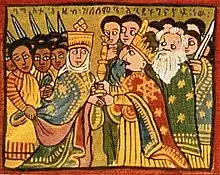
Various Biblical figures are included on Tafari's regnal list. Three of Noah's descendants are named as founders of the first three dynasties; Aram, Ham and Joktan. Gether, son of Aram, and Cush, son of Ham, are also both included as kings on the list. Descendants of Cush named Sabtah, Seba and Sabtechah are named as part of the Kam dynasty. Other Biblical figures include Nimrod, Zerah the Cushite and the Queen of Sheba, whom Ethiopians call "Makeda".
According to Ethiopian tradition Makeda was an ancestor of the Solomonic dynasty and mother of Menelik I, whose father was king Solomon of Israel. E. A. Wallis Budge believed that the queen was more likely to have been from Yemen or Hadhramaut than from Ethiopia.[14] He also believed that the tradition of the Queen of Sheba entered the region of modern-day Ethiopia when it was conquered by a Yemeni tribe called the "Habasha", who were "the first to introduce civilization into the country", as theorized by Carlo Conti Rossini.[14] Budge also thought it was possible that the story was introduced via Jewish traders who settled in Abyssinia/Ethiopia.[14] However, by the early 21st century the theory of a south Arabian or 'Sabaean' origin for Ethiopian civilization was largely abandoned by scholars,[209] and thus some of Budge's ideas would now be considered outdated.
The Biblical events of the flood and the fall of the Tower of Babel are both included in the chronology of the regnal list, dated respectively to 3244 BC and 2713 BC, with the 531-year period in between listed as an interregnum where no kings reigned.
Another Biblical story included is that of the Ethiopian eunuch, named Jen Daraba according to this regnal list, who visited Jerusalem during the reign of the 169th sovereign Queen Garsemot Kandake VI. However, the version of the story presented by Tafari has some major inaccuracies such as mistakenly stating that Philip the Apostle baptised the eunuch when it was actually Philip the Evangelist according to the Bible.
Coptic and Arabic influences
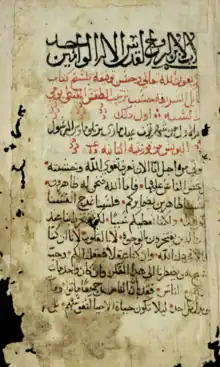
The first dynasty of Tafari's list, the Tribe of Ori, is taken from medieval Coptic and Arabic texts on the kings of Egypt who ruled before the Great Flood. French historian Louis J. Morié, in his 1904 book Histoire de L'Ethiopie, recorded an almost identical list of kings and queens to those found on the first dynasty of Tafari's list.[40] Morié stated that the regnal list he saw was recorded by the Copts in their annals and was found in both Coptic and Arabic tradition.[210] He however felt that the Egyptian Delta would not have been habitable in the Antediluvian era and thus theorized that these kings ruled Thebes and "Ethiopia" (i.e. Nubia).[211] Morié noted that there had originally been a list of 40 kings, but only 19 of them had been preserved up to the early 20th century.[211] He believed that the regnal list originated from the works of Murtada ibn al-Afif, an Arab writer from the 12th century who wrote a number of works, though only one, titled The Prodigies of Egypt, has partially survived to the present day.[211][212] The Coptic regnal list begins with Aram, son of Shem, in the same way that Tafari's regnal list begins with Aram, otherwise known as Ori on the 1922 regnal list.[211]
Manfred Kropp theorized that the 1922 Ethiopian regnal list may have been influenced by the works of Ibn al-Rāhib, a 13th-century Coptic historian whose works were translated into Ge'ez by Ethiopian writer Enbaqom in the 16th century, and Jirjis al-Makin Ibn al-'Amid, another 13th century Coptic historian whose work Al-Majmu' al-Mubarak (The Blessed Collection) was also translated around the same time.[213] Both writers partially based their information on ancient history from the works of Julius Africanus and through him quote the historical traditions of Egypt as recorded by Manetho.[213] Jirgis was known as "Wälda-Amid" in Ethiopia.[213] Kropp believed that some of the names of the early part of Tafari's regnal list were taken from a regnal list included within Jirgis' text which draws upon traditions from Manetho and the Old Testament.[214]
A medieval Arab text called Akhbar al-Zaman (The History of Time), dated to between 940 and 1140, may have been an earlier version of the regnal list Morié saw.[215] The authorship is unknown, but it may have been written by historian Al-Masudi based on earlier Arab, Christian and Greek sources.[215] Another possible author is Ibrahim ibh Wasif Shah who lived during the Twelfth century.[215] The text contained a list of kings of Egypt who ruled before the Great Flood and shows some similarities with the list of kings of the "Tribe of Ori or Aram" included on Tafari's list, who also ruled before the Great Flood. Several kings show similarities in names and chronological order, though not all kings on one list appear on the other.
This regnal list was possibly based on an earlier list found in the medieval Arab text Akhbar al-Zaman (whose title translates to "The History of Time"), which was written between 940 and 1140.[215] Although it is likely based on earlier works such as those of Abu Ma'shar (dated to c. 840–860).[215] The authorship is unknown, but Al-Masudi is possible candidate.[215] The text contains a collection of lore about Egypt and the wider world in the age before the Great Flood and after it.[215] The Akhbar al-Zaman kings frequently reign for impossibly long periods of time, with only two kings showing a similarity in length of reigns with those on Tafari's list. Nineteen kings appear on both lists, with two ruling women also being mentioned.
| Akhbar al-Zaman[215] | Tafari's regnal list | Notes |
|---|---|---|
| Naqraus I (180 years) | – | |
| Naqraus II (167 years) | – | |
| Misram | Ori or Aram (60 years) | |
| – | Gariak I (66 years) | |
| 'Anqam the Priest (Short reign) | Gannkam I (83 years) | |
| – | Queen Borsa (67 years) | |
| 'Arbaq | Gariak II (60 years) | |
| Lujim | Djan I (80 years) | |
| – | Djan II (60 years) | |
| – | Senefrou (20 years) | |
| Khaslim | Zeenabzamin (58 years) | |
| Harsal (34 years) | Sahlan (60 years) | |
| Qadrashan | Elaryan (80 years) | |
| Qadrashan's widow (de facto Queen regent) (9 years) | – | |
| Shamrud | Nimroud (60 years) | |
| Tusidun's mother (Queen regent) (6 years) | Queen Eylouka (45 years) | |
| Tusidun | – | |
| Sarbaq (130 years) | – | |
| Sahluq (443 years) | Saloug (30 years) | |
| Surid (107 years) | Kharid (72 years) | |
| Harjit (99 years) | Hogeb (100 years) | |
| Menaus (73 years) | Makaws (70 years) | |
| – | Assa (30 years) | |
| Afraus (64 years) | Affar (50 years) | |
| Armalinus | Milanos (62 years) | |
| Far'an | Soliman Tehagui (73 years) | None of the pre-Flood kings mentioned in Akhbar al-Zaman share a similar name as this king, however Armalinus' successor Far'an is named as the king who reigned at the time of the Great Flood.[215] Louis J. Morié also stated that "Pharaan" was an alternate name for Soliman Tehagui.[158] |
A number of Coptic monks from Egypt came to Ethiopia in the 13th century and brought with them many books written in Coptic and Arabic.[216] These monks also translated many works into Ge'ez.[216] It is possible that the legends from Akhbar al-Zaman may have entered Ethiopia during this time.
Ancient Egyptian and Nubian influences
_-_Flickr_-_dalbera.jpg.webp)
Many of the Egyptian and Nubian monarchs included on the list are historically verified but are not proven to have ruled the area of modern-day Ethiopia and Eritrea, and often have reign dates that do no match dates used by modern-day archaeologists. The rulers numbered 88 to 96 on the list are the High Priests of Amun who ruled Upper Egypt during the time of the Twenty-first dynasty, whose influence was limited to Lower Egypt. The order of the priests on the list is mostly confirmed by archaeology, though their rule did not extend to modern day Ethiopia and Eritrea. Several other kings on the list have names that are clearly influenced by those of Egyptian pharaohs such as Senefrou (8), Tutimheb (53), Amen Emhat I (63), Amen Emhat II (83), Amen Hotep Zagdur (102), Aksumay Ramissu (103) and Apras (127).
Numerous Nubian rulers from the Kushite kingdom in modern-day Sudan are included on Tafari's regnal list. In particular, most of the pharaohs of the Twenty-fifth Dynasty of Egypt, who ruled over both Nubia and Egypt, are listed as part of the dynasty of Menelik I. However, the Kushite Pharaohs are not known to have ruled much further south than the area of modern-day South Sudan. Kushite monarchs from after the Twenty-Fifth Dynasty of Egypt are also occasionally mentioned on this list, specifically Aktisanes, Aspelta, Harsiotef, Nastasen, Arakamani and Arqamani. Additionally, there are six queens on this list who are referred to as "Kandake", the Meroitic term for the king's sister used by the rulers of Kush. Apart from the monarchs listed above, there were also some Viceroys of Kush who ruled over Nubia during the time of the New Kingdom after Egypt conquered the Kingdom of Kerma in c. 1500 BC.
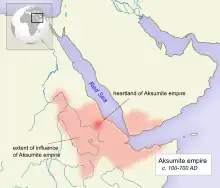
Louis J. Morié's Histoire de l'Éthiopie served as the main source for these Egyptian and Nubian monarchs and the regnal order they are presented in on the 1922 Ethiopian regnal list, as noted above.[25] However, there may also be other reasons why the author of this regnal list felt that the inclusion of Egyptian and Nubian monarchs was appropriate for a historical outline of Ethiopia/Abyssinia. One reason is due to the Axumite conquest of Meroë, the last capital of the Kingdom of Kush, by King Ezana in c. 325 AD.[217] It was from this point onward that the Axumites began referring to themselves as "Ethiopians", the Greco-Roman term previously used largely for the Kushites.[218] Following this, the inhabitants of Axum (modern-day Ethiopia and Eritrea) were able to claim lineage from the "Ethiopians" or "Aethiopians" mentioned in the Bible, including the Kandakes, who were actually Kushites. The claiming of the term "Ethiopian" by the Axumites may, however, pre-date Christianity. For example, Axumite king Ezana is called "King [...] of the Ethiopians" on a Greek inscription where he also calls himself "son of the invincible Mars", suggesting that this pre-dates his conversion to Christianity.[219] Professor of Anthropology Carolyn Fluehr-Lobban believed the inclusion of Kushite rulers on the regnal list suggests that the traditions of ancient Nubia were considered culturally compatible with those of Axum.[220] Makeda, the biblical Queen of Sheba, was referred to as "Candace" or "Queen Mother" in the Kebra Nagast,[221] suggesting a cultural connection between Ethiopia and the ancient kingdom of Kush. Portuguese missionary Francisco Álvares, who travelled to Ethiopia in 1520, recorded one Ethiopian tradition which claimed that Yeha was "the favourite residence of Queen Candance, when she honoured the country with her presence".[222]
There are also some pieces of archaeological evidence that show connections between ancient Nubia and Abyssinia. Some Nubian objects from the Napatan and Meroitic periods have been found in Ethiopian/Abyssinian graves dating to the 8th to 2nd centuries BC.[223] There have also been discoveries of red-orange sherds similar to those from the pre-Axumite period in sites of the Jebel Mokram Group in Sudan, showing contacts along caravan routes toward the Nile Valley in the 1st millennium BC.[224] This shows that interactions between Nubia and modern day Ethiopia long pre-date the Axumite conquest. Archaeologist Rodolfo Fattovich believed that the people of the pre-Axumite culture had contacts with the kingdom of Kush, the Achaemenid Empire and the Greeks, but that these contacts were "mostly indirect".[225]

Scottish traveler James Bruce, in his multi-volume work Travels to Discover the Source of the Nile included a drawing of a stele found in Axum and brought back to Gondar by the Ethiopian emperor.[226] The stele had carved figures of Egyptian gods and was inscribed with hieroglyphs.[226] E. A. Wallis Budge believed the stele to be a "Cippi of Horus" which were placed in homes and temples to keep evil spirits away.[226] He noted that these date from the end of the Twenty-sixth Dynasty (c. 664–525 BC) onwards.[226] Budge believed this was proof of contacts between Egypt and Axum in the early 4th century BC.[226] Archaeological excavations in the Kassala region have also revealed direct contact with Pharaonic Egypt.[227] Some tombs excavated in the Yeha region, the likely capital of the Dʿmt kingdom, contained imported albastron dated to c. 770–404 BC which had a Napatan or Egyptian origin.[228]
The earliest known Greek writings that mention "Aethiopians" date to the 8th century BC, in the writings of Homer and Hesiod. Herodotus, in his work Histories (c. 430 BC), defined "Aethiopia" as beginning at the island of Elephantine and including all land south of Egypt, with the capital being Meroe.[229] This geographical definition confirms that in ancient times the term "Aethiopia" was commonly used to refer to Nubia and the Kingdom of Kush rather than modern day Ethiopia. The earliest known writer to use the name "Ethiopia" for the region of the Kingdom of Axum was Philostorgius around 440 AD.[230]
E. A. Wallis Budge theorised that one of the reasons why the name "Ethiopia" was applied to Abyssinia was because Syrian monks identified Kush and Nubia with Abyssinia when translating the Bible from Greek to Ge'ez.[231] Budge further noted that translators of the Bible into Greek identified Kush with Ethiopia and this was carried over into the translation from Greek to Ge'ez.[232] Louis J. Morié likewise believed the adoption of the word "Ethiopia" by the Abyssinians was due to their desire to search for their origins in the Bible and coming across the word "Ethiopia" in Greek translations.[233] Budge argued that it was unlikely that the "Ethiopians" mentioned in ancient Greek writings were the Abyssinians, but instead were far more likely to be the Nubians of Meroë.[234] He believed that the native name of the region around Axum was "Habesh" from which "Abyssinia" is derived and originating in the name of the Habasha tribe from southern Arabia.[232] He did note however that the modern day people of the region did not like this term and preferred the name "Ethiopia" due to its association with Kush.[232] The ancient Nubians are not known to have used the term "Ethiopian" to refer to themselves, however Silko, the first Christian Nubian king of Nobatia, in the early sixth century described himself as "Chieftain of the Nobadae and of all the Ethiopians".[235]
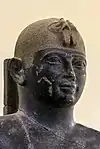
Budge noted that none of the Egyptian and Nubian kings appear on other known regnal lists from Ethiopia.[119] He believed that contemporary Ethiopian priests had been "reading a modern European History of Egypt" and had incorporated in the regnal list Egyptian pharaohs who had "laid Nubia and other parts of the Sudan under tribute", as well as the names of various Kushite kings and Priest kings.[236] To support his argument, he stated that while the names of Abyssinian kings have meanings, the names of Egyptian kings would be meaningless if translated into the Ethiopian language.[16] Historian Manfred Kropp likewise noted that no Ethiopian manuscript prior to Tafari's regnal list included names of monarchs resembling those used by ancient Egyptian rulers.[20]
A comparison of Tafari's list with other known Ethiopian regnal lists shows that most of the kings on Tafari's list with Egyptian or Nubian names do not have these elements in their names on the other regnal lists (see Regnal lists of Ethiopia). For example, the 102nd king on Tafari's list, Amen Hotep Zagdur, only appears as "Zagdur" on one British Museum manuscript and on Rossini's list.[106] The next king, Aksumay Ramissu, is only known as "Aksumay" on the same two lists.[106] The 106th king, Abralyus Wiyankihi II, only appears as "Abralyus" on the same manuscript.[106] The 111th king, Tsawi Terhak Warada Nagash, is a combination of multiple kings. One king named "Sawe" or "Za Tsawe" is listed as the fifth king following Menelik I, according to one British Museum manuscript and the lists recorded by Bruce and Salt.[104] Another king named "Warada Nagash" is named as the eighth king following Menelik I on a different manuscript.[106] No known list includes both kings, and Tafari's list combined the two different kings as a single entry, with the addition of the name "Terhak", to be equated with the Nubian pharaoh Taharqa, who otherwise does not appear on other Ethiopian regnal lists.[106] Taharqa's inclusion on the regnal list ties in with the mention of his name in the Hebrew Bible (2 Kings 19:9; Isaiah 37:9), where he was described as the "King of Ethiopia", in reference to Kush in modern-day Sudan.[237] Also missing from other Ethiopian regnal lists are the six "Kandake" queens numbered 110, 135, 137, 144, 162 and 169. It is likely that these queens refer to the reigning female monarchs of Kush, although it is unclear who exactly they are based on as their names do not match any known queens of Kush. The second Kandake queen, Nikawla (no. 135), has a name which was sometimes used in medieval times to the refer to the Queen of Sheba.[238]
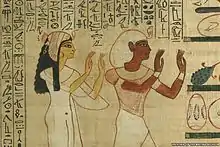
The inclusion of the High Priests of Amun who ruled Upper Egypt between c. 1080 and 943 BC can be directly traced to Louis J. Morié's Histoire de l'Éthiopie and Egyptology of the time.[25] The association between these Egyptian High Priests and Aethiopia was particularly strong in European Egyptological writings in the late 19th and early 20th centuries. During this period, several major Egyptologists (such as Heinrich Brugsch, James Breasted and George Reisner) believed that the rise of the Kush kingdom was due to the influence of the High Priests of Amun moving into Nubia towards the end of the Twentieth Dynasty because of political conflict arising at the end of the New Kingdom.[239] Brugsch in particular entertained the idea that the early Kushite kings were lineal descendants of the priests from Egypt, though this was explicitly rejected by Breasted.[240] Later Egyptologists A. J. Arkell and Walter Emery theorized that a priestly "government in exile" had influenced the Kushite kingdom.[241] E. A. Wallis Budge agreed with these ideas and suggested that the High Priests of Amun moved south to Nubia due to the rise of the Libyan pharaohs in Lower Egypt, and consolidated their high position by intermarrying with Nubian women.[242] Budge further theorised that the name of the Nubian pharaoh Piye or "Piankhi" was taken from that of the High Priest of Amun Piankh and he was possibly Piankh's descendant.[243] Such ideas around the Kushite monarchy originating from this specific line of priests are now considered outdated, but the popularity of these theories in the early 20th century explains their inclusion, in almost exact chronological order, on Tafari's regnal list from 1922.
Greek influences

The ancient Greek mythical queen of Aethiopia, Cassiopeia, is claimed as part of Ethiopia's ancient history according to Tafari's list, which lists her as the 49th monarch and the third of the Agdazyan dynasty. Her grandson Electryon also makes an appearance on this list, though oddly he is placed six centuries before Cassiopeia, as part of the Tribe of Kam. Cassiopeia's husband, Cepheus also makes an appearance on the regnal list, but is numbered 71st and is dated to over 400 years after her reign. These discrepancies stem from the narrative of Louis J. Morié's Histoire de l'Éthiopie, where he claimed that two separate queens named Cassiopeia existed at different times.[52][54] Morié's book also influenced the inclusion of Memnon, a mythical king of "Aethiopia" who fought in the Trojan War, under the name "Amen Emhat II", with his father Tithonus included under the name "Titon Satiyo".[120]
However, the author of the 1922 Ethiopian regnal list did include additional figures who were not part of Morié's original narrative. The legendary Cretian king Minos is listed as the 66th monarch under the name "Mandes", a variation of the name used by Diodorus in his work Bibliotheca Historia,[65] though oddly he was listed as a king of Egypt in Diodorus' text rather than Crete. Diodorus' text seems to have influenced other parts of the regnal list, such as the 122th monarch named "Sabakon" (an alternate name for the Nubian pharaoh Shabaka, who is already mentioned earlier in the list) and the 127th monarch named "Apras", the Greek name for Egyptian pharaoh Wahibre Haaibre. In addition to the above, the Egyptian king Proteus is also included on the list as part of the Agdazyan dynasty, however he only appears in Greek writings and is otherwise unattested in the Egyptian archaeological record.
Conflict with other Ethiopian traditions
Tafari's list occasionally does not match with other Ethiopian traditions. One example is Abreha and Atsbeha, who are believed by Ethiopians to have been two brothers who brought Christianity to Ethiopia. However, Tafari lists 'Abreha Atsbeha' as a single monarch numbered 201st on his list and as a son of queen Sofya. In reality, the son of Sofya was king Ezana who was the first Christian king of Axum. Ezana is however placed much later in the list, over 150 years after the reign of Sofya. Queen Sofya ruled as a regent for her son Ezana, though Tafari considers her to be a reigning monarch in her own right, even allowing for her regency to be counted as a period of co-rule with her son. The listing of 'Abreha Atsbeha' as a single figure may be a transcribable error, as Aleka Taye's version of the regnal list clearly states that 'Abreha' and 'Atsbeha' are two separate individuals.[56]
Another example is that of king Angabo I, who is placed in the middle of the Agdazyan dynasty on the 1922 regnal list. However some Ethiopian legends claim that this king was the founder of a new dynasty.[244] In both cases the dating is given as the late 14th century BC.
E. A. Wallis Budge noted that there were differing versions of the chronological order of the Ethiopian kings, with some lists stating that a king named Aithiopis was the first to rule while other lists claim that the first king was Adam.[245] Tafari's list instead begins with Aram.
The list also has its own internal conflicting information. Tafari claims that it was during the reign of the 169th monarch, queen Garsemot Kandake VI, in the first century AD when Christianity was formally introduced to Ethiopia. However, this is in direct conflict with the story of the later queen Sofya, who ruled 249 years later.
Regnal list
Gregorian Dates: Tafari's regnal list uses dates according to the Ethiopian Calendar. According to Charles Fernand Rey, one can estimate the Gregorian date equivalent by adding a further seven or eight years to the date.[246] As an example, he states that 1 AD on the Ethiopian calendar would be 8 AD on the Gregorian calendar.[246] He notes that the calendar of Ethiopia likely changed in some ways throughout history but argued that this was a good enough method for estimates.[246] E. A. Wallis Budge stated that the Ethiopian calendar was 8 years behind the Gregorian calendar from 1 January to 10 September and 7 years behind from 11 September to 31 December.[12]
Tribe of Ori or Aram (1,286 years)
"Tribe or Posterity of Ori or Aram"[247]
.jpg.webp)
The first dynasty of Tafari's regnal list consists of 21 monarchs who ruled before the Biblical "Great Flood". This dynasty is legendary and borrowed from a list of pre-flood kings of Egypt that is found in medieval Coptic and Arabic texts. French historian Louis J. Morié recorded a similar list of 19 monarchs in his 1904 book Histoire de L'Éthiopie.[40] The medieval Arab text Akhbar al-Zaman contains a regnal list that may have been an earlier version of the list Morié saw centuries later. This list contained a total of 19 kings and the majority had similar names to those found on the later version in 1904.[215] Morié noted that the kings were supposed to be rulers of Egypt, but he personally believed that they had actually ruled what he referred to as "Ethiopia", although he specifically was writing about Nubia.[40] He pointed to a story of the third king, Gankam, who had a palace built beyond the Equator at the Mountains of the Moon, as proof that these kings resided in Aethiopia.[248][212] The kings of this dynasty are described as Priest-kings in Coptic tradition and were called the "Soleyman" dynasty.[212] While the original Coptic tradition called the first king "Aram", in reference to the son of Shem of the same name, this regnal list calls the king "Ori or Aram". The name "Ori" may have originated from Morié's claim that this dynasty was called the "Aurites", and that Aram had inspired the name of his country, which was called "Aurie" or "Aeria".[39]
The "Soleyman" dynasty was said to have been "Priest-kings" who ruled before the Great Flood for 9,000 years, though Morié personally believed the period of rule was closer to 2,000 years.[211] Their capital city was called either "Fanoun" or "Kanoun" and they ruled over much of North and East Africa according to Coptic legend.[211] They also founded other cities named "Gevherabad" (capital of the province of "Schadoukiam"), "Ambarabad" (or "Anbarabad") and "Gabkar" and used a now lost language called "Bialban".[211]
Due to its non-native origin, the tradition of the Ori/Aram dynasty has often been treated as irrelevant to wider Ethiopian tradition. Ethiopian writer and foreign minister Heruy Wolde Selassie ignored this dynasty in his book Wazema.[23] Ethiopian historian Fisseha Yaze Kassa, in his book Ethiopia's 5,000-year history, completely omitted this dynasty and instead begins with the Ham/Kam dynasty.[249] In his book Regents of Nations, Peter Truhart described this dynasty as "non-historical".[250]
Other Ethiopian traditions name a completely different line of kings as the first to rule Ethiopia. Egyptologist E. A. Wallis Budge stated that in his time the contemporary Ethiopians could not "tell us [anything] about the reigns of their [pre-Flood] kings" and relied on Biblical genealogy for a list of names.[251] The list that Budge provided for the pre-Flood kings varies considerably from the one on Tafari's list (see Regnal lists of Ethiopia), essentially using the Biblical genealogy from Adam to Solomon.[252] Budge noted that some Ethiopian regnal lists stretched back to 5500 BC (the year the world was believed by the Ethiopians to have been created) and began with Adam.[200] Other Ethiopian traditions instead state that the Ethiopians descend from Ham, a grandson of Noah.[253] There are some brief regnal lists that outline a genealogy from Ham and his son Cush to kings representing Ethiopia and Axum.[254]
By contrast, Tafari's list names neither Adam or Ham as the founder of the Ethiopian line, but instead chooses Aram, son of Shem, a grandson of Noah, to be the "great ancestor" of the Ethiopian monarchy.[255] E. A. Wallis Budge believed that the reason for this was because contemporary Ethiopians wanted to distance themselves from Ham and the Curse of Ham.[255] The Curse of Ham had been used as an ideological justification for the Atlantic slave trade during the 16th to 19th centuries.[256] Likewise, it was also used to justify the European Scramble for Africa during the 1880s to 1910s, when nearly 90 percent of Africa was colonized by European powers and Ethiopia was one of only two countries to remain independent (the other being Liberia). The medieval Ethiopian text Kebra Nagast stated that "God decreed sovereignty for the seed of Shem, and slavery for the seed of Ham".[255] The original writer of Tafari's regnal list appears to have deliberately relegated Ham to being the founder of the second Ethiopian dynasty instead of the first dynasty as was done on older regnal lists.
The only rulers of this dynasty who do not originate from the Coptic Antediluvian regnal list are "Senefrou" and "Assa", who E. A. Wallis Budge equated with the Egyptian pharaohs Sneferu and Djedkare Isesi. Their inclusion as rulers of Ethiopia may be due to some kind of interaction with Nubia (i.e. "Aethiopia").
One issue with the Ori dynasty is that the regnal list dates the Great Flood to 3244 BC and yet states that Aram, who was born after the Flood, ruled over 1,200 years before it took place. This also causes problems with the dating given for Gether and Nimrod who both lived after the Flood.
| # [247] |
Monarch [247][nb 1] |
Reign Dates (Ethiopian Calendar) [247] |
"Year of the World" [247] |
Reign Length [247] |
Alternate Names | Notes |
|---|---|---|---|---|---|---|
| 1 | Ori I ኦሪ |
4530–4470 BC | 970–1030 A.M. | 60 years | Aram[247][212] |
|
| 2 | Gariak I ጋርያክ |
4470–4404 BC | 1030–1096 A.M. | 66 years | Gether | |
| 3 | Gannkam ጋንካም |
4404–4321 BC | 1096–1179 A.M. | 83 years | – |
|
| 4 | Queen Borsa ቦርሳ |
4321–4254 BC | 1179–1246 A.M. | 67 years | – |
|
| 5 | Gariak II ጋርያክ |
4254–4194 BC | 1246–1306 A.M. | 60 years | – | |
| 6 | Djan I ጃን |
4194–4114 BC | 1306–1386 A.M. | 80 years | Gian[156] Giyan[250] |
|
| 7 | Djan II ጃን |
4114–4054 BC | 1386–1446 A.M. | 60 years | Gian[156] Giyan[250] |
|
| 8 | Senefrou ሰነፍሩ |
4054–4034 BC | 1446–1466 A.M. | 20 years | Sneferu[250] | |
| 9 | Zeenabzamin ዘእናብዛሚን |
4034–3976 BC | 1466–1524 A.M. | 58 years | Zayn az-Zaman[250] Zeyn al-Zaman[156] |
|
| 10 | Sahlan ሳህላን |
3976–3916 BC | 1524–1584 A.M. | 60 years | – |
|
| 11 | Elaryan ኤላርያን |
3916–3836 BC | 1584–1664 A.M. | 80 years | El-Rian[156] Riyan[156] Rujan[156] |
|
| 12 | Nimroud ኒምሩድ |
3836–3776 BC | 1664–1724 A.M. | 60 years | Nimrod[119] Youssef[156] |
|
| 13 | Queen Eylouka ኤይሉካ |
3776–3731 BC | 1724–1769 A.M. | 45 years | Dalukah[250][156] |
|
| 14 | Saloug ሳሉግ |
3731–3701 BC | 1769–1799 A.M. | 30 years | Sahlok[250] Saluq[250] Sahalok[156] |
|
| 15 | Kharid ኃሪድ |
3701–3629 BC | 1799–1871 A.M. | 72 years | Harid[250] Sarid[250] Scharid[156] Surid Ibn Salhouk |
|
| 16 | Hogeb ሆገብ |
3629–3529 BC | 1871–1971 A.M. | 100 years | Hugib[250] Houjb[157] |
|
| 17 | Makaws ማካውስ |
3529–3459 BC | 1971–2041 A.M. | 70 years | Makaos[250] Manos[250] Makaos[157] |
– |
| 18 | Assa አሳ |
3459–3429 BC | 2041–2071 A.M. | 30 years | Isesi[250] |
|
| 19 | Affar አፋር |
3429–3379 BC | 2071–2121 A.M. | 50 years | Afros[250] Aphar[157] |
|
| 20 | Milanos ሚላኖስ |
3379–3317 BC | 2121–2183 A.M. | 62 years | Malinos[250][157] | – |
| 21 | Soliman Tehagui ሶሊማን ታጊ |
3317–3244 BC | 2183–2256 A.M. | 73 years | Soliman Cagi[250] Soleyman Tchaghi[158] Pharaan[158] Pharaon[158] |
|
| "Total: 21 sovereigns of the Tribe of Ori."[247] | ||||||
Interregnum (531 years)
"From the Deluge until the fall of the Tower of Babel".[260]
This 531-year period is the only gap in Tafari's regnal list where no monarchs are named. Tafari leaves this gap unexplained, but some older Ethiopian regnal lists state that the monarchs who reigned between the Great Flood and the fall of the Tower of Babel were pagans, idolators and worshippers of the "serpent", and thus were not worthy to be named.[255]
The Tower of Babel was, according to the Bible, built by humans in Shinar at a time when humanity spoke a single language. The tower was intended to reach the sky, but this angered God, who confounded their speech and made them unable to understand each other and caused humanity to be scattered across the world. This story serves as an origin myth to explain why so many different languages are spoken around the world.
| # [260] |
Monarch [260] |
Reign Dates (Ethiopian Calendar) [260] |
"Year of the World" [260] |
Reign Length [260] |
Alternate Names | Notes |
|---|---|---|---|---|---|---|
| – | – | 3244–2713 BC | 2256–2787 A.M. | 531 years | – | – |
Tribe of Kam (728 years)
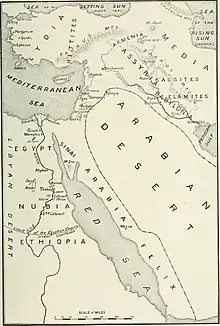
"Sovereignty of the tribe of Kam after the fall of the tower of Babel."[260]
This dynasty begins with the second son of the Biblical prophet Noah, Ham, whose descendants populated the African continent and adjoining parts of Asia according to Biblical tradition. Ham was the father of Cush (Kush/Nubia), Mizraim (Egypt), Canaan (Levant) and Put (Libya or Punt). According to Heruy Wolde Selassie's book Wazema, the Kamites originated from the Middle East and conquered Axum, Meroe, Egypt and North Africa.[261]
Most Ethiopian traditions present a very different line of kings descending from Ham. E. A. Wallis Budge stated that in his time there was a common belief in Ethiopia that the people were descended from Ham, his son Cush and Cush's son Ethiopis, who is not named in the Bible, and from whom the country of Ethiopia gets its name.[262] Budge however found it doubtful that the Kushites were the first to inhabit the region of modern-day Ethiopia.[262] Nonetheless, Ham has often been considered the founder of Ethiopia according to many Ethiopian regnal lists. Some lists explicitly state the names "Ethiopia" and "Axum" come from descendants of Ham that are not named in the Bible.[254] See Alternate Hamitic dynasty section below for more information.
Ethiopian historian Fisseha Yaze Kassa's book Ethiopia's 5,000-year history begins this dynasty with Noah and omits Habassi, but otherwise has a similar line of kings as this list.[249] Heruy Wolde Selassie omitted the first three rulers of this dynasty in his book Wazema and begins the dynasty with Sebtah in 2545 BC.[23] Peter Truhart, in his book Regents of Nations, dated the monarchs of this dynasty to 2585–1930 BC and stated that the capital during this period was called 'Mazez'.[250] He identified king Kout as the first king of this dynasty instead of Kam.[250] Truhart called the monarchs from Kout to Lakniduga the "Dynasty of Kush" based at 'Mazez' and stated they ruled from 2585 to 2145 BC,[250] while the monarchs from Manturay to Piori I are listed as the "Kings of Ethiopia and Meroe" who ruled from 2145 to 1930 BC.[263]
| # [260] |
Monarch [260][nb 2] |
Reign Dates (Ethiopian Calendar) [260] |
"Year of the World" [260] |
Reign Length [260] |
Alternate Names | Notes |
|---|---|---|---|---|---|---|
| 22 | Kam ካም |
2713–2635 BC | 2787–2865 A.M. | 78 years | Ham Kmt[255] Kham[250] |
|
| 23 | Kout ኩሳ |
2635–2585 BC | 2865–2915 A.M. | 50 years | Cush |
|
| 24 | Habassi ሀባሢ |
2585–2545 BC | 2915–2955 A.M. | 40 years | Habisi[57] Habesch[43] |
|
| 25 | Sebtah ሰብታ |
2545–2515 BC | 2955–2985 A.M. | 30 years | Sabtah Sabeta[267] |
|
| 26 | Elektron ኤሌክትሮን |
2515–2485 BC | 2985–3015 A.M. | 30 years | Electryon |
|
| 27 | Neber ነቢር |
2485–2455 BC | 3015–3045 A.M. | 30 years | Nabir[267] | – |
| 28 | Amen I አሜን |
2455–2434 BC | 3045–3066 A.M. | 21 years | – |
|
| 29 | Queen Nehasset Nais ነሕሴት ናይስ |
2434–2404 BC | 3066–3096 A.M. | 30 years | Nahset Nays[267] |
|
| 30 | Horkam ሆርካም |
2404–2375 BC | 3096–3125 A.M. | 29 years | Tarkim[267] Herkam[250] Raema[250][272] Horus[43] |
|
| 31 | Saba I ሳባ |
2375–2345 BC | 3125–3155 A.M. | 30 years | Seba |
|
| 32 | Sofard ሶፋሪድ |
2345–2315 BC | 3155–3185 A.M. | 30 years | Sofarid[267] | – |
| 33 | Askndou እስከንዲ |
2315–2290 BC | 3185–3210 A.M. | 25 years | Eskendi[267] | – |
| 34 | Hohey ሆህይ |
2290–2255 BC | 3210–3245 A.M. | 35 years | Hohey Satwo[267] | – |
| 35 | Adglag አህያጥ |
2255–2235 BC | 3245–3265 A.M. | 20 years | Ahyat[267] Adeldag[263] |
– |
| 36 | Adgala I አድጋስ |
2235–2205 BC | 3265–3295 A.M. | 30 years | Adgas[267] Adgale |
|
| 37 | Lakniduga ላከንዱን |
2205–2180 BC | 3295–3320 A.M. | 25 years | Bakundon Malis[267] | – |
| 38 | Manturay ማንቱራይ |
2180–2145 BC | 3320–3355 A.M. | 35 years | Manturay Haqbi[267] Mithra[44] Mithras[44][263] Mentu-Ra[263] Montu? |
|
| 39 | Rakhu ራክሁ |
2145–2115 BC | 3355–3385 A.M. | 30 years | Rakhu Dedme[267] Rahu[263] Phlegyas[44][263] |
|
| 40 | Sabe I ሰቢ |
2115–2085 BC | 3385–3415 A.M. | 30 years | Sobi[267] Kepheas[44][263] Sabtechah |
|
| 41 | Azagan አዘጋን |
2085–2055 BC | 3415–3445 A.M. | 30 years | Azagan Far'on[267] | – |
| 42 | Sousel Atozanis ሱሹል አቶዛኒስ |
2055–2035 BC | 3445–3465 A.M. | 20 years | Sosahul Atonzanes[267] Aktisanes[45] |
|
| 43 | Amen II አሜን |
2035–2020 BC | 3465–3480 A.M. | 15 years | Amen Sowiza[267] |
|
| 44 | Ramenpahte ራመንፓህቲ |
2020–2000 BC | 3480–3500 A.M. | 20 years | Raminpahti Masalne[267] Menpekhtira[255][263] |
|
| 45 | Wanuna ዋኑና |
2000 BC | 3500 A.M. | 3 days | – | – |
| 46 | Piori I ጲኦሪ |
2000–1985 BC | 3500–3515 A.M. | 15 years | Poeri[274] |
|
| "Total: 25 sovereigns of the tribe of Kam, plus 21 sovereigns of the tribe of Ori – Grand total, 46 sovereigns."[247] | ||||||
Agdazyan Dynasty (1,003 years)
"Agdazyan dynasty of the posterity of the kingdom of Joctan."[275]
Note: Historian Manfred Kropp stated the word "Agdazyan" is likely a transcribal error and meant to say "Ag'azyan", as the Ethiopian syllable signs da and 'a are relatively easy to confuse with each other.[276]
_(14582488388).jpg.webp)
The third dynasty of this regnal list is descended from Joktan, a son of Eber, grandson of Shem and great-grandson of Noah. The first ruler of the dynasty, Akbunas Saba, is likely meant to be Sheba, son of Joktan.[277] The dynasty ends with the famous Queen of Sheba, whose name is Makeda in Ethiopian tradition. According to Genesis 10:7 and 1 Chronicles 1:9, Sheba was a grandson of Cush through Raamah, which provides a link between this Semitic dynasty and the Hamitic dynasty that preceded it. The so-called Agdazyan dynasty includes a number of kings whose names clearly reference ancient Egypt and Kush, most notably the line of High Priests of Amun that reigned near the end of this dynastic period. While most of these monarchs are archaeologically verified, they did not rule modern-day Ethiopia, but rather ruled over or had some contact with ancient Nubia and Kush, which is equated with Ethiopia in some translations of the Bible and these translated editions have influenced modern Ethiopia's belief in an affinity with ancient Nubia.
This section of the regnal list is heavily influenced by Louis J. Morié's book Histoire de L'Éthiopie, with the majority of monarchs having similar names and line of succession to those found in Morié's book.[278] Much of Morié's book cannot be considered historically accurate, as it was written over a century ago and largely attempts to fit contemporary Egyptological knowledge within the Biblical narrative. Historian Manfred Kropp identified this book as a key source in the creation of the 1922 Ethiopian regnal list as a whole, and felt that it was more imaginative than scientific in its approach to the history of Aethiopia.[25] Morié's claim that Sabaeans came to Aethiopia during the reign of either pharaoh Pepi I or Pepi II may have inspired the narrative of a "Sabaean" dynasty ruling Ethiopia, as claimed by the 1922 regnal list.[273]
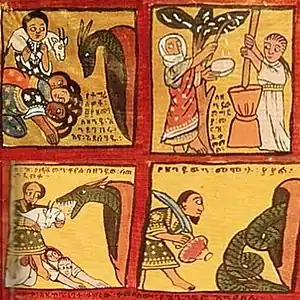
While this dynasty takes inspiration from foreign sources, it does include some notable kings that developed within indigenous tradition. Specifically, five monarchs are named in native Ethiopian sources as rulers from distant ancient times, these being Angabo I (no. 74), who founded a new dynasty after killing the serpent king Arwe, and his successors Zagdur I (no. 77), Za Sagado (no. 80), Tawasya Dews (no. 97) and Makeda (no. 98), the last of whom is identified with the Queen of Sheba (See Regnal lists of Ethiopia for more information).[279][280] The 1922 regnal list incorporates these five rulers within the longer narrative of Louis J. Morié. There is also another king named Ethiopis, who Ethiopian tradition credits with inspiring the name of the country Ethiopia.
The word Ag'azyan means "free" or "to lead to freedom" in Ge'ez.[281][261] According to Heruy Wolde Selassie in his book Wazema, this originated from the liberation of Ethiopia from the rule of the Kamites/Hamites.[261] Selassie also claimed that three of Joktan's sons divided Ethiopia between themselves.[261] Sheba received Tigray, Obal received Adal and Ophir received Ogaden.[261] If this is to be believed, then presumably the later monarchs who followed Sheba/Akbunas Saba ruled from the Tigray Region.
E. A. Wallis Budge had a different theory of the origin of the term Aga'azyan, believing that it referred to several tribes that migrated from Arabia to Africa either at the same time as or after the Habashat had migrated.[281] He stated that the word "Ge'ez" had come from "Ag'azyian".[281] The term "Ag'azyan" may also refer to the Agʿazi region of the Axumite empire located in modern-day Eastern Tigray and Southern Eritrea.
Sheba is usually considered by historians to have been the south Arabian kingdom of Saba, in an area that later became part of the Aksumite Empire. The Kebra Nagast however specifically states that Sheba was located in Ethiopia.[282] This has led to some historians arguing that Sheba may have been located in a region in Tigray and Eritrea, which was once called "Saba".[283] American historian Donald N. Levine suggested that Sheba may be linked with the historical region of Shewa, where the modern Ethiopian capital Addis Ababa is located.[284] Additionally, a Sabaean connection with Ethiopia is evidenced by a number of settlements on the Red Sea coast that emerged around 500 BC and were influenced by Sabaean culture.[285] These people were traders and had their own writing script.[285] Gradually over time their culture merged with that of the local people.[285][286] The Sabaean language was likely the official language of northern Ethiopia during the pre-Axumite period (c. 500 BC to 100 AD).[287]
.jpg.webp)
Some historians believe that the kingdom of Dʿmt was Sabaean-influenced, possibly due to Sabaean dominance of the Red Sea or due to mixing with the indigenous population.[288][289] D'mt had developed by the first millennium BC in modern-day northern Ethiopia and Eritrea, and had "a veneer of cultural affinities adopted largely from the Saba'an culture centred across the Red Sea in the area of modern Yemen".[290] The D'mt area had a written language that appeared "almost entirely Saba'an in origin".[228] Historian Jacke Phillips argued that "some form of underlying political unification must have allowed its dispersal".[228] Older hypotheses on the origin of the pre-Axumite culture suggested that it developed due to migrations of population from south Arabia in pre-modern times or that there had been some kind of Sabaean colonization of the modern-day Ethiopia/Eritrea region.[291] More recent theories instead suggest that the culture developed out of a long process of contacts dating back to the 2nd millennium BC.[291]
Taking into account the proof of Sabaean-Ethiopian contacts, this dynasty, while legendary, is nonetheless a clear reference to the historical interactions with southern Arabia that occurred in the ancient past and influenced Ethiopian culture and tradition. The mix of Egyptian, Nubian, Greek and Biblical figures in this dynasty showcases the many cultural interactions that Ethiopians had with their neighbours.
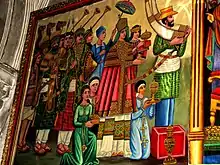
Roman-Jewish historian Josephus wrote that that Achaemenid king Cambyses II conquered the capital of Aethiopia and changed its name from "Saba" to "Meroe".[292] Josephus also stated the Queen of Sheba came from this region and was queen of both Egypt and Ethiopia.[293] This suggests that a belief in a connection between Sheba and Kush was already in place by the 1st century AD. Josephus also associated Sheba/Saba with Kush when describing a campaign led by Moses against the Ethiopians, in which he won and later married Tharbis, the daughter of the king of 'Saba' or Meroe.
This dynasty includes a line of Egyptian High Priests of Amun numbered 88 to 96 which closely matches archaeological evidence but is not entirely correct. Manfred Kropp felt that these monarchs were the clearest borrowings from Egyptological knowledge and he theorized that Heruy Wolde Selassie deliberately altered the chronological order when writing this regnal list.[294]
Peter Truhart, in his book Regents of Nations, dated the kings from Akbunas Saba II to Lakndun Nowarari to 1930–1730 BC and listed them as a continuation of the line of "Kings of Ethiopia and Meroe" that begun in 2145 BC.[263] However, Truhart's regnal list then jumps forward and dates the kings from Tutimheb onwards as contemporaries of the Eighteenth and Nineteenth dynasties of Egypt, with a date range of 1552–1185 BC.[263] Truhart also identified modern-day Ethiopia with the Land of Punt.[263] His list however omits the High Priests of Amun from Herihor to Pinedjem II without giving a clear reason.[120] Despite this, he still acknowledges the rule of the High Priests in Thebes as taking place from c. 1080 to 990 BC.[120]
| # [275] |
Monarch [275][nb 3] |
Reign Dates (Ethiopian Calendar) [275] |
"Year of the World" [275] |
Reign Length [275] |
Alternate Names | Notes |
|---|---|---|---|---|---|---|
| 47 | Akbunas Saba II አክሁናስ ሳባ |
1985–1930 BC | 3515–3570 A.M. | 55 years | Sheba Ahnahus Seba[56] Ankhnas[263] Akhunas Saba[261] Aknunas Saba[261] |
|
| 48 | Nakehte Kalnis ነክህቲ ካልንስ |
1930–1890 BC | 3570–3610 A.M. | 40 years | Nakhati Kalenso[261] Nekhite Kalas[56] Kahlan? |
|
| 49 | Queen Kasiyope ካሲዮጲ |
1890–1871 BC | 3610–3629 A.M. | 19 years | Cassiopeia Kesayopi[56] Kasiopo[263] |
|
| 50 | Sabe II ሰቢ |
1871–1856 BC | 3629–3644 A.M. | 15 years | Sebi II (Képhée)[50] Sebi Ayibe[56] Cepheus[50] Sebi-Meiamoun[50] Adrammelech[50] |
|
| 51 | Etiyopus I ኢትዮጲስ |
1856–1800 BC | 3644–3700 A.M. | 56 years | Ethiopis[295] Aethiopis[57] Atew[58][263] Ityepis[263] Itiyopp'is[296][261] |
|
| 52 | Lakndun Nowarari ላከንዱን ኖወር አሪ |
1800–1770 BC | 3700–3730 A.M. | 30 years | Lakendun Nowar Ori[261] Lakundu Neworos[56] Laknidun Nowarawi[263] Arwe[263] Newer-Ari[263] Nower-Ari[58] |
|
| 53 | Tutimheb ቱት ኤምሄብ |
1770–1750 BC | 3730–3750 A.M. | 20 years | Tehuti-em-heb[119] Thout-em-heb[58] Tharbos[69] |
|
| 54 | Her Hator I ሔርሐቶር |
1750–1730 BC | 3750–3770 A.M. | 20 years | Yotor[56] At-Hor[60][263] Jethre[263] Hephaestus[62] |
|
| 55 | Etiyopus II ኢትዮጲስ |
1730–1700 BC | 3770–3800 A.M. | 30 years | Atew[64][263] Ityopis[261] |
|
| 56 | Senuka I ሰኑካ |
1700–1683 BC | 3800–3817 A.M. | 17 years | Senka Menkon[56] Snouka-Menkon[45][263] Snouka-Menken[46] Sanuka[261] Aktisanes[45] |
|
| 57 | Bonu I ቦኑ |
1683–1675 BC | 3817–3825 A.M. | 8 years | Bennou[66] Tsawente Ben(n)u[263] Bennu[66] |
|
| 58 | Queen Mumazes ሙማዜስ |
1675–1671 BC | 3825–3829 A.M. | 4 years | Moso[70][263] | |
| 59 | Queen Aruas አሩአስ |
1671 BC | 3829 A.M. | 7 months | Arwas[263] Aru'aso[261] |
|
| 60 | Amen Asro I አሚን አስሮ |
1671–1641 BC | 3829–3859 A.M. | 30 years | Amanislo[119] Asru-meri-Amen[263] Ra-anh-ne-wer-het[70][263] Amen Asero Amen Asaro[261] |
|
| 61 | Ori II ኦሪ |
1641–1611 BC | 3859–3889 A.M. | 30 years | Aram[275] | – |
| 62 | Piori II ጲኦሪ |
1611–1596 BC | 3889–3904 A.M. | 15 years | Paser I[74] Poeri[74] Perahu[263] |
|
| 63 | Amen Emhat I አሜን ኤምሐት |
1596–1556 BC | 3904–3944 A.M. | 40 years | Amenemopet[74] Aminswamhat Behas[56] |
|
| 64 | Tsawi ፃውዕ |
1556–1541 BC | 3944–3959 A.M. | 15 years | Dawe[56] Sawe[261] |
– |
| 65 | Aktissanis አክቲሳኒስ |
1541–1531 BC | 3959–3969 A.M. | 10 years | Actisanes Aktisanes Oktisanisa[56] |
|
| 66 | Mandes ማንዲስ |
1531–1514 BC | 3969–3986 A.M. | 17 years | Minos Menden Marron |
|
| 67 | Protawos ጵሮቶውስ |
1514–1481 BC | 3986–4019 A.M. | 33 years | Pretowes Seshul[56] Protaws[261] |
|
| 68 | Amoy I አሞይ |
1481–1460 BC | 4019–4040 A.M. | 21 years | Amoya[56] | – |
| 69 | Konsi Hendawi ኮንሲ ሕንዳዊ |
1460–1455 BC | 4040–4045 A.M. | 5 years | Khonsi (Ganges)[76] Khonsu? |
|
| 70 | Bonu II ቦኑ |
1455–1453 BC | 4045–4047 A.M. | 2 years | Bennou[306][263] Bonou[306] Benben[306] Beben[306] Beber[306] Pahanéah[306] Paneah[306] Phaneah[306] Phanek[306] Phanekh[306] Phanéak[306] Phaanéak[306] Phané[306] Phénix[306] Phoenix[306][263] Belus[78] |
|
| 71 | Sebi III (Kefe) ሰቢ (ኬፊ) |
1453–1438 BC | 4047–4062 A.M. | 15 years | Cepheus[52] Régulus[54] Sebi (Képhéos) Mihrag[52][263] Ramaka[52] Ma-ra-ka[52] Adar Melek[52][263] Adramos[52] Adranos[52] |
|
| 72 | Djagons ጀጎንስ |
1438–1418 BC | 4062–4082 A.M. | 20 years | Se-Khons (Gigon)[60] Jagonso[261] Jagonis Sekones[56] Sekhons[263] Gigon[263] Danaus? |
|
| 73 | Senuka II ሰኑካ |
1418–1408 BC | 4082–4092 A.M. | 10 years | Snouka-Menken[82][263] Raskhoperen[82][263] Senuka Felias[56] Sanuka[261] Aktisanos[82] Aktasines[82] Attozanes[82] Artisanes[82] |
|
| 74 | Angabo I (Zaka Laarwe) አንጋቦ |
1408–1358 BC | 4092–4142 A.M. | 50 years | Za Besi Angabo[280][263][145] Angabos[217][261] Agabo[145] Angad[145] Za on Zia-Bisi-Angaba[145] |
|
| 75 | Miamur ሚአሙር |
1358 BC | 4142 A.M. | 2 days | – |
|
| 76 | Queen Helena ከሊና |
1358–1347 BC | 4142–4153 A.M. | 11 years | Belina[56] Kalina[261] Eleni?[nb 4] |
– |
| 77 | Zagdur I ዘግዱር |
1347–1307 BC | 4153–4193 A.M. | 40 years | Gedur[279][145] Za-Gedur[145] Zabagdour[145] Ghedar[145] Bagdour[145] |
|
| 78 | Her Hator II ሔርሐቶር |
1307–1277 BC | 4193–4223 A.M. | 30 years | Erythras[84][85][263] Erythros[315] Erythreos[315] Erithros[315] Erythra[315] Herhator Ertas[56] |
|
| 79 | Her Hator III ሔርሐቶር |
1277–1276 BC | 4223–4224 A.M. | 1 year | Herhator Zesbado[56] Erythras[86][263] |
|
| 80 | Akate (Za Sagado) ኔክቴ |
1276–1256 BC | 4224–4244 A.M. | 20 years | Zazebass Besaso[280][145] Sebado[279] Za-Sebadho[145] Sabatzo[145] Sabaruth[145] Nekate[317] Nekhti[87] Nycteus[318] Nakhti[87] Epopeus[87] Apis[87] Kinyras[318] Kynor[318] Kinaras[318] Kinnyr[318] Kyrana[318] Kronos[318] Phoenix[318] Thoas[318] Thoantes[318] Theias[318] Theias[318] Asopos[318] Nikti Zesbado[56] |
|
| 81 | Titon Satiyo ቲቶን ሶትዮ |
1256–1246 BC | 4244–4254 A.M. | 10 years | Tetouni[320] Doudoni[320] Tithon[320] Tetuni[120] Tinton Sotio[56][317] Tithonus |
|
| 82 | Hermantu ሔርመንቱ |
1246 BC | 4254 A.M. | 5 months | Emathion[52] Her-Mentou[322] Hermathion[322] Se-Khons[322] Gigon[322] |
|
| 83 | Amen Emhat II አሜን ኤምሐት |
1246–1241 BC | 4254–4259 A.M. | 5 years | Memnon[324][120] Amenemhat-Meiamoun[324] Memno[324] Enpasos[324] Meiamun Amenemhat[120] |
|
| 84 | Konsab ኮንሳብ |
1241–1236 BC | 4259–4264 A.M. | 5 years | Khons-Ab[120] Kus-awil-dendan[120] |
|
| 85 | Sannib ሳኒብ |
1236–1231 BC | 4264–4269 A.M. | 5 years | Konseb[56] Khons-Ab[120] |
|
| 86 | Sanuka III ሰኑካ |
1231–1226 BC | 4269–4274 A.M. | 5 years | Snouka-Menken[95] Snuka-Menken[120] Snouka (Aktisanes) |
|
| 87 | Angabo II አንጋቦ |
1226–1186 BC | 4274–4314 A.M. | 40 years | Angabo Hezbey[56] | – |
| 88 | Amen Astate አሜን አስታት |
1186–1156 BC | 4314–4344 A.M. | 30 years | Amenhotep[327] Amen-As-Tat[96] Monostatos[96][120] |
|
| 89 | Herhor ሔርሆር |
1156–1140 BC | 4344–4360 A.M. | 16 years | Herihor[328] Arhor[56] Her-Hor Meiamoun Se-Amen[328] Nouter-hon-tep-en-Amen[328] |
|
| 90 | Wiyankihi I ፒያንኪያ |
1140–1131 BC | 4360–4369 A.M. | 9 years | Piankh[329] Piyankihi Piyankiya[317] Pianki Henquqay[56] Nouter-hon-tep-en-Amen[329] |
|
| 91 | Pinotsem I ፕኖትሲም |
1131–1114 BC | 4369–4386 A.M. | 17 years | Pinedjem[330] Tenot Sem[56] Pinotsem Meiamoun[330] Ra-men-khoper Mei-Is-Sotep-en-Amen[330] |
|
| 92 | Pinotsem II ፕኖትሲም |
1114–1073 BC | 4386–4427 A.M. | 41 years | Tenot Sem[56] Pinedjem Pinotsem Meiamoun[330] Ra-khoper-ka Sotep-en-Amen[330] |
|
| 93 | Massaherta ማሳሔርታ |
1073–1057 BC | 4427–4443 A.M. | 16 years | Masaharta[331] Mashirtar Tuklay[56] Nouter-hon-tep-en-Amen[331] |
|
| 94 | Ramenkoperm ራመንከፐር |
1057–1043 BC | 4443–4457 A.M. | 14 years | Menkheperre[331] Ramenkopirm Sehel[56] Ra-men-khoper[331] Nouter-hon-tep-en-Amen[331] |
|
| 95 | Pinotsem III ፒኖትሲም |
1043–1036 BC | 4457–4464 A.M. | 7 years | Pinedjem[331] Tenot Sem[56] |
|
| 96 | Sabi IV ሰቢ |
1036–1026 BC | 4464–4474 A.M. | 10 years | Pasebakhaennuit[99] Psusennes[99] Sebi (Képhée)[99] Za Sebadh[120] |
|
| 97 | Tawasaya Dews ተዋስያ ዴውስ |
1026–1013 BC | 4474–4487 A.M. | 13 years | Zakawsya b'Axum[280] Kawnasya[279] Tawasya Za Qawasya[120] Za Qaouasya[145] Zakaouasya[145] Kavasya[145] Aboul-Foutouh-Ouaschy[145] Rouzouan-Shah[145] |
|
| 98 | Queen Makeda ማክዳ |
1013–982 BC | 4487–4518 A.M. | 31 years | Za Makeda[280] Makada[152] Maqueda[152] Makeka[152] Magueda[152] Saba[56] Nicaula[238][152] Nikanta[152] Nicousis[152] Nicaulis[152] Nitocris[152] Azis[152] Kantakeh[152] Bilqis[332] Balqis[332] Balkhis[332] Bekis[332] Baltis[332] |
|
| "Of the posterity of Ori up to the reign of Makeda 98 sovereigns reigned over Ethiopia before the advent of Menelik I."[275] | ||||||
Dynasty of Menelik I (1,475 years)
A new dynasty begins with Menelik I, son of Queen Makeda and King Solomon. The Ethiopian monarchy claimed a line of descent from Menelik that remained unbroken — except for the reign of Queen Gudit and the Zagwe dynasty — until the monarchy's dissolution in 1975. Tafari's 1922 regnal list divides up the Menelik dynasty into three sections:
- Monarchs who reigned before the birth of Christ (982 BC–9 A.D.)
- Monarchs who reigned after the birth of Christ (9–306 A.D.)
- Monarchs who were Christian themselves (306–493 A.D.).
Additionally, a fourth line of monarchs descending from Kaleb is listed as a separate dynasty on this regnal list but most Ethiopian regnal lists do not acknowledge any dynastic break between Kaleb and earlier monarchs. This line of monarchs is dated to 493–920 A.D. and is made up of the last kings to rule Axum before it was sacked by Queen Gudit. The line of Menelik was restored, according to tradition, with the accession of Yekuno Amlak.
Heruy Wolde Selassie considered Makeda to be the first of a new dynasty instead of Menelik.[151]
Monarchs who reigned before the birth of Christ (991 years)
Ethiopian tradition credits Makeda with being the first Ethiopian monarch to convert to Judaism after her visit to king Solomon, before which she had been worshipping Sabaean gods.[338] However, Judaism did not become the official religion of Ethiopia until Makeda's son Menelik brought the Ark of the Covenant to Ethiopia.[339] While Ethiopian tradition asserts that the kings following Menelik maintained the Jewish religion, there is no evidence that this was the case and virtually nothing is known of Menelik's successors and their religious beliefs.[226]
Other Ethiopian regnal lists, based on either oral or textual tradition, present an alternate order and numbering of the kings of this dynasty (see Regnal lists of Ethiopia). If any other Ethiopian regnal list is taken individually, then the number of monarchs from Menelik I to Bazen is not enough to realistically cover the claimed time period from the 10th century BC to the birth of Jesus Christ. Tafari's list tries to bring together various different regnal lists into one larger list by naming the majority of kings that are scattered across various oral and textual records regarding the line of succession from Menelik. The result is a more realistic number of monarchs reigning over the course of ten centuries. Of the 67 monarchs on Tafari's list from Menelik I to Bazen, at least 40 are attested on pre-20th century Ethiopian regnal lists.
Tafari's regnal list names various Nubian and Egyptian rulers as part of Menelik's dynasty. These Nubian and Egyptian rulers did not follow the Jewish religion, so their status as alleged successors of Menelik calls into question how strong the 'Judaisation' of Ethiopia truly was in Menelik's reign. In several cases, the kings do not have Egyptian and Nubian elements in their names on regnal lists from before the 20th century and these elements were only added in 1922 to provide a stronger link to ancient Kush. Louis J. Morié's book Histoire de l'Éthiopie clearly influenced the names and regnal order of this section of the regnal list, as it had also influenced previous dynasties.[340] The author of the 1922 regnal list combined Morié's line of kings with pre-existing Axumite regnal lists to form a longer line of monarchs from Menelik I's reign in the 10th century BC to Bazen's reign which coincided with the birth of Christ. In many cases, kings from Morié's book are combined with different kings from the Axumite regnal lists.
Peter Truhart, in his book Regents of Nations, believed that an "Era of Nubian Supremacy" began with the reign of Amen Hotep Zagdur, as from this point onwards many kings' names show clear links to the kings of Napata and Kush.[120] Truhart believed that the kings from Safelya Sabakon to Apras were likely related to or possibly identifiable with the Pharaohs of the Twenty-fifth and Twenty-sixth dynasties (c. 730–525 BC).[120] He additionally believed that an "Era of Meroen Influence" began with the reign of Kashta Walda Ahuhu.[120]
Some historians refer to this dynasty as the "Solomon" dynasty, in reference to its claimed descent from king Solomon and because of the use of the term to the refer to the later Solomonic dynasty that was descended from this earlier line of kings.[120]
| # [113] |
Monarch [113][nb 5] |
Reign Dates (Ethiopian Calendar) [113] |
"Year of the World" [113] |
Reign Length [113] |
Alternate Names | Notes |
|---|---|---|---|---|---|---|
| 99 | Menelik I ቀዳማዊ |
982–957 BC | 4518–4543 A.M. | 25 years | Ebna El-Hakim[14][120] Ibn Hakim[104] Dawit[120][56] David[341] Daoud[342] Menilekh[343] Menilehec[343] Menelech[343] Menileh[343] Memileh[343] Melilek[343] |
|
| 100 | Hanyon ሃንዮን |
957–956 BC | 4543–4544 A.M. | 1 year | Handeyon[56][151] Za Handadyo[120][104] Handedya[104] Za Handedya[104] Zagdur[104] |
|
| 101 | Sera I (Tomai) ሲራህ (ቶማይ) |
956–930 BC | 4544–4570 A.M. | 26 years | Sirah Tomay[56] Ab-Rakid[106] Tomas[106] Zerakh[107] Zerah[107] Atserk-Amen[107] |
|
| 102 | Amen Hotep Zagdur አመንሆቴፕ ቶማ |
930–899 BC | 4570–4601 A.M. | 31 years | Zagduru[106] Za-Gedur[345] Amenhotep[108] Barakid[345] Amenhotep-Meiamoun[108] |
|
| 103 | Aksumay Ramissu አክሱማይ ራሚሱ |
899–879 BC | 4601–4621 A.M. | 20 years | Aksumay[106] Za Awda[120] Aouda-Amat[345] Ramessou (Ramses)[109] "The Aksumite"[345] |
|
| 104 | Awseyo Sera II አውስዮ ሲራህ |
879–841 BC | 4621–4659 A.M. | 38 years | Sirah[56] Za Awesyo[104][120] Awsabyos[120][106] Aufyi[104] Za Awsyu[104] Za-Aousiou[345] Aterk-Amen II[110] Zerakh[110] |
|
| 105 | Tawasya II ተዋስያ |
841–820 BC | 4659–4680 A.M. | 21 years | Tawasaya Za Sawe[120][104] Ta'asya[106] Tahawasya[106] Saou'[345] Za-Tsaoue[345] Tsaoue[345] |
– |
| 106 | Abralyus Wiyankihi II ፒያንኪ አብራልዩስ |
820–788 BC | 4680–4712 A.M. | 32 years | Piye Piankhi Piyankihi Abralyus[106] Abraham[345] Abramyos[345] Abralios Piankhi[56] Abralyos Piyankiya[151] Piankhi Meiamoun[184] Piankhi-Meriamoun[184] Piankhi-Miamoun[184] Piankhi Meri-Amen[184] Pionkhi-Meiamoun[184] Piankh'i[184] |
|
| 107 | Aksumay Warada Tsahay አክሱማይ ዋራዳ ጸሃይ |
788–765 BC | 4712–4735 A.M. | 23 years | Aksumay Werede Tsehay[56] Warada Dahay[106] Ouarada-Tsahai[150] |
|
| 108 | Kashta Hanyon ካሽታ ሃንዮን |
765–752 BC | 4735–4748 A.M. | 13 years | Kashta Kaseheta Handeyon[56][151] Handadyo[106] Kaschata[346] Kashti[346] Sabakos[346] Sabakon[346] |
|
| 109 | Sabaka ሻባካ |
752–740 BC | 4748–4760 A.M. | 12 years | Shabaka Shabaka-Meiamoun[185] Ra-nower-ka[185] Shabak[185] Schabaka[185] Shabako[185] Shebek[185] Sabakh[185] Sebekh[185] Seveck[185] Sevak[185] Sabakon[185] Sabakkon[185] Sabakos[185] Sabako[185] Sevekha[185] Sevekho[185] Segor[185] Ashka[185] So[185] Tharakos[185] Aktisanes[185] Sethos[185] Sethon[185] |
|
| 110 | Queen Nicauta Kandake I ኒካንታ ቅንዳኬ |
740–730 BC | 4760–4770 A.M. | 10 years | Nikanta Qendeke[56][151] Amenirdis I[116] |
|
| 111 | Tsawi Terhak Warada Nagash ፃውዕ ተርሃክ ዋራዳ ናጋሽ |
730–681 BC | 4770–4819 A.M. | 49 years | Taharqa Dawe' Tirhaq (Werede Negash)[56] Sawe[104] Za Tsawe[104] Za Sawe[104] Warada Nagasha[106] Tahraka[115] Ra-nowerroum-khou[115] Taraka[115] Taruqah[115] Theharaka[115] Tahalqa[115] Tavaka[115] Tearkhon[115] Tharsikes[115] Tearque[115] Sabakaon[115] Zerakh[115] Sethos[115] Sethon[115] Melek-Kousch[115] |
|
| 112 | Erda Amen Awseya እርዳመን አውስያ |
681–675 BC | 4819–4825 A.M. | 6 years | Awesya[120] Asanya[120] Ardamen Awsia[56] Ardamen Awseya[151] Ourd-Amen[348] Ourd-Amen Meiamoun[348] Ra-ouser-ma Sotep-en-Amen[348] Roud-Amen[348] Rout-Amen[348] Roumen[348] Amen-rut[348] Ourdamani[348] Sabakos[348] Sabakon[348] Suekhos[348] |
|
| 113 | Gasiyo Eskikatir ጋሲዮ እስክካቲር |
– | – | – | Gesiyo[56] Gasyo[151] Za Gasyo[120][104] Za Gesyu[104] |
|
| 114 | Nuatmeawn ታኑታሙን |
675–671 BC | 4825–4829 A.M. | 4 years | Tantamani Nuatmiomun[151] Nuatmiamen[56] Za Mawat[120] Mouta[104] Za Maute[104] Nouat-Meiamoun[351] Ra-ba-ka[351] Amen-meri-nouat[351] Tanouatamanou[351] Ammeris[351] Meres[351] Melindos[351] |
|
| 115 | Tomadyon Piyankihi III ቶማድዮን ፒያንኪ |
671–659 BC | 4829–4841 A.M. | 12 years | Toma Dahay[120][106] Toma Seyon[106] Wiyankihi Tomaseyon Piyankiha[151] Piankhi[353] Ra-men-khoper[353] Rameni[353] |
|
| 116 | Amen Asero II አሜን አሰሮ |
659–643 BC | 4841–4857 A.M. | 16 years | Amen Asro Amenasro[122] Amanislo[305] Ra-ankh-nower-het[122] Amenosro[122] Amonaso[122] Amaes[122] Ammeris[122] |
|
| 117 | Piyankihi IV (Awtet) ፒያንኪሂ |
643–609 BC | 4857–4891 A.M. | 34 years | Piankhi IV (Awtio)[56] Biyankiya (Awteyo)[151] Piankhi Se-Bast[124] Ra-ousor-ma[124] Pionchi[124] |
|
| 118 | Zaware Nebret Aspurta ዛዋሬ ንብረት አስፑርታ |
609–568 BC | 4891–4932 A.M. | 41 years | Aspelta Zuwarenbret Aspurta[56][151] Zaware Nebrat Asparout[354] Ra-meri-ka[354] Asphourta[354] Aspalout[354] |
|
| 119 | Saifay Harsiataw ሳይፋይ ሃርሲያታው |
568–556 BC | 4932–4944 A.M. | 12 years | Harsiotef Serfay Harsiatew[56] Hor-se-atew[355] Horsiatew[355] |
|
| 120 | Ramhay Nastossanan ራምሃይ ናስቶሳናን |
556–542 BC | 4944–4958 A.M. | 14 years | Nastasen Ramahay |
|
| 121 | Handu Wuha Abra ሀንዱ ዉሃ አብራ |
542–531 BC | 4958–4969 A.M. | 11 years | Handar[106] Handew Abra[56] Handiwa'bra[151] Houd-as-ew[357] Hydaspe[357] |
|
| 122 | Safelya Sabakon ሴፌሊያ ሳባኮን |
531–500 BC | 4969–5000 A.M. | 31 years | Sofelia Nekibon[56] Zafelya Sabakon[120] Sofelya Nabikon[151] |
|
| 123 | Agalbus Sepekos አጋልበስ ሴፔኮስ |
500–478 BC | 5000–5022 A.M. | 22 years | Shebitku? Agelbul Sewekos[56] |
|
| 124 | Psmenit Waradanegash ጸሜኒት ዋርዳነጋሽ |
478–457 BC | 5022–5043 A.M. | 21 years | Psmeret (Werede Negash)[56][151] |
|
| 125 | Awseya Tarakos አውሴያ ታራኮስ |
457–445 BC | 5043–5055 A.M. | 12 years | Asanya[106] Awesya[106] Awesia Burakos[151][56] |
|
| 126 | Kanaz Psmis ካናዝ ሲምስ |
445–432 BC | 5055–5068 A.M. | 13 years | Qaniz Peshmez[151] Qeniz Pismes[56] Katzina[104] Kanazi[104] Za Qanaz[104][120] Kanati[120] |
|
| 127 | Apras አፕራስ |
432–422 BC | 5068–5078 A.M. | 10 years | Apries Apraso[151][56] |
|
| 128 | Kashta Walda Ahuhu ካሽታ ዋልዳ አሁሁ |
422–402 BC | 5078–5098 A.M. | 20 years | Walda Mehrat[106] Keshita Welde Equh[56] Kasheta Walda Ekhuhu[151] |
– |
| 129 | Elalion Taake ኤላዮን ታአኬ |
402–392 BC | 5098–5108 A.M. | 10 years | Taaaken[129] Elalion Te'niki[360][56] Elalyon[106] Elalior[105] Ilalyos[106][361] Talakhamani? |
|
| 130 | Atserk Amen III አሰርክ አሜን |
392–382 BC | 5108–5118 A.M. | 10 years | Atsirkamin[56][360] Atsekharamen[130] Atsarkamen[130] Adjakheramen[130] Azerkh-Amen[130] Atakharamen[130] Ath-ar-Ammon[130] Atharramon[130] |
|
| 131 | Atserk Amen IV አሰርክ አሜን |
382–372 BC | 5118–5128 A.M. | 10 years | Atsirkamen[56][360] Ankh-teta Mei-Isi[183] Ra-nouat Sotep-en-nouteru[183] |
|
| 132 | Queen Hadina ሃዲና |
372–362 BC | 5128–5138 A.M. | 10 years | Haduna[104] Za Hadena[104] |
|
| 133 | Atserk Amen V አሰርክ አሜን |
362–352 BC | 5138–5148 A.M. | 10 years | Atsirkamin[56][360] |
|
| 134 | Atserk Amen VI አሰርክ አሜን |
352–342 BC | 5148–5158 A.M. | 10 years | Atsirkamin[56][360] |
|
| 135 | Queen Nikawla Kandake II ኒካውላ ካንዳኬ |
342–332 BC | 5158–5168 A.M. | 10 years | Queen of Sheba Kantakeh[132] Kandake Candace |
|
| 136 | Bassyo ባስዮ |
332–325 BC | 5168–5175 A.M. | 7 years | Za Bahas[361] Ba'os[106][361] Basei[56] Bas'u[360] Baskakeren? |
|
| 137 | Queen Akawsis Kandake III አካውሲስ ካንዳኬ |
325–315 BC | 5175–5185 A.M. | 10 years | Nikawsis Qendeke[56] Akawkis Qendeke[360] Kantakeh III[133] Candance[133] Kandake Kantakai-t[133] Kanta[133] Handake[133] Kande[133] |
|
| 138 | Arkamen I አርካመን |
315–305 BC | 5185–5195 A.M. | 10 years | Erk-Amen[134] Ergamenes Arqamani |
|
| 139 | Awtet Arawura አውቴት አራውራ |
305–295 BC | 5195–5205 A.M. | 10 years | Awtet Arawra[56] Awestet[106][361] Awetet[106] Arou-Amen[135] Ankh-teta Mei-Isi-noutert[135] |
|
| 140 | Kolas (Koletro) ቆላስ (ኮሌትሮ) |
295–285 BC | 5205–5215 A.M. | 10 years | Kalas[104] Za Kal'aku[104][361] Kalas Kalito[360] Kels'a (Kelitro)[56] |
– |
| 141 | Zawre Nebrat II ዛውሬ ነበራት |
285–269 BC | 5215–5231 A.M. | 16 years | Zewarienebret[56][360] Zaware Nebret |
– |
| 142 | Stiyo ስቲዮ |
269–255 BC | 5231–5245 A.M. | 14 years | Stoyo[360] Sotio[56] Satyo[361] Za Satyo[104] Solaya[104] |
|
| 143 | Safay ሳፋይ |
255–242 BC | 5245–5258 A.M. | 13 years | Sayfay[360] Sodofay[56] |
– |
| 144 | Queen Nikosis Kandake IV ኒኮሲስ ካንዳኬ |
242–232 BC | 5258–5268 A.M. | 10 years | Nikosis Qendeke[360] Kantakeh[136] Kandake Candace |
– |
| 145 | Ramhay Arkamen II ራምሃይ አርካመን |
232–222 BC | 5268–5278 A.M. | 10 years | Arakamani Ergamenes Ramahay Remhay Armin[56] |
|
| 146 | Feliya Hernekhit ፌሊያ ሄርነኺት |
222–207 BC | 5278–5293 A.M. | 15 years | Falaya[104] Za Filya[104][361] Hor-nekht-atew[137] Hornekhtatef[137] Hornetsatef[137] Fielya Hurnekhet[56] Felya Hurnekeht[360] Aphilos[361] Aphilas? |
|
| 147 | Hende Awkerara ሄንዴ አውቄራ |
207–187 BC | 5293–5313 A.M. | 20 years | Henden[106] Handu[106] Ouikera[137] Ouikeri[137] Hende(n) Awkerarq[361] Hendor[361] Endybis[361] Endubis? |
|
| 148 | Agabu Baseheran አጋቡ ባሰሄራን |
187–177 BC | 5313–5323 A.M. | 10 years | Psheraan[137] Pshilaan[137] Aghabu Bisehran[56][360] Bahas[104] Za Bahse[104] Za Bahas[104] |
|
| 149 | Sulay Kawawmenun ሱለይ ካዋውመኑን |
177–157 BC | 5323–5343 A.M. | 20 years | Kawida[104] Kawuda[104] Za Taweda[104] Khouwoumenou[137] Shoufoumenou[137] Sufumenu[137] Sulay Awawminun[56] Salay(a) Kawawmenun[361] |
|
| 150 | Messelme Kerarmer መሰለሜ ከራመር |
157–149 BC | 5343–5351 A.M. | 8 years | Masleni Qurarmer[360] Meslni Qurarmer[56] Kanata?[104] |
|
| 151 | Nagey Bsente ናጌይ ብሰንቴ |
149–139 BC | 5351–5361 A.M. | 10 years | Psentes[368] Psenthes[368] Nagsay Besinti[360] Negsay Bisiniti[56] |
– |
| 152 | Etbenukawer እትበንካወር |
139–129 BC | 5361–5371 A.M. | 10 years | Berou-Kanower[368] Beru-Kanenfi[368] |
– |
| 153 | Safeliya Abramen ሴፍኢሊያ አብራምን |
129–109 BC | 5371–5391 A.M. | 20 years | Ab-ra-men[369] Sifelya Abramin[56] Za Felya Abramen[361] Aphilas? |
|
| 154 | Sanay ሰናይ |
109–99 BC | 5391–5401 A.M. | 10 years | Senay[56] | – |
| 155 | Queen Awsena አውሴና |
99–88 BC | 5401–5412 A.M. | 11 years | Awasina[360] Asisena[104] Za Awzena[104] Za 'Awsina[104] |
|
| 156 | Dawit II ዳዊት |
88–78 BC | 5412–5422 A.M. | 10 years | – |
|
| 157 | Aglbul አጉልቡል |
78–70 BC | 5422–5430 A.M. | 8 years | Aglebu[104] Engeleb[104][361] Za Aglebu[361][106] Aglebel[361][104] Aghelbuls[56] |
|
| 158 | Bawawl ባዋውል |
70–60 BC | 5430–5440 A.M. | 10 years | Bawel[106] Bawawel[106] Bewawl[56] |
– |
| 159 | Barawas ባራዋስ |
60–50 BC | 5440–5450 A.M. | 10 years | Za Birwas[104][361] Bawaris[106][361] Berewas[56] Brus[104] Za Ber-was[104] |
|
| 160 | Dinedad ዲኔዳድ |
50–40 BC | 5450–5460 A.M. | 10 years | Danidad[56][360] Dinedas[361] |
– |
| 161 | Amoy Mahasse አሞይ ማሀሴ |
40–35 BC | 5460–5465 A.M. | 5 years | Mohesa[104] Za Mahasi[104] Mahasi[106] Za Mahele[104] Za Masih[361] |
|
| 162 | Queen Nicotnis Kandake V ኒኮትኒስ ካንዳኬ |
35–25 BC | 5465–5475 A.M. | 10 years | Nicotris Hendeke[360][56] Nitocris? Amanirenas? |
|
| 163 | Nalke ናልካ |
25–20 BC | 5475–5480 A.M. | 5 years | Nolkee[56] Nolki[360] |
|
| 164 | Luzay ሉዛይ |
20–8 BC | 5480–5492 A.M. | 12 years | Laka[106][361] |
|
| 165 | Bazen ባዘን |
8 BC–9 A.D. | 5492–5509 A.M. | 17 years | Za B'esi Bazen[104] Tazen[106][361] |
|
| "Before Christ 165 sovereigns reigned."[113] | ||||||
Monarchs who reigned after the birth of Christ (297 years)

Text accompanying this section:
"These thirty-five sovereigns at the time of Akapta Tsenfa Arad had been Christianized by the Apostle Saint Matthew. There were few men who did not believe, for they had heard the words of the gospel. After this Jen Daraba, favourite of the Queen of Ethiopia, Garsemat Kandake, crowned by Gabre Hawariat Kandake, had made a pilgrimage to Jerusalem according to the law of Orit (the ancient law)[nb 6], and on his return Philip the Apostle taught him the gospel, and after he had made him believe the truth he sent him back, baptising him in the name of the trinity. The latter (the Queen's favourite), on his return to his country, taught by word of mouth the coming of our Saviour Jesus Christ and baptised them. Those who were baptised, not having found an Apostle to teach them the Gospel, had been living offering sacrifices to God according to the ancient prescription and the Jewish Law."[373]
Despite the text above claiming that Christianity was introduced to Ethiopia during this line of monarchs, Charles F. Rey pointed out that this retelling of events contradicts both the known information around the Christianisation of Ethiopia and the story of Queen Ahwya Sofya and Abreha Atsbeha in the next section.[374]
The claim that Matthew the Apostle had Christianized king Akaptah Tsenfa Arad (no. 167) is inspired by Louis J. Morié's narrative in Historie de l'Éthiopie, in which he claimed that a king named "Hakaptah" ruled Aethiopia beginning in c. 40 A.D. and it was during his reign that Matthew converted the king's daughter Ephigenia.[142] This narrative was inspired by the older Church story of Matthew which involved a king named "Egippus".[139]
The story of Garsemot Kandake VI and Jen Daraba is based on the biblical story of the Ethiopian eunuch, who was the treasurer of Kandake, queen of the Ethiopians and was baptized after travelling to Jerusalem. However, the eunuch was actually baptised by Philip the Evangelist, not Philip the Apostle as Tafari mistakenly states. Louis J. Morié's narrative did not accept that this Kandake queen, whom he numbered fifth rather than sixth, was the one who is mentioned in the story of the Ethiopian eunuch.[143] The apparent contradiction in story of the Christianisation of Ethiopia according to this regnal list is due to an attempt to accommodate both the native Ethiopian tradition around Abreha and Atsbeha and the Biblical traditions of "Ethiopia" (i.e. Nubia).
This section is the last part of the regnal list that directly refers to ancient Nubia and the Kingdom of Kush, which came to an end in the 4th century AD following its conquest by Ezana.
Peter Truhart believed that the line of Axumite kings begins with Gaza Agdur (no. 188) and dated the beginning of his reign to c. 150.[375]
Note: All monarchs numbered 166 to 200 (with the exception of 168 and 169) appear on other Ethiopian regnal lists (see Alternate regnal lists from Bazen to Abreha and Atsbeha). The other lists suggest there are multiple distinct traditions regarding the order of succession from Bazen to Abreha and Atsbeha, which this regnal list attempts to combine into a longer line of succession. Numerous monarchs also have their names expanded or altered specially for the 1922 regnal list.
| # [113] |
Monarch [113] |
Reign Dates (Ethiopian Calendar) [113] |
"Year of the World" [113] |
Reign Length [113] |
Alternate Names | Notes |
|---|---|---|---|---|---|---|
| 166 | Sartu Tsenfa Assegd ሰርቱ ፅንፋ አሰግድ |
9–30 | 5509–5530 A.M. | 21 years | Za Senatu[376][361] Za Sartu[376] Za-Sendo[377] Seretu (Tsenfe Aseged)[56] Sartu Tsenfa Asegad |
|
| 167 | Akaptah Tsenfa Ared አካፕታህ ተስፋ አሬድ |
30–38 | 5530–5538 A.M. | 8 years | Hakaptah[142] Egippus Akatatah (Senfa Ared)[378] Tzenaf Segued[141] Tsenfe Are'd[56][141] |
|
| 168 | Horemtaku ሆሪምታኩ |
38–40 | 5538–5540 A.M. | 2 years | Hor-em-tekhou[142] Hirtacus Heremteku[378] Horemteku[56] |
|
| 169 | Queen Garsemot Kandake VI ጋርሰሞት ካንዳኬ |
40–50 | 5540–5550 A.M. | 10 years | Kantakeh[143] Amanitore? Amanikhatashan? Gersmot[56] Garsamot (Hendeke)[378] |
|
| 170 | Hatoza Bahr Asaged ሃቶዛ ባህር አሳገድ |
50–78 | 5550–5578 A.M. | 28 years | Baher [A]sgad[141] Hatez Baher Asged[56] Hatoza Bahr Asgad[361] |
|
| 171 | Mesenh Germasir ሚሲንህ ጀርመናዊ |
78–85 | 5578–5585 A.M. | 7 years | Meshin Germasor[56] Masenh Germa Sor[361] Za Masenh[376] Za Museneh[376][361] |
|
| 172 | Metwa Germa Asfar የመተዋ ገርማ አስፋር |
85–94 | 5585–5594 A.M. | 9 years | Za Setet[361] Za Shetet[376] Za Sutuwa[376] Setwa Germa Asfir[56] |
|
| 173 | Adgale II አድጋሌ |
94–104 | 5594–5604 A.M. | 10 years and 6 months | Adgala Za Adgaba[376] Za Adgasa[376][361] Bahr Argad[361] |
|
| 174 | Agba አጊባ |
104–105 | 5604–5605 A.M. | 6 months | Za Agabos[361][376] Za Agba[376] |
|
| 175 | Serada ሰሪዳ |
105–121 | 5605–5621 A.M. | 16 years | – | – |
| 176 | Malis Alameda I ማሊስ አላሜዳ |
121–125 | 5621–5625 A.M. | 4 years | Za Malis[376] Za Malik[376] Melis Alamida[56] Malis e la Ameda[361] |
|
| 177 | Hakabe Nasohi Tsyion ሃካበ ናሶሂ ፂዮን |
125–131 | 5625–5631 A.M. | 6 years | Tzion[141] Haqabi Kulu Tsion[56] Hakabe Nasohi Seyon[361] |
|
| 178 | Hakli Sergway ሃክሊ ሰርግዌይ |
131–143 | 5631–5643 A.M. | 12 years | Zoskales? Za Hakli[376][361] Za Hakale[376] Sargai[141] Sharguay[141] Hakale Sergway[361] |
|
| 179 | Dedme Zaray ዴድመ ዘርዓይ |
143–153 | 5643–5653 A.M. | 10 years | Za Demahe[376][375] Zaray[141] Dedeme Zeray[56] |
|
| 180 | Awtet አወት |
153–155 | 5653–5655 A.M. | 2 years | Za Awtet[376][375] | – |
| 181 | Alaly Bagamay አላሊ ባጋማይ |
155–162 | 5655–5662 A.M. | 7 years | Bagamai[141] Bagam Jan[375] Ela Arka[375] El Herka[376] Za Ela-Herka[376] |
|
| 182 | Awadu Jan Asagad አዋዱ ጃን አሳጋድ |
162–192 | 5662–5692 A.M. | 30 years | Za Elawda[376] Za El-'Aweda[376] Jan Segued[141] Sabe Asgad[386] Saba Asgad[375] Awadu Jan Asgad[375] |
|
| 183 | Zagun Tsion Hegez ዛጉን ጽዮን ሄገዝ |
192–197 | 5692–5697 A.M. | 5 years | Za Zigen[376] Zamare[376] Zagen Tsion Hagez[56] Dezta?[375] |
|
| 184 | Rema Tsion Geza ሬማ ጽዮን ገዛ |
197–200 | 5697–5700 A.M. | 3 years | Betza[376] Seyon Geza[141][386] Reima Tsion Geza[56] Zamare?[375] |
|
| 185 | Azegan Malbagad አዘጋን ማልባጋድ |
200–207 | 5700–5707 A.M. | 7 years | Moal Genba[141] Azeigan Me'albagad[56] |
|
| 186 | Gafale Seb Asagad ጋፋሌ ሰብ አሳጋድ |
207–208 | 5707–5708 A.M. | 1 year | Za Gafali[376][375] Gefelie Seb' Aseged[56] |
|
| 187 | Tsegay Beze Wark ጸጋይ ቢዝ ዋርክ |
208–212 | 5708–5712 A.M. | 4 years | Za Baesi Serk[376] Tsegayon Be'esie Serq[56] Segay Besi Sarq[375] |
–
|
| 188 | Gaza Agdur ጋዛ አግዱር |
212–221 | 5712–5721 A.M. | 9 years | GDRT? Zagdur? Agedar[141] Agdur[141] Gadar(at)[375] |
|
| 189 | Agduba Asgwegwe አዱባ አስግዌግዌ |
221–229 | 5721–5729 A.M. | 8 years | Za Elasguaga[376] Za El-Azwagwa[376] Agdur Asguaga[56] Adbah[375] ʽDBH[375] Agduba ela Asgwagwa[375] |
|
| 190 | Dawiza ዳዊዛ |
229–230 | 5729–5730 A.M. | 1 year | Za Baesi tsawera[376] Za Be'si Saweza[376][375] Wasanas[375] |
|
| 191 | Queen Wakana ዋካና |
230 | 5730 A.M. | 2 days | Za Wakena[376] Za Wakna[376] |
|
| 192 | Hadawz ሃዳውዝ |
230 | 5730 A.M. | 4 months | Za Hadus[376] Za Hadawesa[376][375] Hawdes[56] Haduws[375] |
|
| 193 | Ailassan Sagal አላይሳን ሳጋል |
230–233 | 5730–5733 A.M. | 3 years | El Segel[376] Za Ela-Sagal[376][375] Aslal Sen Segel[56] Za Asgal[375] Zoskales[375] |
|
| 194 | Asfehi Asfeha አስፈሂ አስፈሃ |
233–247 | 5733–5747 A.M. | 14 years | El Asfeh[376] Za Ela Asfeha[376][375] Asfeho Asfeha[56] |
|
| 195 | Atsgaba Seifa Arad አጽጋባ ሰይፋ አራድ |
247–253 | 5747–5753 A.M. | 6 years | Saif Araad[141] Senda 'Ar'ad[141] Atsgebe Seyfe Are'd[56] Asgaba Sayfa Arad[375] |
|
| 196 | Ayba አይባ |
253–270 | 5753–5770 A.M. | 17 years | Za Aiba[376] El Aiga[375][376] Za Ela Ayba[375] Za Ela Ayga[375][376] |
|
| 197 | Tsaham Laknduga ጻሃም ላክንዱጋ |
270–279 | 5770–5779 A.M. | 9 years | El Tshemo[376] Za Ela Saham[376] Tseham Lakdun[56] Za Ela Saham Laknduga[375] Tesama[375] |
|
| 198 | Tsegab ፀጋብ |
279–289 | 5779–5789 A.M. | 10 years | El Tsegaba[376] Za Ela Segab[376] Ze Ela Segab(a)[375] Wazebas?[375] |
|
| 199 | Tazer ታዘር |
289–299 | 5789–5799 A.M. | 10 years | Tazier Tazena[56] Seifa Arad[386] Tazena Ela Ameda[375] Tazer Sayfa Arad[375] |
|
| 200 | Queen Ahywa Sofya አህዋ ሶፍያ |
299–306 | 5799–5806 A.M. | 7 years | Sofya[375] El Ahiawya[376] Za Ela 'Ahyawa[376][375] Eguala Anbasa[376][375] |
|
Christian Sovereigns (187 years)
"Chronological table of the Christian sovereigns who received baptism and followed completely the law of the Gospel."[390]
Brothers Abreha and Atsbeha are frequently cited in Ethiopian tradition as the first Christian kings of Ethiopia, although Tafari's list strangely considered them to be one person and this may have been an error that arose when transcribing the list. According to Tyrannius Rufinus, Christianity was introduced to this region by Frumentius and his brother Edesius.[392] They were sailing down the Red Sea with a Syrian merchant named Meropius when they landed on the coast and were seized by the native people, who spared the two brothers and took them to the king.[392] Frumentius was made the king's chancellor and Edesius was made cupbearer or butler.[392] After the king's death, the widowed queen asked both men to stay until her son was grown up and Frumentius assisted her in ruling the kingdom.[392] During his time in power, Frumentius had many churches built and obtained facilities to allow more trade with Christians and years later asked Athanasius, the Pope of Alexandria, to send a bishop to Abyssinia to teach the Christians there who had no leader.[392] E. A. Wallis Budge believed that the brothers had initially arrived at Adulis.[389]
Tafari's regnal list reflects the above tradition by specifically crediting Frumentius, under the name of Aba Salama, with introducing Christianity during the rule of queen Ahywa Sofya, who is the widowed queen of the story. According to Tyrannius Rufinus, the Axumites converted to Christianity during the reign of the Roman Emperor Constantine I (306–337).[393] The dating of Tafari's list aligns with this narrative.
Peter Truhart believed that a "period of disintegration" began with the reign of Queen Adhana I during which there may have been multiple reigning monarchs at the same time.[394] Truhart dated this period to c. 375–450.[394] E. A. Wallis Budge previously stated that he believed there were "kinglets" who ruled parts of Ethiopia between 360 and 480 separate from other lines of kings.[395] This theory was used to explain why there was so much variation between different Ethiopian regnal lists. Budge identified most of the monarchs from Adhana I to Lewi as "kinglets",[395] while the later kings were those who appear more frequently on regnal lists. John Stewart's book African States and Rulers provides alternate reign dates and succession order for the monarchs from Abreha I to Del Na'od.[396]
| # [390] |
Monarch [390] |
Reign Dates (Ethiopian Calendar) [390] |
"Year of the World" [390] |
Reign Lengths [390] |
Alternate Names | Notes |
|---|---|---|---|---|---|---|
| "In the year 327 after Jesus Christ - 11 years after the reign of these two sovereigns (mother and son) - the gospel was introduced to Ethiopia by Abba Salama, and the Queen Sofya, who was baptised, became a good Christian."[390] | ||||||
| – | Joint rule of Queen Ahywa Sofya አህዋ ሶፍያ and her son Abreha Atsbeha አብረሀ አጽብሃ |
306–332 | 5806–5832 A.M. | 26 years | Abreha Atsbeha Ella Abreha[397] Ella Atsbeha[397] Ezana[376][394] Saizana[376] Aizanas[394] Za Ela Asbeha[394] Za Ela Asfeha Masqal[394] |
|
| 201 | Atsbeha አጽብሃ |
332–344 | 5832–5844 A.M. | 12 years |
| |
| 202 | Asfeh Dalz አስፍህ ዳልዝ |
344–351 | 5844–5851 A.M. | 7 years | Asfeh[407] Asfeha[408] |
|
| 203 | Sahle I ሳህሌ |
351–365 | 5851–5865 A.M. | 14 years | Sahel[56] Ella Shahel[397] Ela Sahl[394] Asael[375] Saizana?[394] |
|
| 204 | Arfed Gebra Maskal አርፈድ ገብራ ማስካል |
365–369 | 5865–5869 A.M. | 4 years | Arphad[408] Arfasked[407] Arfaked[394] Arshad[394] Gabra Masqal[394] |
|
| 205 | Queen Adhana I አድሀና |
369–374 | 5869–5874 A.M. | 5 years | Ella 'Adhana[397][394] |
|
| 206 | Riti ሪቲ |
374–375 | 5874–5875 A.M. | 1 year | Ella Rete'a[397][394] |
|
| 207 | Asfeh II አስፌህ |
375–376 | 5875–5876 A.M. | 1 year | Asfeha[56] Ella Asfeh[397][375] Jan Asfeha[408] |
|
| 208 | Atsbeha II አጽብሃ |
376–381 | 5876–5881 A.M. | 5 years | Ella 'Asbeha[397][394] |
|
| 209 | Amey I አሜይ |
381–396 | 5881–5896 A.M. | 15 years | Ameda[408][375][56] Ella 'Amida[397] |
|
| 210 | Abreha II አብረሃ |
396 | 5896 A.M. | 7 months | Ella 'Abreha[397][394] | |
| 211 | Ilassahl ኢላሳሃል |
396 | 5896 A.M. | 2 months | Ella Shahel[397][56] | |
| 212 | Elagabaz I ኤላጋባዝ |
396–398 | 5896–5898 A.M. | 2 years | WʽZB? Ella Gaboz[397] Ella Gobaz[397] |
|
| 213 | Suhal ሱሃል |
398–402 | 5898–5902 A.M. | 4 years | Sahel[56] Ella Shahel[397] Ella Sehal[397] |
|
| 214 | Abreha III አብረሃ |
402–412 | 5902–5912 A.M. | 10 years | Abraha[56] Ella Abreha[397][394] |
|
| 215 | Queen Adhana II አድሀና |
412–418 | 5912–5918 A.M. | 6 years | Ella Adhana[397][394] |
|
| 216 | Yoab ኢዮብ |
418–428 | 5918–5928 A.M. | 10 years | Eyoab[56] |
|
| 217 | Tsaham I ጸሃም |
428–430 | 5928–5930 A.M. | 2 years | Ella Saham[397][394] Sehma[394] Tesama[394] |
|
| 218 | Amey II አሜይ |
430–431 | 5930–5931 A.M. | 1 year | Ameda[56] Ela Ameda[394] Sembrouthes?[394] Semrat?[394] |
|
| 219 | Sahle Ahzob ሳህለ አህዞብ |
431–433 | 5931–5933 A.M. | 2 years | Sahel[56] Ella Shahel[397][394] Lalibala[394] |
|
| 220 | Tsebah Mahana Kristos ጽባሕ ምኻና ክርስቶስ |
433–436 | 5933–5936 A.M. | 3 years | Ella Sebah[397] Ela Sabah[394] Tsebah Meharene Christos[56] |
|
| 221 | Tsaham II ጸሃም |
436–438 | 5936–5938 A.M. | 2 years | Ella Saham[397][394] Sehma[394] Tesama[394] |
|
| 222 | Elagabaz II ኤላጋባዝ |
438–444 | 5938–5944 A.M. | 6 years | Ella Gobaz[397][394] Elle Gabaz[56] |
|
| 223 | Agabi አጋቢ |
444–445 | 5944–5945 A.M. | 1 year | Agabie[56] Angabo[410][394] |
|
| 224 | Lewi ሌዊ |
445–447 | 5945–5947 A.M. | 2 years | Liewee[56] | |
| 225 | Ameda III አሜዳ |
447–450 | 5947–5950 A.M. | 3 years | Amoy Alla Amidas? Ousanas? Yacob[56] Ela Ameda[394] |
|
| 226 | Armah Dawit አርማህ ዳዊት |
450–464 | 5950–5964 A.M. | 14 years | Najashi Ashamah |
|
| 227 | Amsi አምሲ |
464–469 | 5964–5969 A.M. | 5 years | Amzi[408][394] |
|
| 228 | Salayba ሰላይባ |
469–478 | 5969–5978 A.M. | 9 years | Saladoba[408][394] Aladeb[407] Seladoba[56] Al'adoeb[394] |
|
| 229 | Alameda II አላሜዳ |
478–486 | 5978–5986 A.M. | 8 years | Ousanas? Alla Amidas? Ellamida[56] |
|
| 230 | Pazena Ezana ፓዜና ዒዛና |
486–493 | 5986–5993 A.M. | 7 years | Tazena[407] Tazena (Ezana)[56] Ezana Ousanas? Tazena? Wazena? Zitana?[394] Ela Asbeha[394] Tezshana[394] |
|
| "Of the posterity of Sofya and Abreha Atsbeha until the reign of Pazena Ezana 31 sovereigns reigned over Ethiopia: from Ori until the reign of Pazena Ezana 230 sovereigns."[390] | ||||||
Dynasty of Atse (Emperor) Kaleb until Gedajan (427 years)
The majority of the following monarchs are attested on other regnal lists.
Other Ethiopian regnal lists do not acknowledge a dynastic break between Kaleb and earlier kings. It is possible that this list marks a break here only because it considers Kaleb to be the first emperor of Ethiopia. Louis J. Morié stated that Saint Elesbaan (another name for Kaleb) was the first to claim the title of "Emperor".[413] However, Henry Salt believed that Menelik I was the first to use this title.[413]
Despite this section's heading, three further rulers are named after Gedajan, with Dil Na'od being the actual last king of this line of Axumite kings. The choice of title for this section may be due the interruption of the Axumite line by queen Gudit, although some Ethiopian traditions state that she usurped the throne after Dil Na'od, and thus her reign is often dated later compared to this regnal list.
| # [414] |
Monarch [414] |
Reign Dates (Ethiopian Calendar) [414] |
"Year of the World" [414] |
Reign Lengths [414] |
Alternate Names | Notes |
|---|---|---|---|---|---|---|
| 231 | Kaleb ካሌብ |
493–523 | 5993–6023 A.M. | 30 years | Constantine[412] David[412] Ella 'Asbeha[397] Elesbaan Elasboas[394] Helestaios[394] Dawit[394] Questantinos[394] Hellesthaeus Ellestheaeus Eleshaah Elesboam |
|
| 232 | Za Israel እስራኤል |
523 | 6023 A.M. | 1 month | Beta Israel[415][396][394] |
|
| 233 | Gabra Maskal ጋብራ ማስካል |
523–537 | 6023–6037 A.M. | 14 years | Guebra Maskal[408] Gebra Maskal |
|
| 234 | Kostantinos ኮስታንቲኖስ |
537–565 | 6037–6065 A.M. | 28 years | Constantine[408] Constantinus[408] Yeshak[407] Kuostantinos[407] Kostantinos (Sahel)[56] |
|
| 235 | Wasan Sagad ዋሳን ሳጋድ |
565–580 | 6065–6080 A.M. | 15 years | Wusen Segued[408] Wosen Seged Meharene Christos[56] Bazagar?[394] Bazer?[394] |
|
| 236 | Fere Sanay ፍረ ሰናይ |
580–603 | 6080–6103 A.M. | 23 years | Fre Sennai[408] Fere Shanaya[407] Fere Shanay[407] Ferie Senay[56] Fere Sanaya[394] |
|
| 237 | Advenz አድቬንዝ |
603–623 | 6103–6123 A.M. | 20 years | Aderaaz[408] Aderarz[408] Adreazar[394] Armah? |
|
| 238 | Akala Wedem አካላ ዌደም |
623–631 | 6123–6131 A.M. | 8 years | Kala Wedem[419] |
|
| 239 | Germa Asafar ገርማ አሳፋር |
631–646 | 6131–6146 A.M. | 15 years | Gersum?
Guerma Azfare[419] |
|
| 240 | Zergaz ዘርጋዝ |
646–656 | 6146–6156 A.M. | 10 years | Deraz[408] Zeray Zergaz[394] Germa Sor[394] Gergaz[394] |
|
| 241 | Dagena Mikael ዳጌና ሚካኤል |
656–682 | 6156–6182 A.M. | 26 years | Degna Mikael[407][203] Zergaz Degna Mikael[420] |
|
| 242 | Bahr Ekla ባህር ኤክላ |
682–701 | 6182–6201 A.M. | 19 years | Bahra Ekala[408] Baher Ikla[407][420] Ekle Bahre Ekil[420] |
|
| 243 | Gum ጉም |
701–725 | 6201–6225 A.M. | 24 years | Gouma[408] Hezba Seyon Gum[420] |
|
| 244 | Asguagum አስጉጉም |
725–730 | 6225–6230 A.M. | 5 years | Asgoungum[408] Ashagum[407] Asguomgum[407][420] |
|
| 245 | Latem ላተም |
730–746 | 6230–6246 A.M. | 16 years | Let-um[407] Letem[407] |
|
| 246 | Talatam ታላታም |
746–767 | 6246–6267 A.M. | 21 years | Thala-tum[407] Talatem[407][420] |
|
| 247 | Gadagosh ጎዳጎሽ |
767–780 | 6267–6280 A.M. | 13 years | Badagaz[203] Badgaz[419] Woddo Gush[407] Adhsha[407] Oda Sasa[407][420] Ode Gosh[56][421] Adegos[420] Lul Sagad[420] |
|
| 248 | Aizar Eskakatir አይዛር እስክካቲር |
780 | 6280 A.M. | Half a day | Ayzor[407][203] Izoor[407] |
|
| 249 | Dedem ደደም |
780–785 | 6280–6285 A.M. | 5 years | Didum[407] Dedem Almaz Sagad[420] |
|
| 250 | Wededem ወዴዴም |
785–795 | 6285–6295 A.M. | 10 years | Awdamdem[407] Wedemdem[420] |
|
| 251 | Wudme Asfare ውድመ አስፋሬ |
795–825 | 6295–6325 A.M. | 30 years | Woodm Asfar[407] Wedem Asfare[421] Wedem Masfere[407] W'dma Asferie[56] Demawedem Wedem Asfare[420] |
|
| 252 | Armah II አርማህ |
825–830 | 6325–6330 A.M. | 5 years | Remha Armah[420] | |
| 253 | Degennajan ደጀናጃን |
830–849 | 6330–6349 A.M. | 19 years | Degna Djan Degna Zan[421] Degjan[407] |
|
| 254 | Gedajan ገዳጃን |
849–850 | 6349–6350 A.M. | 1 year | Gidajan[426] Ged'a Zan[421] Degna Djan? Dagajan[420] Anbase Wedem?[426] |
|
| 255 | Queen Gudit ጉዲት |
850–890 | 6350–6390 A.M. | 40 years | Yodït[428] Judith[396] Juditta[372] Ester[216] Esato[422][419] Ecato[419] |
|
| 256 | Anbase Wedem አንባሴ ወዴ |
890–910 | 6390–6410 A.M. | 20 years | Ambaca Udem[419] Ambasa Woodim[407] Degnajan Anbasa Wedem[420] |
|
| 257 | Del Naad ዴል ናአድ |
910–920 | 6410–6420 A.M. | 10 years | Dil Na'od |
|
| "27 sovereigns of the posterity of Kaleb; 257 in all."[414] | ||||||
Sovereigns issued from Zagwe (333 years)
The following monarchs are historically verified, though exact dates remain unclear among historians. Some historians, such as Carlo Conti Rossini, believe that this dynasty did not come to power until the 12th century,[441] disagreeing with the much earlier dates suggested by Tafari's list. Some Ethiopian regnal lists omit the Zagwe dynasty altogether, considering it illegitimate.[201] Many regnal lists state that after the reign of Dil Na'od the kingdom was ruled by "another people who were not of the tribe of Israel" (i.e. not descended from king Solomon).[434] Dr. Ghelawdewos Araia disagreed with the idea that the Zagwe kings were usurpers and instead argued that they "continued the material and spiritual culture" of Axum.[56] He also stated that the Zagwe line was founded by the Agaw people.[56]
Multiple traditions around the Zagwe dynasty exist, most commonly stating that the dynasty was in power for 133 or 333 years. Tafari follows the longer tradition for his regnal list. Carlo Conti Rossini suggested that the Zagwe dynasty was actually founded shortly before 1150.[204] E. A. Wallis Budge noted another version of the Zagwe tradition states that 11 kings ruled for 354 years, meaning that each king reigned for an average of 32 years, which Budge felt was unrealistic.[29] James Bruce theorized that five kings of this dynasty were Jewish and descendants of Gudit, while the other six kings were Christians and originated from Lasta.[29] Bruce specifically named Tatadim, Jan Seyum, Germa Seyum, Harbai and Mairari as the "Pagan" or Jewish kings, while Mara Takla Haymanot, Kedus Harbe, Yetbarak, Lalibela, Yemrehana Krestos and Na'akueto La'ab (in these chronological orders) were Christians.[442]
E. A. Wallis Budge noted another tradition that claimed that Na'akueto La'ab abdicated the throne in favour of Yekuno Amlak.[443] If this was the case, then according to Budge the dynasty may have continued to claim the title of Negus until c. 1330, with their descendants governing Lasta for centuries after this.[443]
The following list includes seven consecutive kings ruling for 40 years each. This is also reported in other regnal lists, although there is no confirmed proof that these seven kings ruled for these exact number of years. The suspiciously round numbers given for their reign lengths suggest certain gaps in Ethiopia's history that were filled in by extending the reigns of the Zagwe kings. The existence of multiple traditions for this dynasty, ranging from 133 to 333 years in power, further suggest great uncertainty over this period in Ethiopian history. See Alternate Zagwe dynasty lists section for more information on the alternate lines of succession for this dynasty.
| # [444] |
Monarch [444] |
Reign Dates (Ethiopian Calendar) [444] |
"Year of the World" [444] |
Reign Lengths [444] |
Alternate Names | Notes |
|---|---|---|---|---|---|---|
| 258 | Mara Takla Haymanot ማራ ታክላ ሃይማኖት |
920–933 | 6420–6433 A.M. | 13 years | Zagwe[444] Mararah[445] Takla Haymanot[446] Mera Taqla Haymanot[420] |
|
| 259 | Tatawdem ታታውደም |
933–973 | 6433–6473 A.M. | 40 years | Tatadim Tetewedem[420] |
|
| 260 | Jan Seyum ጃን ስዩም |
973–1013 | 6473–6513 A.M. | 40 years | Jan Sheyum[446] Akotet Jan Seyon[420] |
|
| 261 | Germa Seyum ገርማ ስዩም |
1013–1053 | 6513–6553 A.M. | 40 years | Germa Sheyum[446] Bemnet Germa Seyon[420] |
|
| 262 | Yemrhana Kristos ይምርሃና ክርስቶስ |
1053–1093 | 6553–6593 A.M. | 40 years | Yemrehana Krestos Yemreha[447] Yemrehna Krestos[446] |
|
| 263 | Kedus Arbe ከዱስ ሀርቤ |
1093–1133 | 6593–6633 A.M. | 40 years | Samt[444] Kedus Harbe Qedus Arbe Gabra Maryam[420] |
|
| 264 | Lalibala ላሊበላ |
1133–1173 | 6633–6673 A.M. | 40 years | Lalibela Gebre Meskel Lalibela Gabra Masqal[420] |
|
| 265 | Nacuto Laab ናኩቶ ላብ |
1173–1213 | 6673–6713 A.M. | 40 years | Na'akueto La'ab Ne'akuto Le'ab[420] |
|
| 266 | Yatbarak ይትባረክ |
1213–1230 | 6713–6730 A.M. | 17 years | Yetbarak |
|
| 267 | Mayrari ሜራሪ |
1230–1245 | 6730–6745 A.M. | 15 years | – |
|
| 268 | Harbay ሃርባይ |
1245–1253 | 6745–6753 A.M. | 8 years | – |
|
| "Of the posterity of Mara Takla Haymanot (whose regnal name was Zagwe) until the reign of Harbay 11 sovereigns reigned over Ethiopia; 268 sovereigns in all."[444] | ||||||
Claimants during the Zagwe period
"Chronological table of the 8 generations of an Israelitish dynasty, who were not raised to the throne, during the period of the reign of the posterity of the Zagwe."[444]
.svg.png.webp)
Tafari provides no background information on this list of kings, however E. A. Wallis Budge stated that these kings reigned at Shewa and were descendants of Dil Na'od.[442] Henry Salt likewise stated that the Axumite royal family fled to Shewa after Axum was destroyed by Gudit and reigned there for 330 years until the accession of Yekuno Amlak.[429] The names and order of kings on Tafari's list matches that found in René Basset's 1882 book Études sur l'histoire d'Éthiopie.[442]
A manuscript from Dabra Libanos included an alternate list which numbered a total of 44 kings and a woman named Masoba Wark.[453] In some traditions, Masoba Wark, whose name means "golden basket",[424] is claimed to be a daughter of Dil Na'od who married Mara Takla Haymanot.[441] She supposedly married him against her father's will and together they took the throne.[430] Yekuno Amlak would claim his descent from king Solomon through this line of kings (see Emperors of Ethiopia Family Tree).
The description of this dynasty as an "Israelitish" dynasty is a reference to the Ethiopian monarchy's claimed descent from Solomon of Israel.
| # [444] |
Monarch [444] |
Reign Dates (Ethiopian Calendar) [444] |
"Year of the World" [444] |
Reign Lengths [444] |
Alternate Names | Notes |
|---|---|---|---|---|---|---|
| – | Mahbara Wedem ማህባራ ወዴም |
– | – | – | Mahbera Wedem[420] Mkhbara Widam Maimersa Woodim[454] Mahbere-Widam |
|
| – | Agbea Tsyon አግቤአ ጽዮን |
– | – | – | Agva Sion[454] Agba Seyun Yakob |
– |
| – | Tsinfa Arad ፅንፋ አራድ |
– | – | – | Sin Farat[454] | – |
| – | Nagash Zare ናጋሽ ዘር |
– | – | – | Nagasa Zare[455] Negus Zaré Negush Záree[454] |
|
| – | Asfeh አስፍህ |
– | – | – | Asfeha[455] Atzfé[454] |
|
| – | Yakob ያቆብ |
– | – | – | – | – |
| – | Bahr Asagad ባህር አሳጋድ |
– | – | – | Bahr Seggad Birasgud[454] |
|
| – | Edem Asagad ኤደም አሳጋድ |
– | – | – | Adam Asgad Widma Asgad Woodem Asgud[454] |
|
| "These eight did not mount the throne."[444] | ||||||
Solomonic dynasty before the Ethiopian-Adal war (247 years)
"Chronological table of the sovereigns from Yekuno Amlak, Emperor, and of his posterity, all issued from the ancient dynasties which were raised to the throne".[456]
Note: The following emperors are historically verified. However, some of the reign dates listed below are not used by Ethiopian historians and are inaccurate. For the correct reign dates, see List of emperors of Ethiopia.
The Solomonic dynasty is historically verified, but the dates included on Tafari's regnal list do not always match with the generally accepted dates used by historians, even when taking into account the 7 or 8-year gap between the Ethiopian calendar and the Gregorian calendar.
Historian Manfred Kropp was skeptical of the way this dynasty is often referred to as the "Solomonic" or "Solomonid" dynasty, which he believes was a creation of European Renaissance scholars.[457] He noted that Ethiopian chronicles refer to the throne of the monarchy as the "Throne of David", not Solomon.[457] Tafari's regnal list certainly makes no direct reference to this dynasty being called the "Solomonic" line, only that they were descended from the earlier ancient dynasties.
| # [456] |
Monarch [456] |
Reign Dates (Ethiopian Calendar) [456] |
"Year of the World" [456] |
Reign Lengths [456] |
Alternate Names | Notes | |
|---|---|---|---|---|---|---|---|
| 269 | Yekuno Amlak ይኩኖ አምላክ |
1253–1268 | 6753–6768 A.M. | 15 years | Tasfa Iyasus |
| |
| 270 | Yasbeo Tseyon ይግብአ ጽዮን |
1268–1277 | 6768–6777 A.M. | 9 years | Yagbe'u Seyon Salomon |
| |
| 271 | Tsenfa Arad ሰይፈ አርድ አርብእቱ |
1277–1278 | 6777–6778 A.M. | 1 year | Senfa Ared |
| |
| 272 | Hesba Asagad ሕዝበ አስግድ |
1278–1279 | 6778–6779 A.M. | 1 year | Hezba Asgad |
| |
| 273 | Kedme Asagad ቅድመ አስግድ |
1279–1280 | 6779–6780 A.M. | 1 year | Qedma Asgad |
| |
| 274 | Jan Asagad ጃን አሰግድ |
1280–1281 | 6780–6781 A.M. | 1 year | Jin Asgad |
| |
| 275 | Sabea Asagad ሳባ አሰገድ |
1281–1282 | 6781–6782 A.M. | 1 year | Saba Asgad |
| |
| 276 | Wedma Arad ወደም አራድ |
1282–1297 | 6782–6797 A.M. | 15 years | Wedem Arad |
| |
| 277 | Amda Tseyon ዐምደ ጽዮን |
1297–1327 | 6797–6827 A.M. | 30 years | Gebre Mesqel |
| |
| 278 | Saifa Ared ሳይፋ አረድ |
1327–1355 | 6827–6855 A.M. | 28 years | Newaya Krestos |
| |
| 279 | Wedma Asfare ዋድማ አሳፋሬ |
1355–1365 | 6855–6865 A.M. | 10 years | Newaya Maryam Wedem Asfare Gemma Asfare |
| |
| 280 | Dawit ዳዊት |
1365–1395 | 6865–6895 A.M. | 30 years | – |
| |
| 281 | Tewodoros ቴዎድሮስ |
1395–1399 | 6895–6899 A.M. | 4 years | Walda Anbasa |
| |
| 282 | Yeshak ይሥሓቅ |
1399–1414 | 6899–6914 A.M. | 15 years | Gabra Masqal |
| |
| 283 | Andreyas እንድርያስ |
1414 | 6914 A.M. | 6 months | – |
| |
| 284 | Hesba Nañ ተክለ ማርያም |
1414–1418 | 6914–6918 A.M. | 4 years and 6 months | Takla Maryam | ||
| 285 | Bedl Nan (Sarwe Iyasus) ሥርወ ኢየሱስ This king's name is likely an error, as his actual name was "Sarwe Iyasus". The name "Bedl Nan" is the throne name of the next monarch. |
1418–1419 | 6918–6919 A.M. | 6 months | Mehreka Nan |
| |
| 286 | Amde Tseyon (Amda Iyasus) ዐምደ ኢየሱስ This king's name is likely an error, as his actual name was "Amda Iyasus". |
1419–1426 | 6919–6926 A.M. | 7 years | Badel Nan |
| |
| 287 | Zara Yakob ዘርአ ያዕቆብ |
1426–1460 | 6926–6960 A.M. | 34 years | Kwestantinos |
| |
| 288 | Boeda Maryam በእደ ማርያም |
1460–1470 | 6960–6970 A.M. | 10 years | Cyriacus |
| |
| 289 | Iskender እስክንድር |
1470–1486 | 6970–6986 A.M. | 16 years | Kwestantinos |
| |
| 290 | Amda Tseyon ዐምደ ጽዮን |
1486–1487 | 6986–6987 A.M. | 1 year | – |
| |
| 291 | Naod ናዖድ |
1487–1500 | 6987–7000 A.M. | 13 years | – |
| |
| "Of the posterity of Yekuno Amlak up to the reign of Naod 23 sovereigns ruled over Ethiopia; in all 291 sovereigns."[456] | |||||||
Solomonic dynasty during the Ethiopian-Adal war (55 years)
Note: The following emperors are historically verified. However, some of the reign dates listed below are not used by Ethiopian historians and are inaccurate. For the correct reign dates, see List of emperors of Ethiopia.
Text accompanying this section:
- "Elevation to the throne of Atse (Emperor) Lebna Dengel, and the invasion of Ethiopia by Gran"[456]
- "Fifteen years after Atse (Emperor) Lebna Dengel came to the throne Gran devastated Ethiopia for fifteen years."[456]
The following three kings are usually considered part of the Solomonic dynasty, but are separated by Tafari into a different group, likely because the conquest of three-quarters of Ethiopia by Ahmad ibn Ibrahim al-Ghazi took place during this time.
| # [456] |
Monarch [456] |
Reign Dates (Ethiopian Calendar) [456] |
"Year of the World" [456] |
Reign Lengths [456] |
Alternate Names | Notes | |
|---|---|---|---|---|---|---|---|
| 292 | Lebna Dengel ልብነ ድንግል |
1500–1532 | 7000–7032 A.M. | 32 years | Wanag Sagad Dawit |
| |
| 293 | Galawdewos ገላውዴዎስ |
1532–1551 | 7032–7051 A.M. | 19 years | Mar Gelawdewos Asnaf Sagad |
| |
| 294 | Minas ሚናስ |
1551–1555 | 7051–7055 A.M. | 4 years | Admas Sagad |
| |
| "Grand total: 294 sovereigns."[456] | |||||||
The House of Gondar (224 years)
Note: The following emperors are historically verified. However, some of the reign dates listed below are not used by Ethiopian historians and are inaccurate. For the correct reign dates, see List of emperors of Ethiopia.
The Gordarian Line of the Solomonic dynasty is usually defined as beginning with the reign of Susenyos, however Tafari includes the 3 prior kings to Susenyos as part of this line as well. This is likely because Sarsa Dengel moved the centre of the Ethiopian empire away from Shewa to the Begemder province, where Gondar is located.[466]
The regnal list omitted Susenyos II who reigned briefly in 1770. Susenyos II was said to be an illegitimate son of Iyasu II, but his claims are dubious and this is the most likely reason for his omission.
| # [467] |
Monarch [467] |
Reign Dates (Ethiopian Calendar) [467] |
"Year of the World" [467] |
Reign Lengths [467] |
Alternate Names | Notes | |
|---|---|---|---|---|---|---|---|
| 295 | Sartsa Dengel ሠርጸ ድንግል |
1555–1589 | 7055–7089 A.M. | 34 years | Malak Sagad | ||
| 296 | Yakob ያዕቆብ |
1589–1598 | 7089–7098 A.M. | 9 years | Malak Sagad |
| |
| 297 | Za Dengel ዘድንግል |
1598–1599 | 7098–7099 A.M. | 1 year | Atsnaf Sagad |
| |
| 298 | Susneyos ሱስንዮስ |
1599–1627 | 7099–7127 A.M. | 28 years | Seltan Sagad Malak Sagad |
| |
| 299 | Fasil ፋሲለደስ |
1627–1662 | 7127–7162 A.M. | 35 years | Basilide Alam Sagad |
| |
| 300 | Degu-Johannis ደጉ ዮሃንስ |
1662–1677 | 7162–7177 A.M. | 15 years | Yohannes |
| |
| 301 | Adyam Sagad Iyasu አድያም ሳጋድ ኢያሱ |
1677–1702 | 7177–7202 A.M. | 25 years | Adyam Sagad |
| |
| 302 | Takla Haymanot ተክለ ሃይማኖት |
1702–1704 | 7202–7204 A.M. | 2 years | Le'al Sagad |
| |
| 303 | Tewoflus ቴዎፍሎስ |
1704–1707 | 7204–7207 A.M. | 3 years | Walda Anbasa |
| |
| 304 | Yostos ዮስጦስ |
1707–1711 | 7207–7211 A.M. | 4 years | Tsehay Sagad |
| |
| 305 | Dawit ዳዊት |
1711–1716 | 7211–7216 A.M. | 5 years | Adbar Sagad |
| |
| 306 | Bakaffa በካፋ |
1716–1725 | 7216–7225 A.M. | 9 years | Asma Giyorgis Masih Sagad |
| |
| 307 | Birhan Sagad Iyasu ብርሃን ሳጋድ እያሱ |
1725–1749 | 7225–7249 A.M. | 24 years | Iyasu Alem Sagad |
| |
| 308 | Iyoas ኢዮአስ |
1749–1764 | 7249–7264 A.M. | 15 years | Adyam Sagad |
| |
| 309 | Johannis ዮሐንስ |
1764 | 7264 A.M. | 5 months and 5 days | – |
| |
| 310 | Takla Haymanot ተክለ ሃይማኖት |
1764–1772 | 7264–7272 A.M. | 8 years | Admas Sagad |
| |
| 311 | Solomon ሰሎሞን |
1772–1774 | 7272–7274 A.M. | 2 years | – |
| |
| 312 | Takla Giyorgis ተክለ ጊዮርጊስ |
1774–1779 | 7274–7279 A.M. | 5 years | Feqr Sagad |
| |
| "Of the posterity of Sartsa Dengel up to the reign of King Takla Giyorgis 18 sovereigns reigned over Ethiopia. From Ori to Takla Giyorgis the total is 312 sovereigns."[467] | |||||||
Subsequent monarchs
Tafari's regnal list concludes with the end of the first reign of Takla Giyorgis, after which the Emperors of Ethiopia had significantly diminished power compared to before. By the time Tekle Giyorgis I begun his reign, Ethiopia had already entered the "Zemene Mesafint" or Era of the Princes, during which the emperor was merely a figurehead.
Charles F. Rey provided a list of monarchs that reigned after Takla Giyorgis I, with dates following the Gregorian calendar. Rey noted that from around 1730 to 1855, the kings of Ethiopia had no real power.[467] The power was held by influential Rases, such Ras Mikael Suhul of Tigre (1730–1780), Ras Guksa of Amhara (1790–1819), his son Ras Maryre and grandson Ras Ali.[467]
Rey's list includes the majority of emperors from Iyasu III to the then-incumbent empress Zewditu and prince-regent and heir Tafari Makanannon (the future Haile Selassie).[469] Rey's list however ignored the reigns of Salomon III and Tekle Giyorgis II, as well as the repeated reigns of Tekle Giyorgis I, Demetros and Yohannes III after their first reign.[469] Rey also names Tekle Haymanot of Gondar as emperor of Ethiopia from 1788 to 1789, although he usually not accepted as a legitimate monarch of Ethiopia.[469]
See also
Notes
- Amharic versions of names are taken from the Amharic Wikipedia page for the Kings of Ethiopia.
- Amharic versions of names are taken from the Amharic Wikipedia page for the Kings of Ethiopia.
- Amharic versions of names are taken from the Amharic Wikipedia page for the Kings of Ethiopia.
- E. A. Wallis Budge used the name "Helena" when referring to Eleni, Empress Regent of Ethiopia from 1508 to 1516.[314]
- Amharic versions of names are taken from the Amharic Wikipedia page for the Kings of Ethiopia.
- "Orit" comes from the Syriac word "Urayta", meaning the law of Moses and the Torah.[372]
Sources
- Kropp, Manfred (2006). "Ein später Schüler des Julius Africanus zu Beginn des 20. Jahrhunderts in Äthiopien". In Wallraf, Martin (ed.). Julius Africanus und die christliche Weltchronistik (in German). Berlin: Walter de Gruyter. pp. 315–316. ISBN 978-3-11-019105-9.
- Kropp, Manfred (2006). "Ein später Schüler des Julius Africanus zu Beginn des 20. Jahrhunderts in Äthiopien". In Wallraf, Martin (ed.). Julius Africanus und die christliche Weltchronistik (in German). Berlin: Walter de Gruyter. p. 305. ISBN 978-3-11-019105-9.
- Kropp, Manfred (2006). "Ein später Schüler des Julius Africanus zu Beginn des 20. Jahrhunderts in Äthiopien". In Wallraf, Martin (ed.). Julius Africanus und die christliche Weltchronistik (in German). Berlin: Walter de Gruyter. p. 320. ISBN 978-3-11-019105-9.
- Araia, Ghelawdewos (December 7, 2009). "Brief Chronology of Ethiopian History". Retrieved 4 September 2022.
- Rey, C. F. (1927). In the Country of the Blue Nile. London: Camelot Press. p. 262.
- Rey, C. F. (1927). In the Country of the Blue Nile. London: Camelot Press. pp. 261–274.
- Rey, C. F. (1927). In the Country of the Blue Nile. London: Camelot Press. p. 261.
- Rey, C. F. (1927). In the Country of the Blue Nile. London: Camelot Press. p. 262.
- Rey, C. F. (1927). In the Country of the Blue Nile. London: Camelot Press. p. 3.
- G.W.B. Huntingford, "'The Wealth of Kings' and the End of the Zāguē Dynasty", Bulletin of the School of Oriental and African Studies, 28 (1965), p. 7
- Budge, E. A. Wallis (1928). A History of Ethiopia: Nubia and Abyssinia (Volume I). London: Methuen & Co. p. 305.
- Budge, E. A. Wallis (1928). A History of Ethiopia: Nubia and Abyssinia (Volume I). London: Methuen & Co. p. 139.
- Elias J Bickerman (1980). Chronology of the Ancient World (Aspects of Greek & Roman Life) (2nd sub ed.). Ithaca, N.Y.: Cornell Univ. Press. p. 73. ISBN 0-8014-1282-X.
- Budge, E. A. Wallis (1928). A History of Ethiopia: Nubia and Abyssinia (Volume I). London: Methuen & Co. p. x.
- Budge, E. A. Wallis (1928). A History of Ethiopia: Nubia and Abyssinia (Volume I). London: Methuen & Co. p. xi.
- Budge, E. A. Wallis (1928). A History of Ethiopia: Nubia and Abyssinia (Volume I). London: Methuen & Co. p. xvi.
- F.A.E. (1928). "Reviews: Seven Years in Southern Abyssinia by Arnold Wienholt / In the Country of the Blue Nile C. F. Rey. With a foreword by Major-Gen. Lord Edward Gleichen". The Geographical Journal. 71 (3): 295.
- Kropp, Manfred (2006). "Ein später Schüler des Julius Africanus zu Beginn des 20. Jahrhunderts in Äthiopien". In Wallraf, Martin (ed.). Julius Africanus und die christliche Weltchronistik (in German). Berlin: Walter de Gruyter. p. 315. ISBN 978-3-11-019105-9.
- Kropp, Manfred (2006). "Ein später Schüler des Julius Africanus zu Beginn des 20. Jahrhunderts in Äthiopien". In Wallraf, Martin (ed.). Julius Africanus und die christliche Weltchronistik (in German). Berlin: Walter de Gruyter. p. 304. ISBN 978-3-11-019105-9.
- Kropp, Manfred (2006). "Ein später Schüler des Julius Africanus zu Beginn des 20. Jahrhunderts in Äthiopien". In Wallraf, Martin (ed.). Julius Africanus und die christliche Weltchronistik (in German). Berlin: Walter de Gruyter. pp. 315–316. ISBN 978-3-11-019105-9.
- Kropp, Manfred (2006). "Ein später Schüler des Julius Africanus zu Beginn des 20. Jahrhunderts in Äthiopien". In Wallraf, Martin (ed.). Julius Africanus und die christliche Weltchronistik (in German). Berlin: Walter de Gruyter. p. 305. ISBN 978-3-11-019105-9.
- Kropp, Manfred (2006). "Ein später Schüler des Julius Africanus zu Beginn des 20. Jahrhunderts in Äthiopien". In Wallraf, Martin (ed.). Julius Africanus und die christliche Weltchronistik (in German). Berlin: Walter de Gruyter. p. 306. ISBN 978-3-11-019105-9.
- Kropp, Manfred (2006). "Ein später Schüler des Julius Africanus zu Beginn des 20. Jahrhunderts in Äthiopien". In Wallraf, Martin (ed.). Julius Africanus und die christliche Weltchronistik (in German). Berlin: Walter de Gruyter. p. 320. ISBN 978-3-11-019105-9.
- Kropp, Manfred (2006). "Ein später Schüler des Julius Africanus zu Beginn des 20. Jahrhunderts in Äthiopien". In Wallraf, Martin (ed.). Julius Africanus und die christliche Weltchronistik (in German). Berlin: Walter de Gruyter. p. 318. ISBN 978-3-11-019105-9.
- Kropp, Manfred. "Ein später Schüler des Julius Africanus zu Beginn des 20. Jahrhunderts in Äthiopien (Addendum)" (in German). pp. 328–331. Retrieved 2022-12-15.
- Morié, Louis J. (1904). Histoire de L'Éthiopie (Nubie et Abyssinie): Tome Ier - La Nubie (in French). Paris. p. 3.
- Morié, Louis J. (1904). Histoire de L'Éthiopie (Nubie et Abyssinie): Histoire de L'Abyssinie (in French). Paris. p. 5.
- Truhart, Peter (1984). Regents of Nations (Part 1). Munich: K. G. Saur. pp. 96–100. ISBN 3-598-10492-8.
- Budge, E. A. Wallis (1928). A History of Ethiopia: Nubia and Abyssinia (Volume I). London: Methuen & Co. p. 214.
- Morié, Louis J. (1904). Histoire de L'Éthiopie (Nubie et Abyssinie): Tome Ier - La Nubie (in French). Paris. p. 8.
- Morié, Louis J. (1904). Histoire de L'Éthiopie (Nubie et Abyssinie): Tome Ier - La Nubie (in French). Paris. p. 9.
- Morié, Louis J. (1904). Histoire de L'Éthiopie (Nubie et Abyssinie): Tome Ier - La Nubie (in French). Paris. p. 202.
- Morié, Louis J. (1904). Histoire de L'Éthiopie (Nubie et Abyssinie): Tome Ier - La Nubie (in French). Paris. p. 162.
- Morié, Louis J. (1904). Histoire de L'Éthiopie (Nubie et Abyssinie): Tome Ier - La Nubie (in French). Paris. pp. 8–9.
- Morié, Louis J. (1904). Histoire de L'Éthiopie (Nubie et Abyssinie): Tome Ier - La Nubie (in French). Paris. p. 103.
- Morié, Louis J. (1904). Histoire de L'Éthiopie (Nubie et Abyssinie): Tome Ier - La Nubie (in French). Paris. p. 51.
- Morié, Louis J. (1904). Histoire de L'Éthiopie (Nubie et Abyssinie): Tome Ier - La Nubie (in French). Paris. p. 174.
- Morié, Louis J. (1904). Histoire de L'Éthiopie (Nubie et Abyssinie): Histoire de L'Abyssinie (in French). Paris. p. 70.
- Morié, Louis J. (1904). Histoire de L'Éthiopie (Nubie et Abyssinie): Tome Ier - La Nubie (in French). Paris. pp. 156–157.
- Morié, Louis J. (1904). Histoire de L'Éthiopie (Nubie et Abyssinie): Tome Ier - La Nubie (in French). Paris. pp. 155–161.
- Morié, Louis J. (1904). Histoire de L'Éthiopie (Nubie et Abyssinie): Tome Ier - La Nubie (in French). Paris. p. 203.
- Morié, Louis J. (1904). Histoire de L'Éthiopie (Nubie et Abyssinie): Tome Ier - La Nubie (in French). Paris. p. 210.
- Morié, Louis J. (1904). Histoire de L'Éthiopie (Nubie et Abyssinie): Tome Ier - La Nubie (in French). Paris. p. 224.
- Morié, Louis J. (1904). Histoire de L'Éthiopie (Nubie et Abyssinie): Tome Ier - La Nubie (in French). Paris. p. 228.
- Morié, Louis J. (1904). Histoire de L'Éthiopie (Nubie et Abyssinie): Tome Ier - La Nubie (in French). Paris. p. 234.
- Morié, Louis J. (1904). Histoire de L'Éthiopie (Nubie et Abyssinie): Tome Ier - La Nubie (in French). Paris. p. 255.
- Morié, Louis J. (1904). Histoire de L'Éthiopie (Nubie et Abyssinie): Tome Ier - La Nubie (in French). Paris. p. 236.
- Morié, Louis J. (1904). Histoire de L'Éthiopie (Nubie et Abyssinie): Tome Ier - La Nubie (in French). Paris. pp. 237–238.
- Josephus, Antiquities of the Jews II.10.
- Morié, Louis J. (1904). Histoire de L'Éthiopie (Nubie et Abyssinie): Tome Ier - La Nubie (in French). Paris. p. 239.
- Morié, Louis J. (1904). Histoire de L'Éthiopie (Nubie et Abyssinie): Tome Ier - La Nubie (in French). Paris. p. 226.
- Morié, Louis J. (1904). Histoire de L'Éthiopie (Nubie et Abyssinie): Tome Ier - La Nubie (in French). Paris. p. 146.
- Morié, Louis J. (1904). Histoire de L'Éthiopie (Nubie et Abyssinie): Tome Ier - La Nubie (in French). Paris. pp. 215–217.
- Morié, Louis J. (1904). Histoire de L'Éthiopie (Nubie et Abyssinie): Tome Ier - La Nubie (in French). Paris. p. 266.
- Morié, Louis J. (1904). Histoire de L'Éthiopie (Nubie et Abyssinie): Tome Ier - La Nubie (in French). Paris. p. 267.
- Araia, Ghelawdewos (December 7, 2009). "Brief Chronology of Ethiopian History". Retrieved 4 September 2022.
- Bekerie, Ayele (2004). "Ethiopica: Some Historical Reflections on the Origin of the Word Ethiopia". International Journal of Ethiopian Studies. 1 (2): 113. JSTOR 27828841.
- Morié, Louis J. (1904). Histoire de L'Éthiopie (Nubie et Abyssinie): Tome Ier - La Nubie (in French). Paris. p. 240.
- Morié, Louis J. (1904). Histoire de L'Éthiopie (Nubie et Abyssinie): Tome Ier - La Nubie (in French). Paris. pp. 240–242.
- Morié, Louis J. (1904). Histoire de L'Éthiopie (Nubie et Abyssinie): Tome Ier - La Nubie (in French). Paris. pp. 245–246.
- Morié, Louis J. (1904). Histoire de L'Éthiopie (Nubie et Abyssinie): Tome Ier - La Nubie (in French). Paris. p. 248.
- Morié, Louis J. (1904). Histoire de L'Éthiopie (Nubie et Abyssinie): Tome Ier - La Nubie (in French). Paris. p. 147.
- Morié, Louis J. (1904). Histoire de L'Éthiopie (Nubie et Abyssinie): Tome Ier - La Nubie (in French). Paris. p. 254.
- Morié, Louis J. (1904). Histoire de L'Éthiopie (Nubie et Abyssinie): Tome Ier - La Nubie (in French). Paris. pp. 252–253.
- Lundström, Peter. "King List of Diodorus of Sicily". Retrieved 27 January 2022.
- Morié, Louis J. (1904). Histoire de L'Éthiopie (Nubie et Abyssinie) (in French). Paris. p. 145.
- Morié, Louis J. (1904). Histoire de L'Éthiopie (Nubie et Abyssinie): Tome Ier - La Nubie (in French). Paris. p. 151.
- Morié, Louis J. (1904). Histoire de L'Éthiopie (Nubie et Abyssinie): Tome Ier - La Nubie (in French). Paris. p. 256.
- Morié, Louis J. (1904). Histoire de L'Éthiopie (Nubie et Abyssinie): Tome Ier - La Nubie (in French). Paris. p. 242.
- Morié, Louis J. (1904). Histoire de L'Éthiopie (Nubie et Abyssinie): Tome Ier - La Nubie (in French). Paris. p. 257.
- Morié, Louis J. (1904). Histoire de L'Éthiopie (Nubie et Abyssinie): Tome Ier - La Nubie (in French). Paris. p. 258.
- Morié, Louis J. (1904). Histoire de L'Éthiopie (Nubie et Abyssinie): Tome Ier - La Nubie (in French). Paris. pp. 256–258.
- Morié, Louis J. (1904). Histoire de L'Éthiopie (Nubie et Abyssinie): Tome Ier - La Nubie (in French). Paris. p. 262.
- Morié, Louis J. (1904). Histoire de L'Éthiopie (Nubie et Abyssinie): Tome Ier - La Nubie (in French). Paris. p. 261.
- Morié, Louis J. (1904). Histoire de L'Éthiopie (Nubie et Abyssinie): Tome Ier - La Nubie (in French). Paris. p. 149.
- Morié, Louis J. (1904). Histoire de L'Éthiopie (Nubie et Abyssinie): Tome Ier - La Nubie (in French). Paris. pp. 263–264.
- Morié, Louis J. (1904). Histoire de L'Éthiopie (Nubie et Abyssinie): Tome Ier - La Nubie (in French). Paris. pp. 261–262.
- Morié, Louis J. (1904). Histoire de L'Éthiopie (Nubie et Abyssinie): Tome Ier - La Nubie (in French). Paris. pp. 264–266.
- Morié, Louis J. (1904). Histoire de L'Éthiopie (Nubie et Abyssinie): Tome Ier - La Nubie (in French). Paris. p. 274.
- Morié, Louis J. (1904). Histoire de L'Éthiopie (Nubie et Abyssinie): Tome Ier - La Nubie (in French). Paris. pp. 266–268.
- Morié, Louis J. (1904). Histoire de L'Éthiopie (Nubie et Abyssinie): Tome Ier - La Nubie (in French). Paris. pp. 275–276.
- Morié, Louis J. (1904). Histoire de L'Éthiopie (Nubie et Abyssinie): Tome Ier - La Nubie (in French). Paris. pp. 276–277.
- Morié, Louis J. (1904). Histoire de L'Éthiopie (Nubie et Abyssinie): Tome Ier - La Nubie (in French). Paris. p. 150.
- Morié, Louis J. (1904). Histoire de L'Éthiopie (Nubie et Abyssinie): Tome Ier - La Nubie (in French). Paris. p. 235.
- Morié, Louis J. (1904). Histoire de L'Éthiopie (Nubie et Abyssinie): Tome Ier - La Nubie (in French). Paris. pp. 278–279.
- Morié, Louis J. (1904). Histoire de L'Éthiopie (Nubie et Abyssinie): Tome Ier - La Nubie (in French). Paris. p. 279.
- Morié, Louis J. (1904). Histoire de L'Éthiopie (Nubie et Abyssinie): Tome Ier - La Nubie (in French). Paris. p. 280.
- Morié, Louis J. (1904). Histoire de L'Éthiopie (Nubie et Abyssinie): Tome Ier - La Nubie (in French). Paris. pp. 279–284.
- Herodotus, 5.54 & 7.151
- Morié, Louis J. (1904). Histoire de L'Éthiopie (Nubie et Abyssinie): Tome Ier - La Nubie (in French). Paris. pp. 284–290.
- Morié, Louis J. (1904). Histoire de L'Éthiopie (Nubie et Abyssinie): Tome Ier - La Nubie (in French). Paris. pp. 290–291.
- Morié, Louis J. (1904). Histoire de L'Éthiopie (Nubie et Abyssinie): Tome Ier - La Nubie (in French). Paris. p. 148.
- Morié, Louis J. (1904). Histoire de L'Éthiopie (Nubie et Abyssinie): Tome Ier - La Nubie (in French). Paris. pp. 291–292.
- Morié, Louis J. (1904). Histoire de L'Éthiopie (Nubie et Abyssinie): Tome Ier - La Nubie (in French). Paris. pp. 292–295.
- Morié, Louis J. (1904). Histoire de L'Éthiopie (Nubie et Abyssinie): Tome Ier - La Nubie (in French). Paris. p. 295.
- Morié, Louis J. (1904). Histoire de L'Éthiopie (Nubie et Abyssinie): Tome Ier - La Nubie (in French). Paris. pp. 295–297.
- Morié, Louis J. (1904). Histoire de L'Éthiopie (Nubie et Abyssinie): Tome Ier - La Nubie (in French). Paris. pp. 298–303.
- Morié, Louis J. (1904). Histoire de L'Éthiopie (Nubie et Abyssinie): Tome Ier - La Nubie (in French). Paris. pp. 303–306.
- Morié, Louis J. (1904). Histoire de L'Éthiopie (Nubie et Abyssinie): Tome Ier - La Nubie (in French). Paris. p. 306.
- Morié, Louis J. (1904). Histoire de L'Éthiopie (Nubie et Abyssinie): Tome Ier - La Nubie (in French). Paris. p. 308.
- Morié, Louis J. (1904). Histoire de L'Éthiopie (Nubie et Abyssinie): Tome Ier - La Nubie (in French). Paris. p. 307.
- Morié, Louis J. (1904). Histoire de L'Éthiopie (Nubie et Abyssinie): Tome Ier - La Nubie (in French). Paris. p. 309.
- Morié, Louis J. (1904). Histoire de L'Éthiopie (Nubie et Abyssinie): Tome Ier - La Nubie (in French). Paris. p. 310.
- Budge, E. A. Wallis (1928). A History of Ethiopia: Nubia and Abyssinia (Volume I). London: Methuen & Co. pp. 205–207.
- Henry Salt (1814). A Voyage to Abyssinia. London: W. Bulmer and Co. pp. 460–461.
- Budge, E. A. Wallis (1928). A History of Ethiopia: Nubia and Abyssinia (Volume I). London: Methuen & Co. pp. 207–208.
- Morié, Louis J. (1904). Histoire de L'Éthiopie (Nubie et Abyssinie): Tome Ier - La Nubie (in French). Paris. pp. 308–315.
- Morié, Louis J. (1904). Histoire de L'Éthiopie (Nubie et Abyssinie): Tome Ier - La Nubie (in French). Paris. p. 315.
- Morié, Louis J. (1904). Histoire de L'Éthiopie (Nubie et Abyssinie): Tome Ier - La Nubie (in French). Paris. pp. 315–317.
- Morié, Louis J. (1904). Histoire de L'Éthiopie (Nubie et Abyssinie): Tome Ier - La Nubie (in French). Paris. p. 318.
- Morié, Louis J. (1904). Histoire de L'Éthiopie (Nubie et Abyssinie): Tome Ier - La Nubie (in French). Paris. pp. 319–323.
- Morié, Louis J. (1904). Histoire de L'Éthiopie (Nubie et Abyssinie): Tome Ier - La Nubie (in French). Paris. pp. 323–325.
- Rey, C. F. (1927). In the Country of the Blue Nile. London: Camelot Press. pp. 266–267.
- Morié, Louis J. (1904). Histoire de L'Éthiopie (Nubie et Abyssinie): Tome Ier - La Nubie (in French). Paris. pp. 325–332.
- Morié, Louis J. (1904). Histoire de L'Éthiopie (Nubie et Abyssinie): Tome Ier - La Nubie (in French). Paris. p. 337.
- Morié, Louis J. (1904). Histoire de L'Éthiopie (Nubie et Abyssinie): Tome Ier - La Nubie (in French). Paris. p. 327.
- Morié, Louis J. (1904). Histoire de L'Éthiopie (Nubie et Abyssinie): Tome Ier - La Nubie (in French). Paris. pp. 337–342.
- Morié, Louis J. (1904). Histoire de L'Éthiopie (Nubie et Abyssinie): Tome Ier - La Nubie (in French). Paris. pp. 342–345.
- Budge, E. A. Wallis (1928). A History of Ethiopia: Nubia and Abyssinia (Volume I). London: Methuen & Co. p. xv.
- Truhart, Peter (1984). Regents of Nations (Part 1). Munich: K. G. Saur. p. 98. ISBN 3-598-10492-8.
- Morié, Louis J. (1904). Histoire de L'Éthiopie (Nubie et Abyssinie): Tome Ier - La Nubie (in French). Paris. pp. 345–347.
- Morié, Louis J. (1904). Histoire de L'Éthiopie (Nubie et Abyssinie): Tome Ier - La Nubie (in French). Paris. p. 348.
- Morié, Louis J. (1904). Histoire de L'Éthiopie (Nubie et Abyssinie): Tome Ier - La Nubie (in French). Paris. pp. 348–355.
- Morié, Louis J. (1904). Histoire de L'Éthiopie (Nubie et Abyssinie): Tome Ier - La Nubie (in French). Paris. p. 355.
- Morié, Louis J. (1904). Histoire de L'Éthiopie (Nubie et Abyssinie): Tome Ier - La Nubie (in French). Paris. pp. 355–358.
- Morié, Louis J. (1904). Histoire de L'Éthiopie (Nubie et Abyssinie): Tome Ier - La Nubie (in French). Paris. pp. 358–359.
- Morié, Louis J. (1904). Histoire de L'Éthiopie (Nubie et Abyssinie): Tome Ier - La Nubie (in French). Paris. pp. 360–368.
- Morié, Louis J. (1904). Histoire de L'Éthiopie (Nubie et Abyssinie): Tome Ier - La Nubie (in French). Paris. pp. 368–382.
- Morié, Louis J. (1904). Histoire de L'Éthiopie (Nubie et Abyssinie): Tome Ier - La Nubie (in French). Paris. p. 383.
- Morié, Louis J. (1904). Histoire de L'Éthiopie (Nubie et Abyssinie): Tome Ier - La Nubie (in French). Paris. pp. 386–387.
- Morié, Louis J. (1904). Histoire de L'Éthiopie (Nubie et Abyssinie): Tome Ier - La Nubie (in French). Paris. pp. 391–392.
- Morié, Louis J. (1904). Histoire de L'Éthiopie (Nubie et Abyssinie): Tome Ier - La Nubie (in French). Paris. pp. 384–386.
- Morié, Louis J. (1904). Histoire de L'Éthiopie (Nubie et Abyssinie): Tome Ier - La Nubie (in French). Paris. pp. 395–397.
- Morié, Louis J. (1904). Histoire de L'Éthiopie (Nubie et Abyssinie): Tome Ier - La Nubie (in French). Paris. pp. 387–391.
- Morié, Louis J. (1904). Histoire de L'Éthiopie (Nubie et Abyssinie): Tome Ier - La Nubie (in French). Paris. p. 393.
- Morié, Louis J. (1904). Histoire de L'Éthiopie (Nubie et Abyssinie): Tome Ier - La Nubie (in French). Paris. p. 398.
- Morié, Louis J. (1904). Histoire de L'Éthiopie (Nubie et Abyssinie): Tome Ier - La Nubie (in French). Paris. pp. 402–408.
- Morié, Louis J. (1904). Histoire de L'Éthiopie (Nubie et Abyssinie): Tome Ier - La Nubie (in French). Paris. p. 130.
- The Golden Legend of Jacobus de Voragine. Translated by Ryan, Granger and Helmut Ripperger. Arno Press: Longmans, Green & Co. 1941. pp. 561–566.
- The Autonomous Orthodox Metropolia of Western Europe and the Americas (ROCOR) (2004). St. Hilarion Calendar of Saints for the year of our Lord. Austin, Texas: St. Hilarion Press. p. 70.
- Budge, E. A. Wallis (1928). A History of Ethiopia: Nubia and Abyssinia (Volume I). London: Methuen & Co. p. 208.
- Morié, Louis J. (1904). Histoire de L'Éthiopie (Nubie et Abyssinie): Tome Ier - La Nubie (in French). Paris. pp. 398–401.
- Morié, Louis J. (1904). Histoire de L'Éthiopie (Nubie et Abyssinie): Tome Ier - La Nubie (in French). Paris. pp. 401–402.
- Morié, Louis J. (1904). Histoire de L'Éthiopie (Nubie et Abyssinie): Histoire de L'Abyssinie (in French). Paris. pp. 72–73.
- Morié, Louis J. (1904). Histoire de L'Éthiopie (Nubie et Abyssinie): Histoire de L'Abyssinie (in French). Paris. pp. 76–77.
- Morié, Louis J. (1904). Histoire de L'Éthiopie (Nubie et Abyssinie): Histoire de L'Abyssinie (in French). Paris. pp. 77–88.
- Morié, Louis J. (1904). Histoire de L'Éthiopie (Nubie et Abyssinie): Histoire de L'Abyssinie (in French). Paris. p. 88.
- Morié, Louis J. (1904). Histoire de L'Éthiopie (Nubie et Abyssinie): Histoire de L'Abyssinie (in French). Paris. pp. 93–96.
- Morié, Louis J. (1904). Histoire de L'Éthiopie (Nubie et Abyssinie): Histoire de L'Abyssinie (in French). Paris. pp. 97–105.
- Morié, Louis J. (1904). Histoire de L'Éthiopie (Nubie et Abyssinie): Histoire de L'Abyssinie (in French). Paris. p. 95.
- Kropp, Manfred (2006). "Ein später Schüler des Julius Africanus zu Beginn des 20. Jahrhunderts in Äthiopien". In Wallraf, Martin (ed.). Julius Africanus und die christliche Weltchronistik (in German). Berlin: Walter de Gruyter. p. 324. ISBN 978-3-11-019105-9.
- Morié, Louis J. (1904). Histoire de L'Éthiopie (Nubie et Abyssinie): Histoire de L'Abyssinie (in French). Paris. p. 77.
- Morié, Louis J. (1904). Histoire de L'Éthiopie (Nubie et Abyssinie): Tome Ier - La Nubie (in French). Paris. pp. 409–432.
- Morié, Louis J. (1904). Histoire de L'Éthiopie (Nubie et Abyssinie): Tome Ier - La Nubie (in French). Paris. p. 157.
- Morié, Louis J. (1904). Histoire de L'Éthiopie (Nubie et Abyssinie): Tome Ier - La Nubie (in French). Paris. p. 158.
- Morié, Louis J. (1904). Histoire de L'Éthiopie (Nubie et Abyssinie): Tome Ier - La Nubie (in French). Paris. p. 159.
- Morié, Louis J. (1904). Histoire de L'Éthiopie (Nubie et Abyssinie): Tome Ier - La Nubie (in French). Paris. p. 160.
- Morié, Louis J. (1904). Histoire de L'Éthiopie (Nubie et Abyssinie): Tome Ier - La Nubie (in French). Paris. p. 161.
- Morié, Louis J. (1904). Histoire de L'Éthiopie (Nubie et Abyssinie): Tome Ier - La Nubie (in French). Paris. pp. 203–277.
- Morié, Louis J. (1904). Histoire de L'Éthiopie (Nubie et Abyssinie): Tome Ier - La Nubie (in French). Paris. pp. 203–207.
- Morié, Louis J. (1904). Histoire de L'Éthiopie (Nubie et Abyssinie): Tome Ier - La Nubie (in French). Paris. pp. 207–215.
- Morié, Louis J. (1904). Histoire de L'Éthiopie (Nubie et Abyssinie): Tome Ier - La Nubie (in French). Paris. pp. 224–226.
- Morié, Louis J. (1904). Histoire de L'Éthiopie (Nubie et Abyssinie): Tome Ier - La Nubie (in French). Paris. pp. 226–227.
- Morié, Louis J. (1904). Histoire de L'Éthiopie (Nubie et Abyssinie): Tome Ier - La Nubie (in French). Paris. pp. 227–229.
- Morié, Louis J. (1904). Histoire de L'Éthiopie (Nubie et Abyssinie): Tome Ier - La Nubie (in French). Paris. pp. 230–233.
- Morié, Louis J. (1904). Histoire de L'Éthiopie (Nubie et Abyssinie): Tome Ier - La Nubie (in French). Paris. pp. 233–235.
- Morié, Louis J. (1904). Histoire de L'Éthiopie (Nubie et Abyssinie): Tome Ier - La Nubie (in French). Paris. pp. 236–237.
- Morié, Louis J. (1904). Histoire de L'Éthiopie (Nubie et Abyssinie): Tome Ier - La Nubie (in French). Paris. pp. 237–239.
- Morié, Louis J. (1904). Histoire de L'Éthiopie (Nubie et Abyssinie): Tome Ier - La Nubie (in French). Paris. pp. 239–240.
- Morié, Louis J. (1904). Histoire de L'Éthiopie (Nubie et Abyssinie): Tome Ier - La Nubie (in French). Paris. pp. 230–245.
- Morié, Louis J. (1904). Histoire de L'Éthiopie (Nubie et Abyssinie): Tome Ier - La Nubie (in French). Paris. pp. 245–254.
- Morié, Louis J. (1904). Histoire de L'Éthiopie (Nubie et Abyssinie): Tome Ier - La Nubie (in French). Paris. pp. 245–252.
- Morié, Louis J. (1904). Histoire de L'Éthiopie (Nubie et Abyssinie): Tome Ier - La Nubie (in French). Paris. pp. 252–254.
- Morié, Louis J. (1904). Histoire de L'Éthiopie (Nubie et Abyssinie): Tome Ier - La Nubie (in French). Paris. pp. 255–264.
- Morié, Louis J. (1904). Histoire de L'Éthiopie (Nubie et Abyssinie): Tome Ier - La Nubie (in French). Paris. pp. 258–263.
- Morié, Louis J. (1904). Histoire de L'Éthiopie (Nubie et Abyssinie): Tome Ier - La Nubie (in French). Paris. pp. 264–277.
- Morié, Louis J. (1904). Histoire de L'Éthiopie (Nubie et Abyssinie): Tome Ier - La Nubie (in French). Paris. pp. 266–274.
- Morié, Louis J. (1904). Histoire de L'Éthiopie (Nubie et Abyssinie): Tome Ier - La Nubie (in French). Paris. p. 275.
- Morié, Louis J. (1904). Histoire de L'Éthiopie (Nubie et Abyssinie): Tome Ier - La Nubie (in French). Paris. p. 276.
- Morié, Louis J. (1904). Histoire de L'Éthiopie (Nubie et Abyssinie): Tome Ier - La Nubie (in French). Paris. pp. 278–284.
- Morié, Louis J. (1904). Histoire de L'Éthiopie (Nubie et Abyssinie): Tome Ier - La Nubie (in French). Paris. pp. 284–297.
- Morié, Louis J. (1904). Histoire de L'Éthiopie (Nubie et Abyssinie): Tome Ier - La Nubie (in French). Paris. pp. 306–308.
- Morié, Louis J. (1904). Histoire de L'Éthiopie (Nubie et Abyssinie): Tome Ier - La Nubie (in French). Paris. pp. 318–319.
- Morié, Louis J. (1904). Histoire de L'Éthiopie (Nubie et Abyssinie): Tome Ier - La Nubie (in French). Paris. p. 319.
- Morié, Louis J. (1904). Histoire de L'Éthiopie (Nubie et Abyssinie): Tome Ier - La Nubie (in French). Paris. p. 325.
- Morié, Louis J. (1904). Histoire de L'Éthiopie (Nubie et Abyssinie): Tome Ier - La Nubie (in French). Paris. pp. 332–336.
- Morié, Louis J. (1904). Histoire de L'Éthiopie (Nubie et Abyssinie): Tome Ier - La Nubie (in French). Paris. pp. 360–394.
- Morié, Louis J. (1904). Histoire de L'Éthiopie (Nubie et Abyssinie): Tome Ier - La Nubie (in French). Paris. pp. 382–384.
- Morié, Louis J. (1904). Histoire de L'Éthiopie (Nubie et Abyssinie): Tome Ier - La Nubie (in French). Paris. pp. 393–394.
- Morié, Louis J. (1904). Histoire de L'Éthiopie (Nubie et Abyssinie): Tome Ier - La Nubie (in French). Paris. pp. 395–408.
- Morié, Louis J. (1904). Histoire de L'Éthiopie (Nubie et Abyssinie): Histoire de L'Abyssinie (in French). Paris. pp. 74–76.
- Esheté, Alemé (1971–1972). "Alaqa Taye Gabra Mariam (1861-1924)". Rassegna di Studi Etiopici. 25: 14–30. JSTOR 41299618.
- Esheté, Alemé (1971–1972). "Alaqa Taye Gabra Mariam (1861-1924)". Rassegna di Studi Etiopici. 25: 15. JSTOR 41299618.
- Esheté, Alemé (1971–1972). "Alaqa Taye Gabra Mariam (1861-1924)". Rassegna di Studi Etiopici. 25: 17. JSTOR 41299618.
- Esheté, Alemé (1971–1972). "Alaqa Taye Gabra Mariam (1861-1924)". Rassegna di Studi Etiopici. 25: 22. JSTOR 41299618.
- Budge, E. A. Wallis (1928). A History of Ethiopia: Nubia and Abyssinia (Volume I). New York: Routledge. p. xiii.
- Kropp, Manfred (2006). "Ein später Schüler des Julius Africanus zu Beginn des 20. Jahrhunderts in Äthiopien". In Wallraf, Martin (ed.). Julius Africanus und die christliche Weltchronistik (in German). Berlin: Walter de Gruyter. pp. 304–305. ISBN 978-3-11-019105-9.
- Kropp, Manfred (2006). "Ein später Schüler des Julius Africanus zu Beginn des 20. Jahrhunderts in Äthiopien". In Wallraf, Martin (ed.). Julius Africanus und die christliche Weltchronistik (in German). Berlin: Walter de Gruyter. p. 307. ISBN 978-3-11-019105-9.
- Kropp, Manfred (2006). "Ein später Schüler des Julius Africanus zu Beginn des 20. Jahrhunderts in Äthiopien". In Wallraf, Martin (ed.). Julius Africanus und die christliche Weltchronistik (in German). Berlin: Walter de Gruyter. p. 312. ISBN 978-3-11-019105-9.
- Budge, E. A. Wallis (1928). A History of Ethiopia: Nubia and Abyssinia (Volume I). London: Methuen & Co. p. 204.
- Budge, E. A. Wallis (1928). A History of Ethiopia: Nubia and Abyssinia (Volume I). London: Methuen & Co. p. 205.
- Budge, E. A. Wallis (1928). A History of Ethiopia: Nubia and Abyssinia (Volume I). London: Methuen & Co. p. 229.
- G.W.B. Huntingford, "'The Wealth of Kings' and the End of the Zāguē Dynasty", Bulletin of the School of Oriental and African Studies, 28 (1965), p. 21
- G.W.B. Huntingford, "'The Wealth of Kings' and the End of the Zāguē Dynasty", Bulletin of the School of Oriental and African Studies, 28 (1965), p. 8
- Selassie, Sergew Hable (1972). "The Problem of Gudit". Journal of Ethiopian Studies. 10 (1): 113–124. JSTOR 41965849.
- Selassie, Sergew Hable (1972). "The Problem of Gudit". Journal of Ethiopian Studies. 10 (1): 114f. JSTOR 41965849.
- Tiruneh, Gizachew (2014). "The Kebra Nagast: Can Its Secrets Be Revealed?". International Journal of Ethiopian Studies. 8 (1 & 2): 52. JSTOR 26554817.
- Tiruneh, Gizachew (2014). "The Kebra Nagast: Can Its Secrets Be Revealed?". International Journal of Ethiopian Studies. 8 (1 & 2): 54. JSTOR 26554817.
- Stefan Weninger. "Ḥäbäshat", Encyclopaedia Aethiopica: D-Ha.
- Morié, Louis J. (1904). Histoire de L'Ethiopie: Tome Ier - La Nubie (in French). Paris. p. 155.
- Morié, Louis J. (1904). Histoire de L'Ethiopie: Tome Ier - La Nubie (in French). Paris. p. 156.
- Colavito, Jason. "Murtada ibn al-'Afif". Jason Colavito.
- Kropp, Manfred (2006). "Ein später Schüler des Julius Africanus zu Beginn des 20. Jahrhunderts in Äthiopien". In Wallraf, Martin (ed.). Julius Africanus und die christliche Weltchronistik (in German). Berlin: Walter de Gruyter. p. 308. ISBN 978-3-11-019105-9.
- Kropp, Manfred (2006). "Ein später Schüler des Julius Africanus zu Beginn des 20. Jahrhunderts in Äthiopien". In Wallraf, Martin (ed.). Julius Africanus und die christliche Weltchronistik (in German). Berlin: Walter de Gruyter. p. 310. ISBN 978-3-11-019105-9.
- Colavito, Jason. "Akhbar al-Zaman". Retrieved 14 March 2022.
- Budge, E. A. Wallis (1928). A History of Ethiopia: Nubia and Abyssinia (Volume I). London: Methuen & Co. p. 154.
- Fluehr-Lobban, Carolyn (2021). "Chapter 4: Queen Balqis, "Queen of Sheba"". In Hobson, Janell (ed.). The Routledge Companion to Black Women's Cultural Histories. Routledge. ISBN 978-0367198374.
- Hatke, George (2013). Aksum and Nubia: Warfare, Commerce, and Political Fictions in Ancient Northeast Africa. NYU Press. pp. 52–53. ISBN 978-0-8147-6066-6.
- Gibbon, Edward (14 February 2016). THE HISTORY OF THE DECLINE AND FALL OF THE ROMAN EMPIRE (All 6 Volumes): From the Height of the Roman Empire, the Age of Trajan and the Antonines - to the Fall of Byzantium; Including a Review of the Crusades, and the State of Rome during the Middle Ages. e-artnow. p. Note 137. ISBN 978-80-268-5034-2.
- Fluehr-Lobban, Carolyn (August 20, 1998). "Nubian Queens in the Nile Valley and Afro-Asiatic Cultural History" (PDF). Ninth International Conference for Nubian Studies. Museum of Fine Arts, Boston U.S.A. Retrieved 2018-06-07.
- Budge, E.A. Wallis (2000). The Queen of Sheba and Her Only Son Menyelek (PDF). Cambridge Ontario: Ethiopian Series.
- Henry Salt (1814). A Voyage to Abyssinia. London: W. Bulmer and Co. p. 433.
- Fattovich, Rodolfo (November 1990). "Remarks on the Pre-Axumite Period in Northern Ethiopia". Journal of Ethiopian Studies. 23: 14. JSTOR 44324719.
- Fattovich, Rodolfo (November 1990). "Remarks on the Pre-Aksumite Period in Northern Ethiopia". Journal of Ethiopian Studies. 23: 17. JSTOR 44324719.
- Fattovich, Rodolfo (November 1990). "Remarks on the Pre-Axumite Period in Northern Ethiopia". Journal of Ethiopian Studies. 23: 18. JSTOR 44324719.
- Budge, E. A. Wallis (1928). A History of Ethiopia: Nubia and Abyssinia (Volume I). London: Methuen & Co. p. 146.
- Phillips, Jacke (1997). "Punt and Aksum: Egypt and the Horn of Africa". The Journal of African History. Cambridge University Press. 38 (3): 440. JSTOR 182543.
- Phillips, Jacke (1997). "Punt and Aksum: Egypt and the Horn of Africa". The Journal of African History. Cambridge University Press. 38 (3): 442. JSTOR 182543.
- For all references to Ethiopia in Herodotus, see: this list at the Perseus Project.
- Yamauchi, Edwin M. (2006). "Acts 8:26-40: Why the Ethiopian Eunuch Was Not from Ethiopia". In Bock, Darrell L.; Fanning, Buist M. (eds.). Interpreting the New Testament Text: Introduction to the Art and Science of Exegesis. Crossway. pp. 351–66.
- Budge, E. A. Wallis (1928). A History of Ethiopia: Nubia and Abyssinia (Volume I). London: Methuen & Co. p. vii.
- Budge, E. A. Wallis (1928). A History of Ethiopia: Nubia and Abyssinia (Volume I). London: Methuen & Co. p. 120.
- Morié, Louis J. (1904). Histoire de L'Éthiopie (Nubie et Abyssinie): Histoire de L'Abyssinie (in French). Paris. p. 12.
- Budge, E. A. Wallis (1928). A History of Ethiopia: Nubia and Abyssinia (Volume I). London: Methuen & Co. p. viii.
- Budge, E. A. Wallis (1928). A History of Ethiopia: Nubia and Abyssinia (Volume I). London: Methuen & Co. p. 114.
- Budge, E. A. Wallis (1928). A History of Ethiopia: Nubia and Abyssinia (Volume I). London: Methuen & Co. p. xv-xvi.
- Aubin, Henry T. (2002). The Rescue of Jerusalem. New York, NY: Soho Press, Inc. pp. x, 127, 129–130, 139–152. ISBN 1-56947-275-0.
- "Nicaula". Brooklyn Museum. Retrieved 13 November 2022.
- Morkot, Robert G. (2003). "Chapter 11: On the priestly origin of the Napatan kings: The adaptation, demise and resurrection of ideas in writing Nubian history". In O' Conner, David; Andrew, Reid (eds.). Ancient Egypt in Africa. London: UCL Press. pp. 154–156. ISBN 1-84472-000-4.
- Morkot, Robert G. (2003). "Chapter 11: On the priestly origin of the Napatan kings: The adaptation, demise and resurrection of ideas in writing Nubian history". In O' Conner, David; Andrew, Reid (eds.). Ancient Egypt in Africa. London: UCL Press. pp. 154, 156. ISBN 1-84472-000-4.
- Morkot, Robert G. (2003). "Chapter 11: On the priestly origin of the Napatan kings: The adaptation, demise and resurrection of ideas in writing Nubian history". In O' Conner, David; Andrew, Reid (eds.). Ancient Egypt in Africa. London: UCL Press. p. 159. ISBN 1-84472-000-4.
- Budge, E. A. Wallis (1928). A History of Ethiopia: Nubia and Abyssinia (Volume I). London: Methuen & Co. pp. 25–26.
- Budge, E. A. Wallis (1928). A History of Ethiopia: Nubia and Abyssinia (Volume I). London: Methuen & Co. p. 26.
- Page, Willie F.; R. Hunt Davis, Jr., eds. (2005), "Makeda, Queen (queen of Sheba)", Encyclopedia of African History and Culture, vol. 1 (revised ed.), Facts on File, pp. 158–159
- Budge, E. A. Wallis (1928). A History of Ethiopia: Nubia and Abyssinia (Volume I). London: Methuen & Co. p. ix-x.
- Rey, C. F. (1927). In the Country of the Blue Nile. London: Camelot Press. p. 263.
- Rey, C. F. (1927). In the Country of the Blue Nile. London: Camelot Press. pp. 263–264.
- Morié, Louis J. (1904). Histoire de L'Éthiopie (Nubie et Abyssinie): Tome Ier - La Nubie (in French). Paris. pp. 157–158.
- Fisseha Yaze Kassa (2003). የኢትዮጵያ ፭ ሺህ ዓመት ታሪክ [Ethiopia's 5,000-year history] (PDF) (in Amharic). Ethiopia. p. 30.
- Truhart, Peter (1984). Regents of Nations (Part 1). Munich: K. G. Saur. p. 96. ISBN 3-598-10492-8.
- Budge, E. A. Wallis (1928). A History of Ethiopia: Nubia and Abyssinia (Volume I). London: Methuen & Co. p. 187.
- Budge, E. A. Wallis (1928). A History of Ethiopia: Nubia and Abyssinia (Volume I). London: Methuen & Co. pp. 187–189.
- Budge, E. A. Wallis (1928). A History of Ethiopia: Nubia and Abyssinia (Volume I). London: Methuen & Co. pp. 190–191.
- Budge, E. A. Wallis (1928). A History of Ethiopia: Nubia and Abyssinia (Volume I). London: Methuen & Co. pp. 192–193.
- Budge, E. A. Wallis (1928). A History of Ethiopia: Nubia and Abyssinia (Volume I). London: Methuen & Co. p. xiv.
- Goldenberg, David M. (2003). The Curse of Ham: Race and Slavery in Early Judaism, Christianity, and Islam. Princeton University Press. p. 170. ISBN 9780691114651.
- E. A. Wallis Budge (1922). Kebra Nagast: The Queen of Sheba and Her Only Son Menyelek. p. 12.
- Budge, E. A. Wallis (1928). A History of Ethiopia: Nubia and Abyssinia (Volume I). London: Methuen & Co. p. 275.
- El-Daly, Okasha (2005). Egyptology: The Missing Millennium. London: UCL Press. p. 133.
- Rey, C. F. (1927). In the Country of the Blue Nile. London: Camelot Press. p. 264.
- Kropp, Manfred (2006). "Ein später Schüler des Julius Africanus zu Beginn des 20. Jahrhunderts in Äthiopien". In Wallraf, Martin (ed.). Julius Africanus und die christliche Weltchronistik (in German). Berlin: Walter de Gruyter. p. 322. ISBN 978-3-11-019105-9.
- Budge, E. A. Wallis (1928). A History of Ethiopia: Nubia and Abyssinia (Volume I). London: Methuen & Co. p. 129.
- Truhart, Peter (1984). Regents of Nations (Part 1). Munich: K. G. Saur. p. 97. ISBN 3-598-10492-8.
- Morié, Louis J. (1904). Histoire de L'Ethiopie: Tome Ier - La Nubie (in French). Paris. p. 205.
- Morié, Louis J. (1904). Histoire de L'Ethiopie: Tome Ier - La Nubie (in French). Paris. p. 208.
- Morié, Louis J. (1904). Histoire de L'Ethiopie: Tome Ier - La Nubie (in French). Paris. pp. 207–208.
- Kropp, Manfred (2006). "Ein später Schüler des Julius Africanus zu Beginn des 20. Jahrhunderts in Äthiopien". In Wallraf, Martin (ed.). Julius Africanus und die christliche Weltchronistik (in German). Berlin: Walter de Gruyter. p. 321. ISBN 978-3-11-019105-9.
- Kememihiri Asiresi Yayehi A.A (1989). Israelites in Ethiopia, their history, their culture and their way of life (in Amharic).
- Fisseha Yaze Kassa (2003). የኢትዮጵያ ፭ ሺህ ዓመት ታሪክ [Ethiopia's 5,000-year history] (PDF) (in Amharic). Ethiopia. p. 32.
- Yohannes Wolde Mariam, Yealem Tarik, 1948 pp. 105–106.
- Baker, Darrell D. (2008). Encyclopedia of the Pharaohs: Volume I - Predynastic to the Twentieth Dynasty 3300–1069 BC. Cairo: The American University in Cairo press. p. 277. ISBN 978-977-416-221-3.
- Morié, Louis J. (1904). Histoire de L'Éthiopie (Nubie et Abyssinie): Tome Ier - La Nubie (in French). Paris. p. 209.
- Morié, Louis J. (1904). Histoire de L'Éthiopie (Nubie et Abyssinie): Tome Ier - La Nubie (in French). Paris. p. 229.
- Morié, Louis J. (1904). Histoire de L'Éthiopie (Nubie et Abyssinie): Tome Ier - La Nubie (in French). Paris. p. 237.
- Rey, C. F. (1927). In the Country of the Blue Nile. London: Camelot Press. pp. 265–266.
- Kropp, Manfred (2006). "Ein später Schüler des Julius Africanus zu Beginn des 20. Jahrhunderts in Äthiopien". In Wallraf, Martin (ed.). Julius Africanus und die christliche Weltchronistik (in German). Berlin: Walter de Gruyter. p. 321f. ISBN 978-3-11-019105-9.
- Genesis 10:26–29
- Morié, Louis J. (1904). Histoire de L'Éthiopie (Nubie et Abyssinie): Tome Ier - La Nubie (in French). Paris. pp. 226–306.
- Budge, E. A. Wallis (1928). A History of Ethiopia: Nubia and Abyssinia (Volume I). London: Methuen & Co. p. 193.
- Henry Salt (1814). A Voyage to Abyssinia. London: W. Bulmer and Co. p. 460.
- Budge, E. A. Wallis (1928). A History of Ethiopia: Nubia and Abyssinia (Volume I). London: Methuen & Co. p. 130.
- Ullendorff, Edward (1968). Ethiopia and the Bible. Oxford: University Press for the British Academy. p. 75.
- Munro-Hay, Stuart. The Quest for the Ark of the Covenant: The True History of the Tablets of Moses.
- Levine, Donald N. (1972). Wax and Gold: Tradition and Innovation in Ethiopia Culture. Chicago: Chicago University Press..
- Davidson, Basil (1969). Great Ages of Man: African Kingdoms. Netherlands: Time-Life International (Nederland) N.V. p. 41.
- Fattovich, Rodolfo (November 1990). "Remarks on the Pre-Aksumite Period in Northern Ethiopia". Journal of Ethiopian Studies. 23: 2. JSTOR 44324719.
- Fattovich, Rodolfo (November 1990). "Remarks on the Pre-Aksumite Period in Northern Ethiopia". Journal of Ethiopian Studies. 23: 1–33. JSTOR 44324719.
- Stuart Munro-Hay, Aksum: An African Civilization of Late Antiquity. Edinburgh: University Press, 1991, p. 57.
- Nadia Durrani, The Tihamah Coastal Plain of South-West Arabia in its Regional context c. 6000 BC - AD 600 (Society for Arabian Studies Monographs No. 4) . Oxford: Archaeopress, 2005, p. 121.
- Phillips, Jacke (1997). "Punt and Aksum: Egypt and the Horn of Africa". The Journal of African History. Cambridge University Press. 38 (3): 441–442. JSTOR 182543.
- Fattovich, Rodolfo (November 1990). "Remarks on the Pre-Aksumite Period in Northern Ethiopia". Journal of Ethiopian Studies. 23: 19. JSTOR 44324719.
- William Bodham Donne (1854), "AETHIOPIA", in Smith, William (ed.), Dictionary of Greek and Roman Geography, vol. 1, Little, Brown & Co., p. 60b
- Tobi, Yosef (2007), "QUEEN OF SHEBA", Encyclopaedia Judaica, vol. 16 (2nd ed.), Gale, p. 765
- Kropp, Manfred (2006). "Ein später Schüler des Julius Africanus zu Beginn des 20. Jahrhunderts in Äthiopien". In Wallraf, Martin (ed.). Julius Africanus und die christliche Weltchronistik (in German). Berlin: Walter de Gruyter. p. 323f. ISBN 978-3-11-019105-9.
- Bekerie, Ayele (2004). "Ethiopica: Some Historical Reflections on the Origin of the Word Ethiopia". International Journal of Ethiopian Studies. 1 (2): 110. JSTOR 27828841.
- "Ethiopia". Berhan Ethiopia Cultural Center. Retrieved February 20, 2017.
- Africa Geoscience Review. Rock View International. 2003-01-01. p. 366.
- Budge, E. A. Wallis (1928). A History of Ethiopia: Nubia and Abyssinia (Volume I). London: Methuen & Co. p. ix.
- Budge, E. A. Wallis (1928). A History of Ethiopia: Nubia and Abyssinia (Volume I). London: Methuen & Co. p. 143.
- Flavius Josephus, Jewish Antiquities, Book II, Chapter 10
- Morié, Louis J. (1904). Histoire de L'Éthiopie (Nubie et Abyssinie): Tome Ier - La Nubie (in French). Paris. pp. 241–242.
- Martin Iversen Christensen. "Heads of State of Ethiopia". Retrieved 26 January 2022.
- Rey, C. F. (1927). In the Country of the Blue Nile. London: Camelot Press. p. 265.
- E. A. Wallis Budge (1908). The Kings of Egypt Vol. 2: Dynasties XX-XXX. London: Kegan Paul, Trench, Trübner & Co. p. 208.
- Morié, Louis J. (1904). Histoire de L'Éthiopie (Nubie et Abyssinie): Tome Ier - La Nubie (in French). Paris. p. 354.
- Morié, Louis J. (1904). Histoire de L'Éthiopie (Nubie et Abyssinie): Tome Ier - La Nubie (in French). Paris. p. 264.
- Herodotus, 7.61; Apollodorus, 2.1.3
- Hyginus, De Astronomica 2.9.1
- Martin Iversen Christensen. "Women in power B.C. 4500-1000". Retrieved 26 January 2022.
- Littmann, Enno (1904). The Legend of the Queen of Sheba in the Tradition of Axum. Leiden: Brill. p. 18.
- Budge, E. A. Wallis (1928). A History of Ethiopia: Nubia and Abyssinia (Volume I). London: Methuen & Co. p. 144.
- Manzo, Andrea (2014). "Snakes and Sacrifices: Tentative Insights into the Pre-Christian Ethiopian Religion". Aethiopica. 17: 7–24. doi:10.15460/aethiopica.17.1.737. ISSN 2194-4024.
- Lundström, Peter. "Josephus' Egyptian King List". Retrieved 30 March 2022.
- Budge, E. A. Wallis (1928). A History of Ethiopia: Nubia and Abyssinia (Volume I). London: Methuen & Co. p. 155.
- Morié, Louis J. (1904). Histoire de L'Éthiopie (Nubie et Abyssinie): Tome Ier - La Nubie (in French). Paris. p. 270.
- Scholia on Homer, Iliad 2.499
- Kropp, Manfred (2006). "Ein später Schüler des Julius Africanus zu Beginn des 20. Jahrhunderts in Äthiopien". In Wallraf, Martin (ed.). Julius Africanus und die christliche Weltchronistik (in German). Berlin: Walter de Gruyter. p. 323. ISBN 978-3-11-019105-9.
- Morié, Louis J. (1904). Histoire de L'Éthiopie (Nubie et Abyssinie): Tome Ier - La Nubie (in French). Paris. p. 281.
- "Sagado, Amhara Region, Ethiopia". mindat.com. Retrieved 3 January 2023.
- Morié, Louis J. (1904). Histoire de L'Éthiopie (Nubie et Abyssinie): Tome Ier - La Nubie (in French). Paris. p. 284.
- Morié, Louis J. (1904). Histoire de L'Éthiopie (Nubie et Abyssinie): Tome Ier - La Nubie (in French). Paris. p. 285.
- Morié, Louis J. (1904). Histoire de L'Éthiopie (Nubie et Abyssinie): Tome Ier - La Nubie (in French). Paris. p. 290.
- Fisseha Yaze Kassa (2003). የኢትዮጵያ ፭ ሺህ ዓመት ታሪክ [Ethiopia's 5,000-year history] (PDF) (in Amharic). Ethiopia. p. 62.
- Morié, Louis J. (1904). Histoire de L'Éthiopie (Nubie et Abyssinie): Tome Ier - La Nubie (in French). Paris. p. 291.
- Bernal, Martin (1987). Black Athena: The Afroasiatic Roots of Classical Civilization (Volume 1: The Fabrication of Ancient Greece 1785-1985). London: Free Association Books. p. 19.
- Morié, Louis J. (1904). Histoire de L'Éthiopie (Nubie et Abyssinie): Tome Ier - La Nubie (in French). Paris. p. 211.
- Tekletsadiq Mekuria, History of Nubia, 1959.
- Morié, Louis J. (1904). Histoire de L'Éthiopie (Nubie et Abyssinie): Tome Ier - La Nubie (in French). Paris. p. 299.
- Morié, Louis J. (1904). Histoire de L'Éthiopie (Nubie et Abyssinie): Tome Ier - La Nubie (in French). Paris. p. 303.
- Morié, Louis J. (1904). Histoire de L'Éthiopie (Nubie et Abyssinie): Tome Ier - La Nubie (in French). Paris. p. 304.
- Morié, Louis J. (1904). Histoire de L'Éthiopie (Nubie et Abyssinie): Tome Ier - La Nubie (in French). Paris. p. 305.
- Morié, Louis J. (1904). Histoire de L'Éthiopie (Nubie et Abyssinie): Histoire de L'Abyssinie (in French). Paris. p. 78.
- E. A. Wallis Budge (1922). Kebra Nagast: The Queen of Sheba and Her Only Son Menyelek. p. 17.
- Budge, E. A. Wallis (1928). A History of Ethiopia: Nubia and Abyssinia (Volume I). London: Methuen & Co. p. 228.
- E. A. Wallis Budge (1922). Kebra Nagast: The Queen of Sheba and Her Only Son Menyelek. p. 39.
- Maraqten, Mohammed (2008). "Women's inscriptions recently discovered by the AFSM at the Awām temple/Maḥram Bilqīs in Marib, Yemen". Proceedings of the Seminar for Arabian Studies. 38: 231–249. ISSN 0308-8421. JSTOR 41223951.
- Budge, E. A. Wallis (1928). A History of Ethiopia: Nubia and Abyssinia (Volume I). London: Methuen & Co. p. 221.
- Budge, E. A. Wallis (1928). A History of Ethiopia: Nubia and Abyssinia (Volume I). London: Methuen & Co. pp. 144–145.
- Budge, E. A. Wallis (1928). A History of Ethiopia: Nubia and Abyssinia (Volume I). London: Methuen & Co. pp. 145–146.
- Morié, Louis J. (1904). Histoire de L'Éthiopie (Nubie et Abyssinie): Tome Ier - La Nubie (in French). Paris. pp. 308–398.
- E. A. Wallis Budge (1922). Kebra Nagast: The Queen of Sheba and Her Only Son Menyelek. p. 80.
- Morié, Louis J. (1904). Histoire de L'Éthiopie (Nubie et Abyssinie): Histoire de L'Abyssinie (in French). Paris. p. 82.
- Morié, Louis J. (1904). Histoire de L'Éthiopie (Nubie et Abyssinie): Histoire de L'Abyssinie (in French). Paris. p. 81.
- Reisner, George A. (1920). "Recent Discoveries in Ethiopia". The Harvard Theological Review. 13: 32. doi:10.1017/S0017816000012815. S2CID 162475932.
- Morié, Louis J. (1904). Histoire de L'Éthiopie (Nubie et Abyssinie): Histoire de L'Abyssinie (in French). Paris. p. 97.
- Morié, Louis J. (1904). Histoire de L'Éthiopie (Nubie et Abyssinie): Tome Ier - La Nubie (in French). Paris. p. 323.
- William Bodham Donne (1857), "SABA", in Smith, William (ed.), Dictionary of Greek and Roman Geography, vol. 2, Murray, p. 863a‒863b
- Morié, Louis J. (1904). Histoire de L'Éthiopie (Nubie et Abyssinie): Tome Ier - La Nubie (in French). Paris. p. 342.
- Rey, C. F. (1927). In the Country of the Blue Nile. London: Camelot Press. p. 266.
- Fisseha Yaze Kassa (2003). የኢትዮጵያ ፭ ሺህ ዓመት ታሪክ [Ethiopia's 5,000-year history] (PDF) (in Amharic). Ethiopia. p. 96.
- Morié, Louis J. (1904). Histoire de L'Éthiopie (Nubie et Abyssinie): Tome Ier - La Nubie (in French). Paris. p. 345.
- Morié, Louis J. (1904). Histoire de L'Éthiopie (Nubie et Abyssinie): Tome Ier - La Nubie (in French). Paris. p. 93.
- Morié, Louis J. (1904). Histoire de L'Éthiopie (Nubie et Abyssinie): Tome Ier - La Nubie (in French). Paris. p. 347.
- Morié, Louis J. (1904). Histoire de L'Éthiopie (Nubie et Abyssinie): Tome Ier - La Nubie (in French). Paris. p. 357.
- Morié, Louis J. (1904). Histoire de L'Éthiopie (Nubie et Abyssinie): Tome Ier - La Nubie (in French). Paris. p. 358.
- Selassie, Sergew Hable (1972). "The Problem of Gudit". Journal of Ethiopian Studies. 10 (1): 116. JSTOR 41965849.
- Morié, Louis J. (1904). Histoire de L'Éthiopie (Nubie et Abyssinie): Tome Ier - La Nubie (in French). Paris. p. 368.
- The New Encyclopædia Britannica: Micropædia. Vol. 8 (15th ed.). 2003. p. 817.
- Rey, C. F. (1927). In the Country of the Blue Nile. London: Camelot Press. p. 267.
- Kropp, Manfred (2006). "Ein später Schüler des Julius Africanus zu Beginn des 20. Jahrhunderts in Äthiopien". In Wallraf, Martin (ed.). Julius Africanus und die christliche Weltchronistik (in German). Berlin: Walter de Gruyter. p. 325. ISBN 978-3-11-019105-9.
- Truhart, Peter (1984). Regents of Nations (Part 1). Munich: K. G. Saur. p. 99. ISBN 3-598-10492-8.
- Giovanni Boccaccio (2001). Famous Women. Translated by Virginia Brown. Cambridge and London: Harvard University Press. p. 90. ISBN 0-674-01130-9.
- Ludolphus, Job (1684). A New History of Ethiopia. London. p. 159.
- Jones, David E. (1997). Women Warriors: A History. Brassey. p. 82. ISBN 978-1-57488-106-6.
- Morgan, John Robert; Morgan, J. R.; Stoneman, Richard (1994). Greek Fiction: The Greek Novel in Context. Psychology Press. pp. 117–118. ISBN 978-0-415-08507-6.
- Sharpe, Samuel (1859). The History of Egypt: From the earliest times till the conquest by the Arabs A.D. 640. p. 316.
- Budge, E. A. Wallis (1928). A History of Ethiopia: Nubia and Abyssinia (Volume I). London: Methuen & Co. p. 136.
- Morié, Louis J. (1904). Histoire de L'Éthiopie (Nubie et Abyssinie): Tome Ier - La Nubie (in French). Paris. p. 408.
- Morié, Louis J. (1904). Histoire de L'Éthiopie (Nubie et Abyssinie): Tome Ier - La Nubie (in French). Paris. p. 402.
- Fisseha Yaze Kassa (2003). የኢትዮጵያ ፭ ሺህ ዓመት ታሪክ [Ethiopia's 5,000-year history] (PDF) (in Amharic). Ethiopia. p. 97.
- Henry Salt (1814). A Voyage to Abyssinia. London: W. Bulmer and Co. p. 408.
- Budge, E. A. Wallis (1928). A History of Ethiopia: Nubia and Abyssinia (Volume I). London: Methuen & Co. p. 153.
- Rey, C. F. (1927). In the Country of the Blue Nile. London: Camelot Press. pp. 268–269.
- Rey, C. F. (1927). In the Country of the Blue Nile. London: Camelot Press. p. 269.
- Truhart, Peter (1984). Regents of Nations (Part 1). Munich: K. G. Saur. p. 100. ISBN 3-598-10492-8.
- Budge, E. A. Wallis (1928). A History of Ethiopia: Nubia and Abyssinia (Volume I). London: Methuen & Co. pp. 209–210.
- Morié, Louis J. (1904). Histoire de L'Éthiopie (Nubie et Abyssinie): Histoire de L'Abyssinie (in French). Paris. p. 67.
- Kropp, Manfred (2006). "Ein später Schüler des Julius Africanus zu Beginn des 20. Jahrhunderts in Äthiopien". In Wallraf, Martin (ed.). Julius Africanus und die christliche Weltchronistik (in German). Berlin: Walter de Gruyter. p. 326. ISBN 978-3-11-019105-9.
- Rey, C. F. (1927). In the Country of the Blue Nile. London: Camelot Press. p. 268.
- Budge, E. A. Wallis (1928). A History of Ethiopia: Nubia and Abyssinia (Volume I). London: Methuen & Co. p. 160.
- "Sacred Sites of Ethiopia and the Arc of the Covenant". Sacredsites.com. Retrieved 2022-05-08.
- Morié, Louis J. (1904). Histoire de L'Éthiopie (Nubie et Abyssinie): Tome Ier - La Nubie (in French). Paris. p. 401.
- Henry Salt (1814). A Voyage to Abyssinia. London: W. Bulmer and Co. p. 463.
- Ancient and Medieval Ethiopian History to 1270 (Addis Ababa: 1972), p. 72
- Paul B. Henze, Layers of Time: A History of Ethiopia (New York: Palgrave, 2000), p. 18
- Budge, E. A. Wallis (1928). A History of Ethiopia: Nubia and Abyssinia (Volume I). London: Methuen & Co. p. 209.
- E. A. Wallis Budge (1922). Kebra Nagast: The Queen of Sheba and Her Only Son Menyelek. p. 40.
- Morié, Louis J. (1904). Histoire de L'Éthiopie (Nubie et Abyssinie): Histoire de L'Abyssinie (in French). Paris. p. 68.
- Budge, E. A. Wallis (1928). A History of Ethiopia: Nubia and Abyssinia (Volume I). London: Methuen & Co. p. 148.
- Rey, C. F. (1927). In the Country of the Blue Nile. London: Camelot Press. pp. 269–270.
- Kropp, Manfred (2006). "Ein später Schüler des Julius Africanus zu Beginn des 20. Jahrhunderts in Äthiopien". In Wallraf, Martin (ed.). Julius Africanus und die christliche Weltchronistik (in German). Berlin: Walter de Gruyter. p. 316. ISBN 978-3-11-019105-9.
- Budge, E. A. Wallis (1928). A History of Ethiopia: Nubia and Abyssinia (Volume I). London: Methuen & Co. p. 147.
- Henry Salt (1814). A Voyage to Abyssinia. London: W. Bulmer and Co. p. 464.
- Truhart, Peter (1984). Regents of Nations (Part 1). Munich: K. G. Saur. p. 101. ISBN 3-598-10492-8.
- Budge, E. A. Wallis (1928). A History of Ethiopia: Nubia and Abyssinia (Volume I). London: Methuen & Co. p. 259.
- Stewart, John (2005). African States and Rulers. London: McFarland. p. 23. ISBN 0-7864-2562-8.
- Budge, E. A. Wallis (1928). A History of Ethiopia: Nubia and Abyssinia (Volume I). London: Methuen & Co. pp. 259–261.
- Kropp, Manfred (2006). "Ein später Schüler des Julius Africanus zu Beginn des 20. Jahrhunderts in Äthiopien". In Wallraf, Martin (ed.). Julius Africanus und die christliche Weltchronistik (in German). Berlin: Walter de Gruyter. p. 326f. ISBN 978-3-11-019105-9.
- Hein, Ewald (1999). Ethiopia, Christian Africa : art, churches and culture. Ratingen : Melina-Verlag. pp. 99–100. ISBN 978-3-929255-28-7.
- "Ezana" article on Dictionary of African Christian Biography (http://www.dacb.org) Web site at "'ÉZANA, Ethiopia, Orthodox". Archived from the original on 2017-05-05. Retrieved 2021-12-29.
- Budge, E. A. Wallis (1928). A History of Ethiopia: Nubia and Abyssinia (Volume I). London: Methuen & Co. p. 151.
- Kropp, Manfred (2006). "Ein später Schüler des Julius Africanus zu Beginn des 20. Jahrhunderts in Äthiopien". In Wallraf, Martin (ed.). Julius Africanus und die christliche Weltchronistik (in German). Berlin: Walter de Gruyter. p. 317. ISBN 978-3-11-019105-9.
- Budge, E. A. Wallis (1928). A History of Ethiopia: Nubia and Abyssinia (Volume I). London: Methuen & Co. p. 243.
- Munro-Hay, Stuart (1991). Aksum: An African Civilisation of Late Antiquity. United Kingdom: Edinburgh University Press. pp. 13 and 205–206. ISBN 0-7486-0106-6.
- Kropp, Manfred (2006). "Ein später Schüler des Julius Africanus zu Beginn des 20. Jahrhunderts in Äthiopien". In Wallraf, Martin (ed.). Julius Africanus und die christliche Weltchronistik (in German). Berlin: Walter de Gruyter. p. 309f. ISBN 978-3-11-019105-9.
- Budge, E. A. Wallis (1928). A History of Ethiopia: Nubia and Abyssinia (Volume I). London: Methuen & Co. p. 210.
- Budge, E. A. Wallis (1928). A History of Ethiopia: Nubia and Abyssinia (Volume I). London: Methuen & Co. pp. 211–212.
- Budge, E. A. Wallis (1928). A History of Ethiopia: Nubia and Abyssinia (Volume I). London: Methuen & Co. p. 211.
- G.W.B. Huntingford, The Historical Geography of Ethiopia (London: The British Academy, 1989), pp. 65f.
- Morié, Louis J. (1904). Histoire de L'Éthiopie (Nubie et Abyssinie): Histoire de L'Abyssinie (in French). Paris. p. 69.
- Budge, E. A. Wallis (1928). A History of Ethiopia: Nubia and Abyssinia (Volume I). London: Methuen & Co. p. 260.
- Budge, E. A. Wallis (1928). A History of Ethiopia: Nubia and Abyssinia (Volume I). London: Methuen & Co. p. 261.
- Morié, Louis J. (1904). Histoire de L'Éthiopie (Nubie et Abyssinie): Histoire de L'Abyssinie (in French). Paris. p. 13.
- Rey, C. F. (1927). In the Country of the Blue Nile. London: Camelot Press. pp. 270–271.
- Budge, E. A. Wallis (1928). A History of Ethiopia: Nubia and Abyssinia (Volume I). London: Methuen & Co. p. 264.
- Budge, E. A. Wallis (1928). A History of Ethiopia: Nubia and Abyssinia (Volume I). London: Methuen & Co. pp. 264–265.
- Budge, E. A. Wallis (1928). A History of Ethiopia: Nubia and Abyssinia (Volume I). London: Methuen & Co. p. 265.
- S. C. Munro-Hay, Aksum: An African Civilization of Late Antiquity (Edinburgh: University Press, 1991), p. 93
- G.W.B. Huntingford, "'The Wealth of Kings' and the End of the Zāguē Dynasty", Bulletin of the School of Oriental and African Studies, 28 (1965), p. 21-22
- Truhart, Peter (1984). Regents of Nations (Part 1). Munich: K. G. Saur. p. 102. ISBN 3-598-10492-8.
- G.W.B. Huntingford, "'The Wealth of Kings' and the End of the Zāguē Dynasty", Bulletin of the School of Oriental and African Studies, 28 (1965), p. 22
- Selassie, Sergew Hable (1972). "The Problem of Gudit". Journal of Ethiopian Studies. 10 (1): 115. JSTOR 41965849.
- Molvaer, Reidulf K. (1998). "The Defiance of the Tenth-Century Empress Yodït (Judith) of Ethiopia from an Unpublished Manuscript by Aleqa Teklé (Tekle-Ïyesus) of Gojjam". Northeast African Studies. 5 (1): 52f. JSTOR 41931182.
- Anderson, Knud Tage (2000). "The Queen of the Habasha in Ethiopian History, Tradition and Chronology". Bulletin of the School of Oriental and African Studies, University of London. 63 (1): 42. JSTOR 1559587 – via JSTOR.
- Anderson, Knud Tage (2000). "The Queen of the Habasha in Ethiopian History, Tradition and Chronology". Bulletin of the School of Oriental and African Studies, University of London. 63 (1): 40. JSTOR 1559587 – via JSTOR.
- Anderson, Knud Tage (2000). "The Queen of the Habasha in Ethiopian History, Tradition and Chronology". Bulletin of the School of Oriental and African Studies, University of London. 63 (1): 43. JSTOR 1559587 – via JSTOR.
- Taddesse Tamrat, Church and State in Ethiopia (Oxford: Clarendon Press, 1972), p. 55 n.3.
- Molvaer, Reidulf K. (1998). "The Defiance of the Tenth-Century Empress Yodït (Judith) of Ethiopia from an Unpublished Manuscript by Aleqa Teklé (Tekle-Ïyesus) of Gojjam". Northeast African Studies. 5 (1): 53f. JSTOR 41931182.
- Henry Salt (1814). A Voyage to Abyssinia. London: W. Bulmer and Co. p. 472.
- Anderson, Knud Tage (2000). "The Queen of the Habasha in Ethiopian History, Tradition and Chronology". Bulletin of the School of Oriental and African Studies, University of London. 63 (1): 31–63. doi:10.1017/S0041977X00006443. JSTOR 1559587 – via JSTOR.
- Henze, Paul B. (2000). Layers of Time, A History of Ethiopia. New York: Palgrave. p. 48. ISBN 1-4039-6743-1.
- Bruce. Travels to Discover the Source of the Nile. Vol. 2 (1805 ed.). pp. 451–453.
- Bruce, Travels to Discover the Source of the Nile (1805 edition), vol. 2 pp. 451–453
- Budge, E. A. Wallis (1928). A History of Ethiopia: Nubia and Abyssinia (Volume I). London: Methuen & Co. p. 213.
- G.W.B. Huntingford, "'The Wealth of Kings' and the End of the Zāguē Dynasty", Bulletin of the School of Oriental and African Studies, 28 (1965), p. 6
- Quoted in Taddesse Tamrat, Church and State in Ethiopia (Oxford: Clarendon Press, 1972), p. 39
- Anderson, Knud Tage (2000). "The Queen of the Habasha in Ethiopian History, Tradition and Chronology". Bulletin of the School of Oriental and African Studies, University of London. 63 (1): 33. JSTOR 1559587 – via JSTOR.
- Anderson, Knud Tage (2000). "The Queen of the Habasha in Ethiopian History, Tradition and Chronology". Bulletin of the School of Oriental and African Studies, University of London. 63 (1): 34. JSTOR 1559587 – via JSTOR.
- Anderson, Knud Tage (2000). "The Queen of the Habasha in Ethiopian History, Tradition and Chronology". Bulletin of the School of Oriental and African Studies, University of London. 63 (1): 39. JSTOR 1559587 – via JSTOR.
- Selassie, Sergew Hable (1972). "The Problem of Gudit". Journal of Ethiopian Studies. 10 (1): 117. JSTOR 41965849.
- Taddesse Tamrat. "The Legacy of Aksum and Adafa" in Church and State in Ethiopia. Oxford: Clarendon Press, 1972, pp. 53–64.
- Budge, E. A. Wallis (1928). A History of Ethiopia: Nubia and Abyssinia (Volume I). London: Methuen & Co. p. 218.
- Budge, E. A. Wallis (1928). A History of Ethiopia: Nubia and Abyssinia (Volume I). London: Methuen & Co. p. 284.
- Rey, C. F. (1927). In the Country of the Blue Nile. London: Camelot Press. p. 271.
- G.W.B. Huntingford, "'The Wealth of Kings' and the End of the Zāguē Dynasty", Bulletin of the School of Oriental and African Studies, 28 (1965), pp. 1–23
- Budge, E. A. Wallis (1928). A History of Ethiopia: Nubia and Abyssinia (Volume I). London: Methuen & Co. p. 219.
- Budge, E. A. Wallis (1928). A History of Ethiopia: Nubia and Abyssinia (Volume I). London: Methuen & Co. p. 217.
- James Bruce, Travels to Discover the Source of the Nile (1805 edition), vol. 2 pp. 451–453
- Taddesse Tamrat, Church and State in Ethiopia, (Oxford: Clarendon Press, 1972), p. 56n.
- Budge, E. A. Wallis (1928). A History of Ethiopia: Nubia and Abyssinia (Volume I). London: Methuen & Co. p. 279.
- Getachew Mekonnen Hasen, Wollo, Yager Dibab (Addis Ababa: Nigd Matemiya Bet, 1992), p. 22.
- Budge, E. A. Wallis (1928). A History of Ethiopia: Nubia and Abyssinia (Volume I). London: Methuen & Co. p. 283.
- Budge, E. A. Wallis (1928). A History of Ethiopia: Nubia and Abyssinia (Volume I). London: Methuen & Co. pp. 218–219.
- Henry Salt (1814). A Voyage to Abyssinia. London: W. Bulmer and Co. p. 473.
- Truhart, Peter (1984). Regents of Nations (Part 1). Munich: K. G. Saur. p. 103. ISBN 3-598-10492-8.
- Rey, C. F. (1927). In the Country of the Blue Nile. London: Camelot Press. p. 272.
- Kropp, Manfred (2006). "Ein später Schüler des Julius Africanus zu Beginn des 20. Jahrhunderts in Äthiopien". In Wallraf, Martin (ed.). Julius Africanus und die christliche Weltchronistik (in German). Berlin: Walter de Gruyter. p. 303f. ISBN 978-3-11-019105-9.
- Budge, E. A. Wallis (1928). A History of Ethiopia: Nubia and Abyssinia (Volume I). London: Methuen & Co. p. 285.
- Budge, E. A. Wallis (1928). A History of Ethiopia: Nubia and Abyssinia (Volume I). London: Methuen & Co. p. 216.
- Budge, E. A. Wallis (1928). A History of Ethiopia: Nubia and Abyssinia (Volume I). London: Methuen & Co. p. 287.
- Budge, E. A. Wallis (1928). A History of Ethiopia: Nubia and Abyssinia (Volume I). London: Methuen & Co. p. 298.
- Budge, E. A. Wallis (1928). A History of Ethiopia: Nubia and Abyssinia (Volume I). London: Methuen & Co. p. 302.
- Budge, E. A. Wallis (1928). A History of Ethiopia: Nubia and Abyssinia (Volume I). London: Methuen & Co. p. 303.
- Budge, E. A. Wallis (1928). A History of Ethiopia: Nubia and Abyssinia (Volume I). London: Methuen & Co. p. 312.
- Budge, E. A. Wallis (1928). A History of Ethiopia: Nubia and Abyssinia (Volume I). London: Methuen & Co. p. 325.
- Kaplan, Steven (July 1992). The Beta Israel. p. 88. ISBN 9780814748480.
- Rey, C. F. (1927). In the Country of the Blue Nile. London: Camelot Press. p. 273.
- Budge, E. A. Wallis (1928). A History of Ethiopia: Nubia and Abyssinia (Volume II). London: Methuen & Co. p. 359.
- Rey, C. F. (1927). In the Country of the Blue Nile. London: Camelot Press. p. 274.
Further reading
- Araia, Ghelawdewos (December 7, 2009). "Brief Chronology of Ethiopian History".
- Budge, E. A. (1928). A History of Ethiopia: Nubia and Abyssinia (Volume I). London: Methuen & Co.
- Budge, E. A. (1928). A History of Ethiopia: Nubia and Abyssinia (Volume II). London: Methuen & Co.
- Budge, E. A. (1922). Kebra Nagast: The Queen of Sheba and Her Only Son Menyelek.
- Huntingford, G.W.B. (1965). "The Wealth of Kings and the End of the Zāguē Dynasty". Bulletin of the School of Oriental and African Studies. 28 (1): 1–23. doi:10.1017/S0041977X00056731. JSTOR 611706. S2CID 161195803.
- Kass, Fisseha Yaze (2003). የኢትዮጵያ ፭ ሺህ ዓመት ታሪክ [Ethiopia's 5,000-year history] (PDF) (in Amharic). Ethiopia.
- Kropp, Manfred (2006). "Ein später Schüler des Julius Africanus zu Beginn des 20. Jahrhunderts in Äthiopien". In Wallraf, Martin (ed.). Julius Africanus und die christliche Weltchronistik (in German). Berlin: Walter de Gruyter. ISBN 978-3-11-019105-9.
- Morié, Louis J. (1904). Histoire de L'Éthiopie (Nubie et Abyssinie): Tome Ier - La Nubie (in French). Paris.
- Morié, Louis J. (1904). Histoire de L'Éthiopie (Nubie et Abyssinie): Histoire de L'Abyssinie (in French). Paris.
- Mekuria, Tekle Tsadik (1959). History of Nubia.
- Rey, C. F. (1927). In the Country of the Blue Nile. London: Camelot Press.
- Salt, Henry (1814). A Voyage to Abyssinia. London: W. Bulmer and Co.
- Truhart, Peter (1984). Regents of Nations (Part 1). Munich: K. G. Saur. ISBN 3-598-10492-8.
.svg.png.webp)