No.3 Trainer (Pokémon Card Game Official Tournament promo)
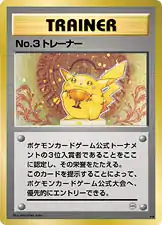
No.3 Trainer (Japanese: No.3トレーナー No.3 Trainer) is an Item card. It was first released in Japan as a Trainer card through several tournaments before becoming the third place prize in the Pokémon World Championships.


Card text
| |
| |
| |
| |
| |
| |
| |
| |
| |
| |
| |
| |
| |
| |
| |
| |
| |
| |
| |
| |
| |
| |
| |
| |
| |
| |
| |
| |
| |
| |
| |
| |
| |
| |
| |
| |
| |
| |
| |
| |
| |
| |
| |
| |
| |
| |
| |
| |
| |
| |
| |
| |
| |
| |
| |
| |
| |
| |
| |
| |
| |
| |
| |
| |
| |
| |
| |
|







Release information
This card was first awarded to the third place winners of the qualifying rounds of the Japanese Pokémon Card Game Official Tournament which was held on the first day of the two day event held at Makuhari Messe convention center in Chiba prefecture on June 14 and 15, 1997. This card was reprinted later in the year and awarded to the third place winners from both age divisions of each regional Lizardon Mega Battle conference, held between November 1997 and February 1998. It was also reprinted and distributed in the same manner to the third place winners of each regional Kamex Mega Battle conference held between July and August 1998.
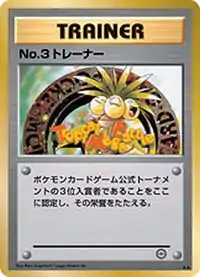
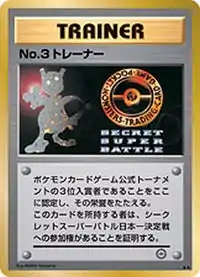
The card was reprinted again and awarded to the third place winners of each regional Challenge Road '99 SUMMER event held between July and August 1999. Participants in elementary school were eligible for entry into Tropical Mega Battle tournaments, whereas those in elementary school third grade (third grade) through to high school second grade (eleventh grade) were eligible for entry into Secret Super Battle tournaments. Participants eligible for both could only compete in one tournament. Third place winners of the Tropical Mega Battle qualifiers were awarded the print featuring Exeggutor and the event logo with artwork by Ken Sugimori and Hiromi Ito, whereas the Secret Super Battle third place winners were awarded the print featuring a Mewtwo silhouette and the event logo with artwork by Hideki Kazama.
The next major iteration featured new artwork by Ken Sugimori and was first awarded to the third place winners of each regional Japanese World Challenge Summer event held between July and August 2000. As with the Challenge Road '99 SUMMER campaign, this was split into Tropical Mega Battle and Secret Super Battle events, retaining the same age-limited structure. Unlike previously awarded trophy cards, these cards were personalised with the name and regional conference of the winner and are Non Holofoil. Two base versions of this card also exist: one depicting a male Trainer and the other a female Trainer. The version of the card awarded depended on the gender of the winner. Top ranking players from the Secret Super Battle were eligible to compete in a "Best in Japan Deciding Match" held in late August 2000. Overall winners of the Tropical Mega Battle regional events would represent their country in the World Exchange Battle in Hawaii while the remaining top ranking players would compete in a domestic "Best in Japan" final. Both of these events were also held in late August 2000. Third place winners of the Secret Super Battle and Tropical Mega Battle "Best in Japan" finals were awarded Holofoil No.3 Trainer cards bearing their photograph superimposed on the illustration.
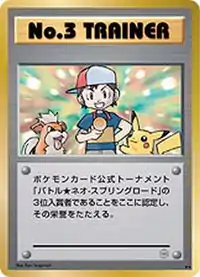
This card was reprinted in 2001 and awarded to the third place winners from both age divisions of each regional Neo Spring Road tournament, held between February and March 2001, and each Neo Summer Road tournament, held between July and August 2001. These versions also include the name and regional conference of the winner, as well as coming in male and female variants. The top ranking players from both age divisions in each regional Neo Spring Road and Neo Summer Road tournament were eligible for entry into "Best in Japan" finals, held on March 31, 2001 and August 25, 2001 respectively. The senior third place winners of these tournaments were awarded a new No.3 Trainer card bearing their photograph superimposed on the competition logo. The Neo Spring Road print features Lugia while the Neo Summer Road print features Ho-Oh. It is currently unknown if the junior champions were also awarded these cards.
This card was reprinted again in 2002 featuring the e-Card Era layout and was awarded to the third place winners of each regional Battle Road Spring 2002 tournament, held between March and April 2002, and each Battle Road Summer 2002 tournament, held between July and August 2002. The Battle Road 2002 series was also the first to introduce the Master age division (for those 18 and over) in addition to the Junior and Senior divisions. The 2002 versions were the last to include the name and regional conference of the winner on the card itself and were also the last to feature male and female variants. The Battle Road Spring 2002 tournaments did not feature a "Best in Japan" final, with the top ranking instead earning byes in the Battle Road Summer 2002 tournament. The latter tournament did however culminate in a "Best in Japan" final, with a new card awarded to the top ranking players.
The latest iteration of this card was awarded to those who came third in each age division in the World Championships. It was first awarded in 2004 when Play! Pokémon hosted the first Pokémon TCG World Championships under Pokémon USA, and has been awarded at every Worlds tournament since. In 2007 this card featured the Diamond & Pearl Series layout, lacking the circle pattern prior prints featured. The 2010 print featured the HeartGold & SoulSilver Series layout, adopting the blue Trainer color scheme and gold illustration window. The 2011 print featured the Black & White Series layout and was printed as an Item card as per all previously classed Trainer cards. For the first time in 2013, the card was awarded to the third place winners of both the Trading Card Game Championships and the Video Game Championships in each age division.
The artwork was updated for the card awarded at the 2014 World Championships, featuring an embossed Full Art Pikachu complete with trophy by 5ban Graphics. The card also features a bronze border. The 2017 print was updated to feature the Sun & Moon Series layout.
Details of each tournament this card was awarded at are below.
|
| ||||||
|
| ||||||
|
| ||||||
|
| ||||||
|
| ||||||
|
| ||||||
|
| ||||||
|
| ||||||
|
| ||||||
|
| ||||||
|
| ||||||
|
|
Gallery
|
|
| ||||||
|
|
Trivia
- The prints awarded between 1997 and 1998 were well publicized during the Pokémon phenomenon at the turn of the century, and are popularly known collectively as the Pikachu Trophy No.3 card in reference to the illustration. There are misconceptions regarding the distribution of these particular cards, one of which is that the latter two prints were awarded in 1998 and 1999, whereas both were awarded across two tournament series in late 1997 and 1998. Similarly, the Tropical Mega Battle print was only awarded during the 1999 event. The other misconception is that they were awarded to the overall winners of the tournament finals, where in fact they were awarded to the qualifying event winners. The same also applies to the Tropical Mega Battle and Super Secret Battle prints.
- The prints awarded between 2000 and 2002 were the only cards to feature printed personalisation until the release of _____'s Snivy, _____'s Tepig, and _____'s Oshawott from a Lawson's campaign in 2011. It is debated that despite the larger quantity of cards in existence, these cards are rarer than the original trophy cards released between 1997 and 1998 as each one is unique.
- The 2000-2002 prints awarded to regional winners also have different numbers of Pokémon present in the illustration depending on the rank of the card awarded—the No.3 Trainer features 2 Pokémon; the No.2 Trainer features 4; the No.1 Trainer features 6. The same pattern would later be used on Victory Cup promotional cards.
- The cards awarded to the "Best in Japan" top ranking players have a photograph of the recipient in the illustration. These cards are amongst several to feature images of real life people.
- The 2000 and 2001 prints have "No.1 Trainer" instead of "Trainer" at the top of the card. On the 2002 print this is present on the top right of the card, making it a unique Trainer card subclass. The double star rarity was also no longer used with the 2002 print.
- The 2007-2009 prints do not have "Trainer" in the top right corner of the card as per all Trainer cards released during the Diamond & Pearl and Platinum Series. The 2011 print onwards also features a ruling as per all Item cards, but is unique to the No.1 Trainer.
- The number of the early Japanese prints in existence is a popular topic of discussion. Based on the dates and age divisions detailed for each event, there were at least 2 copies of the Pokémon Official Tournament print awarded and approximately 14 each of the Lizardon Mega Battle and Kamex Mega Battle prints. Based on the event structure for Challenge Road '99 SUMMER, there were an estimated 9 each of the Tropical Mega Battle and Super Secret Battle prints awarded. Not taking personalized elements into account, there were an estimated 20 of the 2000 Tropical Mega Battle, in which 19 are male trainers and 1 female trainer, and 20 of the Super Secret Battle, in which all 20 are male trainers and 36 of the Neo Spring Road print was awarded, in which 35 are male trainers and 1 female trainer and 28 of the Neo Summer Road print was awarded, in which 26 are male trainers and 2 are female trainers along with 54 each of the Battle Road Spring 2002 and Battle Road Summer 2002 prints. The ratio of male to female variants for the 2002 prints are currently unknown. There was only 1 version of each "Best in Japan" finals print awarded over the course of 2000-2002. The cards awarded via the World Championships are only printed in English, making it one of the rarest English cards in existence. There were only 3 copies of each annual version produced between 2004 and 2012, but this increased to 6 from the 2013 World Championships with the inclusion of the Video Game champions. The text on the 2013 print of the card awarded to the Video Game champions read "Pokémon Trading Card Game World Championships", but this was updated to "Pokémon World Championships" starting with the 2014 print.
- Due to their limited numbers, these cards are often considered amongst the rarest in the world. Value-wise, collectors can expect to pay significant sums of money for any of these cards; however, recent history has shown that the more recent releases do not command as much as the original trophy cards awarded between 1997 and 1999.
Origin
 |
This article is part of Project TCG, a Bulbapedia project that aims to report on every aspect of the Pokémon Trading Card Game. |