Aromatisse/Techs (TCG)
Aromatisse/Techs, also known as Fairy Box, was a Pokémon Trading Card Game deck archetype played during the end of the 2013-2014 and 2014-2015 season. The deck's strategy revolved around Aromatisse's Ability to move energies between Pokémon and the potential to use different types of attackers. Fairy Box players were awarded 3rd place in the Masters and Junior Division at the 2014 Pokémon Trading Card Game World Championships and 6th place in the Masters Division at the 2015 World Championships. 2014 Masters semifinalist Michikazu Tsuda's version was printed as a promotional World Championships deck, Crazy Punch.
| Aromatisse/Techs | ||||||||||
|---|---|---|---|---|---|---|---|---|---|---|
| ||||||||||

Strategy
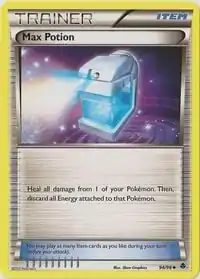
Fairy Box relied on playing as many possible Energy cards in the board and using mostly "Big Basic" Pokémon to hit for heavy damage and then to be completely healed the next turn by a Max Potion or AZ. The drawback of these cards was relieved by Aromatisse's Ability moving 
Key cards
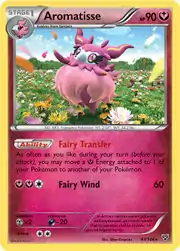
- Aromatisse - Aromatisse's Fairy Transfer Ability allowed, during the player's turn, to move
- Max Potion - Healed all damage from a Pokémon at the cost of discarding its attached energies, which would be moved by Aromatisse's Ability beforehand.
- Muscle Band - Common Tool card in Big Basic decks.
- AZ - Put a Pokémon (but not its attached cards) back to the player's hand, mainly played as a secondary Max Potion.
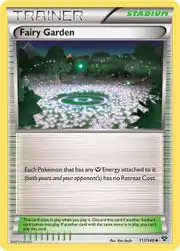
- Fairy Garden - This Stadium allowed the player to freely retreat their Pokémon with
- Rainbow Energy and Prism Energy - Both counted as any kind of energy with small drawbacks and were crucial to play different types of attackers in these decks.
Typical decklist


Possible tech cards
The following cards are often used in Aromatisse/Techs in place of certain cards included in the above lists.
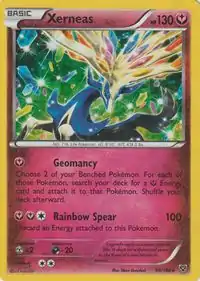
- Xerneas - Xerneas' Geomancy attack was an easy way to put basic
- Mewtwo-EX - A splashable attacker that could do a big shot after moving all energies in play to it.
- TDK Pokémon - Played by Juniors Semifinalist Hitoshi Omura at the 2014 World Championships along with other Basic attackers.
- Virizion-EX - Its Verdant Wind Ability protected the active Pokémon from Hypnotoxic Laser and attacks that dealt special conditions, though Keldeo-EX had a similar use in most lists.
- M Kangaskhan-EX - Though the lack of a Spirit Link made the player end their turn when evolving Kangaskhan-EX, M Kangaskhan was a sturdy Pokémon that could tank most attacks.
- Suicune - Along with Aegislash-EX and Latias-EX, its Ability prevented being damaged by certain Pokémon.
 |
This article is part of Project TCG, a Bulbapedia project that aims to report on every aspect of the Pokémon Trading Card Game. |